
 I love fantasy novels, but have sometimes found that they don’t live up to expectations, so having banged on about this one to the Book God for years, and having finally got it as a Christmas present (not last year by any means) I was peculiarly reluctant to actually make a start. It wasn’t the cover that put me off – I think it’s rather lovely in it’s own way, though what attracted me to the book initially was the original cover showing the scarecrow
  Jack Fetch. I think it was that having wanted it for so long I would have been so disappointed if it hadn’t lived up to the expectations I had. I needn’t have worried. I really, really loved this book; it’s another of those too engrossing to read on the train – I nearly missed my station again – and I read the last two hundred pages in one sitting. It’s almost too complicated to describe, but basically there is a town called Shadows Fall presided over by Old Father Time, where real people and imaginary creatures and characters live alongside each other, where legends go to die when no-one believes in them any more. The town is in danger – a serial killer is on the loose and a prophecy about the destruction of Shadows Fall appears to be coming true. There are about two dozen key characters around whom the story revolves, which may sound a lot, but I found myself so wrapped up in the story that keeping track of them all didn’t prove too difficult, and none of them felt superfluous. I know this isn’t everyone’s cup of tea, and I know that some have found the ending difficult to swallow, but I just loved it, and it will definitely be on the re-read pile.
A Whitby theme, as this batch of books was either purchased in the town on our recent visit or has the town as it’s setting. There is a fantastic bookshop there which we always visit and I don’t think I have ever left there empty handed. One of the great 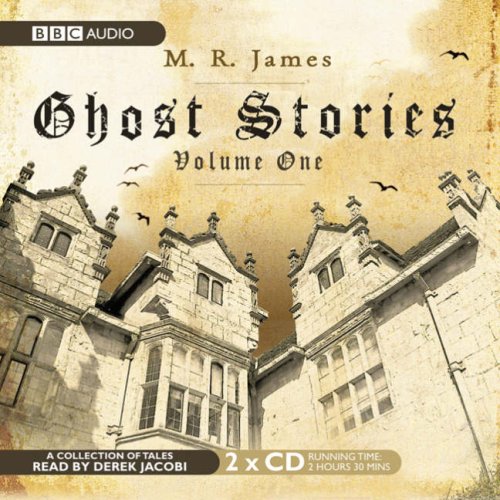 discoveries this time was an audio CD of Sir Derek Jacobi reading MR James’ ghost stories – I was thrilled to find this as our original taped version with Sir Michael Hordern has vanished into the mists of time, and the stories are great for listening to in the car, particularly when driving over the North Yorkshire Moors in the rain. I will be looking out for volume 2. I also picked up two books by Paul Magrs, Never the Bride and Something Borrowed, both featuring Brenda and her Whitby B&B, and of course a supernatural element; these have been well-reviewed and look like a a nice addition to the Gothic stack. And finally, friends have suggested that I try Peter Robinson’s work, so I thought I would start with Caedmon’s Song, a standalone psychological thriller which looks intriguing.
 The latest in the Bryant and May series of crime novels is set in Britain’s coldest winters in many years. Against the backdrop of further attempts to close down the Peculiar Crimes Unit, our heroes are stuck in snowdrifts on their way to a psychic convention, with a killer apparently prowling amongst the stranded vehicles and a woman and her son seemingly on the run from a serial killing stalker. To make matters worse, back in London one of their colleagues has been murdered and the crime has to be solved before the inconvenient visit of a minor member of the royal family. I have mentioned before that I am devotee of this series, but I found it quite difficult to get into this one, perhaps because of the structure which flicks backwards and forward between the three stories, but I am glad I persevered as the solutions to all of the mysteries turned out to be interesting and, indeed, peculiar . My favourite character, Sergeant Janice Long, really gets to show what she can do, which made it even more enjoyable.
 A bit late this month in sharing book purchases from October, and what a lot of them there were! This is partly due to the annual holiday – last minute buying of books before we go, more buying while we are away, and then time to spare at the end of the month to pick up anything that we might have missed. It looks like a fairly varied selection, but all the usual themes are there – it’s depressing to be so transparent!
Crime first of all – Dearly Devoted Dexter by Jeff Lindsay is the second in the series about a man who is a forensic specialist by day and a serial killer by night. I’m looking forward to reading this one as I really enjoyed the TV series based on the first book, which made Dexter a likeable figure despite his homicidal tendencies, and there was a lot of dark humour mixed in with an interesting murder mystery. Then we have Goodnight Sweet Prince by David Dickinson – I’m pretty sure that I have another of his crime works somewhere in the house but can’t put my hands on it at the moment. This is about a murder involving Queen Victoria’s grandson Prince Eddy, and will either be excellent or awful, but I’m very much willing to give it a try. And a new Scottish-based series (well, new to me anyway) which looked like it might be good fun, After the Armistice Ball by Catriona McPherson.
History & biography next – Consuming Passions by Judith Flanders has been recommended on a number of other blogs, and I had already enjoyed her book on the Victorian House , and I also have (but haven’t yet read) her book about the MacDonald sisters, so this was a no-brainer for me, and after buying it I sat in a teashop with the Book God reading sections of it out to him; he was very forbearing as always, and I think this will be one to savour. I also picked up out of curiosity a biography of Peggy Guggenheim by Mary Dearborn; I don’t really know anything about her at all but a first dip suggested it would be interesting; and yet another addition to the sixteenth century pile, The Last Days of Henry VIII by Robert Hutchinson, which speaks for itself I suppose.
New things by old favourites – The Female of the Species by Joyce Carol Oates and Margaret Atwood’s Curious Pursuits.
Oddments – Susan Hill’s Man in the Picture (one for dark night reading over Christmas, I think); Pat Barker’s Life Class (I really, really loved the Regeneration trilogy); Joe Hill’s 20th Century Ghosts – even though I haven’t yet read his novel everything I have heard makes me think I will love this author; and Walking with the Green Man, and odd little book I picked up at the Tullie House Museum in Carlisle – it’s a subject I am very interested in, so will see what new insights if any I get out of this volume.
One of our most enjoyable trips during the holiday was our visit to the home of Sir Walter Scott at Abbotsford.  The Book God has often driven us past the sign giving directions to the house, and during every holiday in the Borders I have meant to visit but never quite made it. This year, though, I was determined, and very glad that we went. The house itself is lovely, and it was easy to imagine Sir Walter living there. It was one of the great loves of his life, and he died there looking out over the River Tweed; the house is well worth a visit, both to see the building and it’s lovely setting. We had an
 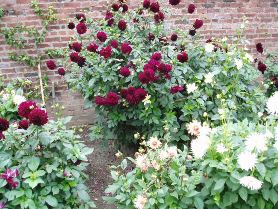 enjoyable chat with the one of the staff in the shop, where I got a hold of a couple of books, The Heart of Midlothian and Sir Walter’s Journal. It seems that apart from Ivanhoe and one or two others, no-one really reads Scott anymore, which I think is a shame. Mind you, I remember in my last year at school wanting to pursue my interest in Scott and being given a small pile of books with the warning not to start with Old Mortality, which of course being 16 I duly ignored and was completely put off, so that may explain things. A few days later we
 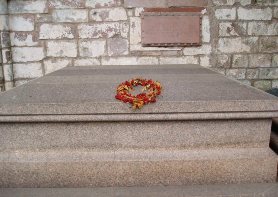 drove to Dryburgh Abbey where Scott is buried. I find the man fascinating, and although much of his work is now unfashionable, he was in a large part responsible for the invention (if you can call it that) of the historical novel. He was also responsible for a lot of the tartanry associated with Scotland, but I’m happy to forgive him for that. He is going to be one of my reading projects for 2008.
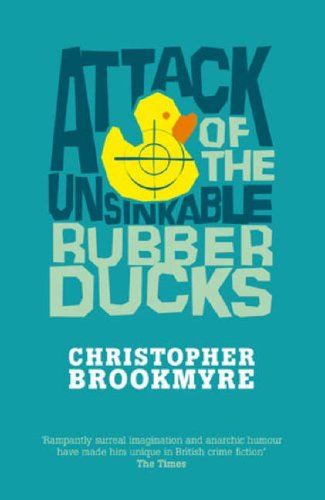 My brother, The Stanley Scot, introduced me to the novels of Christopher Brookmyre while standing in the Piccadilly Waterstones on one of his infrequent visits to London. He thought I would enjoy the very Scottish sense of humour, the occasional gruesomeness and the regular St Mirren jokes, and was of course right in the way that only brothers who pay attention to what their sisters tell them can be. Since then I’ve read all of his back catalogue and he is one of the authors I have to buy in hardback as I can’t bear to wait.
The Attack of the Unsinkable Rubber Ducks features Jack Parlabane who has been the lead character in a number of Brookmyre’s tales. Jack is a journalist with a tendency to get into trouble, and this is no different; having relocated to Glasgow and become Rector of Kelvin University, he finds himself mixed up in events surrounding the attempt of a psychic/spiritualist, Gabriel Lafayette, and his cronies to get the University to set up a Chair which would allow the investigation of the paranormal. Oh, and Jack himself is deceased and telling us the story from beyond the grave.
I really enjoyed this; I’ve always been fascinated by the things which people will believe and how others seem to take advantage of those beliefs, and in several places Brookmyre gives us details of the techniques that are used, which of course are really obvious once you have them explained. I must admit to having worked out one of the plot points about half way though (only in an “I wonder if” kind of way) but it didn’t spoil things for me and I found it a particularly enjoyable holiday read. And I bought it as a birthday present for The Stanley Scot.
 The late Carol Shields wrote an article about The Girls of Slender Means for the Guardian in 2003, where she talked about the experience of re-reading a novel she had first read when in her early twenties, and how she saw it very differently the second time around. I read the book at a similar age (22) and have to agree with her that I missed the sense of foreboding that becomes very clear on returning to the story. She put her reaction down to no longer trying to relate to a group of women of her own age living in an environment similar to her college experience; I’m not sure that I can articulate my own initial impressions at all after so many years.
The novel begins with news of the death of Nicholas Farringdon, a priest who has been killed (martyred really) in Haiti. We are then taken back to 1945, when Nicholas became fascinated by the May of Teck Club, a residence in Kensington for young middle class women of reduced means. He becomes infatuated, and has an affair, with one of the girls, Selina, and his contact with the residents lead to the events which result in his conversion to Catholicism. In addition to Selina we meet several of the other girls, including Jane, whom we first meet ringing round the others to tell them of Nicholas’s death, and who had introduced him to the club; Joanna, a vicar’s daughter who gives elocution lessons and is often heard in the background reciting poetry; and a number of minor characters including one of my favourites, Pauline, who may be mad and spends her evenings pretending to go out to dinner with Jack Buchanan. We learn a lot about the girls lives and the things they share, including a Schiaparelli evening gown which has a key role to play.
It becomes clear that Nicholas’s conversion is a direct result of the tragedy which strikes the May of Teck Club, and a particular event that he witnesses there.
I remember being vaguely unsatisfied with this novel when I first read it, but coming back to it almost 25 years later it has had a more powerful impact than I had expected, and may even make it to the list of books I regularly revisit.
It’s been very quiet around here lately as the Book God and I have been away on our annual holiday for the past three weeks, touring around the Scottish Borders and the north of England, seeing beautiful places such as


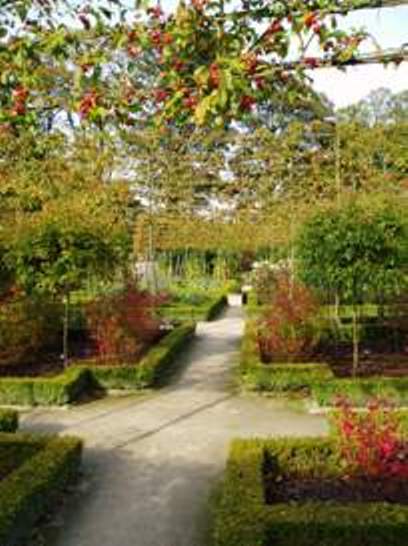
and one of my absolutely favourite places

Not many books got read, but quite a few were bought, and I’ll say more about some of those over the next few posts.
 When Muriel Spark died last year I decided that I would read all of her novels and short stories as a tribute of sorts to an author that had given me a huge amount of pleasure since I was a teenager. I first read her in my final year at school (1978 or 1979, I can’t remember which term exactly) as part of studying the Scottish novel, and was hooked at once. It was The Prime of Miss Jean Brodie and the story of school life in 1930s Edinburgh, far removed from the west of Scotland in the seventies, was fascinating but in some ways not so different. I can’t remember my school motto, but loved the Marcia Blaine Academy’s “O where shall I find a virtuous woman, for her price is above rubies”, and I did have a languages teacher who referred to us as the creme de la creme. To add a bit of glamour, one of the girls in my class was an extra in the Scottish TV series starring Geraldine McEwan, although I still see and hear Maggie Smith when I think of Miss Brodie.
My re-reading faltered after the first five novels, but recently I decided to look at the chronological list again and saw that Jean Brodie was next. I didn’t quite read it in a sitting this time as I had in previous years, but it lost none of its power on South West Trains; give me a girl at an impressionable age and she is mine for life seems to refer to the author as much as her character. The issues of influence and betrayal against the backdrop of the pre-war period had a real impact on me as a sixteen year old and I have always classed this as one of my absolute favourites, to be taken out often and savoured. Most of her novels are short but perfectly formed, and I would recommend her to anyone who loves good writing.
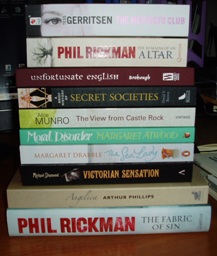 A bit of a stack this month with one or two familiar names as well as one or two speculative buys. To start with the familiar, two of my favourite Canadian authors – Margaret Atwood’s Moral Disorder and Alice Munro’s The View from Castle Rock. I’m particularly interested in the latter because of the Scottish link and the family history thing, which is a particular hobby of mine I won’t bore anyone with now! I also picked up a crime favourite, Tess Gerritsen’s The Mephisto Club; I’ve been waiting for this to come out in paperback for a while and am looking forward to reading it soon. I also decided to take the opportunity of being bored one evening to order the three Merrily Watkins novels by Phil Rickman that I didn’t yet have in my collection (it’s the completist thing, you see) – The Smile of a Ghost (not in the picture as the Book God appears to have secreted it somewhere), The Remains of an Altar and The Fabric of Sin – lovely gothic stuff.
Three of the books pictured were mentioned in my earlier post about visiting the London Review Bookshop, which just leaves the two books I bought in the British Museum shop – Unfortunate English by Bill Brohaugh and A Brief History of Secret Societies by David V Barrett – just couldn’t resist that one!


 Bride of the Book God