
You are currently browsing the category archive for the ‘Reviews’ category.
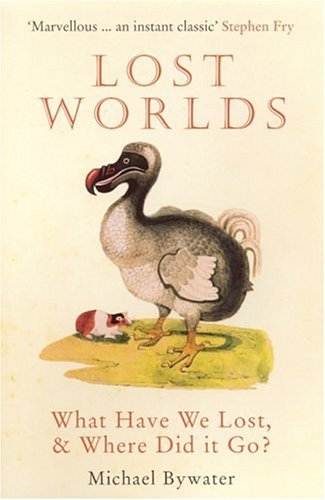 What have we lost and where did it go? asks Michael Bywater in Lost Worlds, a collection of observations on things that appear to be no more. These often go off into tangents which are not wholly connected with the subject at hand. He talks about the love that “then, dared not speak its name, but which is now, thank heavens, walking cheerfully about the place saying hello and introducing itself” when reminiscing about favourite armchairs, men for the use of. He asks what has happened to the Little Man when wondering about the disappearance of clerks. He refers to a mythical Scotland where stockings are still made of lisle, and no-one speaks of things Best Not Spoken Of, and which largely exists in the English mind, when considering pudeur (which I confess to having to look up in the dictionary).
I’ve been dipping into this book for weeks, often laughing out loud followed by the infliction of a particularly humorous quote on the long suffering Book God, and although I haven’t always agreed with the outcome of Bywater’s musings, the experience has been very pleasurable.
 Holmes and Watson are called to Scotland at the behest of Holmes’ brother Mycroft in Caleb Carr’s The Italian Secretary. Queen Victoria’s peaceful retreat to the Highlands has been disturbed by the gruesome murders of two men at Holyrood when she was expected to be in residence, and the mystery must be solved.
The goings on at the palace hark back to the events surrounding the violent death of David Rizzio, Mary, Queen of Scots’ Italian secretary. Is there a link? Does Rizzio’s spirit stalk the palace apartments? Holmes, of course, finds the solution, exposing corruption and preventing a domestic tragedy along the way.
Victorian Edinburgh is beautifully re-created, and although the tale of Rizzio is presented in a rather floridly romantic way to my taste (I’ve never been convinced that Mary was as innocent as some like to make out) the supernatural elements really add something to the atmosphere.
I thought the story here was much slighter than the other Holmes pastiches I have read so far, but I think the characters of Holmes and Watson have rarely been so clearly drawn, and the dialogue (except for Holmes re-telling of Rizzio’s demise) is really spot on.
 Night Watch by Stephen Kendrick, the second of the Holmes pastiches on my list, is slightly unusual, introducing as it does another famous detective as a young man, namely Father Brown. It is Christmas Day, 1902, and Holmes’ brother Mycroft seeks his involvement in the investigation of the murder of a priest in a London church. The murder is significant as a secret conference of leaders from various religious denominations is being held there, and the murderer is likely to be among the distinguished guests.
Father Brown is attending the conference as assistant to the Pope’s representative, and is himself under suspicion; I’m sure I’m not giving anything away if I reveal that he is not only not the murderer, but he provides some assistance to the great detective.
Although most of the novel is set in the claustrophobic atmosphere of the church itself, there are some thrilling outdoor scenes including a chase through the snow on the Thames, and the climax takes place high above the streets on the roof of the church itself.
I really enjoyed the story; I failed to guess the murderer, but loved the Edwardian setting and the short timeframe in which the story takes place. Of course, it made me want to buy the complete Father Brown stories, but that’s for another day.
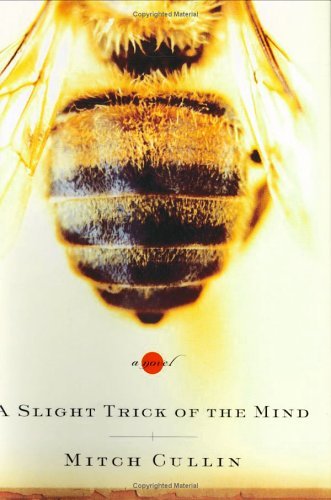 It’s 1947, and an elderly Holmes is in retirement in Sussex with his bees, being looked after by his housekeeper, Mrs Munro, and her son, Roger in the absence of Mrs Hudson and Watson, who are both long dead. He is afraid that his mind is beginning to fail now that he has reached his nineties, and he cuts a very lonely figure.
Mitch Cullin’s story revolves around three things of importance to Holmes: his relationship with Roger, in whom he has encouraged an interest in bees; a recent trip to Japan to investigate the properties of a particular plant which he believes may help to prolong his faculties; and the recollection of a case from his past where he became obsessed with a young woman who had lost both of her children.
There is a tragic event in the middle of this story which, along with Holmes’ experience of Japan in the aftermath of the war through a visit to Hiroshima, makes this a sad and beautiful novel. Holmes has to face up to ageing, and the fact that other people, including Mrs Munro and his Japanese host, ask more of him than he is able to give. I found this a remarkable addition to the vast body of work about about Holmes, and would suggest it even to those who don’t follow the life of the Great Detective.
It has also led me to dig out a number of other Holmes pastiches which the Book God and I have collected over the years, so don’t be surprised to see more on this subject in future posts.
 Marya tells the story of Marya Knauer from her early childhood until I suppose her early thirties when she is established as a well known author following an academic career. After the violent death of her father, her mother abandons Marya and her two young brothers, who are subsequently brought up by an aunt and uncle. The trauma of these early years, including abuse at the hands of a cousin, helps to form Marya’s personality, and we see her develop through school and college, witnessing her key relationships, until she finally decides to find out what became of her mother.
I am a huge admirer of Joyce Carol Oates, and this is another subtle story that really takes hold, even though (or perhaps because) some of the things that happen to Marya are so unpleasant. I’m not sure if I really warmed to her as a person, but she is complex and interesting and held my attention. My only quibble is really with the blurb for the book, which makes a great deal of Marya’s search for her mother even though that really only comes to the fore in the last chapter.
Parts of the novel have appeared in other publications through the years, and the resulting episodic feel as we see Marya at key points in her life really appealed to me.
 I have had this book on my to read pile for almost eight years, but had the urge to pick it up recently – perhaps the unseasonally cool weather made me look for a book whose blurb suggests that it is best read on a cold winter’s night next to a blazing fire rather than the beginning of July. In any case, as soon as I started reading The Unburied by Charles Palliser I was hooked. It is one of the few books which has made me nearly miss my train stop, and that for me is confirmation of the strength of the tale.
The novel is largely taken up by the account of Dr Courtine, a scholar who has gone to visit an old college friend in a Cathedral town, with the aim of locating a manuscript which he hopes will support his own theory of events around the time of King Alfred. During the visit he becomes drawn into a mysterious and seemingly impossible murder, which leads him to question his friendship and his own reliability as a witness.
The main story is framed by the comments of someone else who was present at these events but who has never spoken of them, who has edited Dr Courtin’e account in later life, and perhaps solved the mystery, at least to his own satisfaction.
I really loved this; it had echoes of M R James in terms of atmosphere, and the central story was really gripping. It depends very much on what you as a reader thinks of Courtine himself; I found him complex and all too human, becoming increasingly aware of how he is viewed by the world, and rather liked him. Recommended.
 As I struggled with Carter I needed some light relief, which I found in They Call Me Naughty Lola, a collection of personal ads from the London Review of Books. This was great fun, and it’s almost impossible to read only one. The Book God had to remonstrate with me for giggling while reading, but what does he know? Recommended for dipping.
 I tried really hard but in the end had to give up. Despite the good reviews and the personal recommendation from the Book God, I’m afraid that Carter Beats The Devil beat me as well. It all started so promisingly – the mysterious death of a President, the enigmatic illusionist – but just as things got interesting the childhood flashback knocked me off my stride and I just couldn’t get into the story again. So, the first book this year to be set aside – perhaps not permanently as I suspect there is a good story in there – but not what I want to read at the moment.
I nearly disgraced myself on my daily commute while reading this wonderful novel; it’s the first book that’s made me cry since The Time Traveller’s Wife.
 Unless was first published in 2002 and is the story of Reta Winters whose daughter Norah has made herself homeless and now sits on a corner in Toronto with a sign round her neck which simply reads goodness. The novel follows Reta as she struggles to understand how this has happened, as she tries to write a sequel to her novel. There are some wonderful images in the book; I particularly identified with her description of “Bookish people, who are often maladroit people, perisit in thinking they can master any subtlety so long as its been shped into acceptable expository prose.”
Reta reflects a great deal on the position of women in society but there is nothing strident or preaching here; she suggests trhough one of her characters that powerlessness and passivity are the “traditional refuge of women without power” and that this may explain Norah’s actions.
I have read and loved Carol Shields’ previous work, and am sorry that she is no longer with us. If you have never read her before I urge you to try, and you would do worse than starting with this novel.
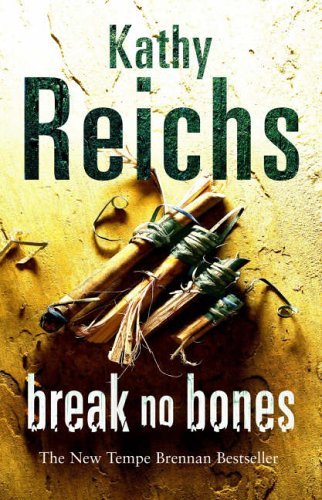 I have just finished the last Kathy Reichs book, Break No Bones, knowing that the next Tempe Brennan book must be coming out fairly soon. I really enjoy these novels and find them far superior to Patricia Cornwell, but I wish Tempe spent a bit more time in Quebec – it was my fascination with anything remotely Canadian which got me into these stories in the first place. Having said all that, this is still excellent; we find Tempe helping out a colleague by running an archaeological field school in South Carolina, where she and her students find a decomposing body and off we go. I was pulled into the story, with both the whodunnit and Tempe’s personal life becoming ever more complicated, and found the ending very satisfying (even though I had a fairly good idea what the murder(s) were all about). Recommended.


