You are currently browsing the category archive for the ‘Reviews’ category.
The Book God’s copy of The Prestige by Christopher Priest has been kicking around for 12 years and I have added it to and 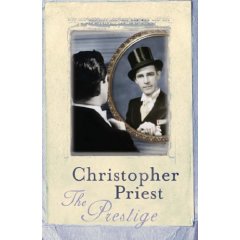 removed it from various reading lists since then. I was finally persuaded to read it by the release of the film version, directed by Christopher Nolan, last year (and now in our possession as a DVD). I really like to read a book before I see its film adaptation. I’m not really sure why – it’s a quirk of my personality that I don’t mind knowing the plot of a film or TV series in advance but absolutely hate the idea of reading ahead; that can really spoil a novel for me.
The Prestige is about the rivalry between two stage illusionists at the turn of the 20th century. Driven by different attitudes to their art and centred around a particular trick where the illusionist is transported from one point of the stage to another, the feud continues until their deaths allow their individual secrets to be revealed.
I loved this book; the atmosphere really gripped me and although I started to get an inkling of what the prestige actually was, I still found the resolution of the story extremely effective. Christopher Priest is a fine writer and I will dig out the other titles by him in the Book God’s collection.
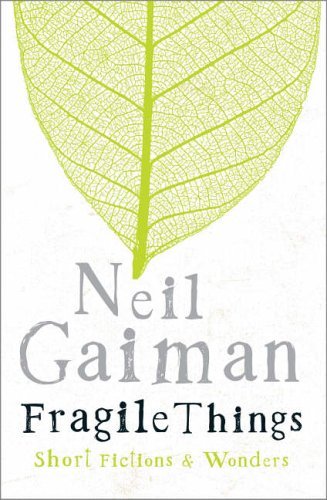 Fragile Things is another wonderful collection of short stories from Neil Gaiman, many previously published in other anthologies and magazines, but still very much worth reading together. I have been a fan since I was introduced to his Sandman graphic novels and have tried to read everything that has come out ever since. Favourite stories include “A Study in Emerald” where the worlds of Sherlock Holmes and HP Lovecraft meet (winner of a Hugo award 2004); “October in the Chair” which won a Locus Award in 2003; “Keepsakes and Treasures” which introduces Mr Smith and Mr Alice, two characters I hope the author will use again; and “How to Talk to Girls at Parties” a new story for the collection which I think is up for an award this year. Even though I’ve singled these stories out I enjoyed them all and can thoroughly recommend the collection if you enjoy fantasy and horror fiction.
 I am sure that I have mentioned elsewhere how much I enjoy books about books, so it was no surprise that I would fall for How to Read a Novel by John Sutherland. Sutherland has produced a number of books on literary puzzles (such as Is Heathcliff a Murderer?) which, besides being enjoyable reads, sent me off in search of classic novels that I knew of but hadn’t read before. For that reason I had high expectations of a book designed (according to the blurb) to be a guide on how to read well, how novels work, and the economics and culture of publishing. I wasn’t disappointed. The Book God was very exasperated at the number of times I read bits out to him, but bore it well.
Sutherland works from two assumptions (1) novels are meant to be enjoyed, and (2) the better we read them, the more enjoyable they can be. He quotes Virginia Woolf, “The only advice, indeed, that one person can give another about reading, is to take no advice, to follow your own instincts, to use your own reason, to come to your own conclusions.”
The main things I took away from this:
- know your taste
- use bestseller lists by picking up titles while they are near the bottom so that you don’t come to them too late (ie when everyone else is reading them – see the Da Vinci Code, which everyone seemed to be reading at the same time, at least on the Tube)
- you can gain a lot of context from looking at the date and publication history and then do a little digging
- if there is an epigraph it’s generally worth reading, for more context
I have also been putting the McLuhan Page 69 test into practice – if you aren’t sure whether you will like a book, flick to page 69, read that, and if you like it, you’ll like the book. It’s working so far!
 Last year I decided that I would expand my Bloomsbury interest by finding out more about Leonard Woolf, and by the power of Amazon was able to get a hold of all five volumes of his autobiography. I have just finished the first, Sowing, which covers the period from his birth in 1880 until his departure for Ceylon in 1904. It’s a nice little Hogarth Press edition from the early 1960s (not the more widely available paperback shown here), designed to slip into the kind of large handbag favoured by the Bride, and is inscribed by a previous owner with her name and the date (of purchase or gift?) – 14 February 1962, 2 weeks after I was born, which feels nice in an odd sort of way.
The book is fascinating in its portrayal of Leonard’s years at Cambridge where he first met many of the figures who would become so prominent in the Bloomsbury circle but I also got a lot of enjoyment from the section on his childhood, particularly the reference to the Marsham Street cow which was pastured at the corner of St James Park in London. The death of his father when Leonard was a boy clearly had a huge impact both emotionally and financially on the family, and the description of his school days makes me glad that things have moved on somewhat. Next volume covers his years in the colonies, and I will read it alongside Christopher Ondaatje’s Woolf in Ceylon, a journey in Leonard’s footsteps.
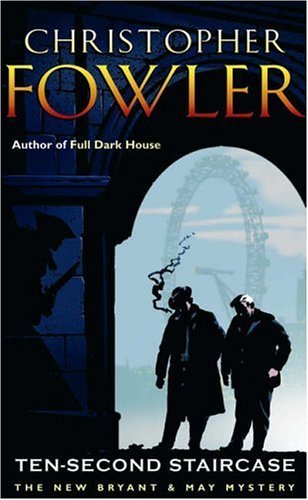 My plan worked and I have spent a very wet Sunday morning curled up in an armchair finishing Ten-Second Staircase by Christopher Fowler.
I first came across Christopher Fowler when I took his novel Darkest Day on holiday with me to Istanbul. The book (which I don’t think is in print any longer) was hugely enjoyable and introduced me to Bryant & May, two elderly detectives who are the main protagonists of the Ten-Second Staircase.
I really enjoy the Bryant and May stories, and always learn something new about London, especially “all the dark and bloody history that’s being forgotten…”, and now have a list of things to Google because I want to know more!
I’m not sure that this novel is the best place to start with these characters – Full Dark House is probably more accessible – but if you have read any of the others you will certainly enjoy this, especially as the case of the Leicester Square Vampire is finally resolved.
BTW, Darkest Day was revised and published as Seventy-Seven Clocks; I must admit I really prefer the original…….
 I am developing a great fondness for crime novels and thrillers set in Scotland, often referred to as Tartan Noir; I especially love Christopher Brookmyre.
When looking for something suitable before Mr B’s next novel, I came across Stuart MacBride, largely by accident and simply because I liked the look of the paperback cover for his first novel, Cold Granite. I enjoyed it so much that I had ordered the sequel before finishing it.
Dying Light is once again set in Aberdeen and features DS Logan Macrae; things are not going well for him in this novel and he has been assigned to work with DI Steel in the “Screw-up Squad”. I won’t go into the plot, but it is gruesome and very satisfying. I particularly enjoy the dark humour which runs through the story and found myself giggling more than once. I love the reminder that almost everything we see on TV crime is English or US law and that there is no right to counsel in Scotland until after the police interview is complete, so asking for your lawyer is a bit redundant.
I can highly recommend this, and am looking forward the the third book in the series which should be with us soon.
 I feel as if I have been reading this novel for ever, but not in a bad way! I started it before Christmas but stuff at home, some difficult commutes which put me off reading and the sheer size of the paperback back mean that I haven’t been picking it up consistently. But this morning I decided that I would finish it, and I’m glad I persevered, as it’s a rich and rewarding read.
Quicksilver is the first of a trilogy, and is set in the late 17th and early 18th centuries. It deals with all sorts of things: alchemy and the development of modern science, revolution and intrigue. It mixes real people like Isaac Newton, William of Orange, James II and Samuel Pepys among many others, with Stephenson’s own characters. It has a lot of detail, which I know has put some people off, but I found that if you allow yourself to sink into it you’ll be swept along by the story. It’s very funny in places and the set pieces are wonderfully described. I’m looking forward to reading the sequels!


