
You are currently browsing the category archive for the ‘Reviews’ category.
 The latest in the Bryant and May series of crime novels is set in Britain’s coldest winters in many years. Against the backdrop of further attempts to close down the Peculiar Crimes Unit, our heroes are stuck in snowdrifts on their way to a psychic convention, with a killer apparently prowling amongst the stranded vehicles and a woman and her son seemingly on the run from a serial killing stalker. To make matters worse, back in London one of their colleagues has been murdered and the crime has to be solved before the inconvenient visit of a minor member of the royal family. I have mentioned before that I am devotee of this series, but I found it quite difficult to get into this one, perhaps because of the structure which flicks backwards and forward between the three stories, but I am glad I persevered as the solutions to all of the mysteries turned out to be interesting and, indeed, peculiar . My favourite character, Sergeant Janice Long, really gets to show what she can do, which made it even more enjoyable.
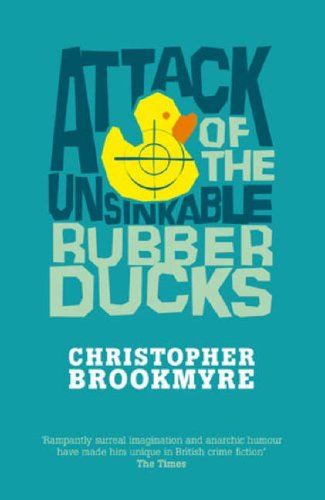 My brother, The Stanley Scot, introduced me to the novels of Christopher Brookmyre while standing in the Piccadilly Waterstones on one of his infrequent visits to London. He thought I would enjoy the very Scottish sense of humour, the occasional gruesomeness and the regular St Mirren jokes, and was of course right in the way that only brothers who pay attention to what their sisters tell them can be. Since then I’ve read all of his back catalogue and he is one of the authors I have to buy in hardback as I can’t bear to wait.
The Attack of the Unsinkable Rubber Ducks features Jack Parlabane who has been the lead character in a number of Brookmyre’s tales. Jack is a journalist with a tendency to get into trouble, and this is no different; having relocated to Glasgow and become Rector of Kelvin University, he finds himself mixed up in events surrounding the attempt of a psychic/spiritualist, Gabriel Lafayette, and his cronies to get the University to set up a Chair which would allow the investigation of the paranormal. Oh, and Jack himself is deceased and telling us the story from beyond the grave.
I really enjoyed this; I’ve always been fascinated by the things which people will believe and how others seem to take advantage of those beliefs, and in several places Brookmyre gives us details of the techniques that are used, which of course are really obvious once you have them explained. I must admit to having worked out one of the plot points about half way though (only in an “I wonder if” kind of way) but it didn’t spoil things for me and I found it a particularly enjoyable holiday read. And I bought it as a birthday present for The Stanley Scot.
 The late Carol Shields wrote an article about The Girls of Slender Means for the Guardian in 2003, where she talked about the experience of re-reading a novel she had first read when in her early twenties, and how she saw it very differently the second time around. I read the book at a similar age (22) and have to agree with her that I missed the sense of foreboding that becomes very clear on returning to the story. She put her reaction down to no longer trying to relate to a group of women of her own age living in an environment similar to her college experience; I’m not sure that I can articulate my own initial impressions at all after so many years.
The novel begins with news of the death of Nicholas Farringdon, a priest who has been killed (martyred really) in Haiti. We are then taken back to 1945, when Nicholas became fascinated by the May of Teck Club, a residence in Kensington for young middle class women of reduced means. He becomes infatuated, and has an affair, with one of the girls, Selina, and his contact with the residents lead to the events which result in his conversion to Catholicism. In addition to Selina we meet several of the other girls, including Jane, whom we first meet ringing round the others to tell them of Nicholas’s death, and who had introduced him to the club; Joanna, a vicar’s daughter who gives elocution lessons and is often heard in the background reciting poetry; and a number of minor characters including one of my favourites, Pauline, who may be mad and spends her evenings pretending to go out to dinner with Jack Buchanan. We learn a lot about the girls lives and the things they share, including a Schiaparelli evening gown which has a key role to play.
It becomes clear that Nicholas’s conversion is a direct result of the tragedy which strikes the May of Teck Club, and a particular event that he witnesses there.
I remember being vaguely unsatisfied with this novel when I first read it, but coming back to it almost 25 years later it has had a more powerful impact than I had expected, and may even make it to the list of books I regularly revisit.
 When Muriel Spark died last year I decided that I would read all of her novels and short stories as a tribute of sorts to an author that had given me a huge amount of pleasure since I was a teenager. I first read her in my final year at school (1978 or 1979, I can’t remember which term exactly) as part of studying the Scottish novel, and was hooked at once. It was The Prime of Miss Jean Brodie and the story of school life in 1930s Edinburgh, far removed from the west of Scotland in the seventies, was fascinating but in some ways not so different. I can’t remember my school motto, but loved the Marcia Blaine Academy’s “O where shall I find a virtuous woman, for her price is above rubies”, and I did have a languages teacher who referred to us as the creme de la creme. To add a bit of glamour, one of the girls in my class was an extra in the Scottish TV series starring Geraldine McEwan, although I still see and hear Maggie Smith when I think of Miss Brodie.
My re-reading faltered after the first five novels, but recently I decided to look at the chronological list again and saw that Jean Brodie was next. I didn’t quite read it in a sitting this time as I had in previous years, but it lost none of its power on South West Trains; give me a girl at an impressionable age and she is mine for life seems to refer to the author as much as her character. The issues of influence and betrayal against the backdrop of the pre-war period had a real impact on me as a sixteen year old and I have always classed this as one of my absolute favourites, to be taken out often and savoured. Most of her novels are short but perfectly formed, and I would recommend her to anyone who loves good writing.
 I have to say up front that I absolutely loved this book, but also that whenever I picked it up I wanted to eat something savoury, because cheese figures very heavily in the plot of the novel. The main story is set in 1969 when Edward Trencom, purveyor of cheeses and owner of a quite remarkable nose, finds out that his family has been subject to what appears to be a curse for nine generations, going back to the Great Fire of London in 1666. He finds a large box of papers and begins to delve into his family’s past to try and discover how each of his direct forbears met their fates, and why they were obsessed with Constantinople and the Greeks. As Edward’s story goes forward we are presented with vignettes from the lives of said ancestors, usually at the point at which they meet their ends. Can Edward be saved from the same fate by the intervention of his wife, Elizabeth, or will he make the same mistake as those before him?
This is really, really enjoyable stuff, and you pick up quite a bit of knowledge about cheese (and history) along the way. Even though you know from the outset how Edward ends up, you aren’t told how and why until the end, which is very satisfying. I’m already pushing the Book God to read this, and would urge anyone else to give it a try also.
 The last of the Holmesian marathon, and a very odd book indeed. The story itself is pretty straightforward and enjoyable; Holmes & Watson are asked to assist Sir James, the nephew of the late Professor Moriarty, who is about to be accused of a terrible crime. Livestock have been mutilated by some apparently demonic force, and now a man has been killed. Superstitious villagers blame Moriarty, and it is only a matter of time before they take matters into their own hands. A significant complication is that young Sir James loathes Holmes for what he has done to the Moriarty name and does not want his help.
Despite what turned out to be an interesting and rather gothic story, I found this book disconcerting. This was largely because of the number of photographs from the Granada TV adaptations starring Jeremy Brett. Don’t get me wrong, I really enjoyed those dramatisations, particularly Edward Hardwick as Watson, but Brett isn’t the image I have in my head when I read a Holmes story (I’ve always been a Rathbone aficionado, despite the dodgy storylines for some of his films), and I found the illustrations more an irritant than anything else.
The book originated from Italy and was obviously meant to be the first in a series, although I haven’t found any of the others in English. Worth having a look at, but not one I think I would pick up again.
 I watched the recent BBC series with the Book God, and although I have never been a huge fan of James Nesbit, I really enjoyed his performance in this; scenery chewing at its very best. The series seems to have really divided opinion, but I’m always willing to give Stephen Moffat the benefit of the doubt, especially as he has written some of the very best episodes of the rejuvenated Dr Who.
There was also an excellent documentary on BBC Four, a companion piece to the series presented by Ian Rankin, which looked at the influences on Robert Louis Stevenson – why the book was set in London and not Edinburgh, who was Jekyll based on etc. It gave some real insights into Victorian double life and the creative process itself.
I didn’t think much more about Jekyll until I came across Dr Jekyll and Mr Holmes as part of my Sherlockian marathon; this  is a retelling of the story with Holmes called upon by Jekyll’s solicitor Mr Utterson to investigate the hold Edward Hyde has on his client. Written by Loren D Estleman, this version of the story works quite well, and I must admit to loving the fairly lurid cover, but it did make me hanker after the original, which I listed to on my daily commute by way of an excellent Naxos audiobook. The Strange Case of Dr Jekyll and Mr Hyde is read by John Sessions (one of my favourite Scottish actors) with real passion, and reminded me
  just how dark the original tale actually is; it’s really well worth a listen. It does reinforce what a masterpiece the Jekyll story is, which of course leaves it open to all sorts of retelling and reinterpreatations. One of the very best of these is Valerie Martin’s Mary Reilly, which looks at the tale from the perspective of Jekyll’s housemaid, who gets drawn into the very heart of her employer’s terrible story.
 Looking back at my book diary, I found that I had read this for the first time on Christmas Eve 1991 (nice and atmospheric) and hadn’t looked at it again since, but on re-reading it I was pleased that it really was as good as I had remembered. Forget the film, which I didn’t take to largely because I thought Julia Roberts was miscast in the title role, and go back to the novel for something special.
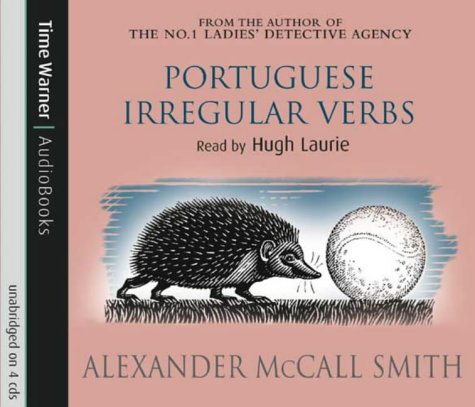 Another August purchase which I completely forgot about, again because it’s an audiobook, but also because I listened to it almost immediately. Portuguese Irregular Verbs is by Alexander McCall Smith, best known for the No. 1 Ladies Detective Agency series. I’ll confess up front that I bought this as much because it’s read by Hugh Laurie (and I was suffering withdrawal symptoms after the end of Season 3 of House) as my enjoyment of the author’s other works. This book revolves around Dr. Moritz-Maria von Igelfeld, author of the the eponymous work on language, and his misadventures with colleagues, his trips to Ireland and India, and his concern about his place in the world. I found it very amusing; it didn’t make me laugh out loud on the train (probably a good thing) but wry smiles and quiet giggles. And Hugh Laurie is, as always, fantastic.
 The Mandala of Sherlock Holmes by Jamyang Norbu is an attempt to fill in the gap in Holmes’ life between his apparent death at the Reichenbach Falls and his miraculous reappearance in London some two years later. Like many, it claims to be based on a hidden or forgotten manuscript recently come to light, this time in India. It is narrated by Hurree Chunder Mookerjee, who accompanies Holmes throughout the tale.
I was particularly interested in this book because of a strong recommendation from the Book God, and also because of its Tibetan setting. It gives a flavour of what the country must have been like before the Chinese finally seized total control. It also links rather neatly with Rudyard Kipling’s Kim, sharing as it does some of the same characters (rather like Laurie King’s The Game).
I enjoyed the setting in India and Tibet, and the mystery itself is fascinating but I found the climax of the novel when the supernatural meets Holmesian logic disappointing; I must admit to not being entirely convinced. However, there was a great deal to enjoy along the way, and ultimately it doesn’t spoil a well-written yarn.
 In Donald Thomas’ book of short stories, Holmes finds himself involved in some of the most intriguing and sensational crimes of his time, including amongst others the Lambeth Poisoner and the Brides in the Bath murders. The enjoyment of reading these stories is in seeing how Holmes and Watson are carefully fitted into narratives that are already pretty familiar to anyone with an interest in true crime. I read most of these in one sitting, a real indulgence for me, and will certainly look out for the other Sherlockian stories by the same author. It has a lovely Atkinson Grimshaw cover too……………


