You are currently browsing the category archive for the ‘Reviews’ category.
 Or Hollywood blockbusters for people who can’t be bothered, as it says on the cover. Sometimes you just need something silly, and things are sufficiently heavy going at work that I set aside my current reading (that means you, Mr Banks) and tried something much, much lighter. This is quite good fun once you get used to the American slang and humour, and it hits more targets than it misses – particularly with Jurassic Park and Independence Day. The latter starts with “Congratulations on your decision to make a sci-fi disaster movie!” and points out that if you name your film after a holiday it will be televised every year. Helps if you’ve seen the films involved, and I was intrigued to see that of the ten covered, the only ones I hadn’t seen were Braveheart and Titanic. And now I don’t have to!
The tactic worked by the way as another 100 pages of Matter were disposed of today on the journey from Nottingham to London, so I am getting there.
 Michael Palin was my favourite Python (along with Terry Jones with whom he did much of his writing) and I was really looking forward to reading his Diaries, which cover the period of Monty Python TV and films, as well as his own Ripping Yarns series (which was excellent). I’m glad to say that I wasn’t disappointed; this is a really entertaining book which gives an insight into the group dynamic which produced such wonderfully hilarious comedy. But it also shares the more private moments of someone in the public eye, and especially when dealing with the death of Palin’s father from Parkinson’s disease is both tender and sad. Hopefully there will be further volumes as I would like to see how he moved from comedy to the travel series for the BBC which have maintained his popularity with the public.
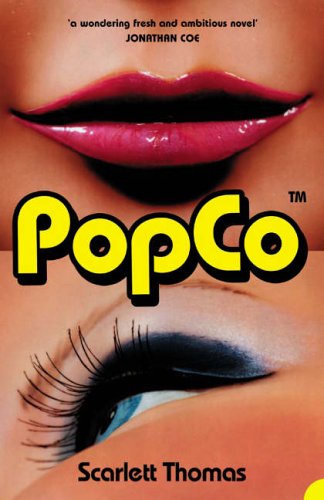 I finished this a week or so ago but decided not to post until I had had a chance to think through why I loved this novel so much. PopCo is written by Scarlett Thomas of End of Mr Y fame (you can read my views on that here), and I have gone in search of her other works in the hopes that they are as good as these two – not all of her writing is easy to come by though, which is a shame.
PopCo is ostensibly about a toy company where Alice Butler works designing a particular range of toys which call on her interest and expertise in ciphers and code breaking, which she inherited from her grandfather. There are two mysteries at the heart of this story – one is the exact purpose of the retreat Alice goes on with co-workers, the other is a mystery from her past which is connected to the necklace she always wears. Add to that a romance with a colleague and as you can see there is a lot of plot, but it never felt too heavy or contrived to me, partly because I’m a sucker for stories about codes etc., but also because Alice herself is such a wonderful, believable character with a full selection of neuroses and worries, who spends a large part of the novel in bed self-medicating on homeopathic remedies. Her “constant conundrum: how do you identify yourself as someone who doesn’t fit in when everything you could possibly do demarcates you as someone who does?”
The mysteries are satisfyingly resolved, at least as far as I was concerned, there’s an interesting extra chapter in the paperback version and a short interview with her about the “puzzle” of storytelling. She is also interviewed in Issue 36 of Mslexia, which I haven’t read properly but looks fascinating.
 I have been looking forward to reading Anthony Blunt by Miranda Carter for some time, and I haven’t been disappointed; this is an extremely well-written and assured biography of a complex man which tries to separate the facts from the various theories that have been kicking around ever since he was exposed in 1979. It makes clear the amazing influence he had on art history after the war, particularly in building up the Courtauld Institute into a place of learning to rival the schools of art history on the continent. It doesn’t shy away from the details of his personal life and talks about his spying in a measured and non-judgemental way which allows the facts to speak for themselves. What is particularly interesting is the impact he had on works of art produced by others; Carter refers in particular to the fact that Blunt was the inspiration for the main (female) character in The Finishing Touch by Brigid Brophy (which I haven’t read), John Banville’s The Untouchable (which I have and consider magnificent), and A Question of Attribution by Alan Bennett. She also speculates that Anita Brookner, who was one of Blunt’s students and later taught at the Courtauld, may have based some of her female characters on the many single, “slightly naive and plain” women who seem to have fallen hopelessly in love with Blunt over the years. I can’t recommend this highly enough.
 I read my first Stephen King novel, a paperback version of Carrie, when I was 15 (an astonishing thirty years ago) and was totally hooked. I have read almost everything that he has written with the exception of some of his Richard Bachman stories, and always look forward to the experience. Lisey’s Story was no exception, and I have been very impressed with this novel, so much so that at one point before Christmas I had to put it down as I had come to care about Lisey so much that I simply didn’t want to read about the horrible thing that was about to happen to her (this is King after all); I had a strong feeling of dread and wanted to be in the right frame of mind to continue. So when I picked it up on my return to work after the holidays as my commuting read I was prepared for the worst, but of course shouldn’t have worried, because yes, unpleasant things happen but there is triumph over adversity and lessons learned and good wins over evil, but as always there is a price to pay.
I found Lisey a really convincing character, and the descriptions of her relationship with her much-loved late husband, the famous author Scott Landon, really rang true – the secret language, the shorthand, the in-jokes – and her relationship with her sisters was also compelling.
When the novel was published last year King said in several interviews that his wife was concerned that people would assume the Landons were based on them, and there is a temptation to try and fit some of the non-supernatural events into what is known of King’s own career, but the strength of tha characters soon leads you away from that road.
I know that King isn’t to everyone’s taste, especially those of a squeamish disposition, but I wish that he was more highly regarded by the literary establishment and not just pigeon-holed as a genre best-seller.
I can hardly wait for his next novel, which is due out very soon.
 In all the excitement around Christmas preparations and the shock of the one day I spent at work between Christmas and New Year, I forgot to post my impressions of the Golden Compass, the film version (as I’m sure you all know) of Northern Lights, my most recently completed read. I have to say that I found myself a bit disappointed – the special effects were wonderful, the casting was on the whole sound, but I felt that the changes that had been made for dramatic purposes detracted from what I thought was a strong, dark story. I’m not a purist about these things; as someone who has read Lord of the Rings more times than I like to admit, I found the changes Peter Jackson made for the film versions did not undermine my enjoyment of them, but that hasn’t been the case here. A missed opportunity, I’m afraid.
I will be very interested to see what the other two films will be like, assuming they go ahead as the box office returns in the US were not as high as expected, which can often scupper future plans.
The Book God, who is half way through the novel, quite enjoyed the film, but has promised to tell me what he thinks in retrospect once he has read the whole book.
By the way, a “Guid New Year ” to one and all!
 I know that I have come to read the His Dark Materials trilogy really, really late, especially since the Book God has had all of the books for some considerable time (though to be fair to me, he hasn’t read them either). I’m not sure why it has taken me so long, perhaps it’s because of Harry Potter overload and not being able to face another fantasy children’s book (although there really is no comparison between the two apart from the fact that they are children’s books); or perhaps it’s because a couple of people I know had not warmed to the first novel at all, and that kind of word of mouth often gives me pause. At any rate, the trigger for finally picking up Northern Lights has of course been my desire to see the film version, The Golden Compass. Whenever I want to see a film based on a novel or short story I am compelled to read the book first, and no change this time. I have to say that, although it’s taken me a little longer to read than I expected, I was pleasantly surprised and have very much enjoyed the story of Lyra and her Daemon. So many of you have probably read this that I won’t go into any of the plot, but I found that the darkness of tone really appealed to me, and the alternative version of our world worked very well. So, not only will I be going to see the film over Christmas, but I intend to read the remainder of the trilogy early next year, and the Book God has committed to reading it as well. That’s what I call a result!
 I’m not sure I can do justice to The End of Mr Y by Scarlett Thomas; the central idea is so fascinating and based on such interesting but difficult theories that I’m not sure I can get my head around them all, and I’m sure I will have to re-read the novel again at some stage so that I can work through the concepts without having to work through the unfolding plot as well. Superficially it seems very straightforward: Ariel Manto is a PhD student whose sponsor has disappeared; they shared an interest in a Victorian author, Thomas Lumas, and in particular his mysterious lost work, The End of Mr Y, which is apparently cursed. Forced out of her university one day by the collapse of a building on the campus, she finds herself in a second-hand bookshop, stumbles across the book in a box with several other titles, and buys the lot with the last of her money. She reads it and discovers a key page is missing; while clearing out her sponsor’s things to make way for others to share her office, she comes across the missing page which he had in his possession all along, and now has the recipe for a potion (for want of a better word) which will allow her to access something called the Troposphere and is of course determined to try it out. Then it all gets weird. When this was reviewed on Simon Mayo’s Book Panel on Radio 5 earlier in the year, all of the reviewers raved about this book, and I agree that it is a wonderful thing, both in content and how it looks, and boy does it leave you with a lot to mull over.
 The latest Temperance Brennan novel hasn’t disappointed, another pacy tale about our (well, my) favourite forensic anthropologist. This time around the focus is on a friend from Tempe’s past who disappeared as a young teenager, never to be heard from again, until the finding of some young bones starts Tempe wondering again what happened, and she enlists the help of a friendly cold case detective to solve the mystery, alongside several other cases on which she is working. Add to that tensions in her relationship with the lovely Andrew Ryan and the arrival of Tempe’s sister and you have a good story which I read in a few train journeys to and from work. Admittedly it gets a bit thrillerish towards the end, and I did guess what the mysterious illness the bones girl had suffered from, but I learned a bit about the Acadians of Canada and more than I needed to about processing bones for analysis so honours are pretty much even. I much prefer the novel version of Tempe to the one that appears on TV in Bones, but have noted that the Book God enjoys the series never having touched the novels, so suppose its horses for courses once again. I have caught up with my Kathy Reichs reading now so will have to wait a while for the new one, presumably coming out next year.
 I love fantasy novels, but have sometimes found that they don’t live up to expectations, so having banged on about this one to the Book God for years, and having finally got it as a Christmas present (not last year by any means) I was peculiarly reluctant to actually make a start. It wasn’t the cover that put me off – I think it’s rather lovely in it’s own way, though what attracted me to the book initially was the original cover showing the scarecrow
  Jack Fetch. I think it was that having wanted it for so long I would have been so disappointed if it hadn’t lived up to the expectations I had. I needn’t have worried. I really, really loved this book; it’s another of those too engrossing to read on the train – I nearly missed my station again – and I read the last two hundred pages in one sitting. It’s almost too complicated to describe, but basically there is a town called Shadows Fall presided over by Old Father Time, where real people and imaginary creatures and characters live alongside each other, where legends go to die when no-one believes in them any more. The town is in danger – a serial killer is on the loose and a prophecy about the destruction of Shadows Fall appears to be coming true. There are about two dozen key characters around whom the story revolves, which may sound a lot, but I found myself so wrapped up in the story that keeping track of them all didn’t prove too difficult, and none of them felt superfluous. I know this isn’t everyone’s cup of tea, and I know that some have found the ending difficult to swallow, but I just loved it, and it will definitely be on the re-read pile.


