You are currently browsing the category archive for the ‘Reviews’ category.
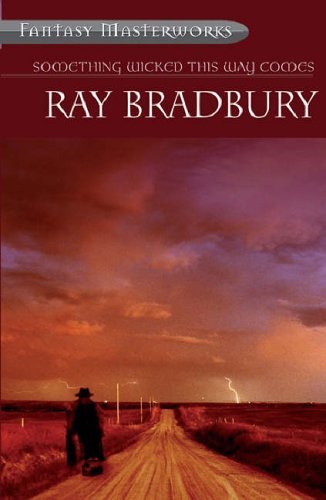 I feel as if I have been reading this book forever; that isn’t a criticism of the book itself, just that I started it before my hiatus and have only just finished it today so it has been with me for what seems like a very long time.
I have to say upfront that I was intrigued about how I was going to react to Something Wicked This Way Comes, because I saw the film adaptation many, many years ago, and although it was only one viewing it has stuck with me ever since. As suspected the film and the book are different in a number of ways, but both are equally enjoyable.
This is the story of two boys, Jim Nightshade and Will Halloway, and how they get drawn into the sinister world of Cooger & Dark’s Pandemonium Shadow Show when it turns up in their Illinois hometown. The carnival, and particularly its proprietor Mr Dark, is incredibly sinister and it becomes clear very quickly that all is not as it seems.
This story deals with so many themes – the desire to grow up, the lure of temptation, disappointment, the power of goodness – that it’s difficult to know where to start. I found it wonderfully atmospheric and quite chilling, and the characters – Mr Dark, Charles Halloway, the Witch – really memorable. It is interesting to me that my favourite character in the book (as in the film where he is played by the wonderful Jason Robards) is Charles Halloway, the older father of a young son wondering what he had a achieved with his life.
I think that this is definitely one that I will come back to in the future – if you haven’t tried Bradbury before this is a good place to start. And isn’t it a great cover?
 I started writing this post, for the last book in the RIP III challenge, back on 4 October, and it seems strange to come back to something I read all those weeks ago and try to put down in words why I enjoyed it. Because I really did enjoy Uncle Montague – a collection of stories told to Edgar during apparently one visit to Uncle Montague in his strange house in the woods.
The stories themselves have a connecting theme – they are all ostensibly about bad things happening to usually young people who don’t listen to what they are told, although I’m not sure that you could call them morality tales. They have a lovely creepy Gothic atmosphere to them and are enhanced by the wonderful illustrations by David Roberts – I particularly like the expression on young Edgar’s face on the cover, which gives a strong impression of someone trying desperately not to look round at what might be behind him.
Particular favourites are Climb Not and A Ghost Story, but they are all very good, and the revelation of exactly what predicament Uncle Montague is in was satisfying. So definitely worth reading, though as I said more atmospheric than genuinely scary.
This was my final read for the RIP III challenge.
 This is a little gem of a book.
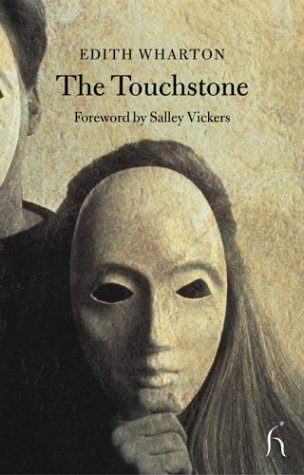
The Touchstone tells the story of Stephen Glennard, who is in love with the beautiful but poor Alexa Tennant but who can’t afford to marry her. When confronted with the possibility of losing her to a lengthy trip in Europe with her aunt, and having come across a newspaper advertisement seeking the letters of the late author Margaret Aubyn, he resolves to publish her correspondence to him as a means of funding his marriage. But of course it isn’t that straightforward, as the reaction to the letters and his own feelings about what he has done to the memory of a woman who had loved him begin to intrude into his domestic bliss.
This is all about moral ambiguity, how we live with the consequences of the choices we have made, and how we might redeem ourselves. It is a powerful story, beautifully written, full of wonderfully quotable passages such as “there are times when the constancy of the woman one cannot marry is almost as trying as that of the woman one does not want to.”
This is a lovely edition, with a striking cover and an excellent foreword by Sally Vickers which is full of interesting insights, including the suggestion that Margaret Aubyn may have been based in part on George Eliot (with the implcation that Edith Wharton dd not like her).
I haven’t read as much Wharton as I should, though I’ve always been attracted by her work ever since reading The House of Mirth as a teenager. I will definitely read this novella again, and will probably pick up more.
This is my sixth and final read for the Novella Challenge.
 I have to say right at the beginning that I really love stories about vampires. That’s not to say that I am uncritical; there are at least two series of vampire novels that I’ve stopped following because the the stories have become formulaic (I won’t mention any names…..). But it means that I’m always on the lookout for something interesting in the genre, and was thrilled to come across Let The Right One In by accident when browsing in a bookshop.
According to the blurb on the cover, Lindqvist has “reinvented the vampire novel” and there is “a whiff of the new Stephen King” so this was a no brainer for me. And I’m so glad that I picked it up, as it is a genuinely creepy and unsettling book which has been stuck in my head over the few days since I finished it.
We are in Sweden, a suburb of Stockholm to be exact, on a council estate. Oskar is 12 years old, being brought up by his mother alone and bullied at school. One night, while acting out a fantasy of revenge in the local play area, he meets Eli, a girl of indeterminate age, and they form a bond. She gives him the courage to face up to his problems, but it soon becomes clear that she isn’t what she seems; she is in fact a vampire who is at least 200 years old.
That’s the set-up, but there is so much more to this story. It’s incredibly bleak in places, a lot of the characters lead disappointedlives, the children are mainly from broken homes. However, the supernatural element blends in; Eli is a victim also, turned into a vampire when a child, not really understanding how it all works but knowing what she needs to do to survive. It’s incredibly gruesome in places (which I don’t mind) but also really affecting, and I found the end satisfying.
I’m not sure I’ve done this unusual story justice, but if you want something new in the vampire tradition then give this a try.
This is my third read for the RIP III challenge.
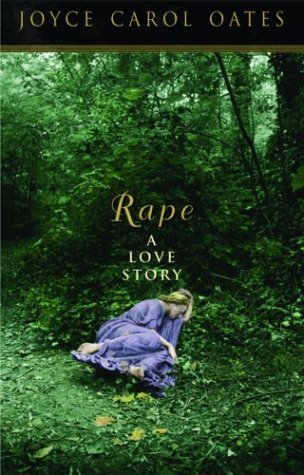 Where to start with this one? A controversial title (I received some askance looks when reading this on my daily commute) perhaps, but as with all works by Joyce Carol Oates carefully chosen, not for shock value but to reflect what the nub of the story really is.
Rape is about Teena Maguire, a single mother, and her daughter Bethie, 12 years old, and the consequences of their short-cut through a local park late at night after a Fourth of July party. Teena is raped by a number of men who are high on drugs and alcohol, beaten and left for dead; Bethie is beaten but escapes, though she can hear from her hiding place what is happening to her mother.
The men’s families hire a lawyer who is able to get their charges reduced to assault by claiming that there was consent and the beating and so on must have been carried out by a different group of men who came along later; after all, no-one actually witnessed the rape. Some of the most difficult parts of the story are here, where the justice system seems to fail Teena and Bethie; the author has made it clear from the start that these men are guilty, there is no room for ambiguity or doubt, but Teena’s poor choice that night, her dress and her family circumstances are used against her. But there is one man who is determined to see justice done, and the latter part of the novella concentrates on how he achieves that; whether his actions are right or wrong is left to the reader to decide.
This is an incredibly powerful story, but not to everyone’s taste; I’m sure many will find it a difficult read. I have said elsewhere that I admire Joyce Carol Oates greatly, and a number of her novels deal with the undercurrent of violence in modern society and how it often erupts into the lives of otherwise ordinary families, and this is no exception. The events stay with Bethie into her adult life.
This is my fifth read for the Novella Challenge.
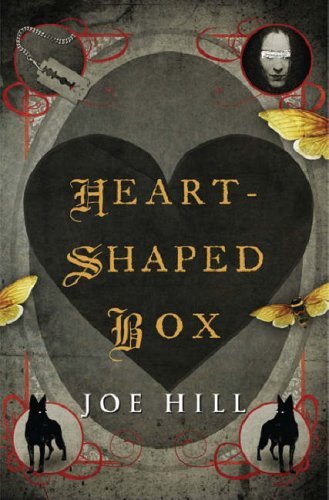 First things first – I loved this book. I read it slowly so that I could enjoy the experience for as long as possible and I’ve been mulling it over ever since, trying to work out exactly why Heart-Shaped Box is so good.
I think it’s basically such a wonderful idea – rock star buys ghost over the Internet and when the titular heart-shaped box containing a black suit arrives, he finds himself genuinely and creepily haunted. And it all goes downhill from there, as he and his current lady-friend try to find a way to rid themselves of this malicious presence.
It helps if you like the characters and I thought all of them were well-rounded, particularly Jude and Marybeth, and I found it was really easy to invest myself in their survival. I particularly loved the stuff about the dogs- I won’t say anymore as I’m sure I’m not actually the last person in the world to read this, although it feels like that sometimes.
It would be really easy to compare Joe Hill’s writing to that of his dad, who as everybody probably knows by now is the great Stephen King, but that comparison would be a bit unfair as Hill has his own distinctive voice. I’m really looking forward to reading more – I have Twentieth Century Ghosts tucked away somewhere for winter reading.
If you haven’t read this you should really give it a try. Great stuff.
This is my second read for the RIP III Challenge.
 The Terror is my first Dan Simmons novel, and I have to say that I’m really very impressed. I wasn’t at all sure what to expect, but found the story really gripping and I read what is a fairly chunky book (at over 750 pages) in pretty quick time for me.
So this is based on the true story of Sir John Franklin’s expedition to find the North West Passage in the 1840s, an attempt that failed with the apparent loss of the crews of the two ships involved, The Erebus and The Terror. Over the years it has become clear that the ships had become stuck in the ice and that the men succumbed to scurvy, starvation, botulism and lead poisoning, the latter from the poorly soldered cans in which much of their food was provided. Dan Simmons builds all this into his tale, but adds a little something extra – what if there was also something out on the ice stalking the men, picking them off, something not natural….?
I couldn’t tear myself away from this, picking it up at every spare moment to find out what was going to happen next. The story is told from the viewpoints of several of the main characters, almost all based on real crew members; this works really well. There is a real sense of foreboding in the novel and the sensation that even the widest of wide-open spaces can be oppressive when you can’t get away. I even enjoyed all the detail about ship-board life, the difference between whaleboats and pinnaces, and I now know much more about the effects of scurvy than I probably wanted to! I also know a little bit more about Inuit mythology than I did before. I found the resolution satisfying, and the mixture of historical fiction and horror worked well, so recommended.
This is my first read for the RIP III challenge.
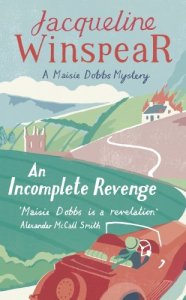 An Incomplete Revenge is the fifth Maisie Dobbs mystery, and maintains the high quality of the series. It is 1931 and Maisie is asked by the son of her former employers to investigate the circumstances around a series of petty thefts and fires in a Kent village where he is intending to buy a brick works. With the help of her assistant who is in the area hop-picking with his family she uncovers the circumstances surrounding a Zeppelin raid in 1916 which has cast a shadow over the community.
I really enjoyed this, as I always do with the Maisie Dobbs stories as I find her such a sympathetic figure. I could see where the story was generally heading, but not the detail around it; this is the second crime novel in recent weeks where that has happened (perhaps I’m reading too many of them) but I don’t mind that really, as long as the novel is well-written and I have an interest in the characters.
I found descriptions of the travelling people (or Romany or gypsies) fascinating, and what we learn about Maisie through her interaction with them really develops her as a character; it is interesting to see how little has changed really in terms of the suspicion and prejudice these people come across wherever they go.
If you haven’t read any of these novels before I wouldn’t start with this one as there is an arc story in the background which reaches a partial conclusion here; they are so lightly written (in a good way) with a lot of compassion and humanity that I would recommend reading the the whole series from the start.
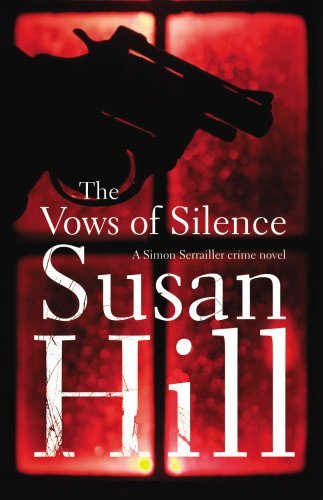 I’ve become very fond of Susan Hill’s Simon Serailler series, and have saved the reading of the latest until I could give it full and undivided attention.
The Vows of Silence begins with the shooting of a young woman, newly married. This is rapidly followed by the deaths of several others, all by a gunman, but what is the connection (if any) and is there more than one killer?
It’s fair to say that this isn’t really a standard police procedural; by that I mean that although there is the usual stuff you would expect, this is a novel as much about Serailler the private man as it is about a senior policemen leading the hunt for a dangerous killer. A lot of the book deals with several characters we have met before, including Serrailler’s family, especially his sister Cat. I didn’t find this a problem; I have grown very attached to these characters over previous novels, and in some ways the personal parts of the book were more compelling than the solution of the crime, especially as I worked out the identity of the killer quite early on.
Parts of this book are really quite moving; there is family tragedy which is so well described that I did have to reach for the tissues, something which doesn’t happen that often (and hasn’t since reading this book). So this might not be to everyone’s taste, but I enjoyed it very much.
 I have to confess that I have never really warmed to Gyles Brandreth, whether as a journalist, a TV personality or as an MP. However, with Oscar Wilde and the Candlelight Murders, I have been pleasantly surprised and will probably have to reassess my view of him.
It is 1889 and Oscar Wilde finds the body of a young man with his throat cut in the room of a house in Westminster where Wilde has an appointment. Although Scotland Yard do become involved, Wilde decides to investigate on his own as the young man was known to him, and he enlists two of his friends. Which sounds much as you would expect, except his friends are Robert Sherard, writer and great-grandson of William Wordsworth, and Artur Conan Doyle, creator of Sherlock Holmes. The game is indeed afoot.
This is really good fun, witty and clever and gives a sense of what Wilde might have been like as a friend. His relationships with both Sherard and Conan Doyle are based on fact, and there are interesting biogrpahical notes at the end of the story for those of us who like to know a bit more of the factual background to this type of novel.
I did twig reasonably early on who might be involved in the death of Billy Wood, but not the reasons why or the detail around the murder and subsequent events. Trying to guess the culprit in a crime novel is all part of the fun as far as I am concerned and it’s always enjoyable to find out just how right or wrong I am. What makes this book so satisfying is the picture it portrays of late Victorian London and the lifestyles of those with a bit of money.
This is the first in a series (I think there are three so far) and I look forward to reading the others.


