
You are currently browsing the category archive for the ‘Reviews’ category.
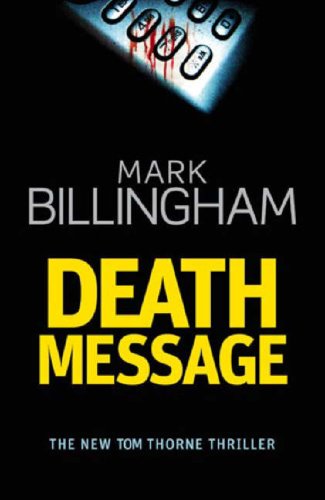 The most recent Tom Thorne thriller, Death Message is a really enjoyable police procedural and a welcome addition to one of my favourite series.
Thorne receives a picture on his mobile phone which clearly shows the face of a dead man. This turns out to be the first of several, and Thorne ends up in a psychological game with a criminal whom he sent to prison, all taking place through the actions of a killer with a clear purpose.
I really enjoyed this book. We get to know the identity of the killer and the reasons for his crimes quite early on but this only added to my enjoyment as the story stopped being a whodunit, or even a whyhedunit, but was really about what was underneath and how it would be resolved.
And as well as a resolution to these particular crimes, Thorne also gets to find out what really happened to his father, a storyline hanging over from a couple of books ago.
I think I enjoy Billingham’s books because I really like Tom Thorne, and am interested in all the personal stuff as well as the case that he’s involved in. If you are new to the series I wouldn’t necessarily start with this one because of the references to previous books, but having said that any of the Thorne novels are worth picking up. Of course now that I have said that Billingham has written a stand-alone novel as a break; hopefully he’ll be back with these characters soon.
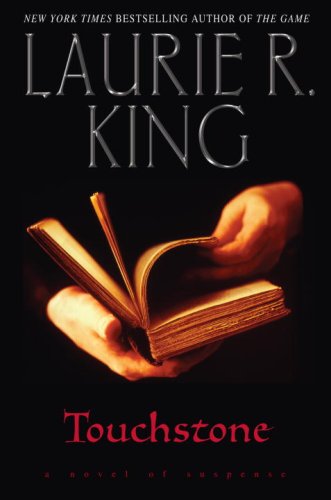 From assassination with William the Silent to anarchy in Touchstone, with a common thread of political change, all part of crime month. The background here is the General Strike of 1926 with huge tensions between the working and ruling classes, an opportunity for those with their own agenda to push the country in a certain direction.
I don’t want to give away too much of the plot; suffice to say that Harris Stuyvesant, an agent of what will become the FBI, arrives in London semi-officially to follow up some leads relating to bombings in the USA. By various means he teams up with Bennett Grey, a survivor of WWI who has some interesting abilities which could help the investigation, as well as some useful contacts with key players through his sister, Sarah.
I really like Laurie King, I have never read a novel by her which I didn’t enjoy, whether it’s the Mary Russell or Kate Martinelli series, or one of her standalones as here. I’m glad to say that I wasn’t disappointed this time either; this is a really well written thriller, the plot slips along nicely but is supported by a depth of characterisation which meant I became really attached to several of the main characters.
I read this largely during my daily commute, and it was so good that on at least one occasion I didn’t realise I’d reached Waterloo and had to scramble to get off the train. Highly recommended, and I hope that she writes more involving Grey and Stuyvesant.
I’m also really, really looking forward to next year’s Mary Russell.
 The Awful End of Prince William the Silent by Lisa Jardine describes the events leading up to the assassination of William and the repercussions of his death within the Low Countries and across Europe. It brings together two of my favourite things – crime and history – and does so in a really accessible way.
You don’t need to know anything about the political situation on the continent at that time as the author gives one of the best synopses I have ever read. So you get an understanding of why the Low Countries were in revolt against Spain, why Philip II felt the need to put a price on William’s head, and why someone might want to take up that challenge even though they knew it meant a certain and deeply unpleasant death for them. You also learn the impact this crime had on the rulers of Europe, Particularly Elizabeth II, and the growing fear of handguns. For as Lisa Jardine says, this crime wouldn’t have been possible without the invention of a pistol that could be loaded and primed in advance, concealed about the person and produced at the right moment to deadly effect.
What I found particularly interesting about this book are the parallels that are drawn with the present day. The 16th century assassin is compared to 21st century suicide bombers, who are almost impossible to stop because they have no concern for their own survival. The repressive measures taken by the English government in particular, trying to stop the wrong type of person from entering the country because of the fear that the Queen might be killed, and the lengths the intelligence services at the time went to to keep tabs on people also have a resonance in today’s fight against terror. And of course the murder of a celebrity and what that can mean to their ongoing reputation is also touched upon.
I thought this was an excellent introduction to the subject, and had the bonus of some original documents in the appendices which really fleshed out the background. Highly recommended.
Updated – I was so intent on trying to articulate what I thought about this book that I forgot to mention it was my fifth and final read for the Non-Fiction Five Challenge.
 R M Dashwood is the daughter of E M Delafield who wrote The Diary of a Provincial Lady, which I read and thoroughly enjoyed many years ago. In Provincial Daughter, Rosmund Dashwood has written not exactly a sequel to her mother’s books, but a new take on a similar situation, that of a middle class woman and the trials and tribulations of bringing up a family with not enough money to quite meet the social expectations of her class. Which makes it all sound a bit pompous, but this is a very funny novel.
The story is set in the 1950s and covers three months where the narrator (never named) decides to keep a diary of her goings-on just to demonstrate to herself that she isn’t wasting her fine mind and expensive education. So we find out about her husband the doctor, her three sons, her friends and neighbours, her German au pair and her writing career.
I found it fascinating; I was born in the early 1960s so this world had largely gone by the tme I would have been old enough to recognise it, although I suspect this is a very English take on things and it might have been a bit different where I grew up. I liked the narrator very much, which always helps, and it’s a shame that there don’t seem to be any further adventures; I would have liked to know whether they moved to Scotland as seemed to be on the horizon at the end of the book, and what that might have meant.
This is good fun, and I loved the cover – what a frock! – and the illustrations by Gordon Davies are excellent. Recommended.
 Regular readers will know that one of my main interests is history, and so when looking for books to read for the non fiction challenge I picked several that were about the past, and this one, Ubiquity, which is about the science of history, an idea that I have always found intriguing. Mark Buchanan is using this book to describe what the blurb calls a new law of nature which can be applied to anything.
I found this a difficult read largely because it is perhaps inevitably more about the science than the history, but the ideas the author discusses were sufficiently interesting to make me persevere, though I did find it hard going at times. If I have understood the book correctly (and that might be a big if) there is evidence of “ubiquitous patterns of change” that run through everything on earth (and presumably beyond). Things that look very different may actually be extremely similar in the way that they are organised. Buchanan uses earthquakes, forest fires and mass extinctions among others as examples of how this might all work.
There is a lot of discussion about power laws which I think means that the bigger something is the less likely it is to happen – the example that stuck with me was research into wars and the size of each conflict as a fraction of the world’s population at the time, which demonstrates that wars become 2.62 time less frequent every time the number of deaths doubles.
One of the key ideas behind this book is probably best described by the author himself: if
chaos teaches physicists that the truly simple can nevertheless look complicated, the critical state teaches them that the truly complicated can behave in ways that are remarkably simple
Buchanan does deal with how this all applies to human society by facing up to the objection that I suspect would be made by many people, that is what about our free will. He uses a number of examples to show that although we do indeed have free will, we also have tendencies and often follow the line of least resistance, so that though we deal with each other on the basis of our own opinions and decisions, there almost always emerges a regular pattern of behaviour.
I’m sure I haven’t done justice to the complexities of this book, and although it wasn’t quite as I expected I found it thought-provoking.
This is my fourth read for the Non Fiction Five challenge.
 I have to confess from the outset that handling numbers has never come easily to me and I have to work really hard at it (which is a pity as it does figure fairly prominently in my job). And although I know that economics is as much about concepts as it is about figures I suppose I have been reluctant to investigate something which on this read has proved to be really fascinating.
In the The Undercover Economist, Tim Harford is trying to get non-economists to think about the world in the way that he does. I will admit that I was sucked into the book simply because his first example was about something I walk past every day, which is the coffee kiosk next to the main entrance/exit at Waterloo Station in London; according to Harford some 74 million commuters use this station every year (and it feels some mornings as if they’re all there at once!) and this kiosk is positioned on the most efficient route out of the station, which is one of the reasons it does so well. The other is that there isn’t another kiosk next door selling coffee more cheaply, and so location means everything to the economic success of that particular business.
Harford talks a lot about the price of coffee and why it is so expensive in large cities like London. It’s not as simple as saying the coffee prices are high because the rents are high; he demonstrates that landlords can only really get away with charging high rents if people are willing to pay high prices for the goods sold in those shops. And commuters tend to be “price blind” because they don’t have the time or the inclination to walk a bit further to find a cheaper coffee.
Last coffee thing: he translates the Starbucks price list from their shop on The Strand in London (as it was when he wrote the book a few years ago) and it really tickled me:
Capuccino = no frills = £1.85
Hot chocolate = no frills = £1.85
Caffe Mocha = mix them together, I feel special =£2.05
White chocolate mocha = use different powder, I feel very special = £2.49
Venti white chocolate mocha = make it huge, I feel greedy = £3.09
This is how we signal that price isn’t important; we are willing to pay more for not very much difference.
Harford touches on economics and the environment, talking about carbon neutrality and how it often doesn’t make sense, and suggests that just because goods are moved within countries or even very locally, that doesn’t mean the environmental costs of transporting them are small.
He gives a simple definition of economics, which makes a lot of sense to me: the economy is about who gets what and why.
I really enjoyed reading this book, it’s well written and engaging, and for a few days it made me look differently at how I spend my money and what signals I give to shopkeepers. It hasn’t changed my habits but perhaps I do recognise a bit more how my behaviour can be interpreted.
This is my third read for the Non Fiction Five challenge.
 This book does exactly what it says on the cover; offers a high level and balanced overview of secret societies throughout history. Barrett’s thesis is clearly set out at the beginning – the history of these societies = the history of esoteric religion = the history of magic, and he proceeds to take us through the the roots of secret societies before looking at several in detail.
It’s almost inevitable, because of the level of interest and the number of books written about them, that he concentrates on Freemasonry and the Knights Templar. He doesn’t shy away from the rumours and controversies, but tries to identify what is factual from what is supposition and leaves the reader to make up their own mind. Once of my favourite quotes: cynics would say that [Freemasons] are a handful of late-middle aged, upper-middle class men who like dressing up in gloriously patterned costumes” rather than grand conspirators.
He comes to the conclusion that we may never know the truth about organisations like the Knights Templar, and that there is more likely to be a spiritual rather than direct line between the old and modern societies. I found this very persuasive; I’ve never been a great believer in conspiracy theories, especially ones that are supposed to have lasted undiscovered for centuries, but I can see how some of their ideas would be picked up and developed by later followers.
By the way, he has a very informative discussion on Tarot, which is a particular interest of mine, and I was fascinated by just how many of these societies use Tarot packs as teaching aids.
If you are at all interested in this subject I think you will find this book a good starting point for further exploration.
This is my second read for the Non-Fiction Five Challenge.
 This turned out to be a completely different book from the one I expected. I thought I was going to read a fairly straightforward historical description about the Empress Constance returning to Sicily to reclaim her father’s kingdom; instead I got a mixture of history and travel book, which jumped back and forwards not only between Constance and the present day followers in her footsteps, but also within Constance’s own story. And although it took me longer to read than I intended, I really enjoyed it.
I normally dislike non-fiction books or films about historical subjects that are inaccurate or play about with history for dramatic effect, but for some reason didn’t mind the fact that the author of Travels With A Medieval Queen has created some imaginary relationships for her protagonist because so little is known about her real companions and she couldn’t bear to have Constance unaccompanied through her journey. So there is an imaginary Arab servant, and imaginary female doctor, and an invented romance with a real poet, Frederick von Hausen.
The story of Constance is fascinating; her marriage to the cold and ruthless Henry VI, son of the Emperor Frederick Barbarossa, her years of infertility and her astonishing first pregnancy at the age of 41, which led her, according to many sources, to deal with suggestions of trickery by giving birth in public. In a tent in the town square. In December.
And against the background of Constance’s own story are the author and her friend retracing as far as they can Constance’s journey from Germany to Sicily.
There are lots of wonderful nuggets of information supplied in passing. I didn’t know that there were so many women doctors during the 12th century, effectively de-legitimised when medicine became “professional” and therefore male. I didn’t know that in the early middle ages red actually meant coloured in general and could cover anything from yellow to purple.
Also, it’s always a good sign when I read bits of a book out to the Book God, and I did a fair bit of that with this one. And it made me want to find out more about the period, and especially Constance’s son Frederick, destined to become Holy Roman Emperor. Delightful. And my first read for the Non-Fiction Five challenge.
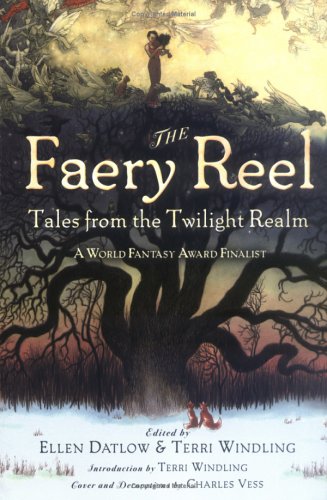 This is my fifth and final read for the Once Upon a Time II challenge, and what a corker. I am a huge fan of short stories (I may have said this before) and this is a strong collection. I began by trying to read one story a day, but actually ended up reading it almost like a novel. I heard someone in a radio interview (I think it was Anne Enright but I may be wrong) saying that she approaches a book of short stories like a box of chocolates – she can’t stop at just one, and despite my attempts at discipline I’m exactly the same.
The Faery Reel, edited by Ellen Datlow and Terri Windling brings together some of the finest fantasy authors and challenges them to write new works about faery in all its guises, and they all rise to the occasion. There wasn’t a single piece in this collection that I didn’t enjoy, but my particular favourites were:
CATNYP by Delia Sherman – a changeling in the faery version of the NY public library, where the catalogue is a talking lion whose first words are always “Title. Author. Subject. Keyword.” This is probably my favourite story in the book, and a new author for me to investigate!
The Faery Handbag by Kelly Link – sassy heroine, very enjoyable.
Never Never by Bruce Glassco – what is it like to be Captain Hook?
And of course there is a contribution from Neil Gaiman, and a wonderful, entertaining and enlightening introduction by Terri Windling herself, with a list of books for me to pursue a continuing interest in the faery world.
As an added bonus, the Charles Vess illustrations at the head of each story are really wonderful, and I can’t recommend this too highly.
And I have now completed my first (but certainly not my last) challenge!
 Apart from Good Omens, which he wrote with Neil Gaiman, I have only ever read two novels by Terry Pratchett, and those were the first two Discworld books – pressed onto me by a friend who was (still is) a huge Pratchett aficionado. That was 16 years ago (doesn’t time fly) and although I found them amusing I didn’t have the urge to pick up any more. Then three things happened:
- a really good adaptation of Hogfather appeared on TV here in the UK
- followed by a pretty good adaptation of the two books I had read
- followed by my remembering that the Book God had bought me a copy of Going Postal because I thought the title was funny
So I decided to give Terry another go because I really, really like the man and do so want to enjoy his books, and I admit that I’m glad I did because this is really very good indeed.
Moist von Lipwig is a conman who has been “rescued” from his execution by Lord Vetinari, the ruler of Ankh Morpork, in order to rejuvenate the Post Office. A simple premise, but so much else is going on in the background, far too much to mention here without spoiling the story. The jokes are good, particularly if like me you have ever worked in the post office or collect stamps – the whole subplot about how stamps and the hobby of collecting them comes about was very enjoyable. And there are Golems – I like Golems, and Mr Pump (Moist’s parole officer) is a great character. There is a love interest, triumph and disaster and a happy ending. I can really recommend this one if you like humourous fantasy, and although there have been mixed reviews I’m going to look out for the sequel Making Money when it comes out in paperback.
This was my fourth read for the Once Upon a Time II challenge.


