You are currently browsing the category archive for the ‘Reviews’ category.
 Well, where to start with this one? Victorian Sensation is packed full of interesting detail about what our Victorian forebears found sensational, the role of the press and what all of this tells us about their society and our own. As the author says (and I full agree) when we talk about Victorians we often really mean middle-class Victorians, but they of course were only one social layer in a complicated world.
The book covers a whole variety of topics that Victorians found sensational (I really am going to have to find another word for this!) and it’s not so very different from the kinds of topics that the tabloid press in particular covers these days, namely the Royal Family, political scandals, sex scandals, morality, murders and celebrities from sport and entertainment. The area that seems to me to be different is the sensation novel and the sensation drama, but I suppose if you substitute soap operas and reality TV for those then again the similarities are obvious.
These days, when it seems there is nothing that can’t be discussed, it’s interesting to look back at a period where so many subjects were off-limits, and shocking in a way to see how people who raised some of these difficult issues (child prostitution, the indignities heaped on women under the enforcement of the Contagious Diseases Acts), were vilified, especially if they were women themselves. There was definitely, again among the middle class, a tendency not to want to face up to many of the things that were happening around them.
One of the great joys of this book are the quotes from the press, this being my absolute favourite: “the particulars published in several daily papers have been so broadly stated that it has been impossible to leave copies of these papers within reach of young people or anyone having the faintest pretension to be considered an honest woman.” Lovely stuff.
There is a very good chapter on the impact of the sensation novel, looking particularly at Wilkie Collins and Mary Braddon, well worth reading, and if you are at all interested in the Victorian period you should certainly give this book a try.
 So Carl is hosting this mini challenge as part of his Sci-Fi Experience and to honour Dewey. The idea is to read at least one sci-fi short story and post about it on his official page. I read three stories from an old anthology that we’ve had kicking around the house for ages, namely The Mammoth Book of Best New SF 13, which covers stories first published in 1999 (wow, last century, remember that?), and therefore cannot be found on Amazon for me to link to (sorry). I read:
1. Suicide Coast by M John Harrison – I found this quite difficult and bleak and I’m not entirely sure that I fully understood it; it’s about gaming and rock climbing I think, and what’s real and what isn’t. Perhaps I just wasn’t in a receptive frame of mind to understand the subtleties?
Anyway, I wasn’t put off, and moved on to:
2. How We Lost The Moon: A True Story By Frank W Allen by Paul J McAuley – I like McAuley’s work though I haven’t read as much as I should have. This story does what it says on the tin; Frank is a witness to and participant in the events that saw an experiment on the Moon go terribly wrong and we, sort of, lost the Moon. Very enjoyable.
3. Evermore by Sean Williams – a story of crippled space-ship crewed by entitities based on the minds of real people on Earth but who technically don’t really exist, and in any case aren’t really speaking to each other. So what happens when something needs to change?
There are a couple of other stories in this anthology that I might save for another time, but all in all this was an interesting experience.
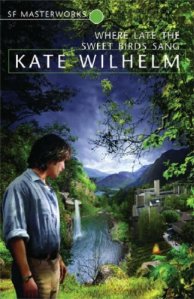 So I said that one of the things I wanted to do as part of the Sci-fi Experience was read more science fiction by women, and when I wrote that Where Late The Sweet Birds Sang was one of the books I had in mind.
To my shame I knew very little about Kate Wilhelm but she is a multi-award winning writer, instrumental in setting up and teaching at the Clarion Workshops which have been very influential in the sci-fi world. And this novel seems to be considered amongst her very best work.
So this is a book about cloning, not just about the idea of it but the successful application of it in an isolated community which has set itself up in the Appalachian Mountains in preparation for the world catastrophe that is clearly coming; not just famine, disease and war but the rapidly developing sterility of the human and animal populations. The community is made up largely of one wealthy family who use their money and expertise to clone and breed themselves in order to survive.
The novel is in three sections, each one told through the eyes of a particular character (David, Molly and Mark) who follow the evolution of the clone society over a period of time. And that’s what’s really fascinating about this novel; the cloning technology is a given, but what the author is really exploring is the kind of a society that would develop, how the original, naturally born people would be regarded by the clones,and how (if and when the time comes) they would venture out of their self-sufficient world.
I was really very impressed with this novel; it’s a moving story, and although my sympathies lay in a particular direction I could really understand the opposite point of view. The structure works really well as it provides a means of watching this society evolve. It’s beautifully written and one that will definitely be on my re-read pile.
 Where to start with The Devil in Amber? This is the second Mark Gatiss novel to feature Lucifer Box – artist; spy/secret agent; a man with an eye for both men and women; a man who lives life to the full, shall we say.
We first met him in The Vesuvius Club which was set in the Edwardian period; we are now in the 1920s, with Fascism rising and the effects of the Great War still being felt. Lucifer is keeping an eye on Olympus Mons and his Amber Shirts, and while doing so is framed for murder and has to escape to Britain, foil the dastardly plot, save the girl and his own reputation.
This is great fun; I love Mark Gatiss (the twenty-seventh most dangerous man in Islington apparently) who has written for (and appeared in) Dr Who – which immediately gives him extra points – but he also wrote and acted in a three-part ghost story on the BBC over Christmas (called Crooked House and I hope it’s going to come out on DVD soon as it was really very good).
This novel is a cross between a classic spy thriller and Denis Wheatley (yes, there are Satanists and mysterious castles and young women in peril and megalomaniacs trying to take over the world) but it’s also really amusing; I love the names, especially Lucifer’s sister Pandora Box. An enjoyable read for a dull and cold January, and I’ve just got a hold of the third Lucifer Box adventure, which looks a little bit more James Bond-ish…..
 I’m going to have a stab at something I find very difficult, namely trying to talk about a Joyce Carol Oates short story in a meaningful way. I often find her short stories elusive; they have an impact on me but I’m not always clear why (if that makes sense).
This story is set in the 1960s (I think it was written in the late 60s) and is about Connie, a fifteen year old girl who has a relatively normal life; she gets on OK with her parents and sister but there are the usual tensions that you get within families. She isn’t always truthful – she tells her parents she’s going to the cinema with her friend but they usually split up and hang around with boys.
One night she catches the eye of a particular boy, Arnold Friend, who comes to her house with one of his friends when he knows she is home alone. Connie realises that both of the boys are a lot older than she thought but she still doesn’t sense the danger…
Although the ending is fairly open, it’s clear what will happen to Connie, especially as I believe the character of Arnold Friend is based on a real person. I found the ideas behind the story quite disturbing, and there is a real sense of menace. I’m sure I haven’t done it justice, but since reading it at the weekend I find myself thinking back to it a lot.
So yesterday found me in our garage unpacking a couple of boxes of books which have been in storage there for goodness knows how long, and I came across the Library of America edition of HP Lovecraft’s Tales, a handsome book which gives an air of scholarly gravitas to stories that are usually printed with more lurid covers. I’m sure I’ve said elsewhere that I have a huge affection for Lovecraft; I first came across him while I was still at primary school in the early 1970s (I must have been about 11); I still have the original paperback and looking at the cover I’m surprised my parents didn’t take it away from me, but there you are.
The first story in the collection is The Statement of Randolph Carter written in 1919 and full of things that would be familiar to all readers of his later work (Lovecraft himself described it as a ghastly tale and said that it was based on an actual dream). Carter and his friend Harley Warren head off into Big Cypress Swamp but only Carter makes it back out. This is his attempt to explain what happened based on the little he can recall.
It’s full of wonderful stuff; the pair have talked of “why certain corpses never decay, but rest firm and fat in their tombs for a thousand years” which gives you some idea of what they were off looking for. The tone of the first couple of pages put me in mind of Charles Gray as The Criminologist in The Rocky Horror Picture Show, though the story gets a bit more hysterical towards the end. Not one of my favourites but it was good fun to read it again.
 So I decided to start the year off with a proper sci-fi read by an author new to me but highly regarded by the Book God. Gary Gibson lives and writes in Glasgow, and the Scottish connection is always of interest to me as we seem to produce some fine writers in the genre (Iain M Banks to name but one)
I like most varieties of sci-fi but will admit to a huge soft spot for those with universe-spanning plots, ambiguous alien races, spaceships, explosions and lots of scientific exposition for me to get my teeth into; Stealing Light meets all of those criteria. And with a really good female protagonist to boot.
Dakota Merrick is a pilot and a machine-head – a person with implants (known as her Ghost) which allow her to perform well above normal human capacity. She is on the run having participated in and witnessed some terrible events, and signs up as the pilot on a cargo ship for what seems to be a straightforward job – taking an expedition to survey a potential mining operation. But of course all is not what it seems. What is the expedition really looking for?
I really, really enjoyed this novel; Dakota is a flawed and damaged heroine and I came to like her very much. The mysterious alien race which seems to be behind most of what happens to her, The Shoal, are a race of sentient fish and the only species with faster than light travel, and although the whole idea of them seems a bit weird at first, I certainly got used to them quite early on. It is quite a violent book, but I didn’t find the level of violence excessive given the dynamics of the plot (and I must admit this isn’t something that normally puts me off).
All I can say is that this is so well done it kept me up to the wee small hours over two nights to finish it, and represents a really good start to my 2009 reading.
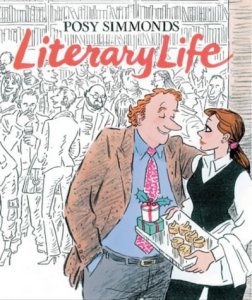 So the first of the Christmas present reads has already been completed, and what good fun it was. I used to read Posy Simmonds’s cartoons in the women’s pages of The Guardian when I was a student, and I have several of her collections, as well as a number of her excellent children’s books, but this was a new one on me.
Literary Life is a collection of strips and other cartoons, again from The Guardian, with a focus on the literary world. There are very recognisable author types, the struggling independent bookshop and (my favourite) Ask Doctor Derek, where a number of common author ailments are dealt with (critical mauling being a good example). The book rounds off with a couple of really good Christmas stories – Murder at Matabele Mansions and a new version of Cinderella.
I love Posy Simmonds and this is a good addition to my collection; it had me giggling all through Boxing Day!
 It’s always exciting when you find a new author that you think you are really going to enjoy, and extremely gratifying when you turn out to be right, as I have been with Charles Stross. I have read about him for a long time, and been intrigued by reviews of his books, but until now haven’t tried any of his works. And in looking for something different after my failure with Emperor, I decided to throw myself into The Atrocity Archives and I’m so glad I did because it is exactly what I needed!
In the acknowledgements at the beginning of the book Stross refers to three authors who made it possible for him to write the book – HP Lovecraft, Neal Stephenson and Len Deighton, which is a really interesting mix when you stop to think about it. The first two have been referred to on this blog more than once (I think – they are both favourites) and Deighton I know mostly through Michael Caine playing Harry Palmer in the movies but don’t think I have ever read.
So as you may have gleaned this is about spies and codes and Nameless Old Ones as seen through the eyes of Bob Howard who has been conscripted into the organisation known as The Laundry and about his experiences as a field agent. It is almost impossible to explain the plot without giving anything away but it is really enjoyable and if you are a civil servant you will recognise some of the worst traits of government bureaucracy (although obviously exaggerated – I don’t remember any zombie doormen, but you never know, I just might not have been looking in the right places). It appeals to the X-Files-and-Fringe-loving part of me, the bit that finds gibbous and rugose perfectly acceptable adjectives, and accepts whole-heartedly that there are lots of secret basements all over the place harbouring information it is better for us not to know about.
I really, really, enjoyed this and am already hunting out more of his work. And don’t skip the afterword – really interesting stuff there too.
 I have to confess to a failure here – I managed to get to page 160 of Emperor when I ground to a halt. This is a rarity for me and I’m not sure why it’s happened in this case; after all:
- I like Stephen Baxter
- I like reading about Rome
- I like alternative history type stuff
But, despite all of these things I just couldn’t persevere with this book. It’s not badly written, and the first section (set around the time of the Claudian invasion of Britain) was really good and I trotted through it very quickly. But then……. who knows?
It’s a shame really as this looked like it could be an interesting series (I think it ran ultimately to four books) but there you have it; the second unfinished novel this year.


