
You are currently browsing the category archive for the ‘Reviews’ category.
 I actually finished reading this weeks ago but have only just got round to writing this review because I didn’t really know what I wanted to say. Some of you will remember that I read my first Dan Simmons novel towards the end of last year (my review is here) and that I absolutely loved it. The Song of Kali is a trickier proposition.
So the American poet Robert Luczak has been commissioned by a magazine to write an article about the Indian poet M. Das, who appeared to be dead but has now resurfaced with a new work. Luczak’s wife is Indian, so she and their baby daughter accompany him to Calcutta to locate Das and see if a deal to publish the new poetry can be worked out. And then, of course, it all goes horribly wrong.
Has Das come back from the dead? Is there going to be a new age of Kali where violence and destruction hold sway? Will the Luczak family get out of all of this unscathed?
This seems to me to be much more of a horror than a fantasy work; it’s incredibly dark, grim, violent and really, really disturbing in places. I struggled to finish it despite the fact that it is so well written, because it is pretty compelling stuff which lodges in your mind, and actually I wasn’t sure that I really did want to know how things were going to work out.
This is very much an acquired taste, and was my first read for the Once Upon a Time III challenge.
 Over the years I’ve come to prefer Barabara Vine to Ruth Rendell (for they are one and the same). Although I used to read the Wexford novels voraciously, I really rate the psychological approach that she takes as Vine, and The Birthday Present maintains what is a pretty good record (the only one I couldn’t get into was Gallowglass).
The book is set in the 1990s when the Conservative government was moving from Mrs Thatcher’s leadership to that of John Major, and the party was struggling with allegations of sleaze. Ivor Trensham is a Tory MP, a single man with ambition and a promising career but who also has secrets – “unconventional” tastes and a mistress, Hebe Furnal, a married woman with a young son. When he organises a special birthday present for Hebe and it goes horribly wrong, leading to a tragic accident, the issue for him becomes one of avoiding scandal; how long before all this gets out, and who will help protect his reputation?
The story is told in the first person by two different narrators; one is Ivor’s brother-in-law in whom he confides over time, and the other is a friend of Hebe’s. I liked the structure of the story which allows the reader to get the full picture in an uncontrived way given that most of the characters (possibly all of them) don’t know all of the facts. I found the atmosphere of imminent ruin for Ivor really pulled me in, and although I had little sympathy for him I still wanted to know what happened. There are lots of hints all the way through but I didn’t really work out what was going to happen until very close to the end, and by then I was so hooked I didn’t really care whether my guesses were correct. I can see myself re-reading this, which isn’t normally the case with crime novels.
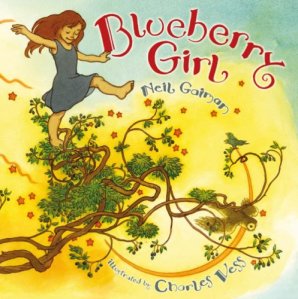 I never know how best to review a picture book, especially one which is designed at least in part for children. They tend to be very short so it’s almost a cheat describing it as something that I’ve read, but they are always beautiful things that deserve to be celebrated, and that’s certainly the case here.
Blueberry Girl is a poem written by Neil Gaiman for his friend, the singer/songwriter Tori Amos when she was expecting her little girl. It’s a prayer wishing for all that’s good to be given to the child so that she grows up to fulfil her potential.
The poem itself is very moving, and is wonderfully supported by gloriously colourful illustrations by the great Charles Vess, filled with animals and flowers.
It’s a gorgeous book and one that I’m sure I’ll go back to; and it’s also my first read for The Dream King Challenge.
 Halting State is only my second Charles Stross novel but I think it’s already clear that he and I are going to have a long and productive relationship as I’ve thoroughly enjoyed both reads so far (see this review for my previous foray).
So we are in Edinburgh and Sergeant Sue Smith has been called to the office of Hayek Associates, a company which produces and supports online games. There has been a robbery, but not one of your usual smash and grabs; this time the robbery has taken place inside a game, and has been carried out by a marauding but organised band of orcs, supported by a dragon.
Add to this mix Elaine Barnaby, a forensic accountant with practical skills in weilding very large swords in medieval role playing games, and Jack Reed, a games programmer who just happens to be unemployed at the right time and with the right skills set to assist in the investigation, and you have the three main characters in a tale of gaming, programming and international terrorism in a 21st century which is a bit of an advance on the one we recognise. And one of the questions is: when is a game not a game?
I loved this; I’ll admit it took me a day or two of typical reading-on-the-train commuter time to really get into the story but once I was housebound with the dreaded Head Cold 2: This Time It’s Personal, this book was exactly what I needed to escape from the depths of feeling sorry for myself. And what more can you ask?
I’ve never played World of Warcraft or any of its competitors but I can see the attraction it has, and although I’m sure you would get a lot of additional pleasure out of this story if you had a background in online gaming, I found I knew enough to make the story intelligible. The techy stuff was really interesting and was very happy with how the plot all worked out in the end. Another recommendation, and another read for the 42 Challenge.
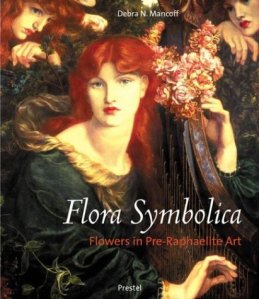 So I’ve been watching Jeremy Paxman’s series on Victorian painting on the BBC, and obviously the pre-Raphaelites feature quite a bit, and I haven’t started any of my reading for the Art History challenge, and the Book God asked me a question about flowers (I think, may have imagined that) so I toodled off and picked this up from the bookshelf. Just to dip into you understand…..
Some time later I had read it from cover to cover; not a huge book but a lovely selection of Pre-Raphaelite paintings featuring flowers and a page on each one explaining what the various plants actually mean.
Interesting diversion into the language of flowers; there wasn’t just one dictionary of meanings apparently, and many a young man had to cope with the tears that ensued from a different interpretation of the bouquet he’d just presented.
The reproductions are lovely and the text interesting. And in case you are wondering, the cover is Rossetti’s “La Ghirlandata”, painted in the 1870s, and the flowers it includes are honeysuckle (affectionate devotion though Rossetti saw it as a symbol of sexual attraction); pink roses (the sexual attraction thing again as they are at their full bloom) and surprisingly monkshood (approach of a dangerous foe) – though William Rossetti thought his brother meant to paint larkspur (an emblem of lightness and levity). So even great artists get it wrong sometimes too.
This is my first read for the Art History Reading Challenge.
 I’m not sure where I came across the name of Charles Finch – it may have been mentioned on someone’s blog, or I may have simply have been seduced by the cover somewhere, but I’m glad I decided to put this on my Christmas list, and grateful to the Book God for buying it for me (I suspect that he wants to read it too)
The hero of A Beautiful Blue Death is Charles Lenox, a Victorian gentleman of leisure with a love for ancient history and travel, and a man who has clearly dabbled in amateur investigations in the past with some measure of success. It is winter in 1860’s London, and although he would prefer to be reading by a fire in his study, he gives in to the request of his childhood friend, and current neighbour, Lady Jane to look into the circumstances surrounding the death of a former maid from her household, who has been found at her new position apparently having committed suicide.
Of course the novel would be over fairly quickly if that were the case, and it becomes clear that the girl was poisoned, and Charles must find out why and by whom, both to satisfy himself and to keep his promise to Lady Jane.
This was a very enjoyable read, to the extent that I stayed up well past my normal bedtime so that I could finish the story. Lenox is a really attractive leading man, his relationship with Lady Jane is nicely drawn, and there is a wonderful cast of supporting characters, particularly his brother Sir Edmund, who is a distinguished Parliamentarian but nevertheless wants to help with the investigation. The denouement was very satisfying, and I will be looking out for the sequel when it becomes available later this year.
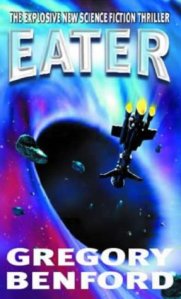 Gregory Benford’s Eater is, according to the cover at any rate, an “explosive new science fiction thriller” set in the fun-packed world of astrophysics. I have some acquaintance with this world, given that the Book God’s predecessor was a Natural Philosopher with an interest in such things. That’s probably where my interest in factual science comes from – I refuse to give him all the credit for my interest in science fiction – I lay that at the door of my English teacher in junior secondary school who had us reading Arthur C Clarke’s A Fall of Moondust.
Anyhow, we are in Hawaii with the astronomers and astrophysicists and there is an anomaly in the heavens, moving the way such things should not. Turns out to be a sentient black hole heading Earthwards – I’m not giving anything away here, a casual glance at the blurb on the back of the edition I have gives away this key plot point. But what does it want and what is the world going to do about it?
This was a bit of a guilty pleasure – I quite enjoyed it while feeling all the way through that I shouldn’t. I think this is because it read very much like it was aiming for the screen, probably as a Sci-Fi Channel mini-series with all the things you would expect. Is there a crumpled deskbound hero scientist who would love to do real work again? Is there a wonderfully intelligent woman suffering from a terminal disease but working through her pain? Is there a rival of long-standing who turns out to be an ally as they all work towards a common goal? Is there tragedy, betrayal and a noble sacrifice? You bet.
I don’t mean to make fun because I did actually enjoy reading this, it was quite pacy and there was a lot of hard science which is one of the things I really enjoy. But in the back of my mind I was casting the movie, and that’s always a bit distracting.
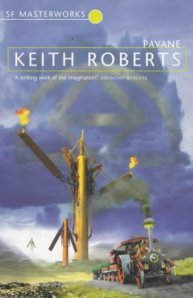 Pavane by Keith Roberts paints a picture of an alternative western world where Elizabeth I was assassinated in1588, the Spanish Armada won, the Protestant Reformation in Europe was defeated, the New World didn’t gain its independence, and the Catholic Church Militant holds sway.
The resulting world is technologically backwards in most respects (no cars but steam driven road trains; no phones but semaphore towers etc.), superstition is rife and the Inquisition (now known as the Court of Spiritual Welfare) continues to put people to the question. Oh and the old ones, in the person of Fairy, are still lurking around, watching and occasionally assisting.
This is less a novel than a series of linked stories which begin in 1968 (the year the book was published). I was immediately attracted by the basic premise (those of you who read this blog regularly will know that sixteenth century history is one of my great loves) and I found the book absolutely fascinating – a complete world which is internally logical. All of the stories are good, my favourite being Corfe Gate where a young woman leads a rebellion against the Church in south-west England, which is where the stories are mainly set.
I enjoyed this very much, although it does throw up a question for me about what we really mean by sci-fi, something which I occasionally find puzzling. This book has a number of fantasy elements, but I suppose it falls into the sci-fi genre because of the alternative history aspect.
The Encyclopaedia of Science Fiction describes Pavane as “moody, eloquent, elegiac and thoroughly convincing” and I think its well worth a read.
 For many people Jasper Fforde is an acquired taste, but I’ve always been glad to say it was one that I acquired early and I have enjoyed both his series of novels.
First Among Sequels is a return to the world of Thursday Next, Jurisfiction agent, supplier of floor coverings to the people of Swindon and cheese smuggler. I’ve always liked Thursday, her complicated family and cloned Dodo, Pickwick. Unfortunately, I was vaguely disappointed in this one, even setting it aside for several days.
The plot for this novel managed to be both simple and complicated at the same time, so I’m not even going to try to summarise it; if you have read any of the others then you will know what to expect., and if you haven’t, I really wouldn’t recommend you start here.
There were too many things going on, and I think I found the alternative Thursday Nexts (I’m not even going to try to explain how she manages to work alongside two alternative versions of herself) irritating.
However, I persevered until the end and was rewarded with some good jokes, interesting set-ups and a cliffhanger which presumably will lead us into another instalment. But these couldn’t save it from being somewhat unsatisfying.
 I actually finished reading Declare last weekend, but a mixture of workload and being severely under the weather for the past three days (can’t decide if it’s a new cold or if I just haven’t entirely got rid of the one I had before Christmas and it’s just come back to remind me how much it cares) meant that I haven’t been out from under enough to consider posting. But I’m beginning to feel a little bit better and may have revived sufficient brain cells to do this some justice. Because I really, really enjoyed this novel.
Bit of background; the Book God is a Powers fan and has been encouraging me to try his stuff, but the only thing I’ve read is The Anubis Gates which was good but didn’t have me rushing to the bookshelves to locate any more. Every time I say to the BG that I’m looking for something to read, he says “why not try Declare?” but I’ve usually gone off and found something else. The thing that made me change my mind this time was reading The Atrocity Archives by Charles Stross – more of that later.
Declare brings together espionage and the supernatural; that’s clear from the beginning. It tells the story of Andrew Hale, recruited by the British Secret Service at the age of seven, undercover in France during the Second World War and in Berlin and the Middle East afterwards, and his connection with Kim Philby and an unfinished operation code-named Declare.
I’m not going to say anything more about the plot; the pleasure of this book is how convincing it is about the world it operates in, of spies and resistance movements and the use of the supernatural by countries for their own ends. It’s very creepy in places, incredibly atmospheric, and Powers has taken what we know about Philby and put an unusual interpretation on the facts. It’s worth reading the author’s afterword.
As for Stross, well he became aware of Declare when writing The Atrocity Archives and although superficially they have common themes, they really are quite different. I think Stross himself said that if he was writing like Len Deighton, then Powers was John le Carre.
I can really recommend this.


