You are currently browsing the tag archive for the ‘Sci-fi’ tag.
 What’s it about?
The first in a trilogy, all three to be published this year, Annihilation tells the story of an expedition into the mysterious Area X, the twelfth such to be sent in the thirty years since a supposed environmental disaster cut the area off. The story is told from the viewpoint of the biologist, one of four women making up this most recent attempt to investigate.
As the blurb says, their mission is:
to chart the land, take samples and expand the Southern Reach’s understanding of Area X.
But of course it’s not as simple as that.
Why did I want to read it?
I’m not sure where I first saw this book mentioned, but it seemed to pop up all over the place with what seemed like uniformly positive reviews. I’m not one who normally follows what everyone else is reading (I think I’ve actually said before that I actively avoid those books until the fuss dies down) but something about this intrigued me and onto the Kindle app it was summoned. I’ve also never read any VanderMeer before though he has been on my radar for ages.
What did I think of it?
This is a really strange book, but I mean that in a good way. For a start we never know the names of the four women who make up the twelfth expedition, they are only ever referred to by their job titles (as well as the biologist we have an anthropologist, a psychologist and a surveyor). We learn early on that there was a fifth woman, a linguist, but we don’t know what happened to her. We also know that previous expeditions have spectacularly failed and its’ clear that things are going to go wrong with this bunch too, and fairly quickly.
There is a tower (or is it a tunnel?) with strange writing that appears to be alive. There is a lighthouse which is somehow significant. There is clear evidence that the team is being manipulated in some way by Southern Reach, the organisation that has sent them in. The psychologist knows more than she is letting on and is using hypnotic suggestion to control her team mates. And of course the biologist has a secret, a reason of her own for having volunteered for this mission.
This is short book, some 200 pages or so, and I read most of it in one sitting. It’s really very strange and I’m not entirely sure what I think of it, other than that it was compelling and communicated a real sense of mystery and dread and weirdness. Things moving in the dark, things that are unnatural, a feeling that nothing is what it seems, foreboding and otherness. A bit Lovecraftian in places (a good thing IMHO). Unsettling.
I’m not articulating my thoughts terribly well because it’s still percolating. But I’ve already pre-ordered the second in the trilogy which comes out in May and I can’t wait to see what more we will find out.
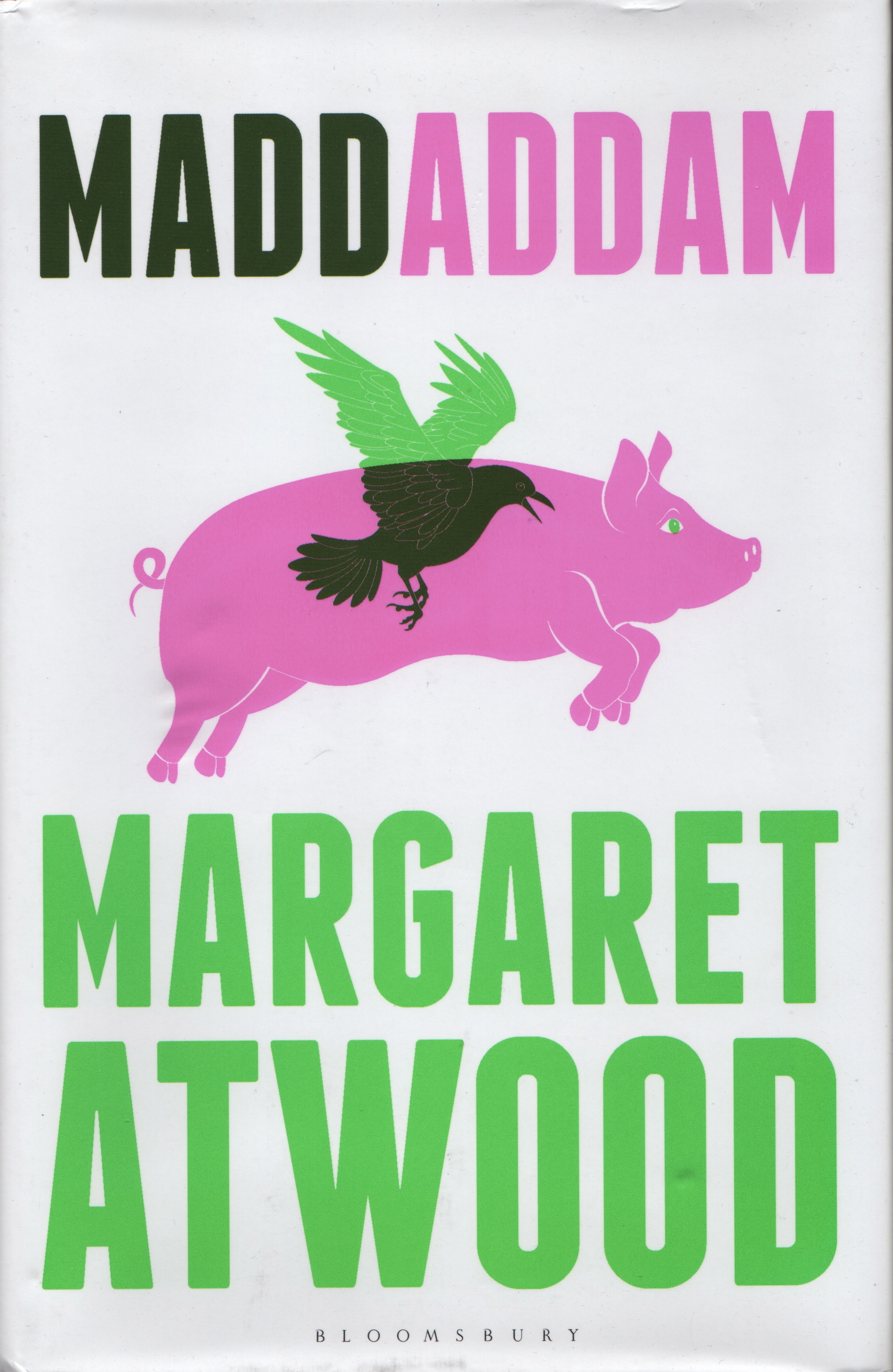 So, MaddAddam is the final volume in the eponymous trilogy by Margaret Atwood which began with Oryx & Crake and The Year of the Flood which I have reviewed separately here and here respectively. At the end of the previous volume the various threads of narrative came together and we are now moving forward into the future.
After the man-made plague a small group of humans have survived and we watch them come together and try to form a community and find a way to live in a world where supplies are dwindling, there uncertainty about just how many other people are still alive, and where they have to adapt to sharing the world with the Crakers, a genetically designed species of people who were designed to replace humanity which should have been wiped out. In amongst all this there are two threats: a few extraordinarily unpleasant men who seem to enjoy nothing other than inflicting pain and misery and, more interestingly, the pigoons, genetically modified intelligent carnivorous pigs who become really key to the survival of our little group in quite unexpected ways.
Although the novel is primarily focussed on establishing a new society (albeit a very localised one) there continue to be flashbacks to the past told through the eyes of Zeb who has become the partner of my favourite character Toby, and in telling her his life story illuminates us further on the background to the creation of the plague and the founding of God’s Gardeners, a sect which turns out to have been more than it seemed.
I enjoyed MaddAddam, was pleased to find out more about characters I had come to feel strongly about, but I’m not sure that it really comes to a conclusion, unless the conclusion is that no matter how well you think you have designed something (in this case the Crakers) you cannot plan for everything and once things are out in the world they will develop as they must. And it is very amusing in places.
 I’m glad I took the time to read the trilogy so close together as I feel that I might have got lost if I’d read them as they were published; I found them dense (in a good way), lots to think about and jeep track of. If you enjoy speculative fiction you should give these a try.
And I was thrilled to get my copy signed by the great lady herself; more of that in a future post.
 The Year of the Flood is the second book in Margaret Atwood’s MaddAddam trilogy. It takes us back to the events described in Oryx & Crake (my review of that is here) but where the first novel told the story of the events around the man-made plague which devastates the world from the inside through one character, Snowman, The Year of the Flood addresses the same events from the perspective of two women in the outside world.
Though it comes as no surprise that, as we work our way through the stories of Ren and Toby, we become aware of links and connections with Snowman’s tale, some more obvious than others.
Ren is an exotic dancer who finds herself trapped in quarantine in the club where she works. Toby has taken refuge in an abandoned health spa and watches and waits on the building’s roof garden. The book alternates between the stories of each woman, and within their individual tales between the present and the past. This helps us build up a picture of the society destroyed by the actions of Crake, and gives us some clues as to why he thought it all had to be wiped away. The segregation, casual violence and exploitation of technology is vividly described in the novel, and the voices of the two women are strong and affecting.
I became particularly fond of Toby as a character, especially her involvement with the sect known as God’s Gardeners and her habit of noting the sermons and saints days and rituals that they practised. And of course her tending of the bees. Inevitably she and Ren come together and the book ends at almost the same point as Oryx & Crake, bringing the two narrative strands together and setting us up for the final instalment.
I loved this book and read it very quickly; middle books often suffer (just like middle films) from being a bridge between the set-up and the denouement and being unresolved in themselves, but I didn’t feel that was the case here at all. Perhaps it was the female point of view, perhaps it was the greater understanding it provided of the world the story is set in, perhaps it was just that I loved Toby so much, but for me (and without pre-empting my review of the final novel) this was the strongest instalment in the trilogy and the one I can see myself going back to. Very enjoyable.
 I have been reading Margaret Atwood since I got a hold of Lady Oracle when I was 15 years old and was totally smitten; that was *gulp* 36 years ago, which is really hard to have to acknowledge, so let’s move swiftly on. I have always wanted to see her in person so was thrilled to get an opportunity to hear her speak about her newest novel, MaddAddam (more of that in another post). Then I realised that I hadn’t read the previous two volumes in what has become known as the MaddAddam trilogy, so I decided to put that right.
Oryx and Crake is set in the not terribly distant future and is seen through the perspective of Snowman who believes himself to be the only survivor of humankind after a man-made plague has wiped out all but the Crakers, a genetically engineered species of humanoid. The book alternates between the difficult present where Snowman struggles to survive, and his memories of the past where he was Jimmy, the best friend of the man who would become Crake and in love with the beautiful Oryx. Before the great catastrophe, the world (or at least the world that Jimmy knew) was split into the Pleeblands, where the majority of the ordinary population lived, and the various Compounds in which the elite lived and worked for corporations and were involved in experimentation in genetic engineering, producing strange hybrid animals which are now roaming free. Snowman is a sort of guardian to the Crakers, for whom the world was swept clean. Sort of.
I thought this was a wonderful piece of speculative fiction (Atwood doesn’t like this novel to be referred to as science fiction, which I’ll pick up on in a future post). Typically I found the build up to the dreadful events more interesting than Snowman’s current struggles and if I’m honest I found the Crakers a bit irritating at first, but it as it becomes clear that their designer had not been able to remove those human traits that he considered destructive (he was not a fan of speculative fiction) they grew on me, as did Jimmy/Snowman himself.
The ending of the book is inconclusive but I quite liked that, the uncertainty of what was going to happen next seemed to me to fit well with the tone of the novel, although I don’t believe at the time that Atwood had a trilogy planned, though se has said that she realised that readers would have questions which she aimed to respond to in the later books.
This had sufficient impact for me to start the sequel immediately, something that I hardly ever do (in fact I can’t think of the last time that happened). More of that anon.
 Every so often a book comes along that everyone seems to be reading and talking about all at once, and because I can be a bit perverse I tend to avoid them until the puff dies down a bit, then I dive in when no-one else is looking and often fall in love with them quietly in a corner. I did that most recently with Gone Girl (which I thought was great as you can see here) and was going to do the same this time round with Lauren Beukes’ The Shining Girls which only came out in April. But something drew me in, possibly the tagline; after all who can resist the idea of “the girl who wouldn’t die hunting the killer who shouldn’t exist”? Certainly not me.
So the book opens in Chicago in the 1920s where we meet Harper Curtis who I think its fair to say is not a nice man at all. He’s in pretty dire straits when we first come across him, beaten and hunted, but he finds himself in possession of a key to a very particular House one that allows him access to other times (and for that reason really deserves to be capitalised). Harper is a killer, hunting down the shining girls, young women of promise and vitality whom he taunts and murders rather brutally. But he meets his match in Kirby Mazrachi who astonishingly survives his horrendous attack and when the police cannot (understandably) find her would-be murderer begins to investigate and comes across evidence which points to a situation which cannot possibly be true. But of course is. And she goes after him.
The Shining Girls is absolutely brilliant, a fabulously clever idea and a wonderfully constructed book which twists and loops through time as we follow both Harper and Kirby. The structure of the novel is complex but never confusing though it must have required a phenomenal amount of organisation to keep the various stories straight over 80 years of events. The young women whom Harper kills are all proper characters; we learn quite a bit about each of them and that makes what happens to them so awful. Kirby is a wonderful character, trying to make sense of the terrible thing that was done to her but still flawed and damaged as you would expect. Harper is just a dreadful human being; it isn’t clear whether the House “makes” him do these awful things or whether he would have done something like this anyway, it’s just the spread of his attacks over time which keeps him hidden. But totally totally odious.
I really loved the mix of time-travel and serial killer and I appreciated that not all of the answers are handed to you as a reader. The situation is just as it is and I found that was good enough for me. Definitely a book worthy of re-reading.
 2312 is exactly the kind of sic-fi novel that I adore; lots and lots of hard science, detailed techie details and complex societies explained at length. I was absolutely in my element reading this as part of Carl’s sci-fi experience and its up there with Jack Glass as my favourite reads of the year so far.
So, those of you who know Kim Stanley Robinson will be aware that apart from the stuff I’ve mentioned above he is brilliant at world building and deeply concerned about what humans are doing the planet. All of those themes are on show here but expanded away from Earth to the other planets and moons of the solar system which humanity has colonised. We are many years into these developments, so Mars, Mercury and so on have been bio-engineered, have their own social structures in place and people have altered themselves in many different ways so gender is a complicated matter. As is the politics, which is the thrust of the story – terrorist attacks (or are they), alliances and rivalries at individual and planetary levels. The role of artificial intelligence is also a big issue – can we trust the technology used to smooth things along, can we really hide things from the implants in our heads and so on.
This is a terribly rambling description of the book and doesn’t really describe the plot terribly well. Against this messy background is basically a love story between Swan and Warham, the former from Mercury and the latter from Titan, physiologically very different but a couple who come together during the course of the story as they try to work ou what’s really going on. I really liked them both and found their relationship convincing and rather lovely.
One of the most interesting things about the book is the structure, which intersperses the main plot developments (which are often described in terms of the main relationships within each of those sections) with extracts from relevant documents and lists of, well, stuff. I love lists so not at all unhappy with this but I think these interjections do slow the pace of the story, and I occasionally got a tiny wee bit impatient.
Reading this through again I feel I haven’t really captured what the novel is about but that’s not surprising. When the Book God asked me what 2312 was about while I was reading it I simply couldn’t describe the story in any coherent way. All I know is that I had a ball reading it and wonder if there will be a sequel because if there is I will so be there!
Loved it.
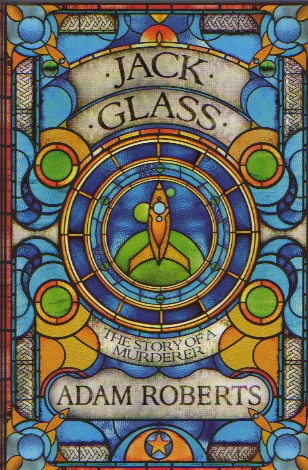 So, I asked and was pleased to receive Jack Glass as a Christmas present and it was always going to be my first proper read for 2013. I will admit that there were two big attractions for me: (1) the astonishingly lovely cover which you can see alongside and really caught my eye and (2) and the subtitle “the story of a murderer” which is intriguing for a sic-fi novel. It was also the first time I had read anything by Adam Roberts and it’s no spoiler to say that I’m going to be looking for more of his stuff.
The novel starts with a bit of scene setting by someone who is identifying themselves as a Doctor Watson figure and tells us what we need to know about what we are going to read, which includes the following:
A quantity of blood is spilled in this story, I’m sorry to say; and a good many people die; and there is some politics too. There is danger and fear. Accordingly I have told his tale in the form of a murder mystery; or to be more precise (and at all costs we must be precise) three, connected murder mysteries.
And so we are presented with a prison story, a regular murder whodunit and a classic locked-room mystery. In a properly sci-fi setting with lots of technical stuff which I always love. So this looked like it was going to be a real treat and I am very pleased to say that I wasn’t at all disappointed and read it in two sittings. All of the stories are equally fascinating but its worth noting that the first one, set on a prison asteroid where seven men have been sentenced for eleven years to mine the thing so that it can be turned into a luxury dwelling of the mini-planet style at the end of that period, so they have to cooperate to survive, is fairly brutal and grim and quite astonishing in its ending and the effects ripple into the rest of the book. That’s not to say that the other two stories are not as good, as they most certainly are, but they are more traditional and less gorily violent (well I thought so at least).
As always I don’t want to say too much about the plot because the fun is in discovering whats seems to be going on as things unfold, but Jack is a compelling character, much more complex than the set up might lead you to believe. And I developed a bit of a girly crush on Diana, one of the other key characters who is a rather privileged fifteen-about-to-turn-sixteen year old faced with some significant events. The world-building is also excellent but never force-fed so you begin to understand the political and other structures as the story unfolds rather than huge chunks of exposition.
 I really recommend this one, loved it, and it proved an excellent read for the 2013 Sci-fi Experience.
Couple of small things:
- the opening section identifies the murderer(s) but I totally forgot by the time I got to the last story particularly, so it was a bit of a revelation and I felt like a total idiot when I realised I should have known;
- the author’s drive for writing this was to bring together some of the conventions of Golden Age sci-fi and detective fiction (which I think he has achieved admirably); and
- a Champagne Supernova is a real thing that astrophysicists are pondering, named after the Oasis song (which is a favourite) and made me giggle
 Justin Cronin’s The Passage is another one of those books that has been on my TBR list for what seems like forever, though thinking back I remember exactly when and where I bought it. It was in January 2011 in the Waterstones at Ludgate Circus and I was with Silvery Dude who was kindly getting me a copy of Rivers of London for my birthday and I saw this and had to have it. I was suffering from a really nasty cold and ended up off work for a few days medicating myself with Stephen King.
And its taken me this long to get to it, but I was just in the mood for some pre-soon-to-be-post-apocalyptic horror; this definitely fits the bill.
So there’s this scientist who goes to South America to follow up on information about strange goings on which may lead to a cure for cancer or everlasting life or something of that sort and despite (or because of perhaps) the involvement of the military it all goes horribly wrong. We leap to some time later and death row inmates are being signed up by the guy I thought was going to be our hero, FBI agent Brad Wolgast, to take part in something which will basically mean they are erased from the record. And we have Amy Harper Bellafonte, a six-year old girl who will turn out to be something pretty special (again not a spoiler, you can get this from the back cover).
So much for the set up, and the book does start of as a conventional but well written and extremely creepy horribleness takes over the world and we are all doomed horror. Not giving anything away to say we’re talking vampires, Jim, but not as we know them.
Then something happens and we are plunged into the post-apocalyptic stuff I mentioned, with a whole bunch of other characters set in the future where the world is significantly changed and people are doing what they can to survive. Then it turns into a road trip slash quest novel as a band of intrepid souls go off for various and quite plausible reasons to find out just what the heck happened and is there, you know, anyone else out there.
I thought this was great, a real page turner. The end of the first section and the leap into the future I’ve described above was a bit of a surprise as I thought we would be with the same set of characters for this book at least (given that I think its part one of a projected trilogy). But I soon got used to that and came to love another set of characters which makes the last page a real WTF moment (I won’t say more than that but I read the last paragraph a couple of times to make sure I was really understanding what was going on).
I think this is a really well written story about characters I really came to care for and it has an internal logic to it which makes the world it describes work for me.
And I really, really want to know what happens next, so Santa has been asked to provide the sequel.
Definitely recommended.
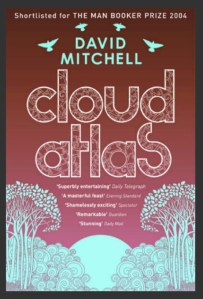 I know I say this a lot, but I really mean it this time: I feel as if I am the last person in the Universe (or the blogosphere at least) to get around to reading Cloud Atlas. I have seen it so many times stacked on tables in bookshops with its lovely coloured cover and I’ve wondered what it was all about but never thought to pick it up, even on a 3 for 2 deal when I’ve been scouring the bookshop looking for something to add. I’m still not entirely sure why I bought it for my Kindle app; I suspect it’s been to do with reading about the film adaptation and thinking that looked interesting and my tendency to want to read a book before I see the movie version.
I should also give a shout out to Silvery Dude who, when I mentioned it to him as a possible read, thought that I would enjoy the experience.
I have to say I’m really intrigued about the film, because I cannot for the life of me see how they are going to do it (or have done it as I think it may already be out in the US?). I can’t even adequately explain the novel to myself having read it, let alone visualise how the structure will translate to the big screen.
For the structure of the book is really important; there are six or seven stories all nested within each other, radiating forward into the future and then back into the past. It’s really disconcerting if you don’t know that, because when I got to the break in the first story I thought there was something wrong with the download (I know, what an eejit) but I persevered and realised what was happening. I’m not even going to try to explain the various stories told but they range over time and there are connections between them all, especially in relation to a comet shaped birthmark (as I remember – the curse of (a) waiting this long to write the post and (b) having it as an e-book is it isn’t always easy to refer back (haven’t yet got the hang of bookmarks and highlighting yet))
And apologies for the excessive use of parentheses here but it sort of fits the book somehow.
I thought it was a compelling read with some interesting things to say about identity and human relationships and all that sort of thing and I would recommend it to anyone else out there who has perhaps not read it yet.
Still haven’t got a clue how they’re going to do it justice on the screen but I’ll look forward to finding out.
 The Adoration of Jenna Fox is a bit of a milestone for me, as it’s the first book I read from start to finish using the Kindle app on my iPad. When the Book God and I went on holiday to Italy in September with my brother the Stanley Scot and his Good Lady we had to limit luggage and so we decided to leave physical books behind and rely on electronic means, and I have to say it was a huge success.
I read all of this in the hotel we stayed at in Spoleto.
This is a YA novel and tells the story of Jenna Fox, who has somehow survived a terrible accident and is rebuilding her life in a new community, and about her struggle to remember what happened and to deal with the oddities that surround her, because there is clearly something going on around her that she doesn’t understand, and she is somehow special.
I really enjoyed this one, the mix of teenage angst and science fiction worked well for me, and I found myself really liking Jenna (though wanting to give her a real shake on occasion). As with lot of YA fiction the writing is clear and direct and just the sort of thing for a holiday read – I finished it in a couple of sittings.
I believe that there is already a sequel and may get that on Kindle at a later stage, as I’d be interested to see where the author takes this given that (in my opinion anyway) the ending didn’t really leave much of an opening.


 Bride of the Book God