You are currently browsing the tag archive for the ‘Loved the cover’ tag.
 Well, I may not be reading very much at the moment but I am still buying books to add to the TBR pile (which by now constitutes most of my house….)
It was our wedding anniversary yesterday and on our way to see Thor (which will be reviewed here at some point in the next day or two) we had a small diversion to a well known chain bookshop “just to have a look”; the outcome of this “looking” was:
- Mr Chartwell by Rebecca Hunt – has had some good reviews and looks very interesting, plus I liked the cover
- Great House by Nicole Krauss – again some good reviews and shortlisted for the Orange Prize
- Harbour by John Avide Lindqvist – oooh, I’ve been waiting for this to come out in paperback for ages, what will he give us after Swedish vampires and Swedish zombies, I wonder?
Now I just have to start reading again…..
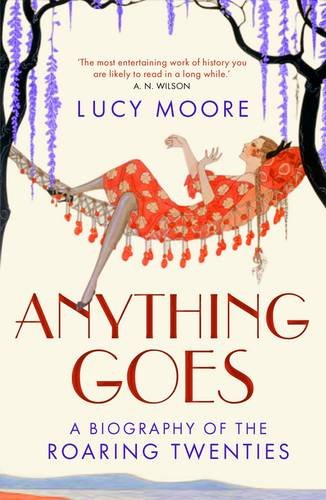 So I got this as a present (last Christmas or this year’s birthday, not entirely sure which) and it was on my wish list because of a fascinating series of programmes about the 1920s which was shown on BBC4; one of the programmes had an interview with the writer of Anything Goes, Lucy Moore.
This interest in the 1920s faded slightly until recently when, following a mixture of inter-war-Mitford-madness and watching the film Bright Young Things I decided to pull this off the TBR stack and give it a go. I hadn’t fully appreciated that this was a biography of the Roaring Twenties i.e. the American rather than the British experience, but that doesn’t matter because it was a thoroughly enjoyable read.
The author covers a wide range of topics and in most of the chapters, which are thematic rather than chronological, she picks key character(s) or event(s) which are emblematic of the topic she’s considering at that point. As a technique that worked very well for me, illuminating the general from the particular.
So for example we have:
- Prohibition through Al Capone;
- Flappers and women in Hollywood through Zelda Fitzgerald and Mary Pickford;
- Americans in Paris through Harry and Caresse Crosby
- Hollywood through Chaplin and a variety of scandals
- The New Yorker through Harold Ross, and so on.
It’s such an interesting and well-written book with lots of asides and nuggets and anecdotes that I just wanted to go off and read more on each of the topics. And it made me glad in many respects that I wasn’t around in the 1920s, although if I had been I would probably have been working in a thread mill in my home town like my great-aunts did rather than swilling illegal cocktails.
Cocktails being very important now as then because as they say
you cannot make your shimmy shake on tea.
A mission statement that I can certainly get behind!
Despite a TBR list that is in danger of constituting a library in its own right I haven’t stopped buying books, although I’m about to enter the pre-Christmas moratorium where the Book God and I swap our wish lists and sit on our hands until Santa has been.
And in advance of that looming date I really have been unbelievably bad on the purchasing front:
- The Winter Ghosts by Kate Mosse – “It’s 1928. Freddie Watson is still giving for his brother, lost in the Great War. Driving through the foothills of the French Pyrenees, his car spins off the road in a snowstorm. Freddie takes refuge in an isolated village and there…..” I have her two previous books but haven’t read them yet, and this looks like it might be fun (and is far less chunky than the others)
- Nancy Mitford: The Biography by Harold Acton – “This intimate biography draws a witty, real-life portrait of Nancy, based on the letters she intended to use for her autobiography…….” Sparkling and irresistible, apparently, and totally part of my current obsession with all things Mitford.
- Changeless and Blameless by Gail Carriger – novels of vampires, werewolves, dirigibles and afternoon tea…… Again I have the first one in this series about Alexia Tarabotti but haven’t read it, so this is a bit of a chance, I suppose (what if I hate it??).
- Blue Eyed Boy by Joanne Harris – “Once there was a widow with three sons, and their names were Black, Brown and Blue. Black was the eldest; moody and aggressive. Brown was the middle child; timid and dull. But Blue was his mother’s favourite. And he was a murderer.” Couldn’t resist it.
- Sourland by Joyce Carol Oates – it’s a new book of short stories by the great JCO so of course I was going to get it.
- Dreadnought by Cherie Priest – the sequel to Boneshaker which I got for Christmas (I think, may have been my birthday, too close to call) and still haven’t read. But I feel that I’m going to enjoy it when I get there.
- Plain Kate by Erin Bow – I saw this on another blog but can’t remember whose (sorry); loved the cover and bought on impulse when in Forbidden Planet with Silvery Dude just after Hallowe’en (I bought The Unwritten 2 at the same time)
- Decca edited by Peter Y Sussman – see Nancy above. I’m sure I’ll grow out of this at some point….
- Coco Chanel by Justine Picardie – there was absolutely no way that once I’d got my hands on a copy I would be able to walk out of the bookshop without it. It’s important to recognise one’s limitations….
- Tamara de Lempicka by Laura Claridge – “Born in 1899 to Russian aristocrats, Tamara de Lempicka escaped the Bolsheviks by exchanging her body for freedom, dramatically beginning a sexual career that included most of the influential men and women she painted.” Irresistible.
 Laurie Colwin’s Family Happiness is the second book in my planned summer of re-reading.
First read in November 1985 (which is incredibly scary) this is my fourth time of reading it and the second of the two copies I have. It’s another firm favourite and has been a great pleasure to revisit. Why so good? Well….
Polly Demarest is a happily married mother of two from what in anyone’s book would be a very privileged and wealthy Jewish family in New York. Her father is a lawyer, as is one of her brothers and her husband. She is the only daughter and there are expectations on her to be sensible, practical, reliable and basically the rock of her family. But Polly has something missing from her life that she didn’t realise until she met, fell in love and embarked on a relationship with an artist, Lincoln Bennett. If the novel is about anything then it’s Polly’s self-growth.
And writing that down I wonder why I ever picked this up as superficially it’s not something that would attract me (although I suppose I do have bit of a thing for family sagas). But pick it up I did and I fell in love with it, because:
- it’s just so beautifully written – there is a real lightness of touch which makes it a joy to read
- I adore Polly, I think she’s a wonderfully complex character, trying to be a good person and slowly realising that her family just takes advantage of her without really seeing her as an individual
- her relationships with her husband, Henry, and with Lincoln are believable and complicated; she clearly loves them both but in different ways
- her family are gloriously eccentric but not monsters – I enjoyed Paul and Beate particularly (but would definitely not want to be related to them)
- it shows that nice people can get in a pickle too
I don’t normally quote from the books I read, especially novels, but there are a couple of passages that I love:
Family life is deflective: it gives everybody something to do. It absorbs sadness and sops up loneliness. It provides work, company, and entertainment. It makes tasks for idle hands and allows an anxious spirit to hide in its capacious bosom.
and
It was surely not right to feel this happy, but it was also undeniable. the air outside was smoky with spring rain. The street was gray. The warehouses across the street were wet. Polly put down her cup. The pure feelings one had in adult life were complicated and mitigated, and they were dearly paid for, but worth everything they cost.
This was the first Laurie Colwin novel that I read, and I quickly sought out the others as well as her short story collections and the two books she wrote on cooking. Sadly she died in 1992 so there are no new works to discover, but what she did produce in her career is in my mind absolutely wonderful, and worth seeking out.
 Jane Smiley’s Duplicate Keys is part of my summer of re-visiting previous reads.
I first picked this up and read it in March 1997 (astonishingly) and this is my third time of reading. I absolutely love this novel with a passion and will be hard-pushed to explain why but am going to have a pretty good stab at it.
Firs a quick trot through the basic story. Alice is part of a group who moved to New York in the late 1960s/early 1970s following their friends Craig and Denny hoping to make it in the music business and although things hadn’t turned out as planned they have settled there. We are now in the early 1980s and Alice visits the apartment of her friend Susan (away on a trip) to water the plants and make sure all is OK, and finds the two musicians shot dead. The novel tells the story of the impact of the murder on the group and, of course, is all about finding who the killer is.
So much so traditional thriller, but this really clicked with me:
- I absolutely fell in love with the cover (I can be funny that way)
- I really, really like Alice – she is ordinary but actually rather brave in her own way (I’ve tried to think over the years who might best play her in a movie version of this but can’t think of anyone) – she is one of my absolutely favourite female characters
- the initial impact of the murder on Alice is seen at a slight distance – we aren’t with her when she finds the bodies of her two friends but pick the story up as she talks to the investigating detective, and I liked that detachment at the start
- the novel says a lot about the mindset of a certain 60’s type – trusting people who seemed like themselves to the extent of giving out keys to their apartment – to the point that Susan has trouble telling the police who might have been able to get in
This works really well as a thriller but is also a fascinating study of friendship and how it changes over time. The 80’s setting seems slightly historical now but of course this was a contemporary thriller and I wished I’d read it when it came out (it was published in 1984, the year I got married the first time).
This really is one of my favourite books.
 It’s actually going to be quite difficult to review Anthropology, a book of 101 short stories, each just a page long and all about love in its various aspects and all narrated in the first person.
The stories are arranged in alphabetical order, so we move from Anthropology (where he explains how he lost his anthropologist girlfriend to the culture she was studying) to Words (about what keeps a marriage together). Some of them are very funny, some of them rather sad, but they are all little gems.
This was another read-a-thon book, and again I read it in one sitting. Looking back I wonder if that was entirely wise and whether some of the stories lost their impact because I read the book like a novel. It made me wonder what the best way to read short stories actually is.
I remember listening to Simon Mayo’s book review podcast ages and ages ago when he was interviewing (I think) Anne Enright and the subject of how to read stories came up. The two approaches discussed were reading one, savouring it and closing the book, as opposed to doing what I’ve just done. Someone compared it to how you might eat a box of chocolates, and I suppose I just have to confess that I handle both the same way – once that box is opened I very rarely have the self-control to just have one chocolate….
I’m going to look for some more Dan Rhodes as I really admired his style, and as a bonus they all seem (like this one) to have a fabulous David Roberts cover illustration.
 This is without doubt a beautifully written book. I finished it a while ago and have been mulling it over ever since, wondering what I could actually say about it without diminishing what was a truly lovely reading experience.
The Alchemy of Stone tells the story of Mattie, an automaton who has become emancipated (up to a point) and who has trained as an alchemist. It’s a dysfunctional society in which she lives, of Alchemists versus Mechanics, each with their own views on how the city should be run, and an underclass which appears to be rising up to overthrow the existing order.
Mattie treads a fine line between maintaining her independence and the need to find a way to get the thing she needs from the mechanic who made her – Loharri, who, though ostensibly letting her go, still holds the key which winds her heart.
I won’t say any more about the story itself, but it’s worth dwelling on the themes which develop within it.
This is a book about identity, what it means to be free, what it means perhaps to be a person. It’s also about class and oppression, about those who claim to know what’s best, about where women fit in to society, about the nature of difference, and about love. The quote on the cover of my edition says it better than I ever could:
A gorgeous meditation on what it means not to be human
And it has gargoyles.
And a man who absorbs the souls of the dead, who can still speak through him.
It’s steampunk at its best, with a main character of real substance, and an ending that I found moving, heart-breaking but also hopeful.
Seriously recommended. And if you’re not sure just look at Carl’s review here. Which has the wonderful cover that originally drew me to finding out about this book, though I’ve come to love the one on mine more.
I thought this was just lovely and am so glad that I was finally able to get my hands on a copy.
 It is a month for favourites – Charles Stross is rapidly becoming one of the authors I leap upon (metaphorically speaking of course) as soon as something new comes out (we have lots of his stuff in the house but I am trying not to gorge myself as he is far too good to be wasted in that way) and Lee Gibbons is becoming one of my favourite sci-fi cover artists.
So Saturn’s Children is yet more space opera with a strong female lead and an extremely interesting premise, so there was no way that I was going to dislike this novel, which is a really good thriller as well as a sci-fi tale.
Freya Nakamachi-47 is a cloned synthetic person, designed to be a concubine for humans, but activated long after the human race has totally died out. The robots, for want of a better word, have built their own society which unfortunately has taken on many of the worst aspects of how humans behaved – rigidly hierarchical with everything from aristocrats to slaves, overly legalistic and potentially very harsh.
Freya gets into trouble on Venus and needs to get off-planet very quickly; to do so she takes on a job as a courier, taking contraband from Mercury to Mars. Of course, this all goes a bit pear-shaped as you might expect, and Freya’s troubles multiply as she tries to find out what’s going on, and in particular who wants to kill her.
I really enjoyed this – it’s very funny in places, the thriller bits are thrilling, Freya is a likeable character in difficult circumstances and the story had a nice pay-off as far as I was concerned. Some of the funniest parts relate to the horrors of interplanetary travel – basically not a lot of fun, takes ages, is expensive and passengers often don’t survive. The variety of robot entities, some more humanoid than others, really add to the offbeat alienness of a non-human society. And there are a number of really cool spaceships.
This is another read for the 42 Challenge, and the Sc-fi experience 2010.
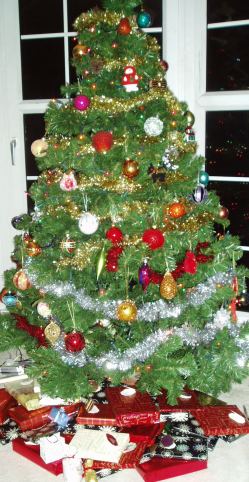 So Christmas 2009 – not quite what I had expected. Stinking cold from 19 December onwards meant that I had little or no voice for significant parts of the holiday season (cheers all round from family, friends and co-workers as you might imagine) and I was also working most of the time (including part of Christmas Eve though I did give in to my cold around lunchtime). Christmas Day itself – opened presents, fell asleep for most of the day, dinner wonderful but late. That’s the advantage of just the two of us on the day, we can play it by ear and only have ourselves to please.
Main highlights so far:
- The Gruffalo on Christmas Day was the surprising TV highlight for me – really sweet and very nicely done
- Dr Who – well, a bit disappointing but I’m reserving my judgement until I’ve seen part two as this was so obviously a first-part-setting-up-the-big-denoument episode; but David Tennant was as lovely as ever, especially when he looked like he was going to cry….
- Sherlock Holmes – the big Christmas movie outing – great fun, will review over on Screen God shortly
But what of the presents? Well, bookwise I did quite well:
- Vintage Handbags by Marnie Fogg – almost obscene in its wonderfulness, a big glossy history of handbags from the 1920s, I am going to be dipping into this one a lot
- The Crimson Rooms by Katharine McMahon – asked for this simply because I loved the cover
- Under the Dome by Stephen King – well, couldn’t resist asking for this one then completely forgot about it; when given the package to unwrap I thought “don’t remember asking for anything this big” – should have known!
- Martyrs and Murderers: the Guise Family and the Making of Europe by Stuart Carroll – sixteenth century, what can I say?
- Anne of Cleves: Henry VIII’s Discarded bride by Elizabeth Norton – ditto
- The Great Silence 1918-1920 by Juliet Nicolson – the period just after the end of WWI and its impact on the social fabric, looks fascinating
- Strange Days Indeed by Francis Wheen – a history of the 1970s which I am really looking forward to reading, given that it covers the decade when I was a teenager
- Alice in Wonderland, illustrated by Rodney Matthews – when I was a student I was much more of a Roger Dean fan but I’ve come to appreciate Matthews more over the years and this is a beautiful volume
- The Rime of the Ancient Mariner, illustrated by Hunt Emerson – a graphic novel version of one of my favourite poems
- Amphigorey: fifteen books by Edward Gorey – huge Gorey fan, ’nuff said
- Angel With Two Faces by Nicola Upson – sequel to her earlier Josephine Tey crime story
- Tamsin by Peter S Beagle – picked up from other blogs
- The Looking Glass Wars by Frank Beddor – ditto
- Dark Harvest by Norman Partridge – just loved the cover
- Lovecraft Unbound, edited by Ellen Datlow – Joyce Carol Oates does Lovecraft, worth it for that alone
- Boneshaker by Cherie Priest – steampunk, really been looking forward to this one
- Vanessa and Virginia by Susan Sellars – and a bit of Bloomsbury to round things off
So that lot should keep me busy for a while……
 So, more Gothic creepiness from the wonderful Mr Priestley in Tales of Terror from the Tunnel’s Mouth, and a good read for RIP IV.
Robert Harper is returning to school, desperate to get away from his stepmother with whom he has been spending his time while his father is fighting the Boers in South Africa. Robert is travelling by train, and we first meet him on the platform with said stepmother, an emotional woman who has a premonition that something will happen to Robert, involving a tunnel and a kiss. Robert shakes her off, gets on the train and finds himself in a carriage which slowly fills up with a number of gentlemen also travelling to London.
Robert dozes off, and when he wakes up he finds that all the other passengers are asleep except for a young woman with red hair, dressed completely in white, who is sitting opposite him. The train has stopped at the mouth of a railway tunnel, and to while away the time the mysterious woman tells Robert a number of sinister stories, while he struggles to keep awake…..
Another really enjoyable collection, with a little mystery at its heart – who is the woman in white? What (if anything) does she want with young Robert? Why is everyone else solidly asleep?
Favourites in this collection are:
- The Glasshouse – you really shouldn’t get too close to some of those plants….
- The Crotach Stone – beware the auld folk….
- Sister Veronica – art appreciation and nuns…
And the illustrations by David Roberts are equally creepy.
This is my second read for RIP IV


 Bride of the Book God