
You are currently browsing the tag archive for the ‘Horror’ tag.
 So way back at the end of August I posted my proposed reading list for Carl’s annual RIP challenge. I’m a wee bit hesitant about challenges these days as I’ve committed so many times in the past and then, because of reading slumps or pressures of work or domestic stuff, singularly failed to meet my own goals. But I’ve been on a real reading high this year and so was more optimistic than usual and that optimism was well-founded because I managed to read nine books and watch two scary movies!
The final tally is (in order read):
- The Island of Dr Moreau by HG Wells
- Let the Old Dreams Die by John Ajvide Lindqvist
- Savage Magic by Lloyd Shepherd
- The Cold Calling by Phil Rickman
- The Jennifer Morgue by Charles Stross
- The Book of Whispering Spirits by Jeff Ferrell
- Goth Girl and the Ghost of a Mouse by Chris Riddell
- Murder by Sarah Pinborough
- Goth Girl and the Fete Worse Than Death by Chris Riddell (the only one not on my original list)
I’m very pleased with that as I had only committed to four. This success is mostly because I was on holiday with lots of reading time, clearly the best way to approach this sort of thing 🙂
For Peril on the Screen I managed to watch Triangle and Event Horizon.
Links to reviews are provided where they’ve been published; not all are on the blog(s) yet, but they will be added over the next couple of days and I’ll update.
How did you guys all do?
 What’s it all about?
The Jennifer Morgue is the second in Charles Stross’s Laundry Files series, where espionage, the joy of the civil service and Cthulhu-adjacent occult matters all meet. In this case our hero Bob Howard is tasked with going into the field (the Caribbean, what a shame) to deal with a demon hell-bent in taking over the world through a suitably megalomaniac billionaire, and to do so is paired with a rather lovely partner who is not all she seems (OK, she’s an assassin under a glamour and possessed by a sex-vampire, but nobody’s perfect)
Why did I want thread it?
I love the Laundry Files and re-read the first volume (The Atrocity Archives, reviewed here) earlier this year. I am planning to work my way through the whole series.
What did I think of it?
I must admit I wasn’t sure what to make of this at first because it seemed very much a parody of the classic James Bond movies – location, gadgets, bad guy intent on sharing his details plans with the hero rather than just killing him, gorgeous good girl sidekick, gorgeous bad girl sidekick, super villain lair and so on – which all seemed a bit weird until it becomes clear that the James Bond thing is actually the whole point – it’s the occult construction that the baddies are using to control the whole thing and prevent themselves from being stopped. Though of course it doesn’t work out that way…
As always the fun here is in the combination of occult weirdness with classic civil service bureaucracy and infighting which is oh so recognisable to anyone who has ever worked in that world, though normally you’re not likely to get possessed with something tentacular. Not normally.
This was very enjoyable and raced along. It is also very funny in places and for anyone of my age who grew up with Dr No and Blofeld the Bond references are particularly enjoyable, right down to the white cat. And the nasties are very nasty indeed. There’s also a nice little additional story as a bonus.
Loved it, and looking forward to reading the next one.
This was my fifth read for RIP IX.
 What’s it all about?
Tried to pull together a synopsis of the plot for this novel but can’t do much better than the blurb:
Life isn’t easy for Detective Inspector Bobby Maiden. Death is even harder. When Maiden is revived in hospital after dying in a hit and run incident, his memories are not the familiar ones of bright lights and angelic music, only of a cold, harsh place he has no wish to revisit…ever. But his experience means that Bobby Maiden may be the only person who can reach The Green Man, a serial murderer the police don’t even know exists…a predator who returns to stone circles, burial mounds and ancient churches in the belief that he is defending Britain’s sacred heritage.
There is also an additional plot involving an American journalist, Grayle Underhill, who specialises in New Age matters and has arrived on the Welsh borders to find out what has happened to her sister who has gone missing after becoming involved in research around Stone Age mysteries.
And of course the two stories will inevitably come together.
Why did I want to read it?
I have read a few of Rickman’s early horror stories, and have most of his Merrily Watkins books though I’m working through those extraordinarily slowly. I hadn’t come across this one before until it appeared on Kindle, largely because it was originally written under a the pseudonym Will Kingdom. It sounded right up my street.
What did I think of it?
Gosh this was grim, but I have often found that with Rickman’s books even as (or perhaps because) he has moved away from pure horror into what the “About the Author” note calls “realistic crime with a subtle element of the paranormal.”
I personally consider this to be a mainly a horror novel; yes there’s a serial killer with a weird fixation but the supernatural element is so strong and certain scenes and events are so nasty (in a non-pejorative sense) that it gave me the creeps as only the best horror can; quite disturbing. As I’ve often found with his work the darkness of tone means I tend to read them over a fairly lengthy period of time in manageable chunks, and this was no exception though it’s fair to say that the experience is always rewarding as the novels are so well written, and in this case about two-thirds of the way into the book something clicked and I did another marathon staying up into the wee small hours to finish it.
So a strong story with flawed but believable characters and a very interesting serial killer whose identity I sort of guessed but not that far in advance of the protagonists so can’t claim much there. I will pick up others in this series and am also looking forward to dipping my toe into his series about John Dee, one of my favourite Elizabethans.
This was my fourth read for RIP IX and means I have met Peril the First!
 What’s it all about?
Savage Magic is the third in Lloyd Shepherd’s series about London’s River Police which started with The English Monster (which I reviewed here) and continued with The Poisoned Island which was my first read of this year, and to (for?) which this novel is something of a sequel, as the starting point for several of the characters is a direct result of the events of the previous novel. So although you don’t need to have read that first, it will all make a bit more sense if you have.
Unofficial plug over.
But what of the plot? Well….
It’s 1814 and London’s Covent Garden is at the centre of a dark trade, enticing rich and poor alike with a cocktail of gin and beer and sex. In the surrounding parishes a group of aristocratic young men are found murdered, all of them wearing the mask of a satyr, all of them behind locked doors with no sign of entry.
And if that wasn’t enough, there are also accusations of witchcraft in the countryside outside London which need to be looked into ….
Why did I want to read it?
I am a great fan of this series and had pre-ordered this as soon as I knew it was coming out. It’s a period of London history that I don’t know very much about and I have become fond of the main characters, particularly Abigail Horton, the wife of our main protagonist, so picking this up was a no-brainer for me.
What did I think of it?
As I’ve already said I enjoy this series very much but I think this is the best so far, which is interesting given that at least one of the main characters from previous volumes (Harrington) is offstage through illness for most of the narrative and the others (Abigail, her husband Charles and Aaron Graham) are apart for most of the novel for very good and important-to-the-plot reasons. In fact I became very anxious indeed about Abigail’s situation…..
The other interesting thing is that very little of the story has anything to do with the Thames at all, though convict transport to Australia and return to England do feature. What we do have is a thoroughly absorbing story which touches on the treatment of the insane (hint – it isn’t good, especially for female patients), the sex trade and in particular the debauchery of the wealthy (which seems in this case to have very few if any limits) and witchcraft and superstition, alive and well in rural parts even post-Enlightenment. I do enjoy a good-locked room mystery, and I also like to see how the various plot strands come together as they inevitably do. Very ingeniously done in this case, with a whiff of the not entirely natural which has been a theme of the series.
It’s also great fun to read about an area that I know pretty well given that when I’m working in London I’m based on Kingsway, just round the corner from Graham’s home in Great Queen Street and a stone’s throw away from Covent Garden.
The reading experience was an unusual one for me in that I started the novel some time ago and then a combination of increased workload before holiday (never a good time to read anything that requires attention in my experience) and the previously mentioned anxiety about what the author was going to put Abigail through meant that it languished on the TBR pile until I found myself in a hotel in the south-west of Scotland where I could give it the attention it deserved, and I read the last third in a single sitting late into the night. And very satisfying it was too.
If you haven’t given this series a try then you really should, whether it’s for the historical setting, the supernatural stuff or a good novel of detection. I’m really looking forward to seeing what comes next.
This was my third read for RIP IX. It is also the book that got me to my target of 52 books in 52 weeks, so everything I read after that is a bonus!
 Let the Old Dreams Die is a book of horror short stories by the Swedish author John Ajvide Lindqvist, first published in 2006 but only relatively recently available in an English language translation. I was very keen to read some of his shorter work having been very impressed by the three of his four novels that I’ve read so far:
- Let the Right One In – Swedish vampires, spawned two films (only one of which I’ve seen (hint – it was brilliant) though I have the other one in my possession
- Handling the Undead – Swedish zombies
- Harbour – Swedish watery strangeness
I really enjoyed this collection which I read over several days while on holiday, staying in a former stately home in Cumbria. I like Lindqvist’s take on horror, which doesn’t ignore gory unpleasantness (as anyone who knows what happens at the end of Let the Right One In will confirm) but is overwhelmingly, to my mind at any rate, one of creepiness tinged with melancholy, which means they aren’t the sort of stories you can binge on. As an aside, I once heard an author being interviewed on the radio (I think it was Anne Enright but I’m not sure) who said something along the lines that people tend to approach anthologies the way they do a box of chocolates – they either eat them singly over time and savour each one, or they devour the lot in one go – I have done both in my time. This is definitely a one sweetie at a time thing.
I’m not going to pick out any individual stories to mention (except perhaps Village on the Hill which led me to consider drains more carefully than I had before) but will say that for many readers the two titles of most interest will be the title story which is sort of but not quite a sequel to Let the Right One In (Lindqvist himself says in his afterword that it deals with a problem of interpretation that he hadn’t identified until he saw the movie version) and The Final Processing, the longest story in the collection, which is basically a sequel to Handling the Undead. There is also Eternal/Love where I think you can see Lindqvist exploring some of the themes that pop up in Harbour.
I really enjoyed this selection; it was a perfect autumn holiday read and it has made me want to pick up the most recent novel, Little Star. Recommended.
This was my second read for RIP IX.
 What’s it all about?
Edward Prendick survives a shipwreck and is picked up by another ship transporting a strange cargo under the direction of the disreputable Montgomery to a mysterious island in the tropics, home to Dr Moreau and his laboratory. Prendick finds out that Moreau is experimenting on animals, continuing work he started back in England but which appalled those in the know so much that he was forced to leave if he wished to continue his research. The callous disregard he has for the subjects of his experiments and the torture he puts them through does not end well, but what will it mean for Prendick?
Why did I want to read it?
The Island of Dr Moreau is one of those classics that you know so much about you think that you’ve actually read it and then of course you realise that you haven’t, and I thought it was about high time that I did. As you can see from the cover image from the edition I read I’ve had a copy of this since the release of the ill-fated and not terribly well-received 1996 movie version.
That’s how long things can moulder on Mount TBR round these parts.
What did I think of it?
I’m not sure it’s what I expected really, based on my only other Wells reading experience which is War of the Worlds, an exciting and pacy read. I thought this would be similar but it’s clearly trying to make more of a point in terms of its message on the price of scientific enquiry and the role of vivisection which has always been a contentious issue. Moreau himself has no redeeming features whatsoever and even Prendick is at times an ambivalent figure; he doesn’t seem to have a problem with the principles being applied, it’s Moreau’s methodology he takes issue with. The beasts themselves are for the most part not well developed and the social satire elements were lost on me.
I’m glad I read it as it is a classic which has influenced other works across a number of media; the song No Spill Blood by Oingo Boingo has just popped into my head and even my late lamented dentist used to refer to his surgery as the House of Pain. So many of the references are embedded in popular culture but I must admit that as a novel it left me entirely cold.
This was my first read for RIP IX.
 What’s it all about?
The Atrocity Archives is all about The Laundry, a secret part of the British security services which deals with the supernatural and the occult and unmentionable things in other dimensions and that sort of stuff. It is most particularly the story of Bob Howard and how he moves from being the tech guy (albeit the tech guy with some very particular knowledge and skills) to an operative in the field. Other than that I shall say nothing about the events that transpire in the two connected stories that make up the novel.
Why did I want to read it?
This is actually a re-read, picked up again because I bought the most recent Laundry Files novel by Charles Stross (The Rhesus Chart) and realised that it would be a good thing to read the lot in sequence and then appalled myself by realising I only had the first one so decided to start from the top and ease myself back into the Laundry world.
What did I think of it?
Re-reads are often a bit dangerous especially after some time has passed because what you may have loved way back then you may not still love now. However, I was really pleased that I found this equally as enjoyable as the first time I read it and it sets me up nicely for the rest of the sequence. Bob is a very engaging character and his origin story (for it kind of is that thing) is cleverer than most because he’s already in the secret organisation, so knows loads of stuff, it’s just the change in his status because of the particular case he gets involved in that by necessity leads him into learning loads of additional cool stuff; and he is good at what he does without being totally smug.
I particularly love this because having been a civil servant for *gulp* 28 years – I was very, very young when I started 🙂 – I recognise the bureaucracy and the obsession with the small things at the risk of missing the bigger picture and the office politics and petty rivalries and the jockeying for position which made this all so believable. Well, recognisable when you put aside the liberal use of the adjective squamous, the zombie doorman, the deployment of Hands of Glory and the general Lovecraftian-ness of it all.
Though now I come to think of it…..
The staff disciplinary measures are a bit extreme!
Great fun and looking forward to working my way steadily through the remaining four novels and three (I think) short stories.
 What’s it all about?
The Girl With All The Gifts is the story of Melanie, about 10 years old and clearly very bright indeed. She also happens to be a zombie, something we learn very early on in the story though Melanie herself doesn’t come to realise this for quite some time. She attends school on an army base with a number of other children just like her in that although they have the drive to eat human flesh like the other “hungries” who have apparently overrun the world, they are also high functioning, intelligent, able to learn and therefore of great interest to the authorities. For the reason they are being held on this base is to be tested (by being taught like normal children would) and experimented on (in rather unpleasant ways) to find out exactly why they are so different and whether this could lead to a cure.
And then it all goes a bit wrong….
Why did I want to read this?
I think I’ve said before that I tend to be more of a vampire than zombie girl but I’ve had the good fortune to read a couple of very good zombie stories over the past few years, and this one came highly recommended. The idea of intelligent zombies who can (at least in Melanie’s case) come to understand what they are and up to a point exercise some level of self-control sounded fascinating, and I really wanted to give this a go to see if it lived up to expectations.
What did I think of it?
Oh, I had all the feelings about this book!
This is an absolutely brilliant novel and I read it in a couple of sittings, desperate to find out what would happen to Melanie. The great strength of the novel is the characterisation, and not just that of Melanie whose side I was definitely on all the way through but the adults that surround her especially once things move outside the base itself. The most sympathetic is Miss Justineau, Melanie’s favourite teacher who has come to think of her as a “normal” child and has introduced her to the Greek myths including the story of Pandora (who was the original “girl with all the gifts”) and believes that her life is worth preserving despite the risks.
But we also have Sgt Parks who over time comes to respect Melanie (in his own way), Pte Gallagher who has known nothing other than a world full of zombies, and Dr Caldwell, the female scientist so obsessed with understanding how the infection that caused zombies spread that she is unable (or refuses) to see the children as people and treats them with appalling cold-bloodedness.
I’m not going to say anything else about the plot because it needs to be experienced first hand though I would agree with other reviews that there isn’t a huge amount that is new here, but I came to feel so strongly about Melanie that none of that mattered. I could see where it might end up and was mostly right but that’s not really the point, and I found the end of the story very satisfying.
I was really pleased that this turned out to be such a good read given that I persuaded Silvery Dude to buy a copy to take on holiday with him. I think he’s finished it but he hasn’t told me what he thinks of it – I’m assuming positive response as we had an exchange of e-mails casting the movie version.
I loved this and can’t recommend it highly enough.
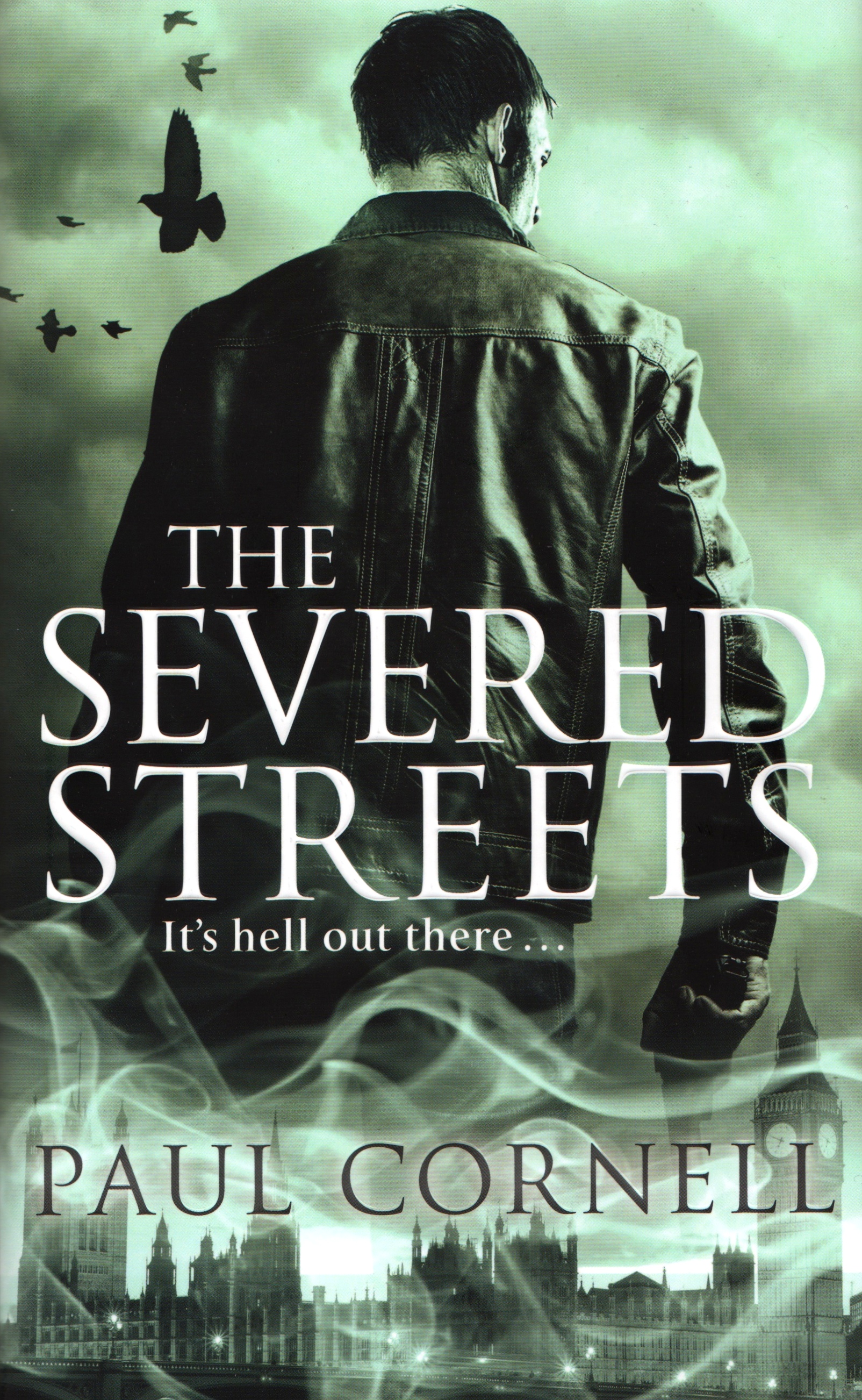 What’s the book about?
So, The Severed Streets is a sequel to London Falling which I read and enjoyed last year (you can find my thoughts about it here), though it’s a sequel in the sense of using the same characters and advancing their story arc with a standalone story.
It’s London, it’s summer and there are protests and riots with masked mobs blocking the streets and causing chaos. An MP is being driven in his official car when he is surrounded by one of these mobs and as a result is brutally murdered. But there is something odd; how did the killer get in (and out of ) the car without being spotted. And is what the driver saw really believable?
Enter Quill and his team who are still feeling their way around their new ability of second sight, and who are clear that something out of this world is involved in the death. And the others that follow. So they go into the underground community to find out what they can alongside good old-fashioned policing methods.
Why did I want to read it?
I really enjoy the whole urban fantasy genre (which I think this fits into but I’m sure someone will correct me if I’m wrong) and this series sits nicely alongside Fowler and Aaronovitch, and regular readers will know how much I love them. I really wanted to see how the team would develop and deal with the personal issues arising from the first book.
What did I think?
I read the final two-thirds of the novel during one of my many recent bouts of insomnia and it is meant as a real compliment when I say that I was so engrossed I actually forgot I was tired. I liked the way the characters developed, still the people we met in the first book but obviously changed by their experiences and trying to find a way to use their new abilities without any help or guidance. I though the story itself was very enjoyable and timely given recent events on which I won’t elaborate as I don’t want to get into the plot too much.
I particularly enjoyed the Neil Gaiman cameo; in other hands it might not have worked but he is properly integrated into the story (a bit more than I expected actually and in a very interesting and unexpected way). I liked the resolution and the introduction of new elements and characters which I hope will continue into future volumes. Quill is a great protagonist and it’s really nice to see a detective with what appears to be a happy home life.
New readers could start here but I would recommend reading them in order. I really enjoyed this and I’m looking forward to the next one.
 What’s it all about?
Black Thursday. Four passenger planes fall out of the sky in four different locations for apparently no reason. Three children from separate flights have miraculously survived . There is also a mysterious message left by a dying American woman. What does it all mean? Who are The Three and is there a purpose behind their survival? And how will the world react?
Why did I want to read it?
I didn’t know anything about this book until (I think) I saw a tweet from Lauren Beukes (author of The Shining Girls which I adored and am therefore pre-disposed to listen to her opinions). I then saw a couple of reviews which suggested that this might be My Sort of Thing.
What did I think about it?
This was great stuff, a nicely creepy conspiracy thriller (bordering on horror), written at real pace and a proper page turner. I like the structure very much, it reminded me a bit of Carrie though with less real-time action and (obviously) more of the story being told through extracts from books and interviews and so on and consequently with several POVs, though the main character (if there is one) is Elspeth, the journalist who wrote a sensational book about The Three and which, along with the message left by Pamela May Donald as she lay dying, gives impetus to a range of conspiracy nuts including a pastor who uses suspicions about the children to set up his own church. Growing paranoia leads to the search for a fourth child survivor and it all ends up in various forms of violence.
I don’t want to go into the plot too much because half the fun is working out where it’s all going; there are lots of hints throughout the story of something bigger and there is a sort of resolution though I think it leaves some of the story elements open (which is not necessarily a bad thing, I don’t necessarily need everything tied up in a bow!).
Another absorbing read.


 Bride of the Book God