You are currently browsing the tag archive for the ‘Gothic’ tag.
 This novel is one of those lovely surprises, a book that came in under my radar and was all the more enjoyable for me not knowing anything about it before I started reading.
The English Monster was brought to my attention via Silvery Dude, who had gone on a little book-buying spree and had been told by one of the nice people at Waterstones Piccadilly that given what he had already picked up he should read this, and he passed the info onto me and I bought it immediately on reading the plot synopsis. Silvery Dude and I had planned a bit of a readalongathon but that turned out to be impractical as (1) SD has been incredibly busy workwise and (2) I just couldn’t put the darned thing down.
It’s a nicely constructed novel which tells two stories in alternating chapters. The first is the tale of the Ratcliffe Highway murders in the Regency London and the nascent police force investigating the killings. The second is the tale of William Abless as he begins his career under the Tudor sailor John Hawkyns in developing the English slave trade. The two stories are clearly going to cross at some point and the fun of reading the novel is in seeing exactly how that happens and why.
I thought this was fabulous, and I say that as someone who normally avoids stories involving pirates like the plague. The Big Thing that happens is handled very cleverly and I had to read it through again just to make sure that what had happened was actually what had happened. The murder mystery sections are fascinating and truly horrible and paint a picture of Regency justice which shows how much the city needed a proper police force when it finally came along. I found the ending really satisfying and am glad that this is the first of a series.
I always enjoy reading the author’s note but this is a particularly fascinating in giving us the lowdown on what’s real and what’s invented but especially in the discussion about Britain’s involvement in setting up the slave trade and all the attendant awfulness, something which has been overshadowed by the focus on abolition. It made me dig out Harry Kelsey’s biography of John Hawkyns from my 16th Century history pile to read more about him.
So, a hidden gem for my last proper read of 2012.
 Rather unfairly, I feel as if I had been reading this book for decades, and that’s a shame because (a) it was really very enjoyable in many ways and (b) I have the other two books in the trilogy still to read so am taking a break and trying very hard not to not read them.
If that makes sense.
Because both the Book God and Silvery Dude enjoyed the story (SD has I believe now read them all) and I am not one to give in when the recommendations of bookish cohorts are causing me trouble (not that it’s a competition, no of course it isn’t, don’t be silly).
But it took me AGES to get through this. It’s not that I wasn’t having a good time with the lush prose and the melodrama and the plot twists and the villains, alliances made and lost and made again, all with some naughtiness to boot.
It was just a reluctance to pick the thing up; it was HEAVY in hardback, though undoubtedly a pretty book – what you can’t tell from the picture is that this is a white hardback with transparent blue plastic overlay (which I was always anxious not to damage, so that didn’t help) and an embossed black mask – masks are very important to this story. And it was tiring to read – something about the prose style which was so over the top (though it suited the story) that it was at times exhausting. But I struggled on through all these hardships because I liked the three main characters and I wanted to know what was going to happen.
So you have Celeste Temple, a young woman in a strange city who has just been dumped by her fiancé; Cardinal Chang who is a hired killer whose intended victim has already met foul play; and Dr Svenson, a medical man looking after a rather unpleasant prince engaged to be married to some poor girl. The stories of all three become intertwined with a far-ranging and diabolical conspiracy involving a mysterious painting and, of course, the glass books themselves. Which are blue.
The men are either dashing or villainous and on occasion villainously dashing; the women are chaste but brave, or vampish in a dastardly way, but all have heaving bosoms and a tendency to use their womanly wiles to manipulate the other characters for good or ill. The plot itself cracks along but I’m not entirely sure I understood what the point of it actually was. But there are steam trains and mines and converted castles and airships and a body count of significant proportions and it would probably make a brilliant TV series, and I will read the others at some point.
Honestly.
 Yes, it’s that time of year again when thoughts turn to autumn and Carl hosts RIP, this year for the seventh time. Not a challenge unless you want it to be, this is a celebration of all things ghostly, horrible, mysterious and thrilling.
I intend to participate again this year but am not setting myself any goals, especially as I’ll be spending 2 weeks in Italy where I’m hoping for warmth and sunshine, not usually conducive to shivers up the spine, but you never know.
We’ll just have to see what turns up…..
 Let’s start with the introduction:
Once there was a widow with three sons, and their names were Black, Brown and Blue. Black was the eldest; moody and aggressive. Brown was the middle child; timid and dull. But Blue was his mother’s favourite. And he was a murderer.
So our narrator is B.B., and what an unreliable person he is. All of his story is told through blog entries, some of them public and commented on by a small group of readers, some of them private and giving more detail and context to what are ostensibly murderous vengeful fantasies, but are they fictionalised versions of real events?
B.B. by his own admission is (as my Gran would have said) “not a nice man, not a nice man at all”, part of a dysfunctional family (horrible brothers, absent father and monstrous mother) and surrounded by secrets from the past which he shares with us piece by piece until we think we have a picture of his troubled past. And then there is a revelation near the end which certainly gave me a bit of a WTF moment and a quick flick back through the pages to see whether I had missed anything as it was rather unexpected.
Joanne Harris has set blueyedboy in the same town as her excellent Gentleman and Players which I read and enjoyed last year, so there is an air of familiarity about the setting and the feeling of being an outsider. I’m not sure I would go so far as to say its a companion piece but there are some similarities, particularly around the need for revenge, but blueyedboy is not anywhere near as gleeful as I found G&P.
It’s an unsettling novel, well written and cleverly plotted and I enjoyed reading it at the time but as the weeks have passed I think the impact has diminished and I’m not sure this is one that will stay with me.
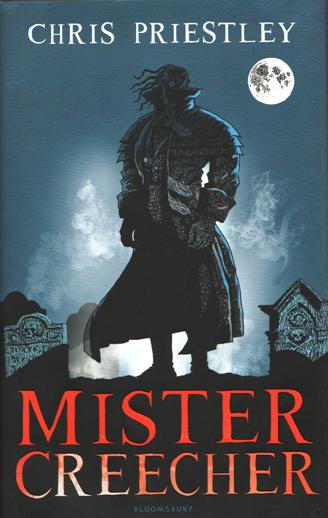 I am a huge fan of Christopher Priestley, having read all three volumes of his Tales of Terror Series, and as part of RIP VI his excellent ghost story Dead of Winter (reviewed here), a real gem. So as soon as I found out that Mister Creecher was being issued I had to get a copy and it hasn’t lingered long on the TBR pile.
So it is 1818, and we meet Billy, on the streets, ill, and turned into a pickpocket after running away from the chimney sweeper who treated him cruelly. He stumbles across an enormous man, apparently dead, lying in a side street, but as he is about to rob the body he is accosted by members of a street gang. But before they can beat him, the mysterious body rises from the ground and does them serious damage. And so we meet Mister Creecher, and his relationship with Billy begins.
Mr C looks after Billy during his illness and they form something of a bond, though Billy is very aware of the strangeness of his new companion and in exchange for food, shelter and some assistance in frightening potential robbery victims into parting with their valuables, Billy simply has to follow one man around London. But that man happens to be Victor Frankenstein.
This is a wonderfully different telling of part of the Frankenstein story. The creature is a compelling character, a mix of intelligence, brawn and childish desires, especially for the mate that Frankenstein has promised him. His recognition of his otherness is both touching and sad, and his desire to not be the only one of his kind, while filling Billy with horror, is the driver that moves him on.
But it is Billy who is really the heart of the story, as he works his way from street urchin to more sophisticated criminal before the events that will turn him into a character that some of us will know from another famous 19th century novel. There are clues to Billy’s identity for those that want to see them, but I’m not going to give it away here as it is part of the impact of the novel.
There are some lovely literary references and in-jokes which I found really enjoyable, and some real historical figures popping up here and there, most notably the Shelleys. Priestley paints a really effective picture of London at the time and what it was like to be an outcast child with no hope other than the workhouse or the type of hard manual labour which we would consider abuse today.
I have to confess that I haven’t read either of the novels from which the main characters are drawn, a bit surprising in relation to Frankenstein given my love of things gothic but I tried once when I was a teenager, and found it really hard going in comparison to Dracula.
But this is an excellent, creepy, atmospheric story which has made me consider giving Frankenstein another chance.
Heartily recommended.
 So Carl’s RIP challenge has come to an end for another year and I’m really pleased that I that I did finish the main challenge as well as dipping into movies and short stories and had a really enjoyable experience.
In terms of books I read the following:
- Duma Key by Stephen King
- The Possessions of Doctor Forrest by Richard T Kelly
- The Dead of Winter by Chris Priestley
- The Rapture by Liz Jensen
- Dark Harvest by Norman Partridge
- Harbour by John Ajvide Lindqvist
I read and wrote about five of the stories from Lovecraft Unbound edited by the wonderful Ellen Datlow and will continue to read the collection
I only watched two of the films on my list but saw an additional one, Contagion, which I’ve decided to include as a worldwide epidemic says “peril” to me.
- The Others
- The Nightmare before Christmas
Still got many of the reviews to complete and publish which I’ll do during the course of this week, but pleased with what I achieved.
 I think it’s fair to say that The Dead of Winter is one of the very best ghost stories that I have ever read, and I say that as someone who thoroughly enjoyed and was totally creeped out by Dark Matter earlier this year. And it’s not just that I am a huge Chris Priestley fan, having read his three books of Terrible Tales (see here, here and here), though of course I am. I just loved this well-written, perfect, little tale.
This is the tale of Michael Vyner, looking back as an adult at the Christmas he spent with his guardian in his isolated East Anglian house, Hawton Mere, and the terrible events that unfolded there. Michael is not there out of choice; his mother has just died, and Sir Stephen is someone he wants nothing to do with – he is bitter that his father was killed saving Sir Stephen while they served together in the army and Michael believes that the wrong man died. But he is a young boy with no other family and reluctantly accedes to his mother’s dying wish that he allow Sir Stephen to give him a new start in life. But Hawton Mere hides a dreadful secret…..
And that’s all I’m going to say because anything more would just spoil it.
This is just smashing, I read it virtually in one sitting and it was totally satisfying as a ghostly tale, very traditional and I mean that in a good way. It’s set in the Victorian period and has everything you might expect – friendly servants, an aloof but actually rather nice lawyer, the strange guardian and his devoted sister, and mysterious goings on some of which are pretty scary. I keep on wanting to compare it to both MR James and The Woman in Black, all for the very best reasons, but that’s a bit lazy of me.
All I will say that if you enjoy ghost stories you will love this.
It is my third read for RIP VI challenge. The shortest so far but already shaping up to be my favourite.
 I really have to get better at making a note of where I find out about the books that I read, because I am pretty sure that I picked The Possessions of Doctor Forrest up because it was mentioned in someone else’s blog – possibly to do with the Edinburgh book festival? Sadly I am too lazy to go and look so we shall just have to leave this as one of those little mysteries that life throws at us and I must remember to have my notebook near me when blog reading.
I do remember that wherever I found it about it my interest was captured by the description of this as a Gothic novel; in fact, the quote from David Peace on the front cover states quite categorically that this book
drags the gothic novel kicking and screaming into this new century
So I don’t think it’s giving too much away to say that this novel owes a lot to stories such as Jekyll & Hyde and Faust, but brings quite a bit of its own style to the genre. And I’m right about what I’ve said about not giving too much away because oh look, there on the back cover blurb it talks about disappearances, diabolical bargains and transformations.
There are three medical men of Scottish background by birth or upbringing who have been friends since school. Hartford s a psychiatrist, Lochran a paediatric surgeon and Forrest, a cosmetic surgeon. They are all more or less discontented with their lot despite being on the surface wealthy and successful in their chosen fields. But Forrest is the most discontented of all, and when he disappears he sets off a chain of bizarre, puzzling and unpleasant events.
I have been mulling my feelings about this novel over for a good couple of weeks since I finished reading it. I liked the structure of the book which has the story told through the diaries of Hartford and Lochran; we see the events unfolding from their individual viewpoints and are party to what they do not share with each other. Their two separate accounts are interspersed with the odd contribution from a few minor characters, giving us more of an idea of what’s going on than they could possibly have themselves.
And then of course we have the “confession” of Forrest himself.
I can’t say that I loved this book; I enjoyed the puzzle, I wanted to know what happened at the end, I enjoyed much of the writing but I didn’t feel involved. This is almost entirely because I didn’t much like any of the characters; even when awful things were happening to and around them I felt very detached, not really caring about them, just wanting to know what the secret was.
So, interesting and well written but rather cold for a book which deals with strong passions. Glad I gave it a go, not sure that I would read it again. But a good fit for RIP VI, for which this was my second read.
It’s that wonderful time of the year when Carl hosts his RIP challenge and I am determined this year not only to take part but to actually finish the challenge and I have selected an interesting (well I think so) bunch of books from the stacks to help me do so.
I’m actually going to take part in three of the challenges – books, short stories and films, between 1 September and 31 October. Exciting stuff.
So, when it comes to books I’m going to take part in Peril the First and will be reading four books (at least) from the following list. I’ve already started the Stephen King and am already enjoying it in that “why haven’t I read this already” way that I always get when I pick up a King book that’s been sitting on the tbr pile. Anyhow the list goes something like this:
- The Fall by Guillermo del Toro and Chuck Hogan – a recent purchase, mentioned here;
- The Possessions of Doctor Forrest by Richard T Kelly – another recent buy, mentioned here;
- The Small Hand by Susan Hill – a ghost story
- Dark Harvest by Norman Partridge – winner of the Bram Stoker award and a fantastic cover (fiery pumpkin-headed things can’t be missed) (I think Susan may also be reading this one);
- Harbour by John Ajvide Lindqvist – had this for ages and Silvery Dude tells me it’s excellent
- The Dead of Winter by Chris Priestley – a boy, a mysterious guardian and a haunted house with a terrible secret;
- The Rapture by Liz Jensen – “electrifying psychological thriller” apparently
- Duma Key by Stephen King – as mentioned above

Not a bad list, I think
 For the short story challenge I’m going to concentrate on Lovecraft Unbound; edited by the wonderful Ellen Datlow this is exactly what it says on the tin, a collection of short stories inspired by the works of one of my all-time favourites HP Lovecraft. A lot of the authors are unknown to me, which is no bad thing, but it does include stories by Michael Chabon and Joyce Carol Oates.
 And finally a movie challenge. I am going to watch as many of the following as I can (given that I’m actually going to be in Germany for a chunk of October but we’ll see what can be done:
- Let Me In – I loved the Swedish original but am curious about what the (possibly unnecessary) US remake is like
- The Others – another one of those “have you really not seen this?” films
- The Ring – ditto
- The Orphanage – the latest in a long run of really good Spanish language horrors
- The Nightmare before Christmas – it’s a tradition to watch this on Hallowe’en chez Bride
Right, well that lot should keep me busy. What’s on your list??
 Going through a bit of a “must buy” phase at the moment, and these are the newest additions to the TBR pile (which now resembles one of the Alps….)
- The Deadly Space Between by Patricia Duncker: after the success of The Composer (as reviewed here), why read the books by her that I already have when I can go out and buy a new one?
- Famous Players by Rick Geary: following on from Jack the Ripper, I thought I’d try one of the titles from the Treasury of XXth Century Murder
- A Visit from the Goon Squad by Jennifer Egan: “You must read this!” said Silvery Dude; I always do what I am told….
- The Fallen Blade by Jon Courtenay Grimwood: this is actually sort of a present for the Book God but once I saw it I realised I want to read it too, a blend of history and dark fantasy in 1407 Venice
- The Hunger Games by Suzanne Collins: everyone will know what this is all about; with the film being heavily touted I thought I should give this a go;
- Wolf Brother by Michelle Paver: having thoroughly enjoyed Dark Matter and following a recommendation from Silvery Dude, I thought I would try her children’s series;
- Your Presence is Required at Suvanto by Maile Chapman: I know absolutely nothing about this book, it was simply lying on a table in the Wimbledon branch of Waterstone’s and I liked the cover and found the idea of a sanatorium in early twentieth century Finland intriguing;
- The Sense of an Ending by Julian Barnes: the only one of the Booker long list that has piqued my interest so far;
- How to be a Woman by Caitlin Moran: bought because I follow her on Twitter and everyone (including the young woman at the till in Waterstone’s while I was paying for it) told me how funny it was;
- The Possession of Dr Forrest by Richard T Kelly: Scottish doctors, friends since boyhood, one goes missing, bizarre, unnerving, menacing, one for RIP
It’s good to be excited by books again.


 Bride of the Book God