You are currently browsing the tag archive for the ‘Creepy stuff’ tag.
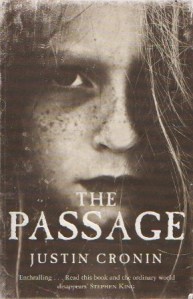 Justin Cronin’s The Passage is another one of those books that has been on my TBR list for what seems like forever, though thinking back I remember exactly when and where I bought it. It was in January 2011 in the Waterstones at Ludgate Circus and I was with Silvery Dude who was kindly getting me a copy of Rivers of London for my birthday and I saw this and had to have it. I was suffering from a really nasty cold and ended up off work for a few days medicating myself with Stephen King.
And its taken me this long to get to it, but I was just in the mood for some pre-soon-to-be-post-apocalyptic horror; this definitely fits the bill.
So there’s this scientist who goes to South America to follow up on information about strange goings on which may lead to a cure for cancer or everlasting life or something of that sort and despite (or because of perhaps) the involvement of the military it all goes horribly wrong. We leap to some time later and death row inmates are being signed up by the guy I thought was going to be our hero, FBI agent Brad Wolgast, to take part in something which will basically mean they are erased from the record. And we have Amy Harper Bellafonte, a six-year old girl who will turn out to be something pretty special (again not a spoiler, you can get this from the back cover).
So much for the set up, and the book does start of as a conventional but well written and extremely creepy horribleness takes over the world and we are all doomed horror. Not giving anything away to say we’re talking vampires, Jim, but not as we know them.
Then something happens and we are plunged into the post-apocalyptic stuff I mentioned, with a whole bunch of other characters set in the future where the world is significantly changed and people are doing what they can to survive. Then it turns into a road trip slash quest novel as a band of intrepid souls go off for various and quite plausible reasons to find out just what the heck happened and is there, you know, anyone else out there.
I thought this was great, a real page turner. The end of the first section and the leap into the future I’ve described above was a bit of a surprise as I thought we would be with the same set of characters for this book at least (given that I think its part one of a projected trilogy). But I soon got used to that and came to love another set of characters which makes the last page a real WTF moment (I won’t say more than that but I read the last paragraph a couple of times to make sure I was really understanding what was going on).
I think this is a really well written story about characters I really came to care for and it has an internal logic to it which makes the world it describes work for me.
And I really, really want to know what happens next, so Santa has been asked to provide the sequel.
Definitely recommended.
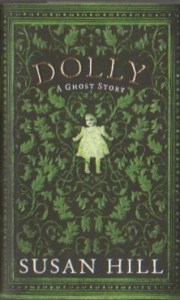 I enjoy a good story, never more than at this time of year, when Hallowe’en has come and gone and the nights are drawing in and Christmas is on its way. I particularly enjoy a good Susan Hill ghost story – The Woman in Black has rightly become a classic, and earlier this year I had a thoroughly good time with The Small Hand as I explained here. So when her new story, Dolly, was released it was no-brainer that I would buy it and devour it in one sitting, as I did.
It’s a short tale, narrated to us by Edward Caley about his lonely orphaned childhood and especially one summer, the first that he spent with his Aunt Kestrel in her forbidding house in the Fens. They are joined by his extraordinarily spoiled cousin Leonora, a wilful child with serious anger management issues, effectively abandoned by her mother and uncontrollable. During her stay she becomes fixated on being given a doll for her birthday, and when she doesn’t get exactly what she wants she becomes enraged and lashes out, an action which has appalling repercussions for them both down the years.
This is nicely creepy in many ways and I enjoyed the experience of reading it at the time, but didn’t get quite the sense of foreboding or the air of melancholy that you get from a really good ghost story. I couldn’t quite get it to make sense for me in terms of actions and consequences. So a bit unsatisfying compared to her other work in the genre but still better than most of the ghost stories out there.
 So there’s a bit of a story to this one. I am a huge fan of Mr Aaronovitch after being introduced to his books by Silvery Dude; in fact the very first one, Rivers of London, helped get me through a particularly nasty cold back in the day. So when I realised that the man himself would be talking and signing books at the Waterstones in Piccadilly, well, I just had to go along, didn’t I? And because I’m a good friend * cough * I got a ticket for the Silvery One as well.
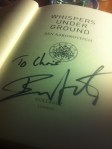
The evening dawned and after numerous “it’ll be fine” exchanges poor old SD couldn’t attend because of domestic (poorly small boy) circumstances so I had to go along by myself, a bit reluctantly I must admit because these things are often more enjoyable when you have someone to chatter with, but it turned out to be huge fun. Mr A is extremely entertaining and a pleasant hour passed as he talked about what bits of the London that appear in his books aren’t real (although it hasn’t stopped me looking for a particular building every time I go through Russell Square), the usual ‘where he gets his ideas from’ stuff and most importantly a hint about how many more volumes there will be in the series (very much a ‘keep going until I run out of stories’ vibe). And as you can see I got my book signed (and got one for SD as well to make up for his missing a night out – and his little boy is OK so smiles all round)
Whispers Underground itself is well up to standard; starts off with a bit of ghost-hunting on the London underground, followed swiftly by the murder of the son of a US Senator which has something whiffy about it and attracts the attention of the FBI and off we go on a really enjoyable story which as always takes in lots of interesting stuff about London and has a nice arc building up in the background.
It’s always tempting to compare this series with the Bryant and May books by Christopher Fowler (which I also adore) but despite the superficial similarities (police investigating odd things, London as a character in the books, lots of interesting facts) they are very different, the supernatural element being the most obvious, but most people I know who enjoy one author also enjoy the other.
So a series that is going from strength to strength and I can’t wait for the next one.

About ‘Salem’s Lot:
‘Salem’s Lot is a small New England town. Like so many others it contains the usual quota of gossips, drinkers, weirdos and respectable folk. Of course, there are tales of strange happenings – but not more than in any other town its size.
Ben Mears, a moderately successful writer, returns to the Lot to write a novel based on his early years, and to exorcise the terrors that have haunted him since childhood. The event he witnessed in the house now rented by a new resident. A newcomer with a strange allure. A man who causes Ben some unease as things start to happen…
When did I first read this? 1976 or thereabouts (Genesis had just released Wind and Wuthering which was being advertised on the radio almost constantly as I was reading this so I think the date is about right)
What age was I? An impressionable 14
How may times since then? I can’t believe this is only the fourth time I’ve read this but the stats don’t lie (at least not in this case)
Thoughts about the book:
This wasn’t the first Stephen King book I had read; I had devoured Carrie earlier the same year, enjoying the thrill of unhappy teenager getting her own back and loving the style of the book with its mix of traditional narrative alongside eyewitness reports and newspaper clippings and so on. But ‘Salem’s Lot was the big one for me, setting two things in stone for the future (1) vampires are my monster of choice (even sparkly ones a la Twilight) and (2) I would read anything by Stephen King – and I’ve pretty much stuck to that in the (gulp) 36 years since then though I sometimes come to his stuff a while after publication.
I wish I had been able to keep the paperback version of this that I read as a teenager; if memory serves it was completely black with an embossed (?) head, and the only colour was a drop of blood – who could resist that? Sadly I lent it to someone and never got it back, but I indulged a few years ago in the rather lovely illustrated edition pictured above, with wonderful photographs, a glorious design and loads of additional material (like deleted scenes etc); a real pleasure to read.
I just love this story – a wonderful cast of characters dealing with the supernatural in a realistic setting, a cliché now perhaps but to someone my age at the time a real revelation. Love, horror, bravery, evil – all there in spades. And I can confirm that the feeling of dread about characters you have come to care about is still there even after several re-reads.
Interesting how much of my view of the book was affected by the TV version starring David Soul, for which I have a real soft spot; some of the scenes are still very vivid. Not a bad adaptation though I was still surprised to be reminded in the book that Ben was dark-haired.
This is a real treat for anyone who hasn’t read it before and worth revisiting for those who have, one of my absolute all time favourites.
This is the third book in my Big Re-Read project.
 The Greatcoat by Helen Dunmore is another ghost story but couldn’t be more different from The Small Hand, though equally atmospheric.
This is set in 1952, and Isabel, newly married, moves to Yorkshire with her husband who is a GP. It’s a time of austerity with rationing still in force and their flat isn’t very warm or welcoming. Isabel is left very much to her own devices as her husband is constantly busy. One night Isabel wakes freezing and wraps herself in an old greatcoat she finds at the back of a cupboard wakes.
And then there is a knock at the window and she sees a young RAF pilot wanting to come in….
This is a story of unfinished business, loneliness and passion, the impact of war and how the recent past can come back to haunt. Very intense and powerful.
This was my seventh and final Readathon read (or at least the last one I finished).
 Yes, it’s that time of year again when thoughts turn to autumn and Carl hosts RIP, this year for the seventh time. Not a challenge unless you want it to be, this is a celebration of all things ghostly, horrible, mysterious and thrilling.
I intend to participate again this year but am not setting myself any goals, especially as I’ll be spending 2 weeks in Italy where I’m hoping for warmth and sunshine, not usually conducive to shivers up the spine, but you never know.
We’ll just have to see what turns up…..
 The Baskerville Legacy was not at all what I expected. When I saw it in the book shop I was immediately attracted by the cover and the subtitle “A Confession”. Ah ha, I thought, this is going to be a lovely Holmesian pastiche telling the true story of the Hound of the Baskervilles; not a straight retelling because Conan Doyle himself appears all the way through, so not a version of Holmes but a “how it came to be”. Which it was and wasn’t.
There isn’t actually a mystery here. It’s the story of how The Hound came to be written; the germ of an idea by a friend of Conan Doyle, a man called Bertram Fletcher Robinson, worked on jointly or so it would appear. But in many ways the tale being written is incidental, as this is a book about friendship, writing, collaboration, professional jealousy, talent or the lack of it and the impact of a dissolute lifestyle. Oh and of course there is spiritualism.
It’s a really enjoyable short book, and one of the most interesting things (apart from the portrait of Conan Doyle who isn’t always the jovial chap he was often portrayed as) is where the author has taken real events and changed or elaborated on them to produce his novel. because Robinson and Doyle were friends, holidayed together, and appeared to have collaborated though Doyle is the sole author on all published versions. there seems to have been a real controversy over this though as the author says none of the correspondence between the two men (if it still exists) has ever been made public. The author’s note at the end is a fascinating read all by itself.
I very much enjoyed this story, with its unsettling air of creepiness, of jealousy and strong feelings, and would recommend it as something a little bit different on the whole Holmesian thing. So not what I expected as I said, but a very happy accident.
This was my second Readathon read.
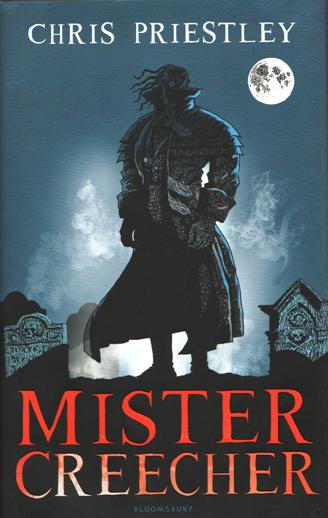 I am a huge fan of Christopher Priestley, having read all three volumes of his Tales of Terror Series, and as part of RIP VI his excellent ghost story Dead of Winter (reviewed here), a real gem. So as soon as I found out that Mister Creecher was being issued I had to get a copy and it hasn’t lingered long on the TBR pile.
So it is 1818, and we meet Billy, on the streets, ill, and turned into a pickpocket after running away from the chimney sweeper who treated him cruelly. He stumbles across an enormous man, apparently dead, lying in a side street, but as he is about to rob the body he is accosted by members of a street gang. But before they can beat him, the mysterious body rises from the ground and does them serious damage. And so we meet Mister Creecher, and his relationship with Billy begins.
Mr C looks after Billy during his illness and they form something of a bond, though Billy is very aware of the strangeness of his new companion and in exchange for food, shelter and some assistance in frightening potential robbery victims into parting with their valuables, Billy simply has to follow one man around London. But that man happens to be Victor Frankenstein.
This is a wonderfully different telling of part of the Frankenstein story. The creature is a compelling character, a mix of intelligence, brawn and childish desires, especially for the mate that Frankenstein has promised him. His recognition of his otherness is both touching and sad, and his desire to not be the only one of his kind, while filling Billy with horror, is the driver that moves him on.
But it is Billy who is really the heart of the story, as he works his way from street urchin to more sophisticated criminal before the events that will turn him into a character that some of us will know from another famous 19th century novel. There are clues to Billy’s identity for those that want to see them, but I’m not going to give it away here as it is part of the impact of the novel.
There are some lovely literary references and in-jokes which I found really enjoyable, and some real historical figures popping up here and there, most notably the Shelleys. Priestley paints a really effective picture of London at the time and what it was like to be an outcast child with no hope other than the workhouse or the type of hard manual labour which we would consider abuse today.
I have to confess that I haven’t read either of the novels from which the main characters are drawn, a bit surprising in relation to Frankenstein given my love of things gothic but I tried once when I was a teenager, and found it really hard going in comparison to Dracula.
But this is an excellent, creepy, atmospheric story which has made me consider giving Frankenstein another chance.
Heartily recommended.
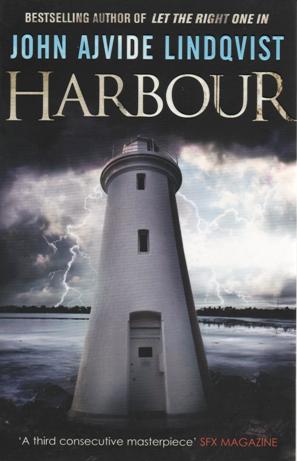 Well now, this one is a bit special.
Readers of this blog will know that I am very fond of John Ajvide Lindqvist having read and reviewed his Swedish vampire novel (Let the Right One In) followed by his Swedish zombie novel (Handling the Undead) both of which were about considerably more than the tags I’ve given them here. Both were about love and relationships and harbour is in many ways no different, though I haven’t yet been able to come up with a suitable Swedish tag for it.
There is a tiny wee story behind this, in that having persuaded my friend Silvery Dude to try Lindqvist he has been racing ahead and actually read this some months before I did. he recommended that I save this until the autumn, which is why I took it with me to berlin on my recent trip. It felt right to be reading this story in a more European setting than good old Surrey, and his recommendation and my instinct were both correct.
So, Harbour tells the story of a community, Domaro, which makes its living from the sea and from the summer visitors who have built houses there. Our entry to the community is through Anders who has a foot in both camps. One winter day he and his wife take their little girl, Maja, out onto the thick ice to visit the local lighthouse. They only look away for a few minutes, but in that short time every parents nightmare occurs; Maja has disappeared. There are no holes in the ice, nowhere that she could have gone, and despite searching high and low with the help of their neighbours, Maja can’t be found.
Two years later, his marriage destroyed and dependent on alcohol, Anders returns to Domaro determined to find out what happened. At this point we are also introduced to Simon, a stage magician and the partner of Anders’ grandmother. As strange events begin to occur and the secrets of Domaro begin to be revealed, Simon comes to understand that despite the number of years he has spent there he is very much an outsider. Between them he and Anders begin to unpick, albeit accidentally at times, what has been lurking underneath daily life.
I really, really enjoyed this novel. As in his previous books, Lindqvist shows great skill in describing strong emotions such as love, grief, betrayal and anger. His characters are fully rounded (my favourite was Simon) and I really wanted to know how they would get through the events which unfolded. The introduction of the supernatural elements (I’m not sure how else to describe them) builds up slowly and by the time some of the more bizarre incidents take place I was really invested in the story. How the community came to collude in and rely on the secret at its heart was all too plausible. If weird.
I agree whole heartedly with the comment on the cover “a third consecutive masterpiece”; so much so that I have already got a hold of his fourth novel, Little Star.
Strongly recommended.
 So Carl’s RIP challenge has come to an end for another year and I’m really pleased that I that I did finish the main challenge as well as dipping into movies and short stories and had a really enjoyable experience.
In terms of books I read the following:
- Duma Key by Stephen King
- The Possessions of Doctor Forrest by Richard T Kelly
- The Dead of Winter by Chris Priestley
- The Rapture by Liz Jensen
- Dark Harvest by Norman Partridge
- Harbour by John Ajvide Lindqvist
I read and wrote about five of the stories from Lovecraft Unbound edited by the wonderful Ellen Datlow and will continue to read the collection
I only watched two of the films on my list but saw an additional one, Contagion, which I’ve decided to include as a worldwide epidemic says “peril” to me.
- The Others
- The Nightmare before Christmas
Still got many of the reviews to complete and publish which I’ll do during the course of this week, but pleased with what I achieved.


 Bride of the Book God