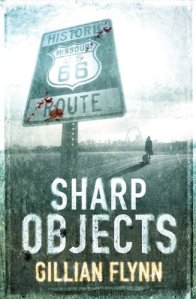
SharpObjectsGillianFlynn45002_fOK, so where to start with this one? Sharp Objects is about a reporter, Camille, who is sent by her paper in Chicago to investigate the murder of one girl and the disappearance of another in her home town of Wind Gap, Missouri. Is a serial killer involved? How are the local police faring in their investigation? Is it a local or an outsider who is committing these crimes? All the usual questions that you would expect when death hits a small town.

And of course, all is not well in Camille’s life. She has a tragic past (death of her sister); to describe her relationship with her mother (with whom she is forced to stay during her trip) would be a gross understatement; and, well, to put it (incredibly) mildly, she doesn’t exactly have a history (or a present) of looking after herself.

And of course, the crimes may all be a lot closer to home than she thinks.

I’m still not entirely sure how I feel about this novel. There’s a very prominent endorsement from the great Stephen King (well, I think he’s great) on the back of the edition I read, where he talks about Sharp Objects as ‘relentlessly creepy’, ‘dreading the last thirty pages’ and so on. And in some ways he is right, it is creepy, the story does linger, it does have a cumulative nastiness factor. Whether you have any positive feelings about the characters or not (and some reviewers really don’t like the portrayal of women in this book) it is in many ways very powerful. But……

And I’m not sure what that but is. I felt a lot of sympathy towards Camille because of her awful childhood and what it had done to her both physically and mentally. But something went askew for me towards the end, and I think it’s because after a slow and relentless build up it was all suddenly over. There was a huge revelation (for Camille at any rate) all the pieces appeared to drop into place, and then there was a ‘Carrie’ ending (film not book so if you haven’t watched the Brian de Palma movie you might not know what I mean). And you knew it was coming, and if you had half a brain you knew what it was, and for all those reasons it was a bit unsatisfying. Which is a real shame.

This is absolutely by no means a bad book; I just think it could have been even better.

This was my first read for RIP IV.

29159So I have this problem. My friend the Silvery Dude has, with his good lady wife, watched Twilight. I am now under some significant pressure, indeed, I have been dared to do likewise, because:
  • it’s Buffy meets the X-Files meets the OC (allegedly)
  • it’s a parallel universe of teen angst which must (apparently) be explored
  • it’s part of the (and I quote) “new lovey-dovey horror sub genre malarkey”

Now some of these points may be good ones (I love Buffy; I love the X-Files); but some are also bad (I care little for teen angst; I may have riposted that said parallel universe should be plunged into the nearest singularity). Also, as I understand it, these vampires are “sparkly”

There is additional evidence which needs to be take into account:

  • I am 47 years old – do I really want to be reminded about being a teenager, albeit one in love with a representative of the undead (which superficially has certain attractions)?
  • My favourite vampire film  is Near Dark – no sparkles
  • I really enjoyed (in a creeped out way) Let the Right One In – definitely no sparkles
  • I have avoided reading the books because almost everyone else has been and I am nothing if not perverse
  • at the risk of upsetting any 15-year-old girls, Robert Thingy’s eyes are too close together for genuine handsomeness
  • I don’t do romance

 Am I being unfair? Should I give it a go? Please, please, give me some advice; I promise to abide by the majority decision……..

Another quiet month for films, though if you would like to know my reaction to Let the Right One In (most suitable for RIP IV) then you should look here.

And the Lord of the Rings Extended Version DVD Marathon was completed on 31 August, but not much more to add to what I said here, here and here.

rip4150The RIP IV challenge is indeed here and after some consideration I have come up with the following list from which to select my four books for Peril the First. I’m also going to try to participate in Short Story Sunday if I can.
So the list is:

So that looks like a reasonable selection, but what of the other challenges I’ve been involved in? Well I still have good intentions for the 42 Challenge and the Art History Reading Challenge, the 100 Shots of Short is looking a bit peaky, but I am definitely going to have to throw in the towel when it comes to the Non-Fiction Five Challenge – that’s just not going to happen this year.

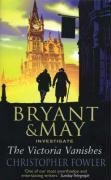
TheVictoriaVanishesBryant49878_fSo in The Victoria Vanishes our favourite elderly detectives, Arthur Bryant and John  May become involved in yet another peculiar crime as women start turning up dead in London pubs. Not violently dead, you understand, but drugged and basically put to sleep. Bryant in particular has cause to be concerned as it becomes clear he saw one of the women shortly before her death entering a pub which, the following day, has mysteriously disappeared and possibly hasn’t actually existed since before the war. So, why are these women being killed? Why are they being killed in pubs? And what happened to The Victoria?

The joy of this novel isn’t just the plot, which is enjoyable and ingenious if a tiny wee bit far-fetched (a very minor quibble believe me), but the knowledge of and love for London which comes through every page. Fowler gives a list of the pubs frequented or at least mentioned in the book, and a number of them are in the area near my office (around Holborn, Fleet St, The Strand and Shaftesbury Avenue) and between us the Book God and I managed to identify a number that one or other or both of us had been in over the years we have lived in London. Sadly a lot of these pubs are beginning to be overrun by developers, but there are still one or two dotted around that are worth visiting, and they give a colourful backdrop to an enjoyable story.

And that brings August to an end and Crime Month is over for another year. I managed to read eight from what was quite an extensive list, and could quite happily have read more if the need to earn a living hadn’t inconveniently got in the way!

So it’s August Bank Holiday and in London it’s  warm and humid but there is a promise of autumn (my favourite season) later in the week, and I am two thirds of the way through the Annual Lord of the Rings Extended Version DVD marathon which finishes this evening with (of course) The Return of the King. It’s only five weeks until I go on holiday, and I have Carl’s RIP IV challenge to participate in so what more could a girl need? Apart from a new handbag, of course…….

TheLanguageofBeesLaurie54241_fThe Language of Bees is the latest instalment in the tales of Mary Russell, wife to Sherlock Holmes, and starts off from the end of the last story (Locked Rooms) with Russell and Holmes arriving back to their home in Sussex to find one of the bee colonies deceased (if that’s what happens to hives) and a figure from Holmes’ past (and I’m not going to say who it is) looking for help. This starts a murder mystery which involves Mycroft (one of my favourite characters from the canon) and his extensive resources assisting Russell and Holmes in travelling up and down the UK to visit some of the most ancient sites in the country, seeking a dangerous and influential man. I think. It’s quite hard to write about this without giving away too much of the plot, which is something I really don’t want to do as the intricacies of the story is what makes the series so successful, alongside as the lead characters of course.

I will put my cards on the table and say that years ago, when King first started writing this series I was sceptical; I loved Sherlock Holmes and couldn’t see him ever getting married, especially to a much younger woman. But I picked up The Beekeeper’s Apprentice and gave it a go, and was instantly hooked. The books are written with such affection for Holmes, Watson et al, Russell herself is a distinctive character, and the events of each (while often harking back on occasions to the past) are all set after Holmes has retired, so don’t really tinker with the mythology at all.

The only disappointment in relation to The Language of Bees is the phrase “to be continued” which appears at the end, and the knowledge that I have to wait untill sometime in 2010 to find out how this particular story develops.

Well worth reading, snatched out of my hands by the Book God as soon as I had finished it, and if you haven’t read any of the Russell stories, then you really should. Excellent.

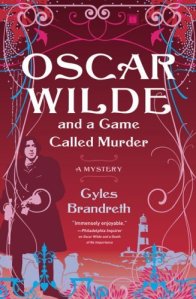
OscarWildeandaGameCalled51000_fSo Susan over at You Can Never Have Too Many Books has started a very interesting discussion on the use of real-life people in fiction, whether it’s justified, how readers feel about it and so on. It’s a really thoughtful piece so do go and have a look, and I mention it here not just because I’m a fan of Susan’s blog (which I am) but because this is the second book in a row I have read which is very much set around people from the real world and I am trying to look at it in the light of Susan’s post and some of the comments that have appeared there already.

Oscar Wilde and a Game Called Murder kind of gives itself away in the title. It’s the second in Gyles Brandreth’s series (I wrote about the first one here) and does what it says on the tin; it turns Oscar Wilde into an amateur sleuth, and is packed with names that are recognisable to anyone who knows the detail of both Wilde’s life and the literary scene of the time. So, we have Arthur Conan Doyle, Bram Stoker, Lord Alfred Douglas, Robert Sherard (Wilde’s first biographer) and several other lesser known names.

The story is quite a simple one; it is 1892 and the Socrates Club is having one of it’s regular dinners, presided over by Wilde himself. At the end of the meal he suggests that the guests play a game called Murder – each of them will write anonymously on a slip of paper the name of the person they would most like to kill, and the other guests will try to work out who was chosen by whom and why. Not explained very elegantly but you can probably see where this is going. Two of the slips are blank, and the same name appears four times. And Wilde’s name is mentioned once, ditto his wife Constance. The game goes a little bit sour, but Wilde thinks nothing of it until over the course of the next three days the first three names on the list, including a parrot, die in more or less mysterious circumstances. Who around the table is a killer?

It’s an ingenious puzzle and I had absolutely no idea who the murderer was, what the motive was and how it all fitted together but I really enjoyed finding out. Wilde comes across as a complex, attractive and sympathetic figure and I learned a lot about the period. It’s well written and clearly meticulously researched by someone with an affection for both the characters and the setting. Do I think that’s what Wilde was really like? Probably not. Does it matter? I’m not sure it does. Did it make me want to find out more about the real people? Well, yes, especially in the case of Conan Doyle’s friend Willie Hornung who created Raffles; I’ve never read any of his stories and am off to find some now. The author’s note is very illuminating, and that is the one thing I do look for in a novel with real people; some indication of what’s true, and what’s invented. And there are some very nice in-jokes, too. Recommended.

AnExpertinMurderJosephine52125_fSo, In An Expert in Murder Nicola Upson has created a new mystery series around a real person, namely Elizabeth Mackintosh, best know to those of us who love crime and mysteries as the author Josephine Tey.

The setting is London’s Theatreland, where Josephine’s successful long-running play Richard of Bordeaux is coming to an end. At the beginning of the novel we see her travelling from her home in Inverness, and on the train she meets a fan, a young woman called Elspeth. They hit it off, but soon after the train arrives at King’s Cross, Elspeth is murdered. Josephine’s friend, Archie Penrose (the model for her fictional detective) is leading the case and Josephine herself soon becomes involved in finding out what secret from the past has led to this and other deaths.

I’m always fascinated when authors use real people in their novels, and I’m always pleased when they include an author’s note to tell you what and who is real, what’s conjecture, what’s totally fictional. I’ve also always liked Josephine Tey’s work, especially The Daughter of Time (though I didn’t agree with her conclusion, but that’s not the point) and hopefully her transition to a fictional character will popularise her work a bit more.

The novel really does invoke the period of the 1930s, and it was great fun reading about events taking place in streets very close to where I work in central London (though obviously it all looks very different now). And though it reads like a classic murder mystery of the golden age, the occasional swearword and the description of relationships that wouldn’t have been written about quite so openly at the time remind you that this is very much a modern novel.

I’m now really looking forward to the sequel, which comes out quite soon I think.

Ilan Volkov prom38So I moaned quite a bit here about how much I dislike August and gave some (though by no means all, believe me) of the reasons why I felt that way. But we are now more than half way through the month and there is light at the end of the tunnel.

A number of things are conspiring to help me get through the month with only a modicum of my usual summer grumpiness:

  • my Crime Month book reading is going well and I’m keeping my reviews up to date;
  • from tomorrow I start working at home for a proportion of each week, so no more daily commute on hot and horrible trains; and
  • the BBC Proms have been really good this year (so far)

Yes, I have been enjoying my summer fix of classical music; in particular,  I headed off on a sunny, sultry London Saturday to the Royal Albert Hall, and despite the best efforts of London Transport got there in plenty of time to enjoy the lovely Ilan Volkov’s final appearance at the Proms with the BBC Scottish Symphony Orchestra performing Beethoven’s Ninth. And it was absolutely wonderful, almost enough to make August worthwhile (but only almost).

Seriously, if you can access the BBC iPlayer I recommend that you have a listen; it’s Prom 40 and is available for the next seven days, I think. The concert itself will be broadcast on TV on BBC Four on 11 September, and again available on the iPlayer where allowed. Well worth a couple of hours of your valuable time, if you like that sort of thing, of course………

TheSeptemberSocietyCharles53587_fSo in The September Society Charles Lenox is approached by the widowed mother of an Oxford student who has gone missing leaving only a dead cat behind him in his rooms.

Lenox takes on the case and finds himself working with both the Oxford police and Scotland Yard as a dead student is found in a public space, and the name of the mysterious September Society keeps on turning up.

And as if this wasn’t enough, Lenox is wrestling with his feelings as he considers making changes in his own personal life.

Although I quite enjoyed this novel I didn’t find it to be as strong as the first in the series, which I reviewed here. I still like Lenox as a character, but found the whole thing about his private life got in the way of what could have been a cracking mystery, and I’m not sure why, because generally I like to see the lead character rounded out and not just be a pawn in the game of solving the mystery. I also think that it didn’t help that I had worked out one of the big reveals quite early on and was slightly annoyed that Lenox took so long to do so, although of course it would have been a much shorter book if he had.

So, pretty solid and likeable but not as gripping as it might have been. Probably won’t stop me reading the next one though. Oh and once again I really liked the cover…

Bride of the Book God

Follow brideofthebook on Twitter

Scottish, in my fifties, love books but not always able to find the time to read them as much as I would like. I’m based in London and happily married to the Book God.

I also blog at Bride of the Screen God (all about movies and TV) and The Dowager Bride, if you are interested in ramblings about stuff of little consequence

If you would like to get in touch you can contact me at brideofthebookgod (at) btinternet (dot) com.

The Sunday Salon.com

Goodreads

Blog Stats

  • 48,562 hits
March 2026
M T W T F S S
 1
2345678
9101112131415
16171819202122
23242526272829
3031  

Categories

Archives