
You are currently browsing the category archive for the ‘Reviews’ category.
 What’s it all about?
Savage Magic is the third in Lloyd Shepherd’s series about London’s River Police which started with The English Monster (which I reviewed here) and continued with The Poisoned Island which was my first read of this year, and to (for?) which this novel is something of a sequel, as the starting point for several of the characters is a direct result of the events of the previous novel. So although you don’t need to have read that first, it will all make a bit more sense if you have.
Unofficial plug over.
But what of the plot? Well….
It’s 1814 and London’s Covent Garden is at the centre of a dark trade, enticing rich and poor alike with a cocktail of gin and beer and sex. In the surrounding parishes a group of aristocratic young men are found murdered, all of them wearing the mask of a satyr, all of them behind locked doors with no sign of entry.
And if that wasn’t enough, there are also accusations of witchcraft in the countryside outside London which need to be looked into ….
Why did I want to read it?
I am a great fan of this series and had pre-ordered this as soon as I knew it was coming out. It’s a period of London history that I don’t know very much about and I have become fond of the main characters, particularly Abigail Horton, the wife of our main protagonist, so picking this up was a no-brainer for me.
What did I think of it?
As I’ve already said I enjoy this series very much but I think this is the best so far, which is interesting given that at least one of the main characters from previous volumes (Harrington) is offstage through illness for most of the narrative and the others (Abigail, her husband Charles and Aaron Graham) are apart for most of the novel for very good and important-to-the-plot reasons. In fact I became very anxious indeed about Abigail’s situation…..
The other interesting thing is that very little of the story has anything to do with the Thames at all, though convict transport to Australia and return to England do feature. What we do have is a thoroughly absorbing story which touches on the treatment of the insane (hint – it isn’t good, especially for female patients), the sex trade and in particular the debauchery of the wealthy (which seems in this case to have very few if any limits) and witchcraft and superstition, alive and well in rural parts even post-Enlightenment. I do enjoy a good-locked room mystery, and I also like to see how the various plot strands come together as they inevitably do. Very ingeniously done in this case, with a whiff of the not entirely natural which has been a theme of the series.
It’s also great fun to read about an area that I know pretty well given that when I’m working in London I’m based on Kingsway, just round the corner from Graham’s home in Great Queen Street and a stone’s throw away from Covent Garden.
The reading experience was an unusual one for me in that I started the novel some time ago and then a combination of increased workload before holiday (never a good time to read anything that requires attention in my experience) and the previously mentioned anxiety about what the author was going to put Abigail through meant that it languished on the TBR pile until I found myself in a hotel in the south-west of Scotland where I could give it the attention it deserved, and I read the last third in a single sitting late into the night. And very satisfying it was too.
If you haven’t given this series a try then you really should, whether it’s for the historical setting, the supernatural stuff or a good novel of detection. I’m really looking forward to seeing what comes next.
This was my third read for RIP IX. It is also the book that got me to my target of 52 books in 52 weeks, so everything I read after that is a bonus!
 Let the Old Dreams Die is a book of horror short stories by the Swedish author John Ajvide Lindqvist, first published in 2006 but only relatively recently available in an English language translation. I was very keen to read some of his shorter work having been very impressed by the three of his four novels that I’ve read so far:
- Let the Right One In – Swedish vampires, spawned two films (only one of which I’ve seen (hint – it was brilliant) though I have the other one in my possession
- Handling the Undead – Swedish zombies
- Harbour – Swedish watery strangeness
I really enjoyed this collection which I read over several days while on holiday, staying in a former stately home in Cumbria. I like Lindqvist’s take on horror, which doesn’t ignore gory unpleasantness (as anyone who knows what happens at the end of Let the Right One In will confirm) but is overwhelmingly, to my mind at any rate, one of creepiness tinged with melancholy, which means they aren’t the sort of stories you can binge on. As an aside, I once heard an author being interviewed on the radio (I think it was Anne Enright but I’m not sure) who said something along the lines that people tend to approach anthologies the way they do a box of chocolates – they either eat them singly over time and savour each one, or they devour the lot in one go – I have done both in my time. This is definitely a one sweetie at a time thing.
I’m not going to pick out any individual stories to mention (except perhaps Village on the Hill which led me to consider drains more carefully than I had before) but will say that for many readers the two titles of most interest will be the title story which is sort of but not quite a sequel to Let the Right One In (Lindqvist himself says in his afterword that it deals with a problem of interpretation that he hadn’t identified until he saw the movie version) and The Final Processing, the longest story in the collection, which is basically a sequel to Handling the Undead. There is also Eternal/Love where I think you can see Lindqvist exploring some of the themes that pop up in Harbour.
I really enjoyed this selection; it was a perfect autumn holiday read and it has made me want to pick up the most recent novel, Little Star. Recommended.
This was my second read for RIP IX.
 What’s it all about?
Edward Prendick survives a shipwreck and is picked up by another ship transporting a strange cargo under the direction of the disreputable Montgomery to a mysterious island in the tropics, home to Dr Moreau and his laboratory. Prendick finds out that Moreau is experimenting on animals, continuing work he started back in England but which appalled those in the know so much that he was forced to leave if he wished to continue his research. The callous disregard he has for the subjects of his experiments and the torture he puts them through does not end well, but what will it mean for Prendick?
Why did I want to read it?
The Island of Dr Moreau is one of those classics that you know so much about you think that you’ve actually read it and then of course you realise that you haven’t, and I thought it was about high time that I did. As you can see from the cover image from the edition I read I’ve had a copy of this since the release of the ill-fated and not terribly well-received 1996 movie version.
That’s how long things can moulder on Mount TBR round these parts.
What did I think of it?
I’m not sure it’s what I expected really, based on my only other Wells reading experience which is War of the Worlds, an exciting and pacy read. I thought this would be similar but it’s clearly trying to make more of a point in terms of its message on the price of scientific enquiry and the role of vivisection which has always been a contentious issue. Moreau himself has no redeeming features whatsoever and even Prendick is at times an ambivalent figure; he doesn’t seem to have a problem with the principles being applied, it’s Moreau’s methodology he takes issue with. The beasts themselves are for the most part not well developed and the social satire elements were lost on me.
I’m glad I read it as it is a classic which has influenced other works across a number of media; the song No Spill Blood by Oingo Boingo has just popped into my head and even my late lamented dentist used to refer to his surgery as the House of Pain. So many of the references are embedded in popular culture but I must admit that as a novel it left me entirely cold.
This was my first read for RIP IX.
 What’s it all about?
Acceptance is the concluding volume in Jeff VanderMeer’s Southern Reach trilogy. Where the first volume told the story of the 12th expedition into Area X and the second looked at things from the perspective of the organisation tasked with sending those expeditions in to investigate, this final volume brings both sides of the story together as surviving characters deal with the aftermath of earlier events and try once again to understand the anomaly from the inside.
Why did I want to read it?
I just love this series of books and hated having to wait quite so long to get my hands on the final volume. Even though I was in the middle of something else when this arrived on my Kindle app I just had to start reading, and I finished it in a single Saturday’s concentrated effort. Though it really wasn’t an effort at all, I was totally absorbed.
What did I think of it?
I really really liked Acceptance, I thought it was a very fitting conclusion to the series and brought together existing strands and themes very well while still managing to introduce new material, including quite a few flashbacks which explained some of the background to both what Area X is and how it came to be. I found myself really committed to the characters and the growing sense of otherness and weirdness was gripping, especially to someone like me who has a great love for all things strange. It manages to balance the creepiness of a Lovecraft tale with real human drama as characters I had come to care about dealt with their experiences.
I don’t want to go into too much detail because this is a book that only makes senses if you have read its predecessors. What I will say though is that I will definitely re-read this trilogy and I have already sought out more of VanderMeer’s work. Though I can understand why some readers have found the lack of a complete set of answers a bit frustrating I rather liked the open ending. Really really enjoyed it.
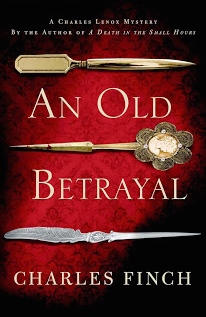 What year are we in? An Old Betrayal is set in 1875
What is Lenox’s case?
Lord John Dallington is ill and asks Lenox to help him with a case by meeting a potential client at Charing Cross station. However, the meeting doesn’t take place as planned and also seems to be connected with the death of a quiet and retiring country gentleman. As Lenox works with Dallington and Scotland Yard it becomes clear that a deeper and more sinister plot is afoot, one that might strike at the monarchy itself.
Apologies for the burst of melodrama there 🙂
What did I learn about that I didn’t know before?
Not a huge amount, though the way that people try to get access to Queen Victoria is quite interesting, and the murkiness of British politics is reinforced once again.
What’s happening in Lenox’s personal life?
Dallington is quite ill but struggling on, McConnell and his wife Toto appear to be having marital problems, there is a rival detective agency involved run by *gasp* a woman, and Lenox looks like he’s finally going to have to decide whether he priers politics or detection.
Did I enjoy it?
Huge fun. More complex in some ways than the others in the series and clearly meant to be a game changer. Alway good to have Queen Victoria pop up in her indomitable fashion and the motivation for the crimes is both obscure and mildly gothic. Looking forward to seeing where the series will go from her. Next volume is already pre-ordered.
 What year are we in? A Death in the Small Hours is set in 1874
What is Lenox’s case?
Lenox has been given the honour of making the first speech at the new Parliamentary session and he is advised to take himself out of London to have quiet time in which to write the speech and otherwise prepare. It just so happens that his Uncle Freddie had asked him and his family to stay at his home in Somerset and investigate a spate of incidents of vandalism in the local village. There is of course a murder, that of a young police constable, and investigating this uncovers a criminal conspiracy.
What did I learn about that I didn’t know before?
Not much new in this novel, though interesting to see how Lenox’s uncle undertakes his duties as a local JP, but it is mostly the usual village life sort of stuff, though very well done of course.
What’s happening in Lenox’s personal life?
Doting on his daughter and building his career are the main preoccupations for Lenox, though it’s clear he relishes the opportunity to get involved in detection again.
Did I enjoy it?
Yes, another pleasurable entry in the series. The subplots all weave together very nicely both in terms of the crimes committed and the developments within Lenox’s own family. The Parliamentary stuff is still fascinating.
 What year are we in? A Burial at Sea is set in 1873
What is Lenox’s case?
Lenox is a rising star in Parliament and has been asked by his brother and other influential politicians to undertake a mission to Egypt, ostensibly to discuss how Britain might become more involved in the Suez Canal, but actually to meet an informant who can tell him whether the French government knows the identities of British spies in their country and has been bumping them off. While on his way aboard HMS Lucy he has to investigate a number of gruesome murders and a stop a potential mutiny.
What did I learn about that I didn’t know before?
I learned a lot of genuinely interesting stuff about the Victorian navy and our view of diplomacy (in relation to the French at least) at that time. Lots of research clearly went into writing this book but it never appears heavy-handed.
What’s happening in Lenox’s personal life?
Lenox and Lady Jane are expecting a baby. Lenox’s nephew Teddy has joined HMS Lucy as a member of the crew.
Did I enjoy it?
I think this may have been my favourite of the four, partly because of the setting on board ship which was both unusual and interesting but also because of the gruesome nature of the murders and the motivation of the killer which is rather more complex than it at first appears. The French are suitably dastardly which is always good fun. Recommended this to the Book God who has a great interest in the British Navy and it seems to have been a hit so far.
 After the success of my binge-read of the Maisie Dobbs books (which I talk about here and here) I decided to do it again, this time with the series of novels about aristocrat, MP and private detective Charles Lenox, set in London in the late 1860s and early 1870s and written by the American author Charles Finch. Like Maisie, Lenox is a very engaging character whose personal life forms a backdrop to and often becomes closely entwined with the cases he investigates.
The main characters alongside Lenox are his best female friend and now wife Lady Jane, his best male friend and useful medical man Thomas McConnell, and his former protege Lord John Dallington. There are now seven books in the series with an eighth coming out later this year, and I read the most recent four in a row in less than a week.
Firstly – A Stranger in Mayfair
What is Lenox’s case?
A fellow MP asks Lenox to look into the murder of his footman who has been beaten to death an alleyway behind the house n which he worked, and it’s clear that all is not what it seems, either in the household itself or the young man’s personal life.
What did I learn about that I didn’t know before?
Quite a bit about the sport of boxing and how a new MP is inducted into the life of Parliament.
What’s happening in Lenox’s personal life?
Newly married, starting his career as an MP, trying to settle down into his new life and leave all that sleuthing nonsense behind.
Did I enjoy it?
Yes I did, a good story to ease myself back into the series after a break of some time, I guessed part of the reason for the murder but not the perpetrator.
 What’s the book about?
The House of Silk is a Conan-Doyle estate approved revival of the Great Detective by Antony Horowitz, told by an aged Dr Watson with Holmes himself gone. The tale has been withheld because of the nature of the crimes involved and the fact that their becoming public would “tear apart the entire fabric of society”, so he is writing them while he still can for release after he too is dead.
Why did I want to read it?
I have always tried to read at last one Holmes-related novel during August Crime Month – the man’s portrait is of course the header for the challenge (the post is here in case you missed it) and this sounded really interesting. I also like what I have read of Horowitz.
What did I think of it?
This is really very well done indeed, capturing the tone of the original stories with slightly more edge to suit modern tastes, being a little less circumspect about the nature of the criminal acts without being explicit, and showing that what we might consider a modern crime does of course have its roots in the way young people in poverty were treated in the past and how the status of certain individuals meant that even the most appalling things would be covered up through fear of at best loss of respect for their betters and at worst potential revolution. All the usual stalwarts are here – Mrs Hudson, Inspector Lestrade and the Baker Street Irregulars – and of course Holmes gets himself into danger and shows of both his analytical skills and talent for disguise. But definitely quid a bit darker than most Holmes-related fare.
The next in the series, Moriarty, comes out later this year (just in time for Christmas, in case anyone’s interested)
 What year are we in? 1933
What’s Maisie’s case?
In Leaving Everything Most Loved, Maisie is called in by Scotland Yard when the brother of a young Indian woman (who has been shot in London), appalled at the lack of progress being made but the police, wants to know why she was killed. For various reasons this becomes connected with an unfinished case and Usha’s death is not the first.
What did I learn that I didn’t know before?
Lots of interesting stuff about the Indian community in London between the wars, mixed marriages and so on, stuff I had never really thought about before and saw as a post-WWII issue (and shame on me for that).
What’s happening in Maisie’s personal life?
Big changes to her family, her business and her love life.
Did I enjoy it?
Really good story, one of the few times in the books where we see Maisie really speak her mind when previously she would have been more circumspect and I cheered when she did it (well, inward cheering anyway). The plight of women brought over from India as servants when they lost their positions for whatever reason was very sad. This is very much a game-changer in the series and I could see it being a finale, but understand the author plans to start a new series with Maisie still at the centre sometime in 2015. So hurrah for that.
I really enjoyed immersing myself in Maisie’s world through reading in such quick succession books that would normally have been available a year apart.


 Bride of the Book God