
You are currently browsing the category archive for the ‘Reviews’ category.
 I have said elsewhere how much I enjoy the Mary Russell series of books by Laurie R King so will not repeat myself unnecessarily here; pleased to say that Pirate King is no exception to that rule and was a lovely fun read after a run of dark and creepy novels.
This is the eleventh in the series and although it does refer back to previous adventures it does so in a non-spoilerish way so would be a good place to start if you have never read a Mary Russell novel before. It is certainly much more light-hearted in many ways than the others and gives a good insight into Mary’s character and her relationship to her famous husband Sherlock Holmes.
So, bit of plot. Mary is persuaded by the imminent arrival of her brother-in-law Mycroft (with whom she’s had a bit of a falling out) to take on the role of assistant to a film crew to investigate the disappearance of her predecessor (was it foul play or had she just had enough) and the distinct air of criminality which follows each of the company’s productions (gun running, drugs etc.) This leads to a trip to Lisbon and then Morocco in what turns out to be a bit of a romp (and that’s a word I normally avoid though it seems appropriate here).
This is huge fun. There are pirates and ingenues and megalomaniacal film directors and chaperones and secret agents and disguises and all manner of derring do set against the backdrop of a silent film production, in this case a film about the making of a film about The Pirates of Penzance. I love stories about early movie making (Bride of the Rat God (sadly out of print it seems) and Hollywood being two that spring to mind, though very different of course) and the technical problems and practicalities of making a movie in the 1920s really spring to life here without being heavy-handed, which has always been one of this author’s strengths for me.
And as much as I love Mary on her own it’s always better when Holmes himself gets involved; the dynamics of their relationship are one of the joys of the series, so I was very pleased whenever he turned up.
A very enjoyable read all round, and I can’t wait for the next one.
I considered listing this as an RIP read because there is mystery and peril galore but it was just too light-hearted to sit alongside my reading this for that challenge.
 There are twenty stories in Lovecraft Unbound, which I’ve chosen as my read for RIP VI’s Peril of the Short Story, and I’m doing them in batches of five. Here are my thoughts on the first tranche:
- The Crevasse – a classic Lovecraft creepy, claustrophobic tale of unnamed things in the Antarctic – really liked this one;
- The Office of Doom – what do you think might be the consequences if you got a copy of the Necronomicon through an ILL? – a gross oversimplification of a great story
- Sincerely Petrified – can a made-up legend take on a life of its own? – interesting premise let down by really very unsympathetic characters
- The Din of Celestial Birds – don’t go into the hovel, no seriously, don’t – doh, too late – couldn’t really get into this one at all
- The Tenderness of Jackals – dark urban fantasy, but didn’t feel that Lovecraftian to me….
So a mixed bunch as you might expect, will be interesting to see what the next five are like!
 I really have to get better at making a note of where I find out about the books that I read, because I am pretty sure that I picked The Possessions of Doctor Forrest up because it was mentioned in someone else’s blog – possibly to do with the Edinburgh book festival? Sadly I am too lazy to go and look so we shall just have to leave this as one of those little mysteries that life throws at us and I must remember to have my notebook near me when blog reading.
I do remember that wherever I found it about it my interest was captured by the description of this as a Gothic novel; in fact, the quote from David Peace on the front cover states quite categorically that this book
drags the gothic novel kicking and screaming into this new century
So I don’t think it’s giving too much away to say that this novel owes a lot to stories such as Jekyll & Hyde and Faust, but brings quite a bit of its own style to the genre. And I’m right about what I’ve said about not giving too much away because oh look, there on the back cover blurb it talks about disappearances, diabolical bargains and transformations.
There are three medical men of Scottish background by birth or upbringing who have been friends since school. Hartford s a psychiatrist, Lochran a paediatric surgeon and Forrest, a cosmetic surgeon. They are all more or less discontented with their lot despite being on the surface wealthy and successful in their chosen fields. But Forrest is the most discontented of all, and when he disappears he sets off a chain of bizarre, puzzling and unpleasant events.
I have been mulling my feelings about this novel over for a good couple of weeks since I finished reading it. I liked the structure of the book which has the story told through the diaries of Hartford and Lochran; we see the events unfolding from their individual viewpoints and are party to what they do not share with each other. Their two separate accounts are interspersed with the odd contribution from a few minor characters, giving us more of an idea of what’s going on than they could possibly have themselves.
And then of course we have the “confession” of Forrest himself.
I can’t say that I loved this book; I enjoyed the puzzle, I wanted to know what happened at the end, I enjoyed much of the writing but I didn’t feel involved. This is almost entirely because I didn’t much like any of the characters; even when awful things were happening to and around them I felt very detached, not really caring about them, just wanting to know what the secret was.
So, interesting and well written but rather cold for a book which deals with strong passions. Glad I gave it a go, not sure that I would read it again. But a good fit for RIP VI, for which this was my second read.
 I may have said this more than once before but it is a statement that bears repeating: I really, really love Stephen King. Ever since I picked up a paper back of Carrie when I was (I think) 14 I have been hooked, and although there may be big gaps between reading his stuff I almost always buy his new thing as soon as it comes out. His work is so deceptively easy to read that I find it really comforting and turn to it in times of illness and stress, which may seem weird given the subject matter but I’m not going to try to explain the unexplainable.
And this year has been a bit of a King year; when I had a really horrible not-quite-flu-but-might-as-well-have-been cold, I consoled myself with Full Dark, No Stars and Just After Sunset, and last weekend when I needed a real break from all the stuff that was going on around me I picked up Duma Key and promptly fell in love. Spent Sunday afternoon finishing it when I really should have been doing other stuff but felt no regrets; this may possibly be one of my favourites.
And its odd really that I became so attached to the protagonist, Edgar Freemantle, because he’s lots of things I’m not: male (obviously), successful in business, a parent, but still I came to be very fond of him as he struggled with his recovery from the terrible accident that kick starts this novel. He loses an arm, his wife, his old life and possibly his sanity (for a bit at least). But he gains a new home in what sounds like a beautiful part of the world, makes some new friends who will become very dear to him and rediscovers a talent for painting.
Though of course that’s where the trouble starts.
His art is a means for something to fight its way through, something of great power that has been dormant for a while. And it becomes clear that Edgar and his new friends may have been called to the island, either because of a long-standing connection (the wonderful old lady Elizabeth Eastlake) or events that have made them vulnerable and sensitive (Wireman and Edgar himself).
And there are shocks aplenty as the awfulness is identified and confronted, and the people around Edgar pay a heavy price as always happens before there is a resolution and Edgar finds peace of sorts.
It was a lovely creepy book with remarkable characters, a believable father-daughter relationship and a cracking good story. Very, very enjoyable.
And my first read for the RIP VI challenge. A successful start.
 I’m a little bit behind in reading the Simon Serailler crime series by Susan Hill; The Shadows in the Street came out last year and a new one is due shortly (in October I think). Probably just a by-product of my reading slump this year as my normal August is Crime Month personal challenge didn’t really happen and this would definitely have been swept up in that.
This was a bit of a slow start for me; a lot of time was spent setting up the characters and context for the crimes that were to follow which although not putting me off did make me slightly impatient and there was certainly not enough of the boy Simon in the first couple of chapters though luckily I like his sister and step-mother who made up for his absence.
So, the story is once again set in Lafferton though this time we see more of the underbelly of the town if I can put it like that; a number of the characters (and indeed three of the victims) are young women who have turned to prostitution either because of drugs or simply no other way to make ends meet. There is a thread of poverty and unemployment and hopelessness that runs through the story which is an interesting contrast to the lives of many of the characters in this series, who if not wealthy are comfortably middle class, and there is a certain amount of looking the other way which is of course not sustainable once the murders begin. The novel also delves into what it is like to be considered a suspect and the impact that can have on your life which was rather sad.
I mentioned in a post here that I found one of the characters to be dreadfully unsympathetic and hoped she would get her comeuppance; of course we learn more about her during the course of the novel and I was a bit harsh (and felt slightly guilty as well) and it just goes to show that I shouldn’t jump to conclusions.
This is a well written police procedural; I wouldn’t say that the story was compelling but I wanted to know what would happen and although (without wanting to give anything away) I was mildly annoyed at one of the plot points towards the end which I thought was a bit too convenient, I didn’t work out who the murderer was and that’s always a good thing in this type of non-puzzle crime novel. But I do think this is one of those series that you really need to read in chronological order because of the Serailler family back story which is so important. And I’ve already pre-ordered the next one.
 So, you know that feeling when one of your dearest friends, someone whose opinion you respect and rely on, goes on and on and on about a book they’ve discovered that you absolutely must read, and you do the “yeah yeah” thing and they still go on about it, not just to you but to anyone who will listen, about how excellent said book is, and how it’s “just all about life, y’know?” and you finally give in and get a copy so that you can have something that resembles a grown up conversation about something that clearly had an impact on them but secretly you reckon it won’t live up to the hype, but it does and you are grateful that they brought it to your attention?
Or is that just me?
Take that first paragraph and insert me, Silvery Dude and A Visit from the Goon Squad at appropriate points and you have a fair idea of what the bits of my life that crossed with the Dudeness over the past few weeks have been like. For more of a picture alcohol should probably be included, and for total accuracy that alcohol should be in the form of red wine and Cosmopolitans.
OK, I will put my hands up and say that I have been a tad unfair to the Silvery One as I often suggest titles to him as a means of “enriching his cultural life” in that annoying “I have a book blog and therefore know of what I speak” way that I sometimes can’t resist just as a wind-up. But he did really enjoy this and said he thought I would as well and so it became my homework while he and his lovely family are having their annual holiday in la belle France. And this is by way of a book report.
And, well AVFTGS is a Pulitzer Prize winning novel and must therefore be both interesting and well written and have something to say, and I settled down to read it and finished the whole thing in two sessions, including a Friday night marathon which led to a late dinner because I wanted to get to the end. And it is all about life, specifically that of a group of friends and acquaintances which takes place over an unspecified period of time (but we are talking years here) with all the good and bad bits and even a bit of a vision of the near future.
I loved the structure which is sort of linked short stories but it doesn’t just take a character from the first and drop them into the second and proceed like that, it goes backwards and forwards and loops about and comes to a satisfying end.
And I didn’t want it to finish and when it did I wanted to start reading it again, I loved it so much. I have ordered a couple more Jennifer Egan novels just to see if this is a one-off (hoping it’s not).
And Silvery Dude can be smug for as long as he likes, because he was right.
The End.
 I haven’t read very much by Joanne Harris, one novel (before my blogging days) and half a book of short stories (really must get round to finishing that one day – if only I could remember exactly where I put it). I’m not even sure why I bought this one; must have been a review somewhere that caught my eye because buy it I did, and it has languished on the tbr pile for ages, until I spied it last week when looking for something a little different to read.
So Gentlemen and Players is set in a boys’ grammar school somewhere in England (I think it’s meant to be in the north but that wasn’t entirely clear). It’s the start of a new term and that brings all sorts of rivalries among the teaching staff to the forefront as timetables are changed, rooms re-allocated and the pecking order re-established. We see St Oswald’s partly through the eyes of one of the teachers, Roy Straitley, who has been at the school since the year dot and is fighting against inevitable retirement. We also see the school through the eyes of an unknown narrator, one of the new teachers but we’re not sure which one, a person with a real grudge against the school and everyone in it, and who has come back to take revenge. That story is told as a mixture of reminiscence and present day plotting, and what plotting there is!
This is a gloriously nasty book, and I mean that as a compliment. The unknown protagonist has thought things through very clearly and has a plan which, while it may need to modified as circumstances dictate, is designed to totally destroy St Oswald’s. There is scandal and murder and spite and I thought it was fantastic. At one point in the novel I thought “I wonder…” and as I was proved right I felt real satisfaction; for once getting slightly ahead of the author was a joy and not a disappointment as the outcome was as I predicted and just added to the fun (if you can refer to fun in a book where very horrible things happen to people who often don’t deserve them); very satisfying.
This was a slow starter for me but a few chapters in when I realised exactly where this might be going I just couldn’t stop reading, and even broke my rule of not reading too late on a work night, sitting up in bed until I had finished it. One of the quotes on the back of my paperback copy referred to this as “wickedly fun” and I’m not sure I can better that description.
 I really enjoy a good ghost story and Dark Matter is a very good ghost story indeed. This had been on my tbr list since I read a number of favourable reviews when the book first came out last year, and the Book God was kind enough to buy me a copy as a present for either Christmas or my birthday (I can’t always remember which as they are so close together).
I had thought to save it for RIP this year but for some reason decided it was just what was needed for a humid and over cast August and was totally gripped by the story as soon as I picked it up.
So it is 1937 and Jack Miller is poor and unhappy and takes up the opportunity to be the radio operator on an expedition to the Arctic. There is tension from the very beginning; there are class issues (everyone else is much more posh than Jack) but he goes along anyway as this is his chance to prove himself – to himself as much as anyone. Through various incidents Jack finds himself alone at their camp on Gruhuken as the sun disappears for months, with only the huskies for company.
Well not only the huskies.
For there is something else on Gruhuken.
This is fabulous stuff. You know right from the outset that the expedition does not go well, that someone is injured and someone dies but not who or how. The bulk of the story is told through Jack’s own journal which gives it an immediacy that a third-person narrative wouldn’t have delivered so well. Whether or not you are afraid of the dark (and I’m not really) the idea of being in a world without the sun for such a long period of time and with no other people around (except for one rather touching interlude) is a daunting prospect to consider. And there is a real sense of foreboding which builds as the story develops.
I am not ashamed to say that this really creeped me out; I was reading in bed and absolutely had to stop, though I devoured the remainder of the story the next day. I found the ending really poignant and have gone back to it a couple of times as it was so affecting and effective.
If you love ghost stories you really must read this; it’s one of my favourite reads of the year so far.
I didn’t know anything about Michelle Paver but understand from Silvery Dude (who has read her back catalogue and has taken a copy of Dark Matter on holiday to France) that she has written a whole series of children’s books and I’m really tempted to give them a try.
But this is one story that will linger with me for a long time.
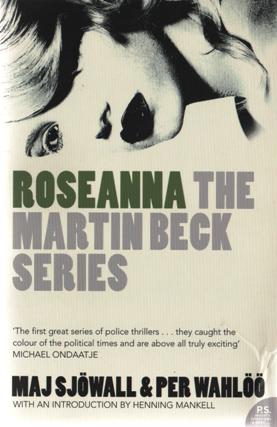 What is it about Scandinavian crime? I’m not reading it all, but there is quite a lot in the stacks and I’m not sure why; I don’t think it’s a bandwagon on which I have jumped along with many others as everything I’ve read so far has been great, but it is interesting how much has been published over the past few years.
Although I have to confess that I picked this up without really registering that it actually was Scandinavian; for some reason I thought it was German – probably just because the hero’s name is Martin Beck, which (feebly) sounds faintly German to me.
Bit of a rambly intro into a review of a book which I enjoyed very much.
Roseanna is the first of 10 novels in the Martin Beck sequence which look at crime as a reflection of Swedish society (as explained by Henning Mankell in his fascinating introduction) and was published in 1965. It is the story of the investigation of the murder of Roseanna, though at the beginning we know nothing about her for quite a long time, she is simply a body pulled from a lake by a dredger, clearly murdered but by whom?
What makes this such an interesting read is how it concentrates on the tedium of much police work. It takes Beck and his colleagues ages to find out anything about the victim other than the stuff that is revealed by the post-mortem, and what they do find out is partly based on luck.
Beck himself is not what I expected; yes, like a lot of detectives, he isn’t entirely happy at home, though he at least is still married to his wife unlike so many others, and he is prone to depression and has problems with his digestion which gives an interesting perspective on how he handles his job. The importance of team work comes across; Beck is not one of those detectives who goes off on his own following hunches, this is a proper police procedural. And the killer and his motive (if it can be called that) was sadly all too plausible.
Will definitely be looking for others in the series.
 This is part of the Treasury of Victorian Murder series, and was the one I was always going to get first simply because I have been fascinated by the Jack the Ripper, and indeed serial killers of all sorts, since I can remember, all the way from Gilles de Rais to Ted Bundy.
A bit morbid, I know, and the sort of admission that immediately gets you marked as the obvious suspect in any decent American crime series. Especially when coupled with the kind of books on the subject that I have in the stacks.
Can’t explain it, just once of those things, no need to be afraid, honest.
So Jack; well, iconic killer largely because his murders not only remained unsolved but have spawned the wildest of theories about his identity, from the Duke of Clarence to Walter Sickert to Sir William Gull, which in turn has led to some great books, both fiction and non fiction. And of course the movies; my particular favourite being Murder by Decree with the great Christopher Plummer.
But I digress.
This is a great little book, which tells the basics of the story as it happened as if through the diary of a contemporary who had access to the police. I loved the artwork which managed to give a real sense of place and conveyed the gruesomeness without dwelling on it, probably helped by being in black and white.
A very nice addition to my true crime library.


 Bride of the Book God