You are currently browsing the category archive for the ‘Reviews’ category.
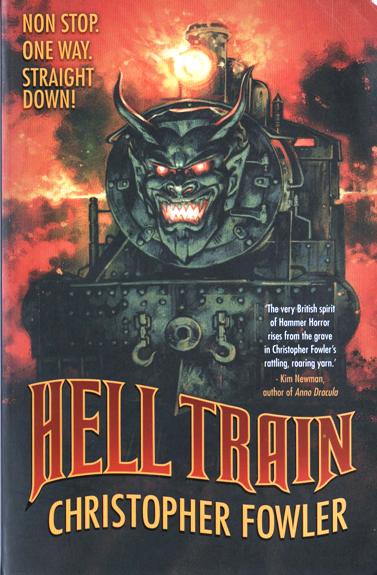 First thing to say is that I pre-ordered Hell Train on Amazon on the basis of the cover and title alone, and when I later read the synopsis of the novel I knew that my instincts were right. This is wonderful, gory stuff.
I am a huge fan of Christopher Fowler, who in recent years has focussed mostly (but not entirely) on his remarkable Bryant & May series of detective novels, but I first came across him as a horror writer via the (sadly now out of print, I think) Darkest Day which I read on holiday in Istanbul; something about its style worked really well in the early evenings against the sound of the call to prayer. Since then I’ve read as much of his stuff as I can get my hands on and a number of his books have been reviewed here.
I’m not going to go into the plot of Hell Train other than to say that it is about a group of passengers who find themselves on a sinister train, the Arkangel, somewhere in Eastern Europe around the time of World War One, and have to deal with some rather unpleasant situations before they reach their unknown destination. The story is book-ended by the tale of Shane Carter, an American who finds himself tasked with writing a script for Hammer Studios.
Oh, I so wish this was a real movie.
I grew up watching Hammer films on TV; I was a particular fan of the various Draculas (I’m sure that’s what triggered a lifelong interest in vampires), loving both Christopher Lee and Peter Cushing. I’m ashamed to say that I don’t think I’ve ever been able to watch the The Curse of Frankenstein since my first attempt ended in abject failure when I stayed up late as a teenager on my own to watch it on BBC 2 and couldn’t bear the Monster’s face when Lee pulls the covering from his face. Although it’s entirely possible I imagined the whole thing….
So this was definitely my cup of tea, especially as it is reminiscent of one the greats from the 1970s, Horror Express. They really don’t make them like that any more.
But what of the novel? Well, quite simply I really loved this; a good framing device, an exciting story, some proper nastiness, excellent villains and characters you can really root for (I am looking at you, Isabella). I am sure there are absolutely loads of references and in-jokes that I didn’t get which will add to the enjoyment of a genuine film buff, but my verdict is great fun all round.
 I’m not sure where I first came across On Monsters but I knew as soon as I had read the synopsis that I really wanted to get my hands on this and pestered the Book God on more than one occasion to get it for me, and bless him he came through at Christmas.
The book is a cultural history of monsters from the ancient world through the medieval period, dealing with the scientific view, the monsters of our innermost thoughts and ending with what we might think future monsters will look like.
It’s a scholarly work but very readable, though one to be savoured as there is so much to take in on each page. It has a number of fascinating illustrations, many of them drawings made by the author, of legendary monsters and medical samples and some examples of modern art which is really out there, where artists have modified their bodies (temporarily or otherwise) to create their art, or swallowed cameras to make sculpture out of the inside of their bodies. All this is about difference, which lets face it underpins a lot of our view of what a “monster” is – something other, strange, and therefore strange and frightening.
This is book full of the sort of facts that have you reading bits of the book out loud to anyone within earshot (well it does if you are me); some of these are totally fascinating, for example:
- in the 1920s, paleontologists working in China were told of dragon bones scattered on the ground, which when investigated turned out to be the remains of late Cretaceous period dinosaurs; when they looked at the skeletons of the parrot-beaked Protoceratops it was clear how similar they were to descriptions of griffins;
- many legends involving St Christopher state that he was a Cynocephalus, ie a dog-headed man and may images show him as such.
The existence of monsters could be a real issue for the medieval church, especially where witches and demons were involved; it was very easy to slip into heresy by claiming that they created monsters. Much better to make the argument that demons couldn’t create a new form of life but could alter the essence of something that already existed; monsters were therefore the production of chemistry rather than creation.
Over time as science took sway (and quite rightly so) our view of monsters changed as we came to understand how aberrations and anomalies can come about within different species. And once psychology gets involved then we start to see certain monsters as projections of our frustrations (a favourite theory of Freud, of course).
Asma is particularly interesting when looking at the cultural impact of monsters. He sets Frankenstein within the context of a period where monsters were seen not to be real but “terrible confusions”, though the impact of the Napoleonic Wars on France and elsewhere contributed to a Counter-Enlightenment position where there could be “too much reason”.
One of my favourite references is to the original version of The Thing (1951) where a dispassionate scientist, Dr Carrington, waxes lyrical about the beauty and superiority of the alien being ( a position often taken by scientists in film and literature – we just don’t understand how magnificent these creatures are, you see); often the outcome is as Asma says “the alien responds to the admiration, of course, by bludgeoning the good doctor.” He also talks about one of my favourites, Blade Runner, and how we define what it means to be a “person”.
The main thing to take away from this wonderfully well written study is that monsters in one form of another are an archetype in every culture’s artwork, and will always be with us, whether a legendary beast, a serial killer or technology gone mad. Excellent stuff, highly recommended.
 Astonishingly I haven’t talked about books that I have read at all this year, my last one being Mister Creecher in December, so it’s nice to not only have finished a book but to be able to talk about it. And this is going to be an interesting one as I feel as if almost everyone in the world who is likely to read The Hunger Games has already done so, and I came to the book having read quite a bit already about the film version which will come out very soon.
I’m not really going to talk about the story as that’s kind of out there already because of the huge popularity of the trilogy and the film and the internet chatter about who is playing whom and what changes may have been made. And I suppose in some respects its difficult to give a full review to a book which clearly doesn’t stand alone; it ends at a point where you can guess that the story is going to take off in another direction.
I’m also aware of the criticism some have made of the author and whether she had or hadn’t read (or seen) Battle Royale which has similar themes (though I may not be competent to comment on as I haven’t seen/read it) and should therefore have acknowledged its influence.
So I read it with all this stuff in the background and the distractions perhaps made it difficult to get into the story but once I did get involved I really wanted to find out who was going to survive. It has real pace and some very interesting observations on how people behave when they are forced to fight not just for their own survival but the fate of their community as well.
Katniss is a very attractive heroine and there are some fabulous supporting characters, but it felt unfinished to me because it’s clearly part of a sequence and perhaps I can only really take a complete view when I’ve read the other two, which I fully attend to do. However, I did enjoy it and do want to know how the whole thing turns out.
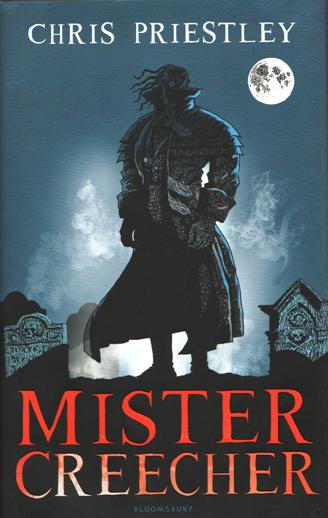 I am a huge fan of Christopher Priestley, having read all three volumes of his Tales of Terror Series, and as part of RIP VI his excellent ghost story Dead of Winter (reviewed here), a real gem. So as soon as I found out that Mister Creecher was being issued I had to get a copy and it hasn’t lingered long on the TBR pile.
So it is 1818, and we meet Billy, on the streets, ill, and turned into a pickpocket after running away from the chimney sweeper who treated him cruelly. He stumbles across an enormous man, apparently dead, lying in a side street, but as he is about to rob the body he is accosted by members of a street gang. But before they can beat him, the mysterious body rises from the ground and does them serious damage. And so we meet Mister Creecher, and his relationship with Billy begins.
Mr C looks after Billy during his illness and they form something of a bond, though Billy is very aware of the strangeness of his new companion and in exchange for food, shelter and some assistance in frightening potential robbery victims into parting with their valuables, Billy simply has to follow one man around London. But that man happens to be Victor Frankenstein.
This is a wonderfully different telling of part of the Frankenstein story. The creature is a compelling character, a mix of intelligence, brawn and childish desires, especially for the mate that Frankenstein has promised him. His recognition of his otherness is both touching and sad, and his desire to not be the only one of his kind, while filling Billy with horror, is the driver that moves him on.
But it is Billy who is really the heart of the story, as he works his way from street urchin to more sophisticated criminal before the events that will turn him into a character that some of us will know from another famous 19th century novel. There are clues to Billy’s identity for those that want to see them, but I’m not going to give it away here as it is part of the impact of the novel.
There are some lovely literary references and in-jokes which I found really enjoyable, and some real historical figures popping up here and there, most notably the Shelleys. Priestley paints a really effective picture of London at the time and what it was like to be an outcast child with no hope other than the workhouse or the type of hard manual labour which we would consider abuse today.
I have to confess that I haven’t read either of the novels from which the main characters are drawn, a bit surprising in relation to Frankenstein given my love of things gothic but I tried once when I was a teenager, and found it really hard going in comparison to Dracula.
But this is an excellent, creepy, atmospheric story which has made me consider giving Frankenstein another chance.
Heartily recommended.
 So, The Fall continues the story begun in The Strain (which I reviewed here) and begins almost immediately where the last novel left off.
Our main cast (and I really should stop treating this as if it was a movie script, but I just can’t seem to) and as a reminder they are:
- flawed scientist hero
- lady scientist love interest
- scientist’s son
- old man with secret knowledge
- exterminator chappie
have not yet recovered from the shock at the end of book one which I won’t go into here, and are re-grouping to decide how they are going to deal with the big bad guy that they failed to stop and whose nefarious plan is coming to fruition. The Big Bad Plan is more extensive than anyone thought, and it becomes really, really, seriously important to discover how the vampires originally came into being, and so the search for this story’s McGuffin – an ancient text called the Occido Lumen – becomes the focus for a large portion of the book.
And that’s probably enough plot, because let’s face it, the main thing this novel has going for it is its plot, so not fair to give more away.
I’m not going to say that the writing is bad as such, but it is pretty workmanlike and totally in the service of driving the story forward. There are huge chunks of exposition throughout which were on occasions a bit distracting, as were the flashbacks (some of which at least served to give some context) and various diversions, including one to the International Space Station which, unless I missed something, didn’t really serve any purpose apart from a bit of gosh-wow-this-is-really-serious-stuff.
Having said all that I did stay up late to read the last third of the story and I will be buying the final volume just to see how on earth (if at all) they all get out of this one. But if you are planning to read this (1) don’t start here and (2) expect a certain amount of middle book of trilogy syndrome. Would still love to see it as a mini-series.
This was on my master list for RIP VI but not read as part of that challenge.
 I decided to read this after I had such a wonderful experience with A Visit from the Goon Squad earlier this year, and several people said that they thought this was better in many ways, so how could I possibly resist? I took it on holiday with me in october and made a good start but took ages to finish it, not because I wasn’t enjoying it but because as often happens, life got in the way.
But finish it I did and I’ve been thinking about it ever since.
Charlotte Swenson is a model now in her early thirties, past the peak of her career but still getting catalogue and other work sufficient to maintain a certain lifestyle in Manhattan. The book begins with her back in her home town near Chicago, recovering from a terrible car crash, her injuries so severe that her face has had to be reconstructed. While there she visits the home of her estranged best friend from school while she believes everyone is out, and gets caught by Ellen’s teenage daughter, also called Charlotte. The novel alternates between their two stories from that point on.
This is a book about identity; older Charlotte’s face looks just different enough that many of the people she knew from her glamorous life simply don’t recognise her, and she struggles to regain her place, ending up taking part in an internet experiment where her life will become available for everyone to follow online. Young Charlotte is struggling with growing up, trying to work out who she is and what she wants from life, against a background of her younger brother’s recovery from cancer and the strain that’s put on her family.
This summary of the very bare bones of the plot makes it sound really glum but I thought it was a smart, engaging and thought-provoking story about how we present ourselves to the world, regardless of what’s going on inside our heads. One of older Charlotte’s gifts (if you can out it like that) is to be able to see the secret inner life of the people she comes across; this only happens when they think no-one is watching and their guard comes down. Older Charlotte almost can’t relax with a person until she has seen that secret self.
There are a number of other characters in the book who serve to illuminate the struggles of the two main characters, including the mysterious Z who seems to have his own agenda as he infiltrates older Charlotte’s world. Indeed, it’s worth reading the author’s afterword where she talks about creating the character of Z well before 2001 and how differently the character appears after the events of 9/11.
My only quibble is that I felt the ending was in many ways rushed. Not badly written at all but I had become so attached to both Charlottes that I just wanted to know more about how things were finally resolved, though that may say more about me as a reader than the success of the novel.
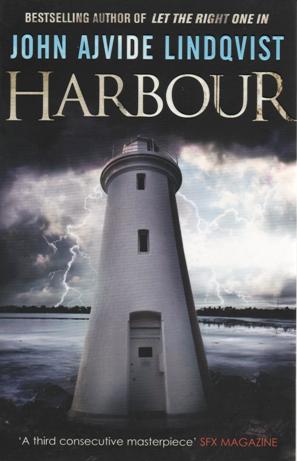 Well now, this one is a bit special.
Readers of this blog will know that I am very fond of John Ajvide Lindqvist having read and reviewed his Swedish vampire novel (Let the Right One In) followed by his Swedish zombie novel (Handling the Undead) both of which were about considerably more than the tags I’ve given them here. Both were about love and relationships and harbour is in many ways no different, though I haven’t yet been able to come up with a suitable Swedish tag for it.
There is a tiny wee story behind this, in that having persuaded my friend Silvery Dude to try Lindqvist he has been racing ahead and actually read this some months before I did. he recommended that I save this until the autumn, which is why I took it with me to berlin on my recent trip. It felt right to be reading this story in a more European setting than good old Surrey, and his recommendation and my instinct were both correct.
So, Harbour tells the story of a community, Domaro, which makes its living from the sea and from the summer visitors who have built houses there. Our entry to the community is through Anders who has a foot in both camps. One winter day he and his wife take their little girl, Maja, out onto the thick ice to visit the local lighthouse. They only look away for a few minutes, but in that short time every parents nightmare occurs; Maja has disappeared. There are no holes in the ice, nowhere that she could have gone, and despite searching high and low with the help of their neighbours, Maja can’t be found.
Two years later, his marriage destroyed and dependent on alcohol, Anders returns to Domaro determined to find out what happened. At this point we are also introduced to Simon, a stage magician and the partner of Anders’ grandmother. As strange events begin to occur and the secrets of Domaro begin to be revealed, Simon comes to understand that despite the number of years he has spent there he is very much an outsider. Between them he and Anders begin to unpick, albeit accidentally at times, what has been lurking underneath daily life.
I really, really enjoyed this novel. As in his previous books, Lindqvist shows great skill in describing strong emotions such as love, grief, betrayal and anger. His characters are fully rounded (my favourite was Simon) and I really wanted to know how they would get through the events which unfolded. The introduction of the supernatural elements (I’m not sure how else to describe them) builds up slowly and by the time some of the more bizarre incidents take place I was really invested in the story. How the community came to collude in and rely on the secret at its heart was all too plausible. If weird.
I agree whole heartedly with the comment on the cover “a third consecutive masterpiece”; so much so that I have already got a hold of his fourth novel, Little Star.
Strongly recommended.
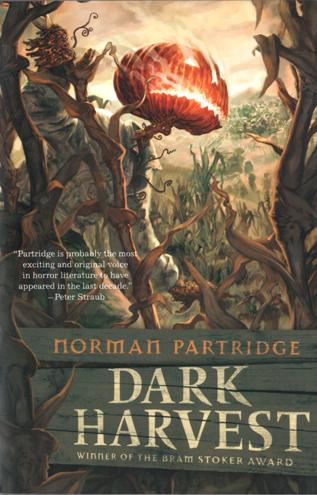 This was an interesting one. I must admit that I bought it largely for the cover, I am a sucker for pumpkin-headed things and am still disappointed that my copy of Simon R Green’s Shadow’s Fall has this cover rather than this one.
Anyway, that’s what attracted my attention, and then of course I read the blurb and liked the idea of an annual animated pumpkin thing rising from fields and running a gauntlet of young men, and one of the quotes on the back talked about blood and gore and candy, so it was a clear choice for RIP.
And then I started reading it and hit a bit of a snag at first because it was unpleasant and nasty and I couldn’t connect with any of the characters. But, just at the point I was seriously considering setting this aside something changed. I’m not sure exactly what or when – perhaps it was the background to the October Boy being explained made it more interesting – but I decided that I would persevere and I’m glad I did because although it continued being nasty and unpleasant it was also well-written and had a real narrative drive and I did begin to like the “hero” a bit more and the character that I particularly loathed got his comeuppance in a suitable way.
So with retribution meted out it turned out to be a good read.
And as I said, very apt for RIP VI for which I think it’s my fifth read.
 A slightly different genre for my next RIP VI read, The Rapture is a described as a psychological thriller; now I’ve never been entirely sure what that means, but I can certainly say that this was thriller of the “will it all really happen the way she predicted kind”, with a world potentially on the brink of catastrophic disaster and only the delusions and/or predictions of a murderous teenager in an institution to warn us of what is to come.
What I don’t think it is is a “haunting story of human passion and burning faith” as it says on the back cover; it has elements of both of those things, yes, but this is more a 2012 ecological end-of-the-world-as-we-know-it story, albeit much less silly than that particular film (and you can find out what I thought about that here.) And my disgruntlement with the world of the blurb-writer goes on…..
So we have Bethany, incarcerated in a facility for the disturbed because of the brutal murder of her mother a few years before. We have Gabrielle, confined to a wheelchair after a car accident, trying to rebuild her career as a therapist. We have Fraser, a scientist who gets drawn into the story when he helps Gabrielle investigate the predictions Bethany has been making and which certainly seem to be coming true. But are they true or is everyone being drawn into Bethany’s delusions as has happened before?
There is evangelical religion in the form of Bethany’s father; what role did that play in how she is now? There are Gabrielle’s trust issues as she struggles to come to terms with her situation. There is romance and distrust and skullduggery, but most of all there is freak weather, earthquakes, floods, hurricanes and at this point I want to start quoting Bill Murray from Ghostbusters when he’s trying to convince the mayor to let them sort out the Big Bad.
And that would be really unfair.
Because although this novel strays into soap-opera-ish melodrama on more than one occasion it does have serious stuff to say about how we manage our planet and the dangers of some forms of extreme religion when faced with real and practical problems. And the author doesn’t dwell on the disasters more than is necessary to give us a sense of scale and to give our heroes a real dilemma to deal with – if you think you know something terrible is going to happen but your source is frankly unbelievable and talking about it could ruin your career do you still have a moral obligation to take action?
I enjoyed this in a potboilery way, it moved along at a fair clip and I was interested in what would happen to the characters and how the scenario would play out. I’m still not sure whether I really liked any of the characters, but let’s face it, we weren’t really seeing them at their best.
This was my fourth read for the RIP VI challenge, and there is more than enough peril in this book for most readers.
 I think it’s fair to say that The Dead of Winter is one of the very best ghost stories that I have ever read, and I say that as someone who thoroughly enjoyed and was totally creeped out by Dark Matter earlier this year. And it’s not just that I am a huge Chris Priestley fan, having read his three books of Terrible Tales (see here, here and here), though of course I am. I just loved this well-written, perfect, little tale.
This is the tale of Michael Vyner, looking back as an adult at the Christmas he spent with his guardian in his isolated East Anglian house, Hawton Mere, and the terrible events that unfolded there. Michael is not there out of choice; his mother has just died, and Sir Stephen is someone he wants nothing to do with – he is bitter that his father was killed saving Sir Stephen while they served together in the army and Michael believes that the wrong man died. But he is a young boy with no other family and reluctantly accedes to his mother’s dying wish that he allow Sir Stephen to give him a new start in life. But Hawton Mere hides a dreadful secret…..
And that’s all I’m going to say because anything more would just spoil it.
This is just smashing, I read it virtually in one sitting and it was totally satisfying as a ghostly tale, very traditional and I mean that in a good way. It’s set in the Victorian period and has everything you might expect – friendly servants, an aloof but actually rather nice lawyer, the strange guardian and his devoted sister, and mysterious goings on some of which are pretty scary. I keep on wanting to compare it to both MR James and The Woman in Black, all for the very best reasons, but that’s a bit lazy of me.
All I will say that if you enjoy ghost stories you will love this.
It is my third read for RIP VI challenge. The shortest so far but already shaping up to be my favourite.


 Bride of the Book God