You are currently browsing the category archive for the ‘Challenges’ category.
So once again I find myself signing up to more challenges despite last year’s poor showing, but I am nothing if not optimistic and willing to have a go at the following:
 The Graphic Novel Challenge 2010
An excuse to read comics (as if I needed one), an excuse to frequent Forbidden Planet even more than I do now (as if I needed one of those either), and excuse to re-read The Sandman (and to persuade Silvery Dude to have a go at volume 2). Sounds like a plan to me..

42 sci-fi things in 42 weeks.
Irresistible, did quite well last year, one of the few that I managed to finish, lots to read and watch so hopeful of an equally good result this year. Not making a list, far too much to ponder on, but at the very least Dr Who: The End of Time will be near the top….
 And last but my no means least, a companion to The 42 is Carl’s Sci-Fi Experience 2010, an excuse to wallow in all things sc-fi for a couple of months. Again, not planning to make a list but I’ll just see what takes my fancy….
 What can I say? The past fortnight has been absolutely hectic at work and at home, with big projects hitting important milestones, crazy working hours, preparations for Christmas and hardly any reading time to speak of.
But, hopefully, with the holidays coming up I can catch my breath a tiny wee bit, actually read some books, wallow in the David-Tennant-obsessed BBC for the rest of the year, and resume something resembling a decent blogging schedule.
Or not.
And the first thing to do is to report back on Fall into Reading 2009. In my original post I set myself the following goals; progress noted alongside:
- read the six books I took on holiday with me (managed three, the others are still firmly on my list)
- read Blonde by Joyce Carol Oates (nope, and no chance between now and 31 December)
- finish the 42 Challenge on time (done – hurrah!)
- finish Carl’s RIP IV challenge on time (not done but read three which, as kind readers reminded me, wasn’t bad)
- restart the Reading Muriel Spark project (nope again)
At the time I thought it was quite a bit to do, and I was right, but it was certainly worth a try and some of these will spread into 2010 I’m sure (looking at you, Joyce and Muriel…)
 So after yesterday’s post it seems a bit surprising to be writing about another challenge, but this one looks too good to resist. Women Unbound runs from 1 November 2009 until 30 November 2010 and involves reading both fiction and non-fiction from the field of women’s studies.
I’m aiming for Bluestocking (at least five books including at least two non-fiction) but hoping to hit Suffragette (at least eight books including at least three non-fiction) and I’m almost certainly going to be reading only non-fiction, partly because I don’t read enough of it anyway, but mostly because I’m not sure what actually constitutes a feminist novel.
My proposed booklist is (in no particular order):
- Death and the Maidens: Fanny Wollstonecraft and the Shelley Circle by Janet Todd
- The Secret Life of Aphra Benn by Janet Todd
- A Literature of Their Own:British Women Novelists from Bronte to Lessing by Elaine Showalter
- Singled Out: How two Million Women Survived without Men After the First World War by Virginia Nicholson
- Bess of Hardwicke: First Lady of Chatsworth by Mary S Lovell
- Rosa Luxemburg: Ideas in Action by Paul Frohlich
- Catherine de Medici by Leonie Frieda
- Divorced, Beheaded, Survived: Feminist Reinterpretation of the Wives of Henry VIII by Karen Lindsey
- Elizabeth & Mary: Cousins, Rivals, Queens by Jane Dunn
- Mary of Guise in Scotland 1548-1560: A Political Study by Pamela E Ritchie
- Diana, Princess of Wales: How Sexual Politics Shook the Monarchy by Beatrix Campbell
- The Bugatti Queen by Miranda Seymour
- Vera Brittain: A Life by Paul Berry and Mark Bostridge
- Christina, Queen of Sweden: The Restless Life of a European Eccentric by Veronica Buckley
So there we have it. Not surprisingly from me, lots of sixteenth century related biographies buried in there, bit of literary stuff as well, tiny wee bit of politics, in fact a pretty reasonable spread which even I with my poor record should be able to get through in a year. Not holding my breath though.
And there is a start-up meme:
1. What does feminism mean to you? Does it have to do with the work sphere? The social sphere? How you dress? How you act? Crumbs, where to start? Well, I was born at the beginning of 1962 so by the time I was a teenager there had been huge changes in the expectations I (and my parents) had for my future compared to what my mother (who was born in 1941) could expect. I think feminism has to relate to all of the above and totally and utterly revolves around choice. There are no right answers for women (as there aren’t for men, to be fair). You have to do what’s best for you and your own personal situation, and should be allowed to do so without criticism. If only.
2. Do you consider yourself a feminist? Why or why not? I definitely do consider myself a feminist and have done so for over thirty years (and lord just typing that makes me feel pretty ancient). I blame Virginia Woolf and A Room of One’s Own which I read just after I started university at the end of the 1970s. But it’s important to me that being a feminist doesn’t mean you can’t do the fashion thing ( as one look at my shoe and handbag collection will testify) and a sense of humour is an absolute necessity.
3. What do you consider the biggest obstacle women face in the world today? Has that obstacle changed over time, or does it basically remain the same? I think this very much depends on what part of the world you are living in. In my bit of western Europe it’s about choice and things like body image and the expectations we put on young women in particular as a society. Elsewhere it’s the fundamentals of access to the democratic process, access to education; really basic stuff which some of us take for granted.
 So yet another failed challenge; it’s been a bad year for reading to order (if I can call it that, possibly being a little bit harsh) and I am choosing to blame it all on pressure of work though poor reading planning on my part is almost certainly just as culpable.
Anyhow, in my original post here I identified eight possibles of which I planned to read four; I actually made it to three:
- the reporter investigating a serial killer in her home town one
- the small boy trapped in train tunnel being entertained by Gothic stories one
- the freaked me out Swedish zombie one
Close, but no cigar.
Oh well, there is always next year….
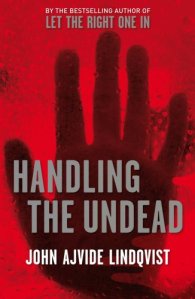 Otherwise known as the it-really-freaked-me-out Swedish zombie one.
So Handling the Undead is the second book by John Ajvide Lindqvist, who wrote Let the Right One In which was one of my favourite reads of last year and spawned one of the best films of 2009 (thoughts on the book are here, and the film over here).
We are in Stockholm; the whole of the population seems to be sharing in one giant communal headache as it what feels like a thunderstorm is approaching, and no electrical appliances can be turned off, so this is a group of people under some stress. And then suddenly it stops. And roughly at the same time the dead come back to life; well not all of the dead, only those who have passed away during the previous two months.
We follow what happens over several days through a small group of characters: David, a stand-up comic whose wife is killed in a car accident just before the zombie stuff starts, and is among the first to come back; Magnus, a reporter whose young grandson died in an accident several weeks before; and Elvy, recently widowed, and her grand-daughter Flora, who both have a paranormal gift and can tell what others are feeling. Not giving too much away here as these characters and their respective situations are all introduced in the first few pages and give the emotional heart to the book.
Now I will put my cards on the table here and say that I have always had a problem with the concept of zombies in that they totally terrify me. I don’t think I have ever been able to sit through a whole zombie movie. I can happily read/watch anything about vampires, werewolves and other supernatural beasties, but zombies definitely give me pause. And I think it’s because it could happen; not the living coming back to life as such, but large groups of people becoming violent through some kind of virus or something sounds all too plausible to me and I’d rather not think about it, thank you very much.
And certainly the beginning of the book played into all of that, being pretty gruesome and not a little frightening, and it’s probably my own fault that I got so freaked as I started reading the book in bed, a stupid thing to do giving everything I said above and perhaps I deserved what I got (but thankfully no nightmares).
But then it turns into something quite different. What do the reliving actually want? How would you react if someone close to you came back but weren’t quite right? How does a modern, liberal, enlightened western European nation actually handle a situation (the answer being not terribly well and far too slowly)? And how do people of faith deal with what could be a harbinger of the end times? Oh, and can love survive?
Sounds like heavy stuff but this manages to deal with all of these issues in a thoughtful way, and this is where the range of characters actually helps move things along as they all look at the situation from a slightly different perspective. And I was so keen to find out how this would all end that I finished the book in bed in the small hours of the morning, despite my previous misgivings. It is quite gory in places but not gratuitously so.
Highly recommended. And my third read for the RIP Challenge. And I may just have to look at this zombie thing in a whole new light …
 So, more Gothic creepiness from the wonderful Mr Priestley in Tales of Terror from the Tunnel’s Mouth, and a good read for RIP IV.
Robert Harper is returning to school, desperate to get away from his stepmother with whom he has been spending his time while his father is fighting the Boers in South Africa. Robert is travelling by train, and we first meet him on the platform with said stepmother, an emotional woman who has a premonition that something will happen to Robert, involving a tunnel and a kiss. Robert shakes her off, gets on the train and finds himself in a carriage which slowly fills up with a number of gentlemen also travelling to London.
Robert dozes off, and when he wakes up he finds that all the other passengers are asleep except for a young woman with red hair, dressed completely in white, who is sitting opposite him. The train has stopped at the mouth of a railway tunnel, and to while away the time the mysterious woman tells Robert a number of sinister stories, while he struggles to keep awake…..
Another really enjoyable collection, with a little mystery at its heart – who is the woman in white? What (if anything) does she want with young Robert? Why is everyone else solidly asleep?
Favourites in this collection are:
- The Glasshouse – you really shouldn’t get too close to some of those plants….
- The Crotach Stone – beware the auld folk….
- Sister Veronica – art appreciation and nuns…
And the illustrations by David Roberts are equally creepy.
This is my second read for RIP IV
 So I know I’ve had lots of problems with challenges this year (only completed one so far) but I enjoyed participating in this one last year and thought I’d have another go.
And that was as far as I got in writing this post on 26 September which seems ages ago; my only excuse for having put this aside being the last minute, signficant flurry of work before my annual holiday, which started technically as soon as I left work on Friday but starts properly tomorrow when we head north.
So, aims for Fall into Reading this year are:
- read the six books I’m taking on holiday with me
- read Blonde by Joyce Carol Oates which I identified as something I wanted to do way back at the beginning of 2009 (and where has the year gone, I ask you?)
- finish the 42 Challenge on time
- finish Carl’s RIP IV challenge on time
- restart the Reading Muriel Spark project which I’ve singularly failed to progress since I started two years ago…
That seems quite a lot to be getting on with; let’s wait and see how I do…..
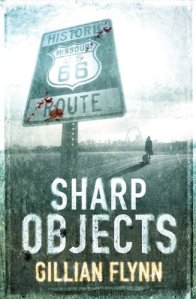 OK, so where to start with this one? Sharp Objects is about a reporter, Camille, who is sent by her paper in Chicago to investigate the murder of one girl and the disappearance of another in her home town of Wind Gap, Missouri. Is a serial killer involved? How are the local police faring in their investigation? Is it a local or an outsider who is committing these crimes? All the usual questions that you would expect when death hits a small town.
And of course, all is not well in Camille’s life. She has a tragic past (death of her sister); to describe her relationship with her mother (with whom she is forced to stay during her trip) would be a gross understatement; and, well, to put it (incredibly) mildly, she doesn’t exactly have a history (or a present) of looking after herself.
And of course, the crimes may all be a lot closer to home than she thinks.
I’m still not entirely sure how I feel about this novel. There’s a very prominent endorsement from the great Stephen King (well, I think he’s great) on the back of the edition I read, where he talks about Sharp Objects as ‘relentlessly creepy’, ‘dreading the last thirty pages’ and so on. And in some ways he is right, it is creepy, the story does linger, it does have a cumulative nastiness factor. Whether you have any positive feelings about the characters or not (and some reviewers really don’t like the portrayal of women in this book) it is in many ways very powerful. But……
And I’m not sure what that but is. I felt a lot of sympathy towards Camille because of her awful childhood and what it had done to her both physically and mentally. But something went askew for me towards the end, and I think it’s because after a slow and relentless build up it was all suddenly over. There was a huge revelation (for Camille at any rate) all the pieces appeared to drop into place, and then there was a ‘Carrie’ ending (film not book so if you haven’t watched the Brian de Palma movie you might not know what I mean). And you knew it was coming, and if you had half a brain you knew what it was, and for all those reasons it was a bit unsatisfying. Which is a real shame.
This is absolutely by no means a bad book; I just think it could have been even better.
This was my first read for RIP IV.
The RIP IV challenge is indeed here and after some consideration I have come up with the following list from which to select my four books for Peril the First. I’m also going to try to participate in Short Story Sunday if I can.
So the list is:
- The Lamplighter by Anthony O’Neill
- something by Stephen King – either Duma Key, Cell, Just After Sunset, or even a re-read of ‘Salem’s Lot in this rather lovely edition
- Handling the Undead by John Ajvide Lindqvist
- 20th Century Ghosts by Joe Hill
- The Mark of the Beast by Rudyard Kipling
- Sharp Objects by Gillian Flynn
- Come Closer by Sara Gran
- Drood by Dan Simmons (despite the mixed reviews)
So that looks like a reasonable selection, but what of the other challenges I’ve been involved in? Well I still have good intentions for the 42 Challenge and the Art History Reading Challenge, the 100 Shots of Short is looking a bit peaky, but I am definitely going to have to throw in the towel when it comes to the Non-Fiction Five Challenge – that’s just not going to happen this year.
 So, a rare event for this year, a challenge I have actually completed! So, just to recap, I said here that I would read one novel, one graphic novel and one young adult or children’s book, and watch one film. And I actually managed to do all of that as follows:
Novel = The Graveyard Book
Graphic Novel = Neverwhere
Children’s book = Blueberry Girl and The Dangerous Alphabet
Film = Coraline
And I’ve persuaded the Silvery Dude to throw himself into reading the first Sandman graphic novel, so spreading the word!


 Bride of the Book God