
You are currently browsing the tag archive for the ‘Victoriana’ tag.
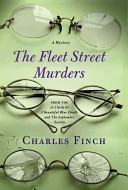 The Fleet Street Murders is third in the Charles Lenox mystery series set in the 1860s. He’s a sort of mid-nineteenth century Lord Peter Wimsey, I suppose (and I’m not the first to have suggested this at all), with detection as more than a hobby but less than a profession (given his aristocratic position).
So, in this one Lenox is standing for Parliament while his friends are in some distress and his love life is wobbling. At the same time two journalists have been murdered in London and he is torn between his duty to his potential constituents and his desire to solve the crime.
As with the others I found this an enjoyable and easy read. The author is American, and there were the occasional usage of words that wouldn’t trip off a Londoner’s tongue now (sidewalk? cookies? (well, maybe these days the latter might be heard) ) let alone in the mid-Victorian period (and I’m happy for any Captain Pedantics out there to set me straight if I’ve got that wrong) but these were only very mildly irritating. His lady love is still too good to be true, though maybe marriage will sort that out. Mystery was pretty satisfying but the best bits for me were all to do with his political campaign.
So, good holiday read and I will certainy look out for the fourth in the series.
 We’ve now decamped to Perthshire, and for our first full day in the area we decided to take one of our favourite drives through Blairgowrie to Kirriemuir to Edzell, where we stopped off at Edzell Castle. This is one of our absolutely favourite places, and I’ve included a picture of the gardens which doesn’t do it justice by any means.
Then to Banchory, where we picked up Queen Victoria’s trail, through Ballater (where we stopped for afternoon tea at what was the station where the Royal trains would stop, and shopped in a grocer’s with the Royal Warrant on the wall), before skirting Balmoral and heading back Perthwards via Braemar and Glen Shee.
Would love to share pictures of the gorgeous autumn colours but a mixture of dampness and low cloud made getting a decent snap difficult; perhaps later in the week I’ll be luckier.
 So The Kingdom Beyond the Waves is sort of a sequel to The Court of the Air (which I reviewed here) in as much as it takes place a few years after the events of that book and features some of the same characters but that’s as far as it goes. It’s possible, I think, to read this as a standalone novel, and a very enjoyable piece of steampunk it is too.
What we have is an adventure-quest-type story. Amelia Harsh, she of the gorilla-sized arms who appeared briefly in the first novel, has a bit of an obsession with the lost land of Camlantis, a perfect society blown into the sky to be hidden rather than fall prey to the barbaric hordes seeking to destroy it. She is funded in her search by the wealthiest man in Jackals, Abraham Quest, equally obsessed. She heads into hostile jungle territory on a submarine with a crew of liberated prisoners and a mercenary army of extremely effective female warriors. It becomes clear, however, that she has not been told the whole story, and there is danger and treachery aplenty before she reaches the end of her search….
As I said, this is very enjoyable, although I will be honest and admit that it took me longer to get into, mostly because I found it difficult to immediately engage with any of the main characters. But once again the world of Jackals and the other societies that surround it are so wonderfully imagined and constructed that I persevered, and there came a point when all the subplots and the main story came together and everything clicked in such a way that I was really keen to find out how all this was going to be resolved. Great stuff.
 So Susan over at You Can Never Have Too Many Books has started a very interesting discussion on the use of real-life people in fiction, whether it’s justified, how readers feel about it and so on. It’s a really thoughtful piece so do go and have a look, and I mention it here not just because I’m a fan of Susan’s blog (which I am) but because this is the second book in a row I have read which is very much set around people from the real world and I am trying to look at it in the light of Susan’s post and some of the comments that have appeared there already.
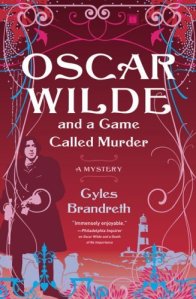
Oscar Wilde and a Game Called Murder kind of gives itself away in the title. It’s the second in Gyles Brandreth’s series (I wrote about the first one here) and does what it says on the tin; it turns Oscar Wilde into an amateur sleuth, and is packed with names that are recognisable to anyone who knows the detail of both Wilde’s life and the literary scene of the time. So, we have Arthur Conan Doyle, Bram Stoker, Lord Alfred Douglas, Robert Sherard (Wilde’s first biographer) and several other lesser known names.
The story is quite a simple one; it is 1892 and the Socrates Club is having one of it’s regular dinners, presided over by Wilde himself. At the end of the meal he suggests that the guests play a game called Murder – each of them will write anonymously on a slip of paper the name of the person they would most like to kill, and the other guests will try to work out who was chosen by whom and why. Not explained very elegantly but you can probably see where this is going. Two of the slips are blank, and the same name appears four times. And Wilde’s name is mentioned once, ditto his wife Constance. The game goes a little bit sour, but Wilde thinks nothing of it until over the course of the next three days the first three names on the list, including a parrot, die in more or less mysterious circumstances. Who around the table is a killer?
It’s an ingenious puzzle and I had absolutely no idea who the murderer was, what the motive was and how it all fitted together but I really enjoyed finding out. Wilde comes across as a complex, attractive and sympathetic figure and I learned a lot about the period. It’s well written and clearly meticulously researched by someone with an affection for both the characters and the setting. Do I think that’s what Wilde was really like? Probably not. Does it matter? I’m not sure it does. Did it make me want to find out more about the real people? Well, yes, especially in the case of Conan Doyle’s friend Willie Hornung who created Raffles; I’ve never read any of his stories and am off to find some now. The author’s note is very illuminating, and that is the one thing I do look for in a novel with real people; some indication of what’s true, and what’s invented. And there are some very nice in-jokes, too. Recommended.
 So in The September Society Charles Lenox is approached by the widowed mother of an Oxford student who has gone missing leaving only a dead cat behind him in his rooms.
Lenox takes on the case and finds himself working with both the Oxford police and Scotland Yard as a dead student is found in a public space, and the name of the mysterious September Society keeps on turning up.
And as if this wasn’t enough, Lenox is wrestling with his feelings as he considers making changes in his own personal life.
Although I quite enjoyed this novel I didn’t find it to be as strong as the first in the series, which I reviewed here. I still like Lenox as a character, but found the whole thing about his private life got in the way of what could have been a cracking mystery, and I’m not sure why, because generally I like to see the lead character rounded out and not just be a pawn in the game of solving the mystery. I also think that it didn’t help that I had worked out one of the big reveals quite early on and was slightly annoyed that Lenox took so long to do so, although of course it would have been a much shorter book if he had.
So, pretty solid and likeable but not as gripping as it might have been. Probably won’t stop me reading the next one though. Oh and once again I really liked the cover…
 So, I have been visiting Deanna Raybourn’s blog for absolutely ages; it’s one that I look at almost every day, and I always find something of interest there. But until now I hadn’t actually read any of her novels, and I’m sorry that I waited because Silent in the Grave is very enjoyable indeed.
Our heroine is Lady Julia Grey, and she is widowed at the very outset of the story when her husband collapses during a party at their home; this isn’t a total shock as he has a congenital heart problem and none of the men in his family live terribly long. However, one of the people present at Sir Edward’s death, Nicholas Brisbane, tells Lady Julia that he had been retained by her husband who had received some threatening letters, and that he believes this was murder. So we have our set up, and things really take off from there. I don’t really want to say much more about the plot as it’s nice and twisty with lots of satisfying red herrings
I loved this for all sorts of reasons: Lady Julia herself; Brisbane, tall, dark, handsome and mysterious; Julia’s eccentric family; the servants in the Grey household; and the setting in the London of 1886. It’s well written, pacy and I found the mystery quite fascinating.
I had one of “I wonder if X is the murderer” moments, and turned out to be right purely on guesswork with no idea as to the motive, but frankly it wouldn’t have made much difference if I’d worked it all out completely as I enjoyed the experience of reading this so much that I bought the sequel as soon as I had finished this one!
 Some new additions to the Bride’s library in recent weeks:
Margaret of York: The Diabolical Duchess by Christine Weightman: a biography of the sister of Richard III, a thorn in the side of the Tudors, wife of Charles of Burgundy, fomenting rebellion from across the Channel. Looks absolutely fascinating;
Leviathan, or The Whale by Philip Hoare: this book has just won the BBC Samuel Johnson Prize for Non-Fiction 2009, and is apparently a mixture of the natural history of the whale and Hoare’s own obsession with them which was triggered by Moby Dick. Already dipped in, and this may move to the top of the tbr pile;
The September Society by Charles Finch: the second Charles Lenox mystery, set in Oxford in 1866. I enjoyed the first one very much so looking forward to this as part of August crime month.
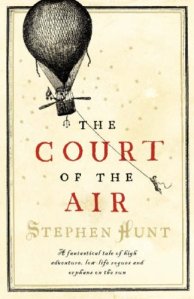 So, what to say about The Court of the Air by Stephen Hunt, which was intended to be one of my reads for Carl’s Once Upon a Time III challenge but which I miserably failed to complete on time? Well, before getting into the meat of the plot, it’s worth recording that this is one of the best examples of steam-punk that I have read, and it’s a good introduction to that genre if you have never tried it before.
We are in Jackals, a pseudo-Victorian society with a parliamentary democracy of sorts, a nominal king (who has his arms amputated when he inherits the throne so that he can never take up weapons against his people) and an extensive secret police. We have two young people: Molly, who is an orphan in the Poor House and towards the beginning of the book is taken to work in a local bawdy-house; and Oliver, who is shunned by his local community because of the time he spent within the Feymist, from where people return dangerously changed, if indeed they return at all. A separate series of violent deaths lead these two to go on the run supported by a motley crew of helpers, before their paths cross as a mysterious, ancient evil foments rebellion, threatens civilization as they know it, and all the usual society-in-peril-waiting-to-be-saved-by-an-ordinary-person-with-a-hidden-secret stuff
This is a really good adventure story with a remarkably well-imagined world as its setting. Some of the other species (if that’s the right word) that Molly and Oliver come across are absolutely fascinating, my particular favourites being the Steammen, sentient machines with astonishing abilities and a well-developed society of their own. There is an extensive cast of characters but these are so well-drawn that there is little danger that a reader will get confused over who’s who, and the plot comes together well without those obvious coincidences that sometimes get in the way of a good tale.
I absolutely loved this; another one of those books that I got so wrapped up in that I nearly forgot to get off the train at the right station, and when I got to the last third of the book where things really get moving I basically gave up all thoughts of doing anything else and spent a happy Sunday morning polishing the thing off.
I can really recommend this, and am looking forward to reading the next book in the sequence, though not quite yet….
 I’m not sure where I came across the name of Charles Finch – it may have been mentioned on someone’s blog, or I may have simply have been seduced by the cover somewhere, but I’m glad I decided to put this on my Christmas list, and grateful to the Book God for buying it for me (I suspect that he wants to read it too)
The hero of A Beautiful Blue Death is Charles Lenox, a Victorian gentleman of leisure with a love for ancient history and travel, and a man who has clearly dabbled in amateur investigations in the past with some measure of success. It is winter in 1860’s London, and although he would prefer to be reading by a fire in his study, he gives in to the request of his childhood friend, and current neighbour, Lady Jane to look into the circumstances surrounding the death of a former maid from her household, who has been found at her new position apparently having committed suicide.
Of course the novel would be over fairly quickly if that were the case, and it becomes clear that the girl was poisoned, and Charles must find out why and by whom, both to satisfy himself and to keep his promise to Lady Jane.
This was a very enjoyable read, to the extent that I stayed up well past my normal bedtime so that I could finish the story. Lenox is a really attractive leading man, his relationship with Lady Jane is nicely drawn, and there is a wonderful cast of supporting characters, particularly his brother Sir Edmund, who is a distinguished Parliamentarian but nevertheless wants to help with the investigation. The denouement was very satisfying, and I will be looking out for the sequel when it becomes available later this year.
 I don’t normally do posts that are just about stuff, but it has been that kind of week really. I’ve finally caught up with my blog reading, having been out of touch really since the middle of January when my flu/trip to Glasgow/bad weather/work overload phase started. Everything is back to normal except for the work thing which is likely to continue for the rest of this year (but which I’m secretly enjoying, if I’m honest….) So I’ve resigned myself to blogging even more erratically than normal and not really commenting elsewhere (sorry guys) but you never know, if I get myself organised things might improve.
So, stuff:
- I’m really very sad that Steven Page is leaving Barenaked Ladies – I know the band will probably continue and will still be great, but it just won’t be the same
- One of my New Year’s resolutions was to buy fewer books and to read more from my tbr pile. I’ve done quite well, though helped by having my birthday at the end of January and getting my fix through the Book God’s gift-giving, but I have finally succumbed and bought two novels which I’ve been waiting for with bated breath – Drood by Dan Simmons(who can ignore a book which begins “My name is Wilkie Collins”?) and Handling the Undead by John Ajvide Lindqvist (after last year’s Swedish vampires, we now have Swedish zombies). Irresistible.
- I took delivery of some Dr Who figures as shown in the picture (along with a mini-Cyberman and mini-Dalek) – this is potentially very sad when you consider that I am a forty-seven year old woman, but I choose to see it as something positive – everyone has their particular enthusiasm and mine just happens to be a very small rubber David Tennant
All that plus the Book God and I are going to see Watchmen at the London IMAX tomorrow afternoon…………….
Updated – and Criminal Minds is back on British TV so Friday nights are fun again and I no longer have to wonder about who got blown up in the SUVs…


 Bride of the Book God