
You are currently browsing the tag archive for the ‘Serial killers’ tag.
 Let’s start with the introduction:
Once there was a widow with three sons, and their names were Black, Brown and Blue. Black was the eldest; moody and aggressive. Brown was the middle child; timid and dull. But Blue was his mother’s favourite. And he was a murderer.
So our narrator is B.B., and what an unreliable person he is. All of his story is told through blog entries, some of them public and commented on by a small group of readers, some of them private and giving more detail and context to what are ostensibly murderous vengeful fantasies, but are they fictionalised versions of real events?
B.B. by his own admission is (as my Gran would have said) “not a nice man, not a nice man at all”, part of a dysfunctional family (horrible brothers, absent father and monstrous mother) and surrounded by secrets from the past which he shares with us piece by piece until we think we have a picture of his troubled past. And then there is a revelation near the end which certainly gave me a bit of a WTF moment and a quick flick back through the pages to see whether I had missed anything as it was rather unexpected.
Joanne Harris has set blueyedboy in the same town as her excellent Gentleman and Players which I read and enjoyed last year, so there is an air of familiarity about the setting and the feeling of being an outsider. I’m not sure I would go so far as to say its a companion piece but there are some similarities, particularly around the need for revenge, but blueyedboy is not anywhere near as gleeful as I found G&P.
It’s an unsettling novel, well written and cleverly plotted and I enjoyed reading it at the time but as the weeks have passed I think the impact has diminished and I’m not sure this is one that will stay with me.
 I’m a little bit behind in reading the Simon Serailler crime series by Susan Hill; The Shadows in the Street came out last year and a new one is due shortly (in October I think). Probably just a by-product of my reading slump this year as my normal August is Crime Month personal challenge didn’t really happen and this would definitely have been swept up in that.
This was a bit of a slow start for me; a lot of time was spent setting up the characters and context for the crimes that were to follow which although not putting me off did make me slightly impatient and there was certainly not enough of the boy Simon in the first couple of chapters though luckily I like his sister and step-mother who made up for his absence.
So, the story is once again set in Lafferton though this time we see more of the underbelly of the town if I can put it like that; a number of the characters (and indeed three of the victims) are young women who have turned to prostitution either because of drugs or simply no other way to make ends meet. There is a thread of poverty and unemployment and hopelessness that runs through the story which is an interesting contrast to the lives of many of the characters in this series, who if not wealthy are comfortably middle class, and there is a certain amount of looking the other way which is of course not sustainable once the murders begin. The novel also delves into what it is like to be considered a suspect and the impact that can have on your life which was rather sad.
I mentioned in a post here that I found one of the characters to be dreadfully unsympathetic and hoped she would get her comeuppance; of course we learn more about her during the course of the novel and I was a bit harsh (and felt slightly guilty as well) and it just goes to show that I shouldn’t jump to conclusions.
This is a well written police procedural; I wouldn’t say that the story was compelling but I wanted to know what would happen and although (without wanting to give anything away) I was mildly annoyed at one of the plot points towards the end which I thought was a bit too convenient, I didn’t work out who the murderer was and that’s always a good thing in this type of non-puzzle crime novel. But I do think this is one of those series that you really need to read in chronological order because of the Serailler family back story which is so important. And I’ve already pre-ordered the next one.
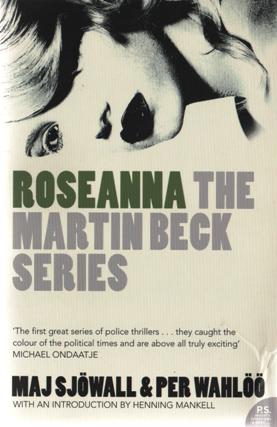 What is it about Scandinavian crime? I’m not reading it all, but there is quite a lot in the stacks and I’m not sure why; I don’t think it’s a bandwagon on which I have jumped along with many others as everything I’ve read so far has been great, but it is interesting how much has been published over the past few years.
Although I have to confess that I picked this up without really registering that it actually was Scandinavian; for some reason I thought it was German – probably just because the hero’s name is Martin Beck, which (feebly) sounds faintly German to me.
Bit of a rambly intro into a review of a book which I enjoyed very much.
Roseanna is the first of 10 novels in the Martin Beck sequence which look at crime as a reflection of Swedish society (as explained by Henning Mankell in his fascinating introduction) and was published in 1965. It is the story of the investigation of the murder of Roseanna, though at the beginning we know nothing about her for quite a long time, she is simply a body pulled from a lake by a dredger, clearly murdered but by whom?
What makes this such an interesting read is how it concentrates on the tedium of much police work. It takes Beck and his colleagues ages to find out anything about the victim other than the stuff that is revealed by the post-mortem, and what they do find out is partly based on luck.
Beck himself is not what I expected; yes, like a lot of detectives, he isn’t entirely happy at home, though he at least is still married to his wife unlike so many others, and he is prone to depression and has problems with his digestion which gives an interesting perspective on how he handles his job. The importance of team work comes across; Beck is not one of those detectives who goes off on his own following hunches, this is a proper police procedural. And the killer and his motive (if it can be called that) was sadly all too plausible.
Will definitely be looking for others in the series.
 This is part of the Treasury of Victorian Murder series, and was the one I was always going to get first simply because I have been fascinated by the Jack the Ripper, and indeed serial killers of all sorts, since I can remember, all the way from Gilles de Rais to Ted Bundy.
A bit morbid, I know, and the sort of admission that immediately gets you marked as the obvious suspect in any decent American crime series. Especially when coupled with the kind of books on the subject that I have in the stacks.
Can’t explain it, just once of those things, no need to be afraid, honest.
So Jack; well, iconic killer largely because his murders not only remained unsolved but have spawned the wildest of theories about his identity, from the Duke of Clarence to Walter Sickert to Sir William Gull, which in turn has led to some great books, both fiction and non fiction. And of course the movies; my particular favourite being Murder by Decree with the great Christopher Plummer.
But I digress.
This is a great little book, which tells the basics of the story as it happened as if through the diary of a contemporary who had access to the police. I loved the artwork which managed to give a real sense of place and conveyed the gruesomeness without dwelling on it, probably helped by being in black and white.
A very nice addition to my true crime library.
 I know that I’ve said this before, but it bears repeating: I am a huge fan of Stephen King and have been for over thirty years which in one way is depressing (how can I possibly be old enough?) but is also comforting (the Bride’s brand loyalty is second to none). What I have found, though, is that despite buying his books as soon as they come out (timing is good for the Christmas list) I tend to read him in spurts. I have a bit of a backlog at the moment, but my recent illness (and I promise I will stop talking about that soon) had me heading towards two of his collections of short stories so that I could read in small chunks.
But of course I ended up devouring both of them as if they were novels (or boxes of chocolates….)
So Full Dark, No Stars is his most recent book and is a set of four novellas or at least longer short stories. They are:
1922 – domestic strife and stress leading to unforeseen and far-reaching consequences (really liked this one)
Big Driver – a revenge story following an act of dreadful violence
Fair Extension – what would you do if you were given an extension? Would you be prepared to pay the price?
A Good Marriage – you think you know the person you’re married to (to whom you are married) and then you go rummaging in the garage….
Well, I know that King isn’t to everyone’s taste because of the fact that a lot (if not most) of the violence is directed against women, but much of horror fiction is and I think his stuff works because most of his female characters are find strength and fight back. Some of the details in these stories did make me wince, but they are well written and full of suspense. And on occasion quite frightening, which is after all the point.
And as always the afterword is well-worth reading.
A good collection.
 I can announce quite happily that my reading slump is finally over, but what that means is that I now have a nice stack of reviews for both here and the Screen God blog that I need to catch up on (grammatically incorrect I’m sure but too hot to think of an alternative).
But I have an excuse (I think) and it’s not my normal gosh-I’ve-been-so-busy-at-work-poor-little-me nonsense. No, this backlog is all because of a hectic social life which has seen lunches and cocktails and catching up with friends before they go on holiday all having taken place since last Sunday. There won’t be another week like it until Christmas, mark my words.
I like excuses like that, it sounds like I know how to have a good time. Which I do, I just don’t get the chance to do it all at once. Anyhow, enough of all this nonsense.
First on the review pile is the latest Christopher Fowler, namely Bryant & May off the Rails. Now, it isn’t that long ago since I read and reviewed the previous book in the series (see here) and I normally don’t read sequences close together because I’m always afraid that I will somehow lose interest, but in this case I was really keen to get my hands on this because the events follow on almost immediately from the previous story and I wanted to know what happens.
And it doesn’t disappoint, building on what’s gone before, developing the character of the enigmatic Mr Fox, and throwing in loads of absolutely fascinating information about the London Underground. As before, not going to discuss the plot as I don’t want to spoil it for anyone but as always I really, really enjoyed this. Not terribly eloquent as a review, but that just shows what too many Cosmopolitans can do to a woman; although I’m not entirely convinced that there is such a thing as too many Cosmopolitans, but that may be a Scottish thing.
And behind the curve as always, I discover that I’m one of the last to know that Mr Fowler has his own blog which is really worth reading; you can find it here.
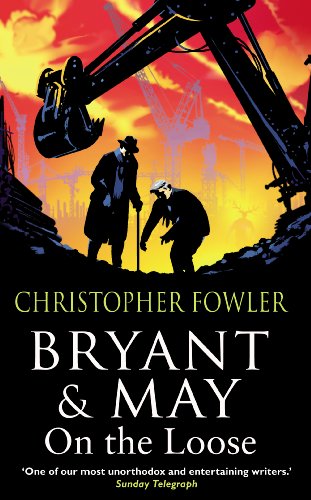 Another excellent entry in the Bryant & May series, On the Loose finds the Peculiar Crimes Unit disbanded and our protagonists looking for a new purpose, or possibly just having to accept retirement. But the finding of a decapitated body in a freezer in a derelict shop in King’s Cross leads to the unit being unofficially reconstituted and as more headless bodies are found it becomes clear that something very strange is happening in this part of London. And the authorities want it all kept quiet, hence turnign reluctantly to the PCU.
This is great stuff; I’ve always been a fan of this series and one of the great pleasures of the books is the way Christopher Fowler feeds in the history and mythology of London. Now, I’ve lived here for over twenty years and don’t profess to know huge amount about the city but one of the things I do know is that it is an ancient and fascinating place and there is still an air of mystery about certain parts of the city, and it is tapping into this which gives the Bryant & May books such depth.
You wouldn’t think that an area as seemingly prosaic as King’s Cross, with its major stations and regeneration programme would fit the bill, but digging up a place can reveal some interesting elements of the past, and the idea that change can lead some people to get in touch with history and use it to their own ends is really plausible. So the idea that the personification of an ancient myth (in the shape of a half man half beast with antlers constructed from knives) can be terrorising the workers on a construction site isn’t really that far-fetched, especially when you consider that many of those workers come from eastern Europe where some of these traditions are still very evident in everyday life.
So not much more to say about the plot (don’t want to give anything away) but the villain of the piece is a very interesting character and the ending sets up a sequel very nicely. And I read this just in time for the next one (Bryant and May Off the Rails) which comes out towards the end of the month.
So, one of the best of the series and very, very enjoyable indeed.
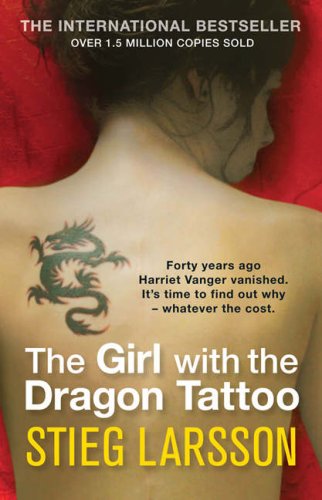 OK, so I know I’ve come to this one so much later than everyone else, but if you read this blog regularly then you will have worked out by now that I have never really been an early adopter (of anything). Add to that a natural reluctance to be reading something at the same time as everyone else and you get an inkling about why it’s taken me so long to pick this up.
In fact, my resistance was so strong I wasn’t even going to buy this as I thought it couldn’t possibly live up to the hype, and it was the Book God who brought it into the house.
A little bit of context on the reading experience. As I’m sure I’ve said before, for all sorts of reasons I do most of my reading on the train to and from work, and this is how I started The Girl with the Dragon Tattoo. Then Oscar weekend came along, and I planned to pull an all-nighter (succeeded, too). However, I have to recognise that I am getting on a bit and the whole staying up all night thing is not as easy for me as it used to be, so in addition to taking a day off on the Monday to recover, I decided to take an afternoon nap. I am not a natural napper; I don’t really like sleeping during the day and find it difficult to do so unless I am ill. So I decided that I needed something to read as a way of lulling me towards a natural, relaxing sleep.
Bad move.
I had read as far as page 149 in my copy. By the time I decided that I probably should move I had actually read the remainder of the book, that’s around 365 pages. In one afternoon. Can’t remember the last time I did that, but it tells you something about the power of the story.
So, plot synopsis very briefly in case there is anyone else out there who hasn’t had a go at this. Crusading journalist convicted of libel steps back from his day job and takes on a private commission, ostensibly the history of an industrialist’s family but actually an investigation into the disappearance and likely murder of said industrialist’s niece, probably by another member of the family. Throw in titular investigator, a young woman with, I think it’s fair to say, issues and you have a really enjoyable and gripping, if occasionally unpleasant, thriller. Don’t mind unpleasant, myself, so not an issue.
As a story it really tanks along at great speed. I never know how to judge translations (I don’t speak/read Swedish though I know a man who does) so can’t say how this stacks up to the original, but I thoroughly enjoyed it.
The Book God has now got his hands on the first sequel so I’m sure I’ll be revisiting these characters later in the year.
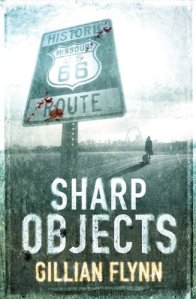 OK, so where to start with this one? Sharp Objects is about a reporter, Camille, who is sent by her paper in Chicago to investigate the murder of one girl and the disappearance of another in her home town of Wind Gap, Missouri. Is a serial killer involved? How are the local police faring in their investigation? Is it a local or an outsider who is committing these crimes? All the usual questions that you would expect when death hits a small town.
And of course, all is not well in Camille’s life. She has a tragic past (death of her sister); to describe her relationship with her mother (with whom she is forced to stay during her trip) would be a gross understatement; and, well, to put it (incredibly) mildly, she doesn’t exactly have a history (or a present) of looking after herself.
And of course, the crimes may all be a lot closer to home than she thinks.
I’m still not entirely sure how I feel about this novel. There’s a very prominent endorsement from the great Stephen King (well, I think he’s great) on the back of the edition I read, where he talks about Sharp Objects as ‘relentlessly creepy’, ‘dreading the last thirty pages’ and so on. And in some ways he is right, it is creepy, the story does linger, it does have a cumulative nastiness factor. Whether you have any positive feelings about the characters or not (and some reviewers really don’t like the portrayal of women in this book) it is in many ways very powerful. But……
And I’m not sure what that but is. I felt a lot of sympathy towards Camille because of her awful childhood and what it had done to her both physically and mentally. But something went askew for me towards the end, and I think it’s because after a slow and relentless build up it was all suddenly over. There was a huge revelation (for Camille at any rate) all the pieces appeared to drop into place, and then there was a ‘Carrie’ ending (film not book so if you haven’t watched the Brian de Palma movie you might not know what I mean). And you knew it was coming, and if you had half a brain you knew what it was, and for all those reasons it was a bit unsatisfying. Which is a real shame.
This is absolutely by no means a bad book; I just think it could have been even better.
This was my first read for RIP IV.
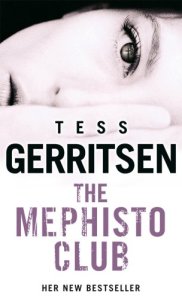 So, cards on the table, I really, really like Tess Gerritsen. I like the fact that her two main recurring characters are women. I like the fact that her books are pacy and easy to read. I like the fact that the plots are nicely judged so that they are a bit (but not too) complicated. I like the fact that there is just enough bloody murder to satisfy the gorehounds but not so much that the crime fan who’s a bit squeamish about the whole serial killer thing will be put off. The Mephisto Club fits the bill, and I lapped it up.
I’m not even going to attempt to explain the plot because the whole point of a good crime/detective novel is not to know what’s going to happen in advance and then having the fun of trying to work it out yourself. So here we have dismemberment, ancient symbols, mirror-writing, revenge, evil, an elite group with a mysterious purpose and all the right connections, a long-buried secret, and lots and lots and lots of blood. What’s not to like?
I absolutely adore anything with a decent secret society; even though I don’t believe any of them really exist, the idea of some kind of cabal running the world, or at least a little bit of the world, or maybe just having influence in a particular sphere, manages to be both comforting and worrying at the same time.
Failed once again to work out the murderer but still huge fun.


 Bride of the Book God