You are currently browsing the tag archive for the ‘Sci-fi’ tag.
 So unbelievably it’s the end of February already, and the end of this year’s Sci-fi Experience. When I signed up for this I set myself some fairly modest goals (you can find my original post here) and connected it to the 42 Challenge which I’m also participating in (in which I’m also participating? – grammar – a tricky thing).
Sadly, for all sorts of reasons, I didn’t read nearly as much as I had intended to, but it was really great fun and got me thinking quite a bit about science fiction and what it is. I found some new authors, and at least one classic which I know I will read again (this one, if you’re interested). I’ve also found myself dipping into the Book God’s copy of the Encyclopedia of Science Fiction, probably a bad idea as it set off a couple of trails which led me to even more authors that I haven’t read – I’m managing to resist the temptation so far (but only just)
The stats are: 3 short stories, four novels started, three finished and reviewed, and one still in progress. Not bad given a bout of flu where I couldn’t read for about a week…….
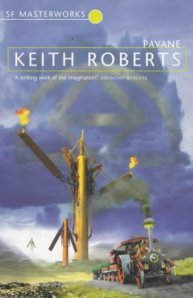 Pavane by Keith Roberts paints a picture of an alternative western world where Elizabeth I was assassinated in1588, the Spanish Armada won, the Protestant Reformation in Europe was defeated, the New World didn’t gain its independence, and the Catholic Church Militant holds sway.
The resulting world is technologically backwards in most respects (no cars but steam driven road trains; no phones but semaphore towers etc.), superstition is rife and the Inquisition (now known as the Court of Spiritual Welfare) continues to put people to the question. Oh and the old ones, in the person of Fairy, are still lurking around, watching and occasionally assisting.
This is less a novel than a series of linked stories which begin in 1968 (the year the book was published). I was immediately attracted by the basic premise (those of you who read this blog regularly will know that sixteenth century history is one of my great loves) and I found the book absolutely fascinating – a complete world which is internally logical. All of the stories are good, my favourite being Corfe Gate where a young woman leads a rebellion against the Church in south-west England, which is where the stories are mainly set.
I enjoyed this very much, although it does throw up a question for me about what we really mean by sci-fi, something which I occasionally find puzzling. This book has a number of fantasy elements, but I suppose it falls into the sci-fi genre because of the alternative history aspect.
The Encyclopaedia of Science Fiction describes Pavane as “moody, eloquent, elegiac and thoroughly convincing” and I think its well worth a read.
Carl at Stainless Steel Droppings saw this meme on another blog and did it himself for fun, and I thought at the time that I would do the same but it’s taken me a little while to get round to it.
Like Carl I was really surprised by some of the titles listed as sci-fi or fantasy but I rather like that as I’m always amused (and slightly annoyed) by authors who write sci-fi books and try to pretend they haven’t.
Anyway, herewith the list with those I’ve read in bold and those I have tbr in italics.
- Douglas Adams: The Hitch-hikers Guide to the Galaxy (1979)
- Brian W Aldiss: Non-Stop (1958 )
- Isaac Asimov: Foundation (1951)
- Margaret Atwood: The Blind Assassin (2000)
- Paul Auster: In the Country of Last Things (1987)
- Iain Banks: The Wasp Factory (1984) – wonderful!
- Iain M Banks: Consider Phlebas (1987) – not my favourite of his sci-fi works
- Clive Barker: Weaveworld (1987)
- Nicola Barker: Darkmans (2007)
- Stephen Baxter: The Time Ships (1995)
- Greg Bear: Darwin’s Radio (1999)
- Alfred Bester: The Stars My Destination (1956)
- Poppy Z Brite: Lost Souls (1992) – I’d have classed this as horror myself..
- Algis Budrys: Rogue Moon (1960)
- Mikhail Bulgakov: The Master and Margarita (1966)
- Edward Bulwer-Lytton: The Coming Race (1871)
- Anthony Burgess: A Clockwork Orange (1960)
- Anthony Burgess: The End of the World News (1982)
- Edgar Rice Burroughs: A Princess of Mars (1912)
- William Burroughs: Naked Lunch (1959)
- Octavia Butler: Kindred (1979) – on my wish list though!
- Samuel Butler: Erewhon (1872)
- Italo Calvino: The Baron in the Trees (1957)
- Ramsey Campbell: The Influence (1988 )
- Lewis Carroll: Alice’s Adventures in Wonderland (1865)
- Lewis Carroll: Through the Lookin-Glass, and What Alice Found There (1871)
- Angela Carter: Nights at the Circus (1984)
- Michael Chabon: The Amazing Adventures of Kavalier and Clay (2000)
- Arthur C Clarke: Childhood’s End (1953)
- GK Chesteron: The Man Who Was Thursday (1908 )
- Susanna Clarke: Jonathan Strange and Mr Norrell (2004)
- Michael G Coney: Hello Summer, Goodbye (1975)
- Douglas Coupland: Girlfriend in a Coma (1998 )
- Mark Danielewski: House of Leaves (2000) – I found this really, really unsettling
- Marie Darrieussecq: Pig Tales (1996)
- Samuel R Delaney: The Einstein Intersection (1967)
- Philip K Dick: Do Androids Dream of Electric Sheep? (1968 )
- Philip K Dick: The Man in the High Castle (1962)
- Umberto Eco: Foucault’s Pendulum (1988 )
- Michael Faber: Under the Skin (2000)
- John Fowles: Tha Magus (1966)
- Neil Gaiman: American Gods (2001)
- Alan Garner: Red Shift (1973)
- William Gibson: Neuromancer (1984)
- Charlotte Perkins Gilman: Herland (1915)
- William Golding: Lord of the Flies (1954)
- Joe Haldeman: The Forever War (1974)
- M John Harrison: Light (2002)
- Robert A Heinlein: Stranger in a Strange Land (1961)
- Frank Herbert: Dune (1965)
- Hermann Hesse: The Glass Bead Game (1943) – one of my absolute favourite novels
- Russell Hoban: Riddley Walker (1980)
- James Hogg: The Private Memoirs and Confessions of a Justifies Sinner (1824)
- Michael Houellebecq: Atomised (1998 )
- Aldous Huxley: Brave New World (1932)
- Kazuo Ishiguro: The Unconsoled (1995)
- Shirley Jackson: The Haunting of Hill House (1959)
- Henry James: The Turn of the Screw (1898 )
- PD James: The Children of Men (1992)
- Richard Jefferies: After London; or Wild England (1885)
- Gwyneth Jones: Bold as Love (2001)
- Franz Kafka: The trial (1925)
- Daniel Keyes: Flowers for Algernon (1966)
- Stephen King: The Shining (1977) – more horror!
- Marghanita Laski: The Victorian Chaise-longue (1953)
- Joseph Sheridan Le Fanu: Uncle Silas (1864)
- Stanislaw Lem: Solaris (1961)
- Doris Lessing: Memoirs of a Survivor (1974)
- David Lindsay: A Voyage to Arcturus (1920)
- Ken MacLeod: The Night Sessions (2008 )
- Hilary Mnatel: Beyond Black (2005)
- Michael Marshall Smith: Only Forward (1994)
- Richard Matheson: I am Legend (1954)
- Charles Maturin: Melmoth the Wanderer (1820)
- Patrick McCabe: The Butcher Boy (1992)
- Cormac McCarthy: The Road (2006)
- Jed Mercurio: Ascent (2007)
- China Mieville: The Scar (2002)
- Andrew MIller: Ingenious Pain (1997)
- Walter M Miller Jr: A Canticle for Leibwitz (1960) – long overdue for a re-read I think
- David Mitchell: Cloud Atlas (2004)
- Michael Moorcick: Mother London (1988 )
- William Morris: News from Nowhere (1890)
- Toni Morrison: Beloved (1987)
- Haruki Murakami: The Wind-up Bird Chronicle (1995)
- Vladimir Nabokov: Ada or Ardor (1969)
- Audrey Niffenegger: The Tine Traveller’s Wife (2003)
- Larry Niven: Ringworld (1970)
- Jeff Noon: Vurt (1993)
- Flann O’Brien: The Third Policeman (1967)
- Ben Okri: The Famished Row (1991)
- Chuck Palahniuk: Fight Club (1996)
- Thomas Love Peacock: Nightmare Abbey (1818 )
- Mervyn Peake: Titus Groan (1946)
- John Cowper Powys: A Glastonbury Romance (1932)
- Christopher Priest: The Prestige (1995)
- Francois Rabelais: Gargantua and Pantagruel (1532-34)
- Ann Radcliffe: The Mysteries of Udolpho (1794)
- Alastair Reynolds: Revelation Space (2000)
- Kim Stanley Robinson: The Years of Rice and Salt (2002)
- JK Rowling: Harry Potter and the Philosopher’s Stone (1997)
- Salman Rushdie: The Satanic Verses (1988 )
- Antoine de Sainte-Exupery: The Little Prince (1943)
- Jose Saramago: Blindness (1995)
- Will Self: How the Dead Live (2000)
- Mary Shelley: Frankenstein (1818 )
- Dan Simmons: Hyperion (1989)
- Olaf Stapledon: Star Maker (1937)
- Neal Stephenson: Snow Crash (1992)
- Robert Louis Stevenson: The Strange Case of Doctor Jekyll and Mr Hyde (1886)
- Bram Stoker: Dracula (1897)
- Rupert Thomson: The Insult (1996)
- Mark Twain: A Connecticut Yankee at King Arthur’s Court (1889)
- Kurt Vonnegut: Sirens of Titan (1959)
- Robert Walser: Institute Benjamenta (1909)
- Sylvia Townsend Warner: Lolly Willowes (1926)
- Sarah Waters: Affinity (199)
- HG Wells: The Time Machine (1895)
- HG Wells: The War of the Worlds (1898 )
- TH White: The Sword in the Stone (1938 )
- Gene Wolfe: The Book of the New Sun (1980-83)
- John Wyndham: Day of the Triffids (1951)
- John Wyndham: The Midwich Cuckoos (1957)
- Yevgeny Zamyatin: We (1924)
I’m quite pleased with the number I’ve read, given that the inclusion of some of these on the list seems a little odd to me, and appalled as always by the number I have on my tbr pile.
 So Carl is hosting this mini challenge as part of his Sci-Fi Experience and to honour Dewey. The idea is to read at least one sci-fi short story and post about it on his official page. I read three stories from an old anthology that we’ve had kicking around the house for ages, namely The Mammoth Book of Best New SF 13, which covers stories first published in 1999 (wow, last century, remember that?), and therefore cannot be found on Amazon for me to link to (sorry). I read:
1. Suicide Coast by M John Harrison – I found this quite difficult and bleak and I’m not entirely sure that I fully understood it; it’s about gaming and rock climbing I think, and what’s real and what isn’t. Perhaps I just wasn’t in a receptive frame of mind to understand the subtleties?
Anyway, I wasn’t put off, and moved on to:
2. How We Lost The Moon: A True Story By Frank W Allen by Paul J McAuley – I like McAuley’s work though I haven’t read as much as I should have. This story does what it says on the tin; Frank is a witness to and participant in the events that saw an experiment on the Moon go terribly wrong and we, sort of, lost the Moon. Very enjoyable.
3. Evermore by Sean Williams – a story of crippled space-ship crewed by entitities based on the minds of real people on Earth but who technically don’t really exist, and in any case aren’t really speaking to each other. So what happens when something needs to change?
There are a couple of other stories in this anthology that I might save for another time, but all in all this was an interesting experience.
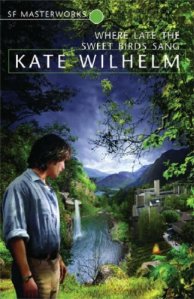 So I said that one of the things I wanted to do as part of the Sci-fi Experience was read more science fiction by women, and when I wrote that Where Late The Sweet Birds Sang was one of the books I had in mind.
To my shame I knew very little about Kate Wilhelm but she is a multi-award winning writer, instrumental in setting up and teaching at the Clarion Workshops which have been very influential in the sci-fi world. And this novel seems to be considered amongst her very best work.
So this is a book about cloning, not just about the idea of it but the successful application of it in an isolated community which has set itself up in the Appalachian Mountains in preparation for the world catastrophe that is clearly coming; not just famine, disease and war but the rapidly developing sterility of the human and animal populations. The community is made up largely of one wealthy family who use their money and expertise to clone and breed themselves in order to survive.
The novel is in three sections, each one told through the eyes of a particular character (David, Molly and Mark) who follow the evolution of the clone society over a period of time. And that’s what’s really fascinating about this novel; the cloning technology is a given, but what the author is really exploring is the kind of a society that would develop, how the original, naturally born people would be regarded by the clones,and how (if and when the time comes) they would venture out of their self-sufficient world.
I was really very impressed with this novel; it’s a moving story, and although my sympathies lay in a particular direction I could really understand the opposite point of view. The structure works really well as it provides a means of watching this society evolve. It’s beautifully written and one that will definitely be on my re-read pile.
 So I decided to start the year off with a proper sci-fi read by an author new to me but highly regarded by the Book God. Gary Gibson lives and writes in Glasgow, and the Scottish connection is always of interest to me as we seem to produce some fine writers in the genre (Iain M Banks to name but one)
I like most varieties of sci-fi but will admit to a huge soft spot for those with universe-spanning plots, ambiguous alien races, spaceships, explosions and lots of scientific exposition for me to get my teeth into; Stealing Light meets all of those criteria. And with a really good female protagonist to boot.
Dakota Merrick is a pilot and a machine-head – a person with implants (known as her Ghost) which allow her to perform well above normal human capacity. She is on the run having participated in and witnessed some terrible events, and signs up as the pilot on a cargo ship for what seems to be a straightforward job – taking an expedition to survey a potential mining operation. But of course all is not what it seems. What is the expedition really looking for?
I really, really enjoyed this novel; Dakota is a flawed and damaged heroine and I came to like her very much. The mysterious alien race which seems to be behind most of what happens to her, The Shoal, are a race of sentient fish and the only species with faster than light travel, and although the whole idea of them seems a bit weird at first, I certainly got used to them quite early on. It is quite a violent book, but I didn’t find the level of violence excessive given the dynamics of the plot (and I must admit this isn’t something that normally puts me off).
All I can say is that this is so well done it kept me up to the wee small hours over two nights to finish it, and represents a really good start to my 2009 reading.


 Bride of the Book God