You are currently browsing the tag archive for the ‘Sci-fi’ tag.
 Not wanting to behave too much like a Twihard (it’s so undignified for a woman of my advancing years) but Neil Gaiman is writing for Season Two of the Matt Smith Dr Who.
Two of my absolutest favourite things/people/stuff/whatever coming together in what will surely be a glorious televisual event.
Must be true – it’s on Mr G’s own blog plus at SFX
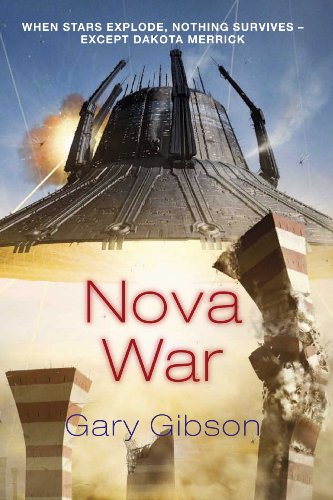 So Gary Gibson was my big find of last year (well, I didn’t exactly find him, I was pointed in his direction by the Book God) and Stealing Light one of my favourite reads. So anticipation was high for Nova War and it didn’t disappoint.
But it’s going to be difficult to review here because it is a straight sequel (part of the Shoal sequence, the third volume comes out later this year) and so any in-depth discussion would give away details of the outcome of the first book, and I wouldn’t want to do that because it was huge fun to read and I don’t want to spoil it for anyone likely to give it a go.
So what do you need to know? Well, it’s a space opera (hurrah! I’m a sucker for those) with a couple of strong central characters, a convincing range of truly alien alien races (the Emissaries being particular favourites for their sheer nastiness), fantastic spaceships, revelations, war, realpolitik and (yay!) exploding suns.
I absolutely loved it from the Lee Gibbons cover to the set-up for book three. I strongly identified with at least one of the main characters (is it too much to say that Dakota Merrick survives from book one ? Probably not given that she is the heroine after all), actually felt a tiny wee bit of sympathy for one of the villains (we find out what was done to him in the past to make him who he is now and it is truly terrible – sympathy doesn’t last that long, though) and just enjoyed the whole big-wide-world-of-spacefaring thing that was going on.
What can I say? I just can’t resist hard SF.
 Or the non-science-fiction-science fiction one.
So this is the latest from the great Iain Banks, one of my favourite authors. In the US (and possibly elsewhere, I’m not absolutely sure) this is being marketed as a science fiction novel, but not here in the UK where it’s being positioned as a mainstream novel which kind of has sci-fi overtones. I heard Mr B being interviewed on Simon Mayo’s radio programme some weeks ago and this was touched on, and he seems to regard Transition as non-sci-fi. Although I’m only a reader, I beg to differ….
The multiple universes, the mechanisms for travelling between them, and the all-powerful Concern all push me towards the sci-fi view. However you could see it as it’s described in the blurb which explains it as a “high-definition, hyper-real, apocalyptic fable” and a great deal of the action does take place in “our” world, in the period between the fall of the Berlin Wall and the attack on the Twin Towers. But an awful lot of it doesn’t…..
But setting all of that aside, it is a really absorbing story of politics and greed and paranoia and terrorism and torture and parallel worlds and I thoroughly enjoyed it. I particularly liked The Transitionary (which is probably just as well) moving between worlds and interfering in various ways for the greater good (or is he?) and Mrs Mulverhill and her habit of wearing small hats with veils, a style I never managed to pull off in the ten minutes when it was fashionable in the eighties. The structure of the novel, using multiple narrators really worked for me as well given the subject matter of the story, and although I had to read the end a couple of times to make sure I really had understood it, I found it a satisfying read.
And I don’t care, I’m going to claim this for the 42 Challenge.
Can’t wait until the next Culture novel, though.
 What can I say? Despite my best intentions to cut down on buying this year, August and September (so far) have been totally booktastic.
Crime-type stuff
- The Sweetness of the Bottom of the Pie by Alan Bradley – recommended by many good reviews, but particularly Carl here;
- Silent in the Sanctuary and Silent on the Moor by Deanna Raybourn – I loved the first one so couldn’t resist stocking up on the sequels;
- Keeping the Dead by Tess Gerritsen – ‘He washed them. He clothed them. But first …. he killed them’ Ooooh… ;
- The Girl Who Played with Fire by Stieg Larsson – everyone tells me how good the first one in this series (which I have but not read yet) is, so I went ahead and got the sequel;
- Death Qualified by Kate Wilhelm – I discovered this author earlier this year as part of the Sci-Fi experience 2009, and though her crime fiction sounded equally interesting.
History-type stuff
- The Cecils by David Loades – the family business of the Cecils was supporting Elizabeth I who said “No prince in Europe hath such a counsellor as I have in mine” Just my kind of 16th century thing;
- Prince Rupert by Charles Spencer – all about the Last Cavalier, if his portrait is anything to go by he was pretty handsome, had (I believe) a giant poodle called Boy as a hunting dog, pretty cool guy;
- Wolf Hall by Hilary Mantel – a novel about Henry VIII’s right-hand man Thomas Cromwell, Man Booker nominated, looks astonishing.
Sci-fi type stuff
- Transition by Iain Banks – I know that this is being marketed in the UK as straight and not sci-fi but at the very least this is a crossover novel as it seems to have lots to do with parallel universes. I don’t care what they call it, it’s going to be good;
- Halfhead by Stuart B MacBride – so I love the Bearded Writist’s gory Aberdonian crime novels and this foray into sort of sci-fi thriller looks very interesting; and there’s a Banks-type differentiating middle initial going on as well.
Miscellaneous
- Muriel Spark by Martin Stannard – the biography – my admiration for Mrs Spark is unbounded, I should really re-start the Muriel Reading Marathon which faltered last year….. ;
- A Book of Silence by Sara Maitland – all about silence, a very enjoyable writer, looking forward to what this will cover;
- Love All by Elizabeth Jane Howard – ‘an unforgettable novel about love and the consequences of its absence’ it says on the cover.
Oh-lord-what-did-I-think-would-happen-if-I-went-to-Forbidden Planet
So having introduced the Silvery Dude to the Night’s Dawn trilogy by encouraging him to take the first volume on holiday with him, I agreed to accompany him to FP to get volume two, despite the whole Twilight/District 9 thing that we’ve been bickering about (he wants me to watch the former and saw the latter before I did much to my annoyance). Anyhoo, I hadn’t planned to do anything other than buy Gary Gibson’s Nova War for the Book God, but of course it didn’t stop there….
- The Boy with the Cuckoo-Clock Heart by Mathias Malzieu – translated from the French, this is a fairytale set in Edinburgh in 1874 and I picked it up totally because of the cover;
- Half-Minute Horrors – ‘a collection of instant frights from the world’s most astonishing authors and artists’ – including Neil Gaiman, just a bit of fun;
- Edgar Allan Poe’s Tales of Death and Dementia, illustrated by the great Gris Grimly, which was the sole reason for buying it as I have a lot of Poe kicking around already (if I can put it like that).
 I have to confess that I have never read anything written by Jodi Picoult and from what I know of her work it probably isn’t my thing anyway. I also have never read a Wonder Woman graphic novel before, so the combination of the two looked interesting enough to give it a try.
Not going to even attempt to describe what this is about as it’s clearly in the middle of a much longer story (there’s even a ‘Previously on Wonder Woman’ thing at the beginning which was an interesting approach) and it ends on a cliffhanger. Suffice to say that WW’s human alter ego is supposed to capture and bring to justice WW herself, which is all far too confusing for everyone involved.
The story is quite good but I always feel a bit odd about WW – maybe it’s my age but I can’t help thinking she’llcatch her death in that outfit, that the costume just looks so uncomfortable, and that despite all the stuff about female empowerment I’m probably not the intended audience for someone so impossibly pneumatic. Having said all that I read it in a sitting and am curious as to how the situation at the end is going to be resolved, though not curious enough to have actually bought the sequel.
Enjoyed the Batman cameo though.
 So we find ourselves in an alternative 21st century, one where Germany won the First World War and the Ottoman Empire still exists. Ashraf Bey is the son of an American photographer and apparently the Emir of Tunis, though his mother always told him his Dad was a Swiss watchmaker or something. Anyhow, Raf is on the run from prison near Seattle where he was serving time for a murder he probably didn’t commit, and has been summoned to El Iskandryia (alternative world Alexandria) by an aunt he didn’t know existed, and is to be married off for money. For he is pashazade, a member of the aristocracy with a diplomatic passport and extremely eligible as a husband for the daughter of a man climbing his way up the social ladder.
But of course it doesn’t work out quite like that. His aunt is murdered, he is the prime suspect and of course that means he has to go on the run again, relying as much as he can on the help, reluctant or otherwise, of Felix (an expatriate American policeman), Zara (the woman whose hand in marriage he has rejected) and Hani (his nine year old niece). All while trying to identify both the killer and the motive and clear his own name.
I really enjoyed this, because it brings together two things I love – science fiction and crime – and does so very successfully. The sci-fi is quite light, the world of El Iskandryia is not so far away from our own that its unrecognisable, but still sufficiently different that you know we are in an alternative time-line. The mystery is well done; didn’t guess the murderer this time but you can’t win them all. It works because Raf himself is an ambivalent and attractive character and its easy to root for him. This is the first of a trilogy and I am looking forward to reading the sequels.
 So this is a bit of a stop-gap post; things are still very busy at work and that means I haven’t been reading very much. It’ s on the cards that I won’t complete the Once Upon a Time III challenge as I still haven’t finished my second book with only a couple of days to go before it closes.
But there are some things worth recording:
- Finally a National Treasure is given his due – arise Sir Christopher Lee!
- Andy Murray won at Queen’s Club – roll on Wimbledon
- New stamps with designs by Dave McKean have been issued, with background supplied by one Neil Gaiman– and I got my set this morning (so I’m outed as a stamp collector)
But most importantly, I was lucky enough to get a ticket to a preview of the first episode of the new Torchwood series, Children of Earth. It was absolutely fabulous, and was followed by a discussion panel with John Barrowman and Eve Myles from the cast, the director Euros Lyn and Russell T Davies himself. A fantastic experience, but no spoilers here, I’ll review the whole series over at the Screen God once it’s been broadcast. But believe me, it’s going to be worth watching.
And I promise there will be some book reviews soon.
What did I think of the Other Mother in Coraline?
How dear to me was Cheri?
Did Star Trek boldly go, not once but twice?
How did Leo and Kate fare in Revolutionary Road?
 Halting State is only my second Charles Stross novel but I think it’s already clear that he and I are going to have a long and productive relationship as I’ve thoroughly enjoyed both reads so far (see this review for my previous foray).
So we are in Edinburgh and Sergeant Sue Smith has been called to the office of Hayek Associates, a company which produces and supports online games. There has been a robbery, but not one of your usual smash and grabs; this time the robbery has taken place inside a game, and has been carried out by a marauding but organised band of orcs, supported by a dragon.
Add to this mix Elaine Barnaby, a forensic accountant with practical skills in weilding very large swords in medieval role playing games, and Jack Reed, a games programmer who just happens to be unemployed at the right time and with the right skills set to assist in the investigation, and you have the three main characters in a tale of gaming, programming and international terrorism in a 21st century which is a bit of an advance on the one we recognise. And one of the questions is: when is a game not a game?
I loved this; I’ll admit it took me a day or two of typical reading-on-the-train commuter time to really get into the story but once I was housebound with the dreaded Head Cold 2: This Time It’s Personal, this book was exactly what I needed to escape from the depths of feeling sorry for myself. And what more can you ask?
I’ve never played World of Warcraft or any of its competitors but I can see the attraction it has, and although I’m sure you would get a lot of additional pleasure out of this story if you had a background in online gaming, I found I knew enough to make the story intelligible. The techy stuff was really interesting and was very happy with how the plot all worked out in the end. Another recommendation, and another read for the 42 Challenge.
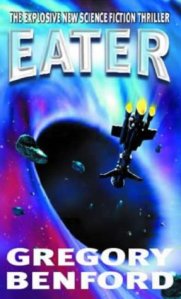 Gregory Benford’s Eater is, according to the cover at any rate, an “explosive new science fiction thriller” set in the fun-packed world of astrophysics. I have some acquaintance with this world, given that the Book God’s predecessor was a Natural Philosopher with an interest in such things. That’s probably where my interest in factual science comes from – I refuse to give him all the credit for my interest in science fiction – I lay that at the door of my English teacher in junior secondary school who had us reading Arthur C Clarke’s A Fall of Moondust.
Anyhow, we are in Hawaii with the astronomers and astrophysicists and there is an anomaly in the heavens, moving the way such things should not. Turns out to be a sentient black hole heading Earthwards – I’m not giving anything away here, a casual glance at the blurb on the back of the edition I have gives away this key plot point. But what does it want and what is the world going to do about it?
This was a bit of a guilty pleasure – I quite enjoyed it while feeling all the way through that I shouldn’t. I think this is because it read very much like it was aiming for the screen, probably as a Sci-Fi Channel mini-series with all the things you would expect. Is there a crumpled deskbound hero scientist who would love to do real work again? Is there a wonderfully intelligent woman suffering from a terminal disease but working through her pain? Is there a rival of long-standing who turns out to be an ally as they all work towards a common goal? Is there tragedy, betrayal and a noble sacrifice? You bet.
I don’t mean to make fun because I did actually enjoy reading this, it was quite pacy and there was a lot of hard science which is one of the things I really enjoy. But in the back of my mind I was casting the movie, and that’s always a bit distracting.


 Bride of the Book God