
You are currently browsing the tag archive for the ‘Loved the cover’ tag.
 So in The September Society Charles Lenox is approached by the widowed mother of an Oxford student who has gone missing leaving only a dead cat behind him in his rooms.
Lenox takes on the case and finds himself working with both the Oxford police and Scotland Yard as a dead student is found in a public space, and the name of the mysterious September Society keeps on turning up.
And as if this wasn’t enough, Lenox is wrestling with his feelings as he considers making changes in his own personal life.
Although I quite enjoyed this novel I didn’t find it to be as strong as the first in the series, which I reviewed here. I still like Lenox as a character, but found the whole thing about his private life got in the way of what could have been a cracking mystery, and I’m not sure why, because generally I like to see the lead character rounded out and not just be a pawn in the game of solving the mystery. I also think that it didn’t help that I had worked out one of the big reveals quite early on and was slightly annoyed that Lenox took so long to do so, although of course it would have been a much shorter book if he had.
So, pretty solid and likeable but not as gripping as it might have been. Probably won’t stop me reading the next one though. Oh and once again I really liked the cover…
 This is not my first exposure to the Gothic creepy tales of Chris Priestley; last year I read and reviewed this, and Tales of Terror from the Black Ship has a very similar structure.
Ethan and Cathy are ill, and have been left home alone by their father who has gone off in search of a doctor. But this is no ordinary home; The Old Inn is perched on top of a cliff which is only joined to the Cornish coastline by a bridge of rock. A huge and powerful storm has blown up and while they wait for their father to return, they are joined by a mysterious stranger called Thackeray, a youngish man who has somehow managed to make his way to the inn through the treacherous weather. He settles in to see out the storm, and to “entertain” the children he tells them creepy stories, all connected with the sea and sailors.
And after that it’s more of the same, which is no bad thing in my book. The stories are nicely unsettling, as is the wraparound tale, because it becomes very clear that something is not quite right in Ethan and Cathy’s world.
Favourites for me were The Boy in the Boat (beware innocent looking little children), Nature (you will never look at snails the same way again, though in all honesty I have trouble looking at them at the best of times), and The Scrimshaw Imp (I didn’t know what scrimshaw was until I read this).
I really enjoyed this book, and the unsettling nature of some of the tales wasn’t lessened by the fact that I was reading it during a more or less sunny late July. Recommended for the Gothic lovers among us, this would have worked really well for Carl’s RIP challenge.
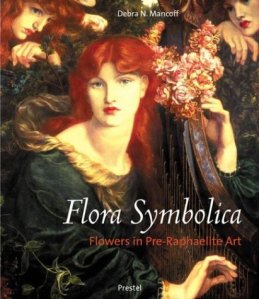 So I’ve been watching Jeremy Paxman’s series on Victorian painting on the BBC, and obviously the pre-Raphaelites feature quite a bit, and I haven’t started any of my reading for the Art History challenge, and the Book God asked me a question about flowers (I think, may have imagined that) so I toodled off and picked this up from the bookshelf. Just to dip into you understand…..
Some time later I had read it from cover to cover; not a huge book but a lovely selection of Pre-Raphaelite paintings featuring flowers and a page on each one explaining what the various plants actually mean.
Interesting diversion into the language of flowers; there wasn’t just one dictionary of meanings apparently, and many a young man had to cope with the tears that ensued from a different interpretation of the bouquet he’d just presented.
The reproductions are lovely and the text interesting. And in case you are wondering, the cover is Rossetti’s “La Ghirlandata”, painted in the 1870s, and the flowers it includes are honeysuckle (affectionate devotion though Rossetti saw it as a symbol of sexual attraction); pink roses (the sexual attraction thing again as they are at their full bloom) and surprisingly monkshood (approach of a dangerous foe) – though William Rossetti thought his brother meant to paint larkspur (an emblem of lightness and levity). So even great artists get it wrong sometimes too.
This is my first read for the Art History Reading Challenge.
 I’m not sure where I came across the name of Charles Finch – it may have been mentioned on someone’s blog, or I may have simply have been seduced by the cover somewhere, but I’m glad I decided to put this on my Christmas list, and grateful to the Book God for buying it for me (I suspect that he wants to read it too)
The hero of A Beautiful Blue Death is Charles Lenox, a Victorian gentleman of leisure with a love for ancient history and travel, and a man who has clearly dabbled in amateur investigations in the past with some measure of success. It is winter in 1860’s London, and although he would prefer to be reading by a fire in his study, he gives in to the request of his childhood friend, and current neighbour, Lady Jane to look into the circumstances surrounding the death of a former maid from her household, who has been found at her new position apparently having committed suicide.
Of course the novel would be over fairly quickly if that were the case, and it becomes clear that the girl was poisoned, and Charles must find out why and by whom, both to satisfy himself and to keep his promise to Lady Jane.
This was a very enjoyable read, to the extent that I stayed up well past my normal bedtime so that I could finish the story. Lenox is a really attractive leading man, his relationship with Lady Jane is nicely drawn, and there is a wonderful cast of supporting characters, particularly his brother Sir Edmund, who is a distinguished Parliamentarian but nevertheless wants to help with the investigation. The denouement was very satisfying, and I will be looking out for the sequel when it becomes available later this year.
 Where to start with The Devil in Amber? This is the second Mark Gatiss novel to feature Lucifer Box – artist; spy/secret agent; a man with an eye for both men and women; a man who lives life to the full, shall we say.
We first met him in The Vesuvius Club which was set in the Edwardian period; we are now in the 1920s, with Fascism rising and the effects of the Great War still being felt. Lucifer is keeping an eye on Olympus Mons and his Amber Shirts, and while doing so is framed for murder and has to escape to Britain, foil the dastardly plot, save the girl and his own reputation.
This is great fun; I love Mark Gatiss (the twenty-seventh most dangerous man in Islington apparently) who has written for (and appeared in) Dr Who – which immediately gives him extra points – but he also wrote and acted in a three-part ghost story on the BBC over Christmas (called Crooked House and I hope it’s going to come out on DVD soon as it was really very good).
This novel is a cross between a classic spy thriller and Denis Wheatley (yes, there are Satanists and mysterious castles and young women in peril and megalomaniacs trying to take over the world) but it’s also really amusing; I love the names, especially Lucifer’s sister Pandora Box. An enjoyable read for a dull and cold January, and I’ve just got a hold of the third Lucifer Box adventure, which looks a little bit more James Bond-ish…..
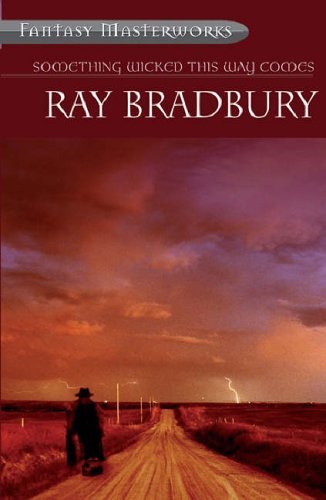 I feel as if I have been reading this book forever; that isn’t a criticism of the book itself, just that I started it before my hiatus and have only just finished it today so it has been with me for what seems like a very long time.
I have to say upfront that I was intrigued about how I was going to react to Something Wicked This Way Comes, because I saw the film adaptation many, many years ago, and although it was only one viewing it has stuck with me ever since. As suspected the film and the book are different in a number of ways, but both are equally enjoyable.
This is the story of two boys, Jim Nightshade and Will Halloway, and how they get drawn into the sinister world of Cooger & Dark’s Pandemonium Shadow Show when it turns up in their Illinois hometown. The carnival, and particularly its proprietor Mr Dark, is incredibly sinister and it becomes clear very quickly that all is not as it seems.
This story deals with so many themes – the desire to grow up, the lure of temptation, disappointment, the power of goodness – that it’s difficult to know where to start. I found it wonderfully atmospheric and quite chilling, and the characters – Mr Dark, Charles Halloway, the Witch – really memorable. It is interesting to me that my favourite character in the book (as in the film where he is played by the wonderful Jason Robards) is Charles Halloway, the older father of a young son wondering what he had a achieved with his life.
I think that this is definitely one that I will come back to in the future – if you haven’t tried Bradbury before this is a good place to start. And isn’t it a great cover?
 I started writing this post, for the last book in the RIP III challenge, back on 4 October, and it seems strange to come back to something I read all those weeks ago and try to put down in words why I enjoyed it. Because I really did enjoy Uncle Montague – a collection of stories told to Edgar during apparently one visit to Uncle Montague in his strange house in the woods.
The stories themselves have a connecting theme – they are all ostensibly about bad things happening to usually young people who don’t listen to what they are told, although I’m not sure that you could call them morality tales. They have a lovely creepy Gothic atmosphere to them and are enhanced by the wonderful illustrations by David Roberts – I particularly like the expression on young Edgar’s face on the cover, which gives a strong impression of someone trying desperately not to look round at what might be behind him.
Particular favourites are Climb Not and A Ghost Story, but they are all very good, and the revelation of exactly what predicament Uncle Montague is in was satisfying. So definitely worth reading, though as I said more atmospheric than genuinely scary.
This was my final read for the RIP III challenge.
 R M Dashwood is the daughter of E M Delafield who wrote The Diary of a Provincial Lady, which I read and thoroughly enjoyed many years ago. In Provincial Daughter, Rosmund Dashwood has written not exactly a sequel to her mother’s books, but a new take on a similar situation, that of a middle class woman and the trials and tribulations of bringing up a family with not enough money to quite meet the social expectations of her class. Which makes it all sound a bit pompous, but this is a very funny novel.
The story is set in the 1950s and covers three months where the narrator (never named) decides to keep a diary of her goings-on just to demonstrate to herself that she isn’t wasting her fine mind and expensive education. So we find out about her husband the doctor, her three sons, her friends and neighbours, her German au pair and her writing career.
I found it fascinating; I was born in the early 1960s so this world had largely gone by the tme I would have been old enough to recognise it, although I suspect this is a very English take on things and it might have been a bit different where I grew up. I liked the narrator very much, which always helps, and it’s a shame that there don’t seem to be any further adventures; I would have liked to know whether they moved to Scotland as seemed to be on the horizon at the end of the book, and what that might have meant.
This is good fun, and I loved the cover – what a frock! – and the illustrations by Gordon Davies are excellent. Recommended.


 Bride of the Book God