You are currently browsing the tag archive for the ‘Crime’ tag.
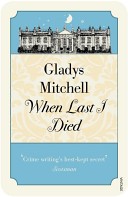 So I want it noted for the record that I love Gladys Mitchell, and have done so for years. I read my first one (The Mystery of a Butcher’s Shop – my old paperback has an absolutely hideous cover) in 1991 and was sad to see them go out of print, despite quite a good BBC adaptation starring Diana Rigg, who was brilliant in the main role despite being far too glamorous for the character.
However, chuffed to see that Vintage is bringing the novels of the Great Gladys (so named by Philip Larkin) back and grabbed the opportunity to pick up one I hadn’t read before as a way of rounding off the read-a-thon.
First published in 1941 When Last I Died kicks off with Mrs Bradley visiting a reformatory school where she has been asked to consult as a psychologist on behalf of the government. She subsequently takes a house on the coast to give some of the boys a chance for a break from the institution, and once they’ve been packed off she spends some time there with her grandson, who finds rather an interesting diary. The diary’s author (now dead) used to work at the same reformatory and was once accused of murdering her aunt. This is the starting point for a mystery involving haunted houses, investigations of the paranormal and missing schoolboys.
And I absolutely loved it. Really satisfying story, clever plotting and Mrs Bradley is a gloriously grotesque character. Suspect I will be building up my collection over the next few months.
 Oh Lordy. So, I’m back in that place where I always seem to find myself these days, trying to write a review months and months after everyone else has read the thing and (almost) everyone has loved it and articulated their feelings about it much better than I think I can (I refer the jury to Carl’s review as exhibit number one).
Your view of The Sweetness at the Bottom of the Pie is I think going to depend on how you feel about Flavia de Luce, heroine and amateur sleuth, 11 years old and plunged into a murder investigation when the body of a man who may or may not be known to her father is found in the cucumber patch. Given that Flavia’s mother died when she was very young, her father is her only family apart from her two fairly odious sisters, so she naturally sets out to get to the bottom of the whole thing.
We are in 1950’s England, recovering from the Second World War, and Flavia is part of a family fallen on hard times and living in a mansion that has seen better days. She has a remarkable chemistry lab which sounds fabulous (even though I don’t do smells), her father is obsessed with his stamp collection (can understand that, I drool over my own occasionally) and their household staff are pretty odd but very loyal.
The plot is irrelevant in lots of ways, though it is fairly enjoyable and although I suspect there are several plot holes I quite happily went along with it all simply because, precocious and faintly unbelievable though she may be, I really liked Flavia.
Like my other read-a-thon books this probably benefitted from being read in a sitting (more or less) and it certainly got me through to the wee small hours. Looking forward to the sequel which is probably out already but I’m saving for later in the year.
 Finally getting around to reviews after another (and not yet finished) busy period at work, and of course all the excitement of the UK General Election (which is still distracting me from other things – as a civil servant I am keen to know who my next set of bosses is going to be….)
All this means that I’m not reading as much as I should – I often go through these patches driven sometimes by not being able to find something that I’m interested on reading just at that particular point, but more often (as now) just not finding the time to read regularly.
So, After the Armistice Ball by Catriona McPherson is a detective novel in the classic style, set in 1920s Scotland and is huge fun. In terms of plot, there’s a bit of a scandal brewing amongst Dandy (short for Dandelion) Gilver’s social set when some valuable diamonds are stolen after the eponymous ball. Asked by her friend Daisy to do a bit of sleuthing she gets pulled into something much darker when Cara Duffy, the youngest daughter of the diamonds’ owner dies in a fire in a remote cottage, and it becomes clear that this might not have been an accident.
Which is about all that can be said without giving away too much of the plot. It’s well-written, pacy, has a nice sense of location and time and an attractive heroine who is easy to identify. This was my first read-a-thon book and so benefitted from being read in one sitting, and I enjoyed it so much I’ve already bought the second in the series.
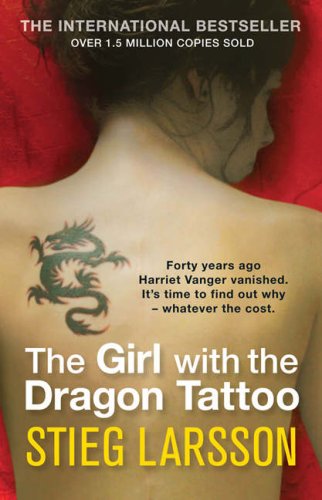 OK, so I know I’ve come to this one so much later than everyone else, but if you read this blog regularly then you will have worked out by now that I have never really been an early adopter (of anything). Add to that a natural reluctance to be reading something at the same time as everyone else and you get an inkling about why it’s taken me so long to pick this up.
In fact, my resistance was so strong I wasn’t even going to buy this as I thought it couldn’t possibly live up to the hype, and it was the Book God who brought it into the house.
A little bit of context on the reading experience. As I’m sure I’ve said before, for all sorts of reasons I do most of my reading on the train to and from work, and this is how I started The Girl with the Dragon Tattoo. Then Oscar weekend came along, and I planned to pull an all-nighter (succeeded, too). However, I have to recognise that I am getting on a bit and the whole staying up all night thing is not as easy for me as it used to be, so in addition to taking a day off on the Monday to recover, I decided to take an afternoon nap. I am not a natural napper; I don’t really like sleeping during the day and find it difficult to do so unless I am ill. So I decided that I needed something to read as a way of lulling me towards a natural, relaxing sleep.
Bad move.
I had read as far as page 149 in my copy. By the time I decided that I probably should move I had actually read the remainder of the book, that’s around 365 pages. In one afternoon. Can’t remember the last time I did that, but it tells you something about the power of the story.
So, plot synopsis very briefly in case there is anyone else out there who hasn’t had a go at this. Crusading journalist convicted of libel steps back from his day job and takes on a private commission, ostensibly the history of an industrialist’s family but actually an investigation into the disappearance and likely murder of said industrialist’s niece, probably by another member of the family. Throw in titular investigator, a young woman with, I think it’s fair to say, issues and you have a really enjoyable and gripping, if occasionally unpleasant, thriller. Don’t mind unpleasant, myself, so not an issue.
As a story it really tanks along at great speed. I never know how to judge translations (I don’t speak/read Swedish though I know a man who does) so can’t say how this stacks up to the original, but I thoroughly enjoyed it.
The Book God has now got his hands on the first sequel so I’m sure I’ll be revisiting these characters later in the year.
 So, despite Christmas and birthday gifts I still apparently felt that there wasn’t enough to read -n the house and got involved in a little retail therapy when things got a bit tense at work this week, coupled with a late birthday present and a freebie from a publisher.
Confession time:
- Iris Murdoch: A Writer at War edited by Peter J Conradi – combining two of my favourite things, diaries/letters and digging into the background of favourite authors; didn’t even know this was coming out
- Uncommon Arrangements: Seven Marriages in Literary London 1910-1939 by Katie Roiphe – sticking my nose into private matters once again, this includes amongst others the Bells, the Morrells and the Wells’s – almost rhymed too
- Barking by Tom Holt – a present from Silvery Dude, not an author I’ve read before, this has a cast including (apparently) unicorns, vampires, werewolves and lawyers…..
- The Strange Case of the Composer and His Judge by Patricia Duncker – a free book from the lovely people at Bloomsbury, religious sects and death in France
And with this on order, I couldn’t be happier!
 So Christmas 2009 – not quite what I had expected. Stinking cold from 19 December onwards meant that I had little or no voice for significant parts of the holiday season (cheers all round from family, friends and co-workers as you might imagine) and I was also working most of the time (including part of Christmas Eve though I did give in to my cold around lunchtime). Christmas Day itself – opened presents, fell asleep for most of the day, dinner wonderful but late. That’s the advantage of just the two of us on the day, we can play it by ear and only have ourselves to please.
Main highlights so far:
- The Gruffalo on Christmas Day was the surprising TV highlight for me – really sweet and very nicely done
- Dr Who – well, a bit disappointing but I’m reserving my judgement until I’ve seen part two as this was so obviously a first-part-setting-up-the-big-denoument episode; but David Tennant was as lovely as ever, especially when he looked like he was going to cry….
- Sherlock Holmes – the big Christmas movie outing – great fun, will review over on Screen God shortly
But what of the presents? Well, bookwise I did quite well:
- Vintage Handbags by Marnie Fogg – almost obscene in its wonderfulness, a big glossy history of handbags from the 1920s, I am going to be dipping into this one a lot
- The Crimson Rooms by Katharine McMahon – asked for this simply because I loved the cover
- Under the Dome by Stephen King – well, couldn’t resist asking for this one then completely forgot about it; when given the package to unwrap I thought “don’t remember asking for anything this big” – should have known!
- Martyrs and Murderers: the Guise Family and the Making of Europe by Stuart Carroll – sixteenth century, what can I say?
- Anne of Cleves: Henry VIII’s Discarded bride by Elizabeth Norton – ditto
- The Great Silence 1918-1920 by Juliet Nicolson – the period just after the end of WWI and its impact on the social fabric, looks fascinating
- Strange Days Indeed by Francis Wheen – a history of the 1970s which I am really looking forward to reading, given that it covers the decade when I was a teenager
- Alice in Wonderland, illustrated by Rodney Matthews – when I was a student I was much more of a Roger Dean fan but I’ve come to appreciate Matthews more over the years and this is a beautiful volume
- The Rime of the Ancient Mariner, illustrated by Hunt Emerson – a graphic novel version of one of my favourite poems
- Amphigorey: fifteen books by Edward Gorey – huge Gorey fan, ’nuff said
- Angel With Two Faces by Nicola Upson – sequel to her earlier Josephine Tey crime story
- Tamsin by Peter S Beagle – picked up from other blogs
- The Looking Glass Wars by Frank Beddor – ditto
- Dark Harvest by Norman Partridge – just loved the cover
- Lovecraft Unbound, edited by Ellen Datlow – Joyce Carol Oates does Lovecraft, worth it for that alone
- Boneshaker by Cherie Priest – steampunk, really been looking forward to this one
- Vanessa and Virginia by Susan Sellars – and a bit of Bloomsbury to round things off
So that lot should keep me busy for a while……
 What can I say? Despite my best intentions to cut down on buying this year, August and September (so far) have been totally booktastic.
Crime-type stuff
- The Sweetness of the Bottom of the Pie by Alan Bradley – recommended by many good reviews, but particularly Carl here;
- Silent in the Sanctuary and Silent on the Moor by Deanna Raybourn – I loved the first one so couldn’t resist stocking up on the sequels;
- Keeping the Dead by Tess Gerritsen – ‘He washed them. He clothed them. But first …. he killed them’ Ooooh… ;
- The Girl Who Played with Fire by Stieg Larsson – everyone tells me how good the first one in this series (which I have but not read yet) is, so I went ahead and got the sequel;
- Death Qualified by Kate Wilhelm – I discovered this author earlier this year as part of the Sci-Fi experience 2009, and though her crime fiction sounded equally interesting.
History-type stuff
- The Cecils by David Loades – the family business of the Cecils was supporting Elizabeth I who said “No prince in Europe hath such a counsellor as I have in mine” Just my kind of 16th century thing;
- Prince Rupert by Charles Spencer – all about the Last Cavalier, if his portrait is anything to go by he was pretty handsome, had (I believe) a giant poodle called Boy as a hunting dog, pretty cool guy;
- Wolf Hall by Hilary Mantel – a novel about Henry VIII’s right-hand man Thomas Cromwell, Man Booker nominated, looks astonishing.
Sci-fi type stuff
- Transition by Iain Banks – I know that this is being marketed in the UK as straight and not sci-fi but at the very least this is a crossover novel as it seems to have lots to do with parallel universes. I don’t care what they call it, it’s going to be good;
- Halfhead by Stuart B MacBride – so I love the Bearded Writist’s gory Aberdonian crime novels and this foray into sort of sci-fi thriller looks very interesting; and there’s a Banks-type differentiating middle initial going on as well.
Miscellaneous
- Muriel Spark by Martin Stannard – the biography – my admiration for Mrs Spark is unbounded, I should really re-start the Muriel Reading Marathon which faltered last year….. ;
- A Book of Silence by Sara Maitland – all about silence, a very enjoyable writer, looking forward to what this will cover;
- Love All by Elizabeth Jane Howard – ‘an unforgettable novel about love and the consequences of its absence’ it says on the cover.
Oh-lord-what-did-I-think-would-happen-if-I-went-to-Forbidden Planet
So having introduced the Silvery Dude to the Night’s Dawn trilogy by encouraging him to take the first volume on holiday with him, I agreed to accompany him to FP to get volume two, despite the whole Twilight/District 9 thing that we’ve been bickering about (he wants me to watch the former and saw the latter before I did much to my annoyance). Anyhoo, I hadn’t planned to do anything other than buy Gary Gibson’s Nova War for the Book God, but of course it didn’t stop there….
- The Boy with the Cuckoo-Clock Heart by Mathias Malzieu – translated from the French, this is a fairytale set in Edinburgh in 1874 and I picked it up totally because of the cover;
- Half-Minute Horrors – ‘a collection of instant frights from the world’s most astonishing authors and artists’ – including Neil Gaiman, just a bit of fun;
- Edgar Allan Poe’s Tales of Death and Dementia, illustrated by the great Gris Grimly, which was the sole reason for buying it as I have a lot of Poe kicking around already (if I can put it like that).
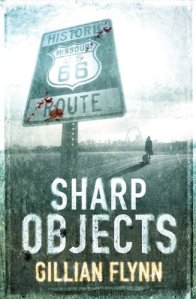 OK, so where to start with this one? Sharp Objects is about a reporter, Camille, who is sent by her paper in Chicago to investigate the murder of one girl and the disappearance of another in her home town of Wind Gap, Missouri. Is a serial killer involved? How are the local police faring in their investigation? Is it a local or an outsider who is committing these crimes? All the usual questions that you would expect when death hits a small town.
And of course, all is not well in Camille’s life. She has a tragic past (death of her sister); to describe her relationship with her mother (with whom she is forced to stay during her trip) would be a gross understatement; and, well, to put it (incredibly) mildly, she doesn’t exactly have a history (or a present) of looking after herself.
And of course, the crimes may all be a lot closer to home than she thinks.
I’m still not entirely sure how I feel about this novel. There’s a very prominent endorsement from the great Stephen King (well, I think he’s great) on the back of the edition I read, where he talks about Sharp Objects as ‘relentlessly creepy’, ‘dreading the last thirty pages’ and so on. And in some ways he is right, it is creepy, the story does linger, it does have a cumulative nastiness factor. Whether you have any positive feelings about the characters or not (and some reviewers really don’t like the portrayal of women in this book) it is in many ways very powerful. But……
And I’m not sure what that but is. I felt a lot of sympathy towards Camille because of her awful childhood and what it had done to her both physically and mentally. But something went askew for me towards the end, and I think it’s because after a slow and relentless build up it was all suddenly over. There was a huge revelation (for Camille at any rate) all the pieces appeared to drop into place, and then there was a ‘Carrie’ ending (film not book so if you haven’t watched the Brian de Palma movie you might not know what I mean). And you knew it was coming, and if you had half a brain you knew what it was, and for all those reasons it was a bit unsatisfying. Which is a real shame.
This is absolutely by no means a bad book; I just think it could have been even better.
This was my first read for RIP IV.
 So in The Victoria Vanishes our favourite elderly detectives, Arthur Bryant and John May become involved in yet another peculiar crime as women start turning up dead in London pubs. Not violently dead, you understand, but drugged and basically put to sleep. Bryant in particular has cause to be concerned as it becomes clear he saw one of the women shortly before her death entering a pub which, the following day, has mysteriously disappeared and possibly hasn’t actually existed since before the war. So, why are these women being killed? Why are they being killed in pubs? And what happened to The Victoria?
The joy of this novel isn’t just the plot, which is enjoyable and ingenious if a tiny wee bit far-fetched (a very minor quibble believe me), but the knowledge of and love for London which comes through every page. Fowler gives a list of the pubs frequented or at least mentioned in the book, and a number of them are in the area near my office (around Holborn, Fleet St, The Strand and Shaftesbury Avenue) and between us the Book God and I managed to identify a number that one or other or both of us had been in over the years we have lived in London. Sadly a lot of these pubs are beginning to be overrun by developers, but there are still one or two dotted around that are worth visiting, and they give a colourful backdrop to an enjoyable story.
And that brings August to an end and Crime Month is over for another year. I managed to read eight from what was quite an extensive list, and could quite happily have read more if the need to earn a living hadn’t inconveniently got in the way!
So it’s August Bank Holiday and in London it’s warm and humid but there is a promise of autumn (my favourite season) later in the week, and I am two thirds of the way through the Annual Lord of the Rings Extended Version DVD marathon which finishes this evening with (of course) The Return of the King. It’s only five weeks until I go on holiday, and I have Carl’s RIP IV challenge to participate in so what more could a girl need? Apart from a new handbag, of course…….
 The Language of Bees is the latest instalment in the tales of Mary Russell, wife to Sherlock Holmes, and starts off from the end of the last story (Locked Rooms) with Russell and Holmes arriving back to their home in Sussex to find one of the bee colonies deceased (if that’s what happens to hives) and a figure from Holmes’ past (and I’m not going to say who it is) looking for help. This starts a murder mystery which involves Mycroft (one of my favourite characters from the canon) and his extensive resources assisting Russell and Holmes in travelling up and down the UK to visit some of the most ancient sites in the country, seeking a dangerous and influential man. I think. It’s quite hard to write about this without giving away too much of the plot, which is something I really don’t want to do as the intricacies of the story is what makes the series so successful, alongside as the lead characters of course.
I will put my cards on the table and say that years ago, when King first started writing this series I was sceptical; I loved Sherlock Holmes and couldn’t see him ever getting married, especially to a much younger woman. But I picked up The Beekeeper’s Apprentice and gave it a go, and was instantly hooked. The books are written with such affection for Holmes, Watson et al, Russell herself is a distinctive character, and the events of each (while often harking back on occasions to the past) are all set after Holmes has retired, so don’t really tinker with the mythology at all.
The only disappointment in relation to The Language of Bees is the phrase “to be continued” which appears at the end, and the knowledge that I have to wait untill sometime in 2010 to find out how this particular story develops.
Well worth reading, snatched out of my hands by the Book God as soon as I had finished it, and if you haven’t read any of the Russell stories, then you really should. Excellent.


 Bride of the Book God