
You are currently browsing the tag archive for the ‘Crime’ tag.
 I have been very quiet on the blog recently, simply because I haven’t been reading that much, due to an increase in social activity (it’s that time of year, lots of cocktails, what can I say) and also because I have been distracted by my new toy, the iPad which I bought myself as an early “didn’t I do well in 2010” present.
I have always been easily diverted by bright and shiny things.
So I will not reach my target of 52 books this year but will attack the same goal with renewed vigour in 2011. At least, that’s what I’m saying now.
And I will be helped by the bookish spoils received from the Book God and others this Christmas:
- My Favourite Dress by Gity Monsef and others – a beautiful big fashion picture book, full of talented designers picking their favourite frocks, none of which I can ever afford or indeed hope to fit into…
- 100 Years of Fashion Illustration by Cally Blackman – absolutely gorgeous book with wonderful examples of fashion illustration from Paul Iribe in 1908 to Kareem Illya in 2005. Has made me realise that I would have liked to have been a wealthy Edwardian
- Britten & Brulightly by Hannah Berry – a graphic novel to add to the collection “There are murder mysteries and there are murder mysteries, but this is a noir where nothing is black and white” sayeth the blurb
- The Wonderful Wizard of Oz by L. Frank Baum, in graphic form by Eric Shanower and Skottie Young – exactly what you might think, absolutely lovely and wished for solely because I liked the illustration of the Cowardly Lion on the cover….
- Full Dark, No Stars by Stephen King – it wouldn’t be Christmas without a new Stephen King purchase though in terms of reading I am about 5 books behind (not to mention the Dark Tower series (so let’s not and say we did))
- Blow by Blow by Detmar Blow with Tom Sykes – the story of Isabella Blow, muse to Alexander McQueen – yet more high fashion
- Paperboy by the lovely Christopher Fowler – won the first Green Carnation prize and looks like it will be brilliant – to be saved for the dead grey days of January
- Dark Matter by Michelle Paver – a ghost story “Out of nowhere, for no reason, I was afraid”
- Phantoms on the Bookshelves by Jacques Bonnet – I love books about books
- The Dead of Winter by Chris Priestley – another one of my favourite authors. “A boy, a mysterious guardian and a haunted house with a terrible secret”.
- Gaslight Grimoire: fantastic tales of Sherlock Holmes – Fantastic tales. Sherlock Holmes. What’s not to like?
- A Gate at the Stairs by Lorrie Moore – shortlisted for the Orange Prize, don’tcha know. Audrey Niffenegger says its full of perfect sentences and that would be good enough for me even if I didn’t already like Lorrie Moore
- The Existential Detective by Alice Thompson – on my wish list simply because I read about it at Lizzy’s Literary Life and it sounded right up my street
- The Thoughtful Dresser by Linda Grant – more fashion; “the thinking woman’s guide to our relationship with what we wear”
- A Duty to the Dead by Charles Todd – WWI mystery novel
- The Swan Thieves by Elizabeth Kostova – can it live up to The Historian? I hope so…
- Of Bees and Mist by Erick Setiawan – “Three strong women. Two feuding families. A singular story of enchantment…”
Not a bad haul, I have to admit. And there’s also The Pattern in the Carpet by Margaret Drabble (a personal history with jigsaws) which I have already started.
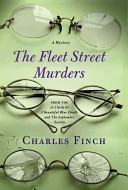 The Fleet Street Murders is third in the Charles Lenox mystery series set in the 1860s. He’s a sort of mid-nineteenth century Lord Peter Wimsey, I suppose (and I’m not the first to have suggested this at all), with detection as more than a hobby but less than a profession (given his aristocratic position).
So, in this one Lenox is standing for Parliament while his friends are in some distress and his love life is wobbling. At the same time two journalists have been murdered in London and he is torn between his duty to his potential constituents and his desire to solve the crime.
As with the others I found this an enjoyable and easy read. The author is American, and there were the occasional usage of words that wouldn’t trip off a Londoner’s tongue now (sidewalk? cookies? (well, maybe these days the latter might be heard) ) let alone in the mid-Victorian period (and I’m happy for any Captain Pedantics out there to set me straight if I’ve got that wrong) but these were only very mildly irritating. His lady love is still too good to be true, though maybe marriage will sort that out. Mystery was pretty satisfying but the best bits for me were all to do with his political campaign.
So, good holiday read and I will certainy look out for the fourth in the series.
 So. How to describe this book? Well, in his introduction to this collection of William Roughead’s writings on true crime, Luc Sante suggests that the author might just be the Henry James of the genre, which is a fascinating thought, and given Roughead’s prose style (which I loved, by the way) I can see why he came to that conclusion.
Roughead was a Scot, born in 1870, who trained as a lawyer but found his calling in writing about famous crimes, mostly but not entirely Scottish, and mostly, but not entirely murders. He is notable for the fact that he attended every significant murder trial held in Edinburgh between 1889 and 1949, a remarkable feat. And he turned most of them into articles or books written in his own inimitable style which would, as has been said by others, make you think that he came from a much earlier age. I found myself reading out whole paragraphs to the Book God because they were too much fun not to be shared.
This is hugely enjoyable if you are at all interested in true crime. Roughead covers some of the very obvious ones like Deacon Brodie, Burke & Hare and Madeleine Smith, but also others that I wasn’t familiar with at all, such as the Arran and Ardlamont cases.
The one that particularly caught my interest was his revisiting of the infamous Oscar Slater case which was taken up by Sir Arthur Conan Doyle as one of the greatest miscarriages of justice of the early twentieth century. It made me angry to read how Slater was imprisoned for many years for a crime he didn’t commit, the ineptitude of the legal system that couldn’t or wouldn’t recognise that the police had got it wrong, even to the extent of persecuting one of their own officers. Slater was never pardoned and no-one else was prosecuted for the crime, and the case has had an impact in modern times, expecially around the conduct of identity parades.
But setting aside crossness at the lack of justice meted out in some of these cases, there is a huge amount of pleasure to be gained in Roughead’s prose style. It’s a chunky read but rewarding.
 The God of the Hive is the long-awaited (by me at least) sequel to The Language of Bees which I reviewed here last year. Having to wait 12 months to find out what happens next has been a tiny wee bit frustrating. But it has been worth the wait.
Again it’s difficult to talk about the plot of this novel because it runs on immediately from the events of its predecessor, and by that I mean within minutes of the end rather than weeks or months afterwards. And I don’t want to give anything away. Suffice to say that Sherlock and Russell are separated for much of the book, on the run, hiding from the powerful and menacing group who have killed several people already, trying to get to the bottom of what was going on.
So all I can say is that it’s pacy and exciting and all the great characters appear and some new ones are introduced and all the disguises and skulking about and action is all included, so thoroughly enjoyable and devoured in a couple of days. The only downside was that the Book God had read this first and kept on offering to give me pointers to the way the plot would develop in an annoying fashion which has been noted in the future. He won’t get the chance to do that to me next time.
So if you are already a fan of the Russell novels you will find a lot to enjoy here, but you really need to read The Language of Bees first as otherwise it just won’t make sense.
 The Girl Who Played with Fire is the second novel in Larsson’s much-praised Millennium trilogy, and pick Lisbeth Salander’s story up some months after the events of The Girl with the Dragon Tattoo (which I talked about here).
It’s always difficult to talk about the plot of a book which is part of a series and I suppose theoretically could be read as a standalone but does really need some knowledge of its predecessor to really make sense.
Suffice to say that Blomkvist is now a major celebrity and Lisbeth is no longer in touch with him. Because of stuff that happened in the previous story some nasty people are out to get Lisbeth, and this leads to her being suspected of murdering three people. So the bulk of the story covers her on the run while trying to find out what’s going on.
Separately, Blomkvist is trying to clear Lisbeth’s name; two of the victims were friends/colleagues of his and he doesn’t belive Lisbeth committed the crime (though interestingly enough not because she isn’t capable of doing so). It’s her capacity for wreaking revenge on those who have treated her badly or offended her very personal moral code that makes her such a compelling character.
It’s all very grim, with strong violence particularly (but not solely) against women – the original journalistic investigation which kicks all of this off is about sex trafficking, continuing the theme of the exploitation of women as a hidden facet of Swedish society which characterised the first book.
In the end, how you react to this will depend on your stomach for the subject matter and whether you warm to the character of Lisbeth. I thought this was a very powerful story with some quite appalling events and revelations at the end of the book which mean that I will definitely be picking up the final volume in the series.
 I can announce quite happily that my reading slump is finally over, but what that means is that I now have a nice stack of reviews for both here and the Screen God blog that I need to catch up on (grammatically incorrect I’m sure but too hot to think of an alternative).
But I have an excuse (I think) and it’s not my normal gosh-I’ve-been-so-busy-at-work-poor-little-me nonsense. No, this backlog is all because of a hectic social life which has seen lunches and cocktails and catching up with friends before they go on holiday all having taken place since last Sunday. There won’t be another week like it until Christmas, mark my words.
I like excuses like that, it sounds like I know how to have a good time. Which I do, I just don’t get the chance to do it all at once. Anyhow, enough of all this nonsense.
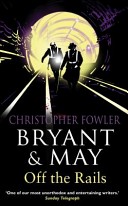
First on the review pile is the latest Christopher Fowler, namely Bryant & May off the Rails. Now, it isn’t that long ago since I read and reviewed the previous book in the series (see here) and I normally don’t read sequences close together because I’m always afraid that I will somehow lose interest, but in this case I was really keen to get my hands on this because the events follow on almost immediately from the previous story and I wanted to know what happens.
And it doesn’t disappoint, building on what’s gone before, developing the character of the enigmatic Mr Fox, and throwing in loads of absolutely fascinating information about the London Underground. As before, not going to discuss the plot as I don’t want to spoil it for anyone but as always I really, really enjoyed this. Not terribly eloquent as a review, but that just shows what too many Cosmopolitans can do to a woman; although I’m not entirely convinced that there is such a thing as too many Cosmopolitans, but that may be a Scottish thing.
And behind the curve as always, I discover that I’m one of the last to know that Mr Fowler has his own blog which is really worth reading; you can find it here.
 So it’s a sunny if windy day here in London after a week of heat and humidity which I always find difficult to handle. And my usual summer grumpiness has arrived slightly earlier this year (I usually wait until August to feel annoyed with heat and my favourite people not being around and travelling on crowded public transport and all that jazz) but is not as intense as in previous years so I may just get through this OK (fingers crossed).
So my thoughts are turning to what I might read over July and August.
The latter is usually Crime Month and I will certainly be reading that sort of thing, but I had the thought that I might do some re-reading of old favourites in tandem with the murder/mayhem thing. Said thought was triggered by purchasing books for friends, a practice I’ve started in preference to lending things to people as (a) it takes the pressure off (no hurry to read the thing just to get it back to the owner) and (b) I don’t get twitchy wondering what’s happened to my precious, precious books.
I recently got Espedair Street by Iain Banks for Silvery Dude and Fifth Business by Robertson Davies for another good friend, the Semi-Scandinavian. So that’s two for the re-read pile, plus I want to read the sequence of four novels by AS Byatt that starts with The Virgin in the Garden, plus I want to re-read all my Laurie Colwin books (especially Family Happiness) and suddenly this look like it might be fun.
But I’m not giving any hostages to fortune so no lists will be posted, and you’ll just have to watch this space……..
I also have a small stack of reviews to catch up on (hurrah, actually managed to finish some books), so hopefully activity on the blog will pick up over the next wee while.
So I’ve been talking recently about my reading slump, and several people suggested that I needed to be reading more than one book at a time (I have tended to be very traditional and have no more than two, three at most, books on the go); that way I can switch as my mood takes me.
That may seem very obvious to many of you, but let’s note for the record here that one person’s obvious is usually my “jings, why didn’t I think of that?”
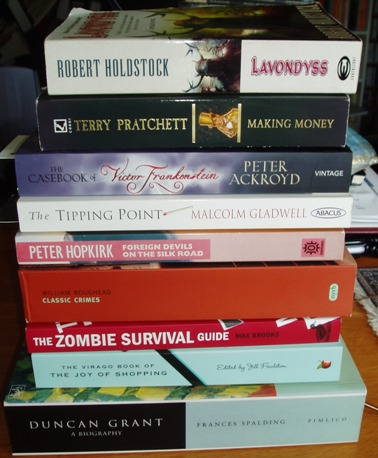
So I have thrown myself into this with gusto, and am currently at various stages of reading the pile at you see here:
- Lavondyss by Robert Holdstock – a planned read for the Once Upon a Time challenge, this is a sequel to the equally excellent Mythago Wood
- Making Money by Terry Pratchett – will confess that I’m stalled with this one, I should be loving it but am finding it difficult to pick up again – another planned read for Once Upon a Time
- The Casebook of Victor Frankenstein by Peter Ackroyd – recommended by the Silvery Dude and only started late last night – creepy
- The Tipping Point by Malcolm Gladwell – because I’m in a bit of a non-fiction phase and I keep on meaning to read this
- Foreign Devils on the Silk Road by Peter Hopkirk – as recommended by the Book God after an excellent lecture on engaging with China which we attended at the British Museum
- Classic Crimes by William Roughead – what it says on the tin
- The Zombie Survival Guide by Max Brooks – vaguely unsettling what to do if they were real guide-book
- The Virago Book of the Joy of Shopping, edited by Jill Foulston – which called out to me by name when shopping in Blackwell’s on the Charing Cross Road for a present for Silvery Dude
- Duncan Grant by Frances Spalding – a Bloomsbury fix for the Art History Reading Challenge
And I might even finish some of these!
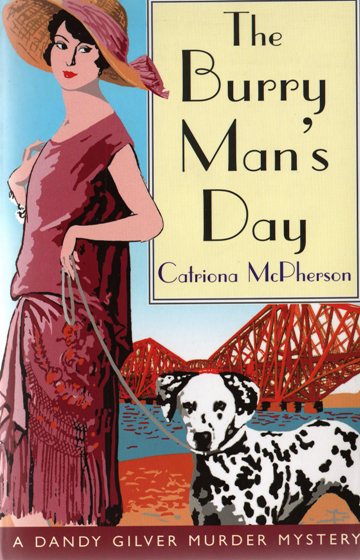 So, having read the first Dandy Gilver mystery (as reviewed here) and fallen in love with it, it seemed the natural thing to do to read the second as a way of getting myself a little further out of my current reading slump.
The Burry Man’s Day finds Dandy in Queensferry where an old schoolfriend and her American husband have come into their inheritance (a rather nice castle-type dwelling with attendant estate). With this inheritance has come some obligations around the annual fair – judging various competitions, awarding prizes and so on – and Dandy and her other friend Daisy are there to assist.
One of the highlights of the fair is the Burry Man – a sort of Green Man type character wearing a costume completely covered in burrs (hence the name) who progresses through the town collecting pennies and/or shots of Scotch to bring good luck to the town. Unfortunately said Burry Man drops dead at the end of the day and the big question is, of course, was it murder?
Step forward Dandy, who calls in her “Watson” from the first book, Alec, to assist.
I enjoyed this very much. There was sufficient uncertainty about whether there had been foul play to keep it going, and I liked the fact that Dandy did try to remind everyone that, though there may be a mystery about some of the actions of key players, that didn’t necessarily mean that murder had taken place. I thought the solution was plausible, but my only quibble is with the very end, which I did think was a bit far-fetched. But to be fair it didn’t spoil the remainder and did show (if it needed to be repeated) that the effects of the First World War were deep and far-reaching.
Still fond of Dandy, so much so that I’ve bought the three other books in the series so far, and will enjoy working my way through them over the summer.
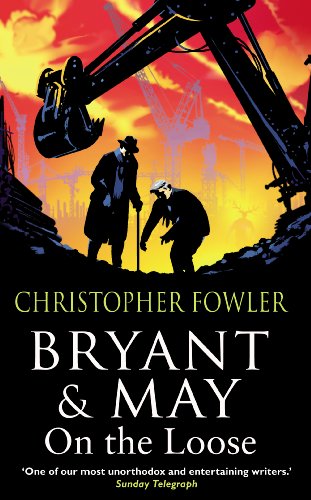 Another excellent entry in the Bryant & May series, On the Loose finds the Peculiar Crimes Unit disbanded and our protagonists looking for a new purpose, or possibly just having to accept retirement. But the finding of a decapitated body in a freezer in a derelict shop in King’s Cross leads to the unit being unofficially reconstituted and as more headless bodies are found it becomes clear that something very strange is happening in this part of London. And the authorities want it all kept quiet, hence turnign reluctantly to the PCU.
This is great stuff; I’ve always been a fan of this series and one of the great pleasures of the books is the way Christopher Fowler feeds in the history and mythology of London. Now, I’ve lived here for over twenty years and don’t profess to know huge amount about the city but one of the things I do know is that it is an ancient and fascinating place and there is still an air of mystery about certain parts of the city, and it is tapping into this which gives the Bryant & May books such depth.
You wouldn’t think that an area as seemingly prosaic as King’s Cross, with its major stations and regeneration programme would fit the bill, but digging up a place can reveal some interesting elements of the past, and the idea that change can lead some people to get in touch with history and use it to their own ends is really plausible. So the idea that the personification of an ancient myth (in the shape of a half man half beast with antlers constructed from knives) can be terrorising the workers on a construction site isn’t really that far-fetched, especially when you consider that many of those workers come from eastern Europe where some of these traditions are still very evident in everyday life.
So not much more to say about the plot (don’t want to give anything away) but the villain of the piece is a very interesting character and the ending sets up a sequel very nicely. And I read this just in time for the next one (Bryant and May Off the Rails) which comes out towards the end of the month.
So, one of the best of the series and very, very enjoyable indeed.


 Bride of the Book God