
You are currently browsing the tag archive for the ‘Crime’ tag.
 I can’t believe how long it’s been since I last sat down to update this blog, but that’s been a constant refrain this year due to a combination of not reading as much as I used to and other distractions (mostly work) leading to me only really thinking about this sort of ting at the weekend when there are competing priorities. But I am determined to catch up on my reviews before I go on holiday to Italy in the middle of September.
And where better to start than with a book I picked up purely on spec in our local branch of Waterstone’s.
I don’t know why it caught my eye – a combination of the cover and the fact that this is a new imprint designed to
showcase unjustly neglected works by great writers from the 1930s – the so-called golden age of crime writing – through to the 1970s
Francis Beeding is a pseudonym for two guys who wrote collaboratively over more than 20 years, and five of their novels have been made into films – haven’t gone looking for those yet – so clearly very successful but until now I hadn’t heard of them at all, and there works seem to have drifted into relative obscurity. Which is a real shame because this is an absolute cracker.
So we have a seaside resort in England, nothing special about it really, except that at least one of its residents has a pretty significant secret. And then the murders start.
This is a classic police procedural; we see the impact from the local angle as well as from the press (a reporter happens to be on holiday here and covers the story) and the detectives from London brought in to help solve the case. There is a real sense of unease as the community turns in on itself, wondering why this is happening to them. Perhaps unusually for this sort of story there is not only an arrest but a court case and a wonderful twist at the end which I will confess I didn’t really see coming and which has a really modern (to my mind) approach. Without giving anything away, I worked out the what but had no idea about the who.
Death Walks in Eastrepps was once apparently described as one of the ten greatest detective stories of all time, and its easy to see why. Highly recommended.
This was my fourth Readathon read.
 The Baskerville Legacy was not at all what I expected. When I saw it in the book shop I was immediately attracted by the cover and the subtitle “A Confession”. Ah ha, I thought, this is going to be a lovely Holmesian pastiche telling the true story of the Hound of the Baskervilles; not a straight retelling because Conan Doyle himself appears all the way through, so not a version of Holmes but a “how it came to be”. Which it was and wasn’t.
There isn’t actually a mystery here. It’s the story of how The Hound came to be written; the germ of an idea by a friend of Conan Doyle, a man called Bertram Fletcher Robinson, worked on jointly or so it would appear. But in many ways the tale being written is incidental, as this is a book about friendship, writing, collaboration, professional jealousy, talent or the lack of it and the impact of a dissolute lifestyle. Oh and of course there is spiritualism.
It’s a really enjoyable short book, and one of the most interesting things (apart from the portrait of Conan Doyle who isn’t always the jovial chap he was often portrayed as) is where the author has taken real events and changed or elaborated on them to produce his novel. because Robinson and Doyle were friends, holidayed together, and appeared to have collaborated though Doyle is the sole author on all published versions. there seems to have been a real controversy over this though as the author says none of the correspondence between the two men (if it still exists) has ever been made public. The author’s note at the end is a fascinating read all by itself.
I very much enjoyed this story, with its unsettling air of creepiness, of jealousy and strong feelings, and would recommend it as something a little bit different on the whole Holmesian thing. So not what I expected as I said, but a very happy accident.
This was my second Readathon read.
 Let’s start with the introduction:
Once there was a widow with three sons, and their names were Black, Brown and Blue. Black was the eldest; moody and aggressive. Brown was the middle child; timid and dull. But Blue was his mother’s favourite. And he was a murderer.
So our narrator is B.B., and what an unreliable person he is. All of his story is told through blog entries, some of them public and commented on by a small group of readers, some of them private and giving more detail and context to what are ostensibly murderous vengeful fantasies, but are they fictionalised versions of real events?
B.B. by his own admission is (as my Gran would have said) “not a nice man, not a nice man at all”, part of a dysfunctional family (horrible brothers, absent father and monstrous mother) and surrounded by secrets from the past which he shares with us piece by piece until we think we have a picture of his troubled past. And then there is a revelation near the end which certainly gave me a bit of a WTF moment and a quick flick back through the pages to see whether I had missed anything as it was rather unexpected.
Joanne Harris has set blueyedboy in the same town as her excellent Gentleman and Players which I read and enjoyed last year, so there is an air of familiarity about the setting and the feeling of being an outsider. I’m not sure I would go so far as to say its a companion piece but there are some similarities, particularly around the need for revenge, but blueyedboy is not anywhere near as gleeful as I found G&P.
It’s an unsettling novel, well written and cleverly plotted and I enjoyed reading it at the time but as the weeks have passed I think the impact has diminished and I’m not sure this is one that will stay with me.
 Didn’t do very much reading this week; continued to make some progress on The Glass Books of the Dream Eaters. I decided on my reading list for Carl’s Once Upon a Time VI challenge, and started my first read, The Forgotten Beasts of Eld. Hoping to do more reading over the Easter break.
The following new books came into the Bride’s abode this week:
- A Lesson in Secrets by Jacqueline Winspear – the latest Maisie Dobbs mystery (I think I’m a book behind so must get on)
- Timeless by Gail Carriger – the latest Alexia Tarabotti story, “a novel of vampires, werewolves and Egyptian thingamabobs”
As of today I am on a book-buying embargo (apart from those pre-ordered on Amazon) and I am also going to try to catch up with my backlog of reviews (four books and counting) before I forget what it was that I thought about them.
Only finished one book this week, though have started a couple of others. The one I did finish was Blueeyedboy by Joanne Harris which was really compelling as I said in my post last week. I have continued to read and love The Glass Books of the Dream Eaters and have started one of my big re-reads.
New books arriving chez Bride this week are:
- Immortal Queen by Elizabeth Byrd – Mary Queen of Scots in a 1970s style
- Eat Him If You Like by Jean Teule – “A true story. Tuesday 16 August 1870, Alain de Money, makes his way to the village fair. He arrives at two o’clock. Two hours later, the crowd has gone crazy; they have lynched, tortured, burned and eaten him”. A short but apparently powerful story.
- The Suicide Shop by Jean Teule – “Has your life been a failure? Let’s make your death a success”
- Unwritten Secrets by Ronald Frame -“Mariel Baxter, a famous American soprano, has suddenly cancelled all her recitals and flown to Vienna. In the 1980s she came to the city to study the art of lieder singing with the reclusive Ursule Kroll, one of the brightest stars of the Nazi era and a favourite of the Fuhrer himself. The two haven’t communicated since Mariel’s unexpected departure over twenty-five years ago. So why has Mariel come back?”
I have loved Ronald Frame for a very long time and may write a post just about him in the near future. He pops up again because on a long trip back home from Manchester I played about on the Amazon app on my iPhone and downloaded some of his stories for the Kindle app on my iPad (which I don’t talk about very much because although I have quite a few books on there I haven’t actually read any). But this week I’ve bought quite a few, namely:
- One Day by David Nicholls, because I thought it was time that I did
- Carnbeg Picallili, Mysteries of Carnbeg and A Carnbeg Affair by Ronald Frame, beacuse of my liking for Carnbeg as a setting
- Kind of Cruel by Sophie Hannah, because I read a very good review (but have forgotten where, sorry)
This week I have alot of travelling (Manchester and Glasgow) and some time off so I’m hoping to get a bit of reading done.
 I have said elsewhere how much I enjoy the Mary Russell series of books by Laurie R King so will not repeat myself unnecessarily here; pleased to say that Pirate King is no exception to that rule and was a lovely fun read after a run of dark and creepy novels.
This is the eleventh in the series and although it does refer back to previous adventures it does so in a non-spoilerish way so would be a good place to start if you have never read a Mary Russell novel before. It is certainly much more light-hearted in many ways than the others and gives a good insight into Mary’s character and her relationship to her famous husband Sherlock Holmes.
So, bit of plot. Mary is persuaded by the imminent arrival of her brother-in-law Mycroft (with whom she’s had a bit of a falling out) to take on the role of assistant to a film crew to investigate the disappearance of her predecessor (was it foul play or had she just had enough) and the distinct air of criminality which follows each of the company’s productions (gun running, drugs etc.) This leads to a trip to Lisbon and then Morocco in what turns out to be a bit of a romp (and that’s a word I normally avoid though it seems appropriate here).
This is huge fun. There are pirates and ingenues and megalomaniacal film directors and chaperones and secret agents and disguises and all manner of derring do set against the backdrop of a silent film production, in this case a film about the making of a film about The Pirates of Penzance. I love stories about early movie making (Bride of the Rat God (sadly out of print it seems) and Hollywood being two that spring to mind, though very different of course) and the technical problems and practicalities of making a movie in the 1920s really spring to life here without being heavy-handed, which has always been one of this author’s strengths for me.
And as much as I love Mary on her own it’s always better when Holmes himself gets involved; the dynamics of their relationship are one of the joys of the series, so I was very pleased whenever he turned up.
A very enjoyable read all round, and I can’t wait for the next one.
I considered listing this as an RIP read because there is mystery and peril galore but it was just too light-hearted to sit alongside my reading this for that challenge.
 I’m a little bit behind in reading the Simon Serailler crime series by Susan Hill; The Shadows in the Street came out last year and a new one is due shortly (in October I think). Probably just a by-product of my reading slump this year as my normal August is Crime Month personal challenge didn’t really happen and this would definitely have been swept up in that.
This was a bit of a slow start for me; a lot of time was spent setting up the characters and context for the crimes that were to follow which although not putting me off did make me slightly impatient and there was certainly not enough of the boy Simon in the first couple of chapters though luckily I like his sister and step-mother who made up for his absence.
So, the story is once again set in Lafferton though this time we see more of the underbelly of the town if I can put it like that; a number of the characters (and indeed three of the victims) are young women who have turned to prostitution either because of drugs or simply no other way to make ends meet. There is a thread of poverty and unemployment and hopelessness that runs through the story which is an interesting contrast to the lives of many of the characters in this series, who if not wealthy are comfortably middle class, and there is a certain amount of looking the other way which is of course not sustainable once the murders begin. The novel also delves into what it is like to be considered a suspect and the impact that can have on your life which was rather sad.
I mentioned in a post here that I found one of the characters to be dreadfully unsympathetic and hoped she would get her comeuppance; of course we learn more about her during the course of the novel and I was a bit harsh (and felt slightly guilty as well) and it just goes to show that I shouldn’t jump to conclusions.
This is a well written police procedural; I wouldn’t say that the story was compelling but I wanted to know what would happen and although (without wanting to give anything away) I was mildly annoyed at one of the plot points towards the end which I thought was a bit too convenient, I didn’t work out who the murderer was and that’s always a good thing in this type of non-puzzle crime novel. But I do think this is one of those series that you really need to read in chronological order because of the Serailler family back story which is so important. And I’ve already pre-ordered the next one.
 I haven’t read very much by Joanne Harris, one novel (before my blogging days) and half a book of short stories (really must get round to finishing that one day – if only I could remember exactly where I put it). I’m not even sure why I bought this one; must have been a review somewhere that caught my eye because buy it I did, and it has languished on the tbr pile for ages, until I spied it last week when looking for something a little different to read.
So Gentlemen and Players is set in a boys’ grammar school somewhere in England (I think it’s meant to be in the north but that wasn’t entirely clear). It’s the start of a new term and that brings all sorts of rivalries among the teaching staff to the forefront as timetables are changed, rooms re-allocated and the pecking order re-established. We see St Oswald’s partly through the eyes of one of the teachers, Roy Straitley, who has been at the school since the year dot and is fighting against inevitable retirement. We also see the school through the eyes of an unknown narrator, one of the new teachers but we’re not sure which one, a person with a real grudge against the school and everyone in it, and who has come back to take revenge. That story is told as a mixture of reminiscence and present day plotting, and what plotting there is!
This is a gloriously nasty book, and I mean that as a compliment. The unknown protagonist has thought things through very clearly and has a plan which, while it may need to modified as circumstances dictate, is designed to totally destroy St Oswald’s. There is scandal and murder and spite and I thought it was fantastic. At one point in the novel I thought “I wonder…” and as I was proved right I felt real satisfaction; for once getting slightly ahead of the author was a joy and not a disappointment as the outcome was as I predicted and just added to the fun (if you can refer to fun in a book where very horrible things happen to people who often don’t deserve them); very satisfying.
This was a slow starter for me but a few chapters in when I realised exactly where this might be going I just couldn’t stop reading, and even broke my rule of not reading too late on a work night, sitting up in bed until I had finished it. One of the quotes on the back of my paperback copy referred to this as “wickedly fun” and I’m not sure I can better that description.
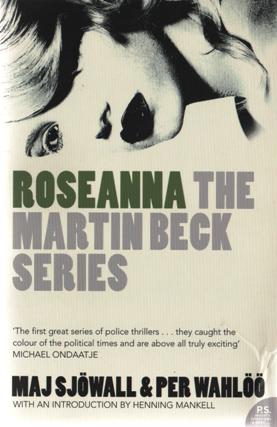 What is it about Scandinavian crime? I’m not reading it all, but there is quite a lot in the stacks and I’m not sure why; I don’t think it’s a bandwagon on which I have jumped along with many others as everything I’ve read so far has been great, but it is interesting how much has been published over the past few years.
Although I have to confess that I picked this up without really registering that it actually was Scandinavian; for some reason I thought it was German – probably just because the hero’s name is Martin Beck, which (feebly) sounds faintly German to me.
Bit of a rambly intro into a review of a book which I enjoyed very much.
Roseanna is the first of 10 novels in the Martin Beck sequence which look at crime as a reflection of Swedish society (as explained by Henning Mankell in his fascinating introduction) and was published in 1965. It is the story of the investigation of the murder of Roseanna, though at the beginning we know nothing about her for quite a long time, she is simply a body pulled from a lake by a dredger, clearly murdered but by whom?
What makes this such an interesting read is how it concentrates on the tedium of much police work. It takes Beck and his colleagues ages to find out anything about the victim other than the stuff that is revealed by the post-mortem, and what they do find out is partly based on luck.
Beck himself is not what I expected; yes, like a lot of detectives, he isn’t entirely happy at home, though he at least is still married to his wife unlike so many others, and he is prone to depression and has problems with his digestion which gives an interesting perspective on how he handles his job. The importance of team work comes across; Beck is not one of those detectives who goes off on his own following hunches, this is a proper police procedural. And the killer and his motive (if it can be called that) was sadly all too plausible.
Will definitely be looking for others in the series.
 This is part of the Treasury of Victorian Murder series, and was the one I was always going to get first simply because I have been fascinated by the Jack the Ripper, and indeed serial killers of all sorts, since I can remember, all the way from Gilles de Rais to Ted Bundy.
A bit morbid, I know, and the sort of admission that immediately gets you marked as the obvious suspect in any decent American crime series. Especially when coupled with the kind of books on the subject that I have in the stacks.
Can’t explain it, just once of those things, no need to be afraid, honest.
So Jack; well, iconic killer largely because his murders not only remained unsolved but have spawned the wildest of theories about his identity, from the Duke of Clarence to Walter Sickert to Sir William Gull, which in turn has led to some great books, both fiction and non fiction. And of course the movies; my particular favourite being Murder by Decree with the great Christopher Plummer.
But I digress.
This is a great little book, which tells the basics of the story as it happened as if through the diary of a contemporary who had access to the police. I loved the artwork which managed to give a real sense of place and conveyed the gruesomeness without dwelling on it, probably helped by being in black and white.
A very nice addition to my true crime library.


 Bride of the Book God