
You are currently browsing the tag archive for the ‘Crime’ tag.
 Every so often a book comes along that everyone seems to be reading and talking about all at once, and because I can be a bit perverse I tend to avoid them until the puff dies down a bit, then I dive in when no-one else is looking and often fall in love with them quietly in a corner. I did that most recently with Gone Girl (which I thought was great as you can see here) and was going to do the same this time round with Lauren Beukes’ The Shining Girls which only came out in April. But something drew me in, possibly the tagline; after all who can resist the idea of “the girl who wouldn’t die hunting the killer who shouldn’t exist”? Certainly not me.
So the book opens in Chicago in the 1920s where we meet Harper Curtis who I think its fair to say is not a nice man at all. He’s in pretty dire straits when we first come across him, beaten and hunted, but he finds himself in possession of a key to a very particular House one that allows him access to other times (and for that reason really deserves to be capitalised). Harper is a killer, hunting down the shining girls, young women of promise and vitality whom he taunts and murders rather brutally. But he meets his match in Kirby Mazrachi who astonishingly survives his horrendous attack and when the police cannot (understandably) find her would-be murderer begins to investigate and comes across evidence which points to a situation which cannot possibly be true. But of course is. And she goes after him.
The Shining Girls is absolutely brilliant, a fabulously clever idea and a wonderfully constructed book which twists and loops through time as we follow both Harper and Kirby. The structure of the novel is complex but never confusing though it must have required a phenomenal amount of organisation to keep the various stories straight over 80 years of events. The young women whom Harper kills are all proper characters; we learn quite a bit about each of them and that makes what happens to them so awful. Kirby is a wonderful character, trying to make sense of the terrible thing that was done to her but still flawed and damaged as you would expect. Harper is just a dreadful human being; it isn’t clear whether the House “makes” him do these awful things or whether he would have done something like this anyway, it’s just the spread of his attacks over time which keeps him hidden. But totally totally odious.
I really loved the mix of time-travel and serial killer and I appreciated that not all of the answers are handed to you as a reader. The situation is just as it is and I found that was good enough for me. Definitely a book worthy of re-reading.
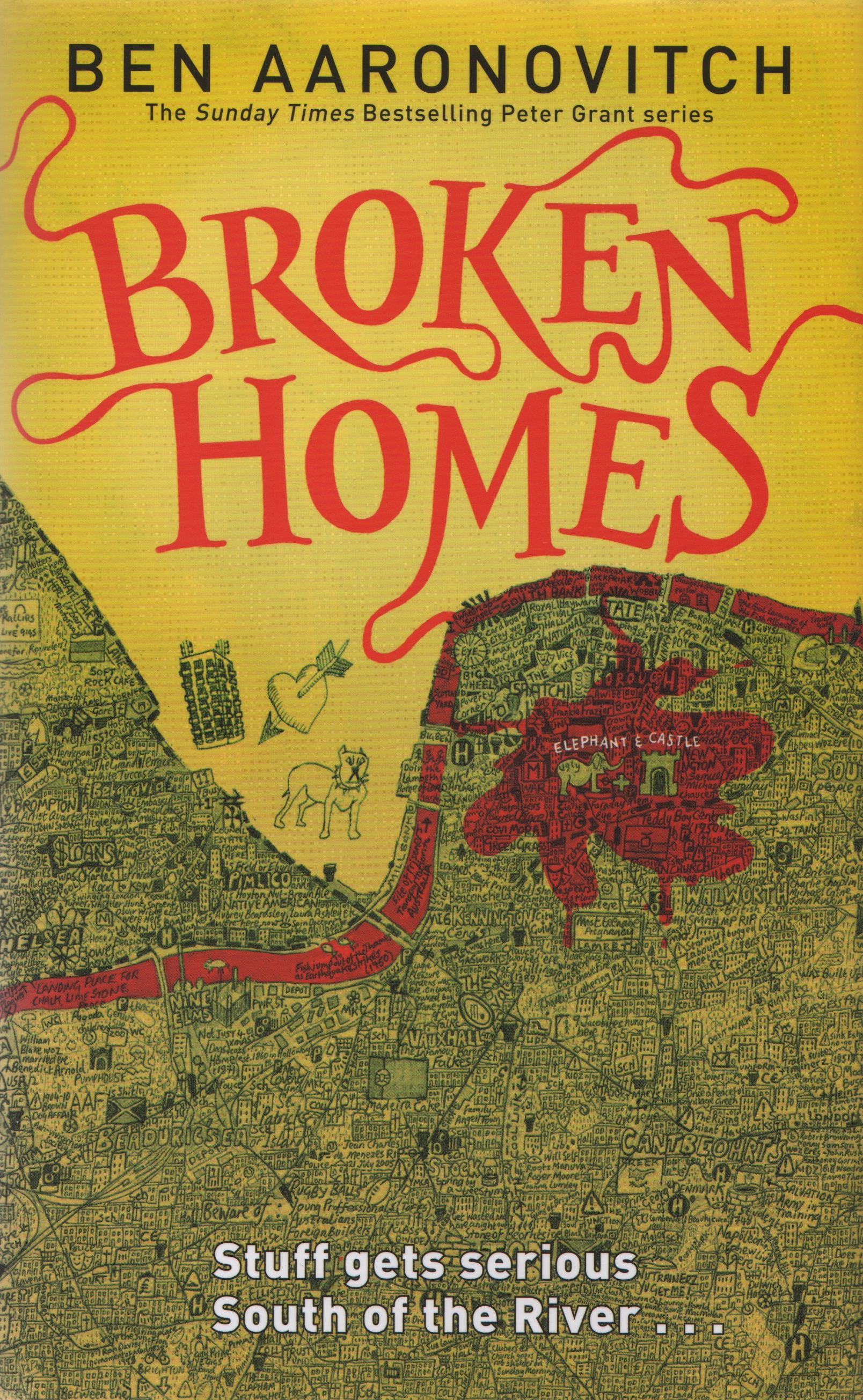 It is no secret to anyone who reads this blog regularly (and there must be someone out there, surely?) how much I like Ben Aaronvitch’s Rivers of London series, and how thrilled I was to get my copy of Whispers of Underground signed at an event last year. Sadly I couldn’t make the London event this year but no matter, as soon as my copy of Broken Homes arrived I dived (dove?) right in and devoured the thing in short order.
So much as before we have Peter Grant, PC and wizard, his boss Nightingale and colleague Jenny still on the hunt for the rather nasty Faceless Man, still interacting with the various incarnations of the Thames and its tributaries and still being dragged in to any case with a whiff of the supernatural. This story starts with an odd car crash, some mutilated bodies and *gasp* the need to go south of the river to work out exactly what, if anything the connection is with a particularly unusual housing complex designed by the somewhat eccentric Erik Stromberg.
As you might expect I really loved this and its mixture solid police work and, well, magic. The story really clips along. As always (and its perhaps a bit of a cliché to say this, but hey, this is how things become clichés) London itself is a significant character and also as always I learned quite a bit that I didn’t know about the city that I live and work in. Although I think all the books are strong this seems to me to be the best since Rivers of London itself.
And the end was Oh!
Followed by Ah!
Followed by a rush to the web to find out when the next volume is due because I want to see where this is all going.
Absolutely great stuff.
 So, Gone Girl by Gillian Flynn is one of those books that everyone was reading at the same time last year, and, as I always seem to do, I postponed my read so as not to get caught up in it all. I have absolutely no idea why I do this but it has become a habit and I suspect I’m not going to change anytime soon.
I have read Gillian (a bit over-familiar, sorry) before, Sharp Objects which I reviewed here, and enjoyed it enough to buy (but not yet read, her second novel, Dark Places, and I do have a tendency to read things in order, but I jumped into Gone Girl because I became curious and ended up finishing it in a massive single sitting when I wasn’t very well just before Easter. And I can recommend it as a book to take your mind off illness because it is totally compelling and I really, really wanted to know how it was going to work out.
This is the story of Nick and Amy, a golden couple whose life changes when they have to move away from New York to Nick’s hometown when they both lose their jobs. One day Amy disappears; there are signs of a struggle and Nick is distressed but there is something not quite right, and we follow the investigation into her disappearance from Nick’s point of view, alternating with entries from Amy’s diary from the point at which she first meets her husband.
I loved this. I thought I knew where the story was going, and then a thing happened that both reinforced my theory and undermined it entirely, and then another thing happened which I didn’t see coming at all.
As well as a fabulous psychological thriller it’s also a compelling portrait of a marriage and reminds us all that you never really know what’s going on in someone else’s head.
Gillian has been accused of misogyny amongst other things; if you want to know what her reaction is to that then do read this interview with her in The Guardian.
If you are one of the three people in the world who hasn’t read this yet then I can’t recommend it too highly.
 Garment of Shadows is the twelfth (I think) and latest instalment in the chronicles of Mary Russell and Sherlock Holmes, husband and wife sleuthing team. It follows on directly from the events of Pirate King which I talked about here.
The book opens with Russell waking up in a strange room in Morocco with amnesia from a head injury; snatches of memory come back to her in dribs and drabs and she is aware of a range of skills that are clearly second nature but she has no idea how she developed them. At the same time Holmes is hugely concerned that his wife has gone missing and sets off to search for her. All of this against the background of unrest and revolution in the country. Is it all connected?
Well, of course it’s all connected and we’d be disappointed if it wasn’t, especially as it turns out that the French governor is a distant cousin of Holmes. The book is full of intrigue and ambushes, captures and escapes, and figures from the past. The amnesia device could have been a cliché but is handled really well and the manner in which Russell regains her memories rings true. I’m also pleased to say ( and I don’t think this is a spoiler) that the separation from Holmes is not strung out for two long as (and I know I’ve said this before) I really believe that one of the strengths of this series is the relationship between the two and I love to see them working together.
As always the historical research is impeccable but it’s handled very lightly and I learned quite a few things I didn’t know before; the author’s note is very interesting in that respect.
A special treat was the novella included at the end of the book, previously only available electronically, which takes us back to events in the very first novel The Beekeeper’s Apprentice.
Another very enjoyable read.
 The Weed that Strings the Hangman’s Bag is the second of the murder mysteries featuring the precocious eleven-year-old Flavia de Luce, set in 1950’s England. I read the first one a couple of years ago during the 24 hour readathon (my thoughts are here) and enjoyed it sufficiently to start collecting the sequels (I already have the third and hoping to get the fourth as a present for my birthday at the end of this month).
Flavia’s circumstances haven’t changed much from the previous story; she is still being treated badly by her horrid older sisters, her father is still distracted by financial worries and she is still sticking her nose into adult affairs which she doesn’t entirely understand of course given her tender years.
On this occasion a travelling puppet show finds itself stranded in Bishops Lacey and Flavia gets involved (along with the local vicar) in persuading them to put on a show for the villagers and as is inevitable tensions burst out into murder.
The underlying story is rather dark and very sad but there is a lot of fun in Flavia’s attempts to get to the bottom of what’s going on. She is a really interesting character; sometimes she seems to be older than she is meant to be (but not often enough to cause problems with consistency) but it is clear that some of the motivations of the adults are beyond her though her instincts and fascination with chemistry lead her to the correct explanation for many of the events (she memorably twigs that one of the female characters is pregnant) and she has the grudging respect from the investigating detectives.
This was the perfect read for me at the time, given that I was suffering from Norovirus and needed something worth reading but not too challenging intellectually, and this was exactly that; I read it in a day.
Looking forward to reading the next one!
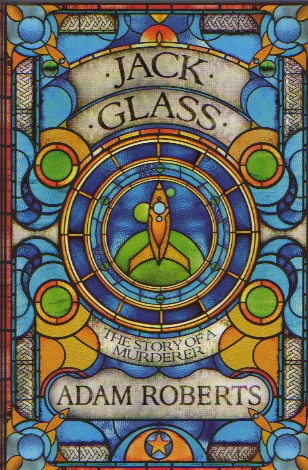 So, I asked and was pleased to receive Jack Glass as a Christmas present and it was always going to be my first proper read for 2013. I will admit that there were two big attractions for me: (1) the astonishingly lovely cover which you can see alongside and really caught my eye and (2) and the subtitle “the story of a murderer” which is intriguing for a sic-fi novel. It was also the first time I had read anything by Adam Roberts and it’s no spoiler to say that I’m going to be looking for more of his stuff.
The novel starts with a bit of scene setting by someone who is identifying themselves as a Doctor Watson figure and tells us what we need to know about what we are going to read, which includes the following:
A quantity of blood is spilled in this story, I’m sorry to say; and a good many people die; and there is some politics too. There is danger and fear. Accordingly I have told his tale in the form of a murder mystery; or to be more precise (and at all costs we must be precise) three, connected murder mysteries.
And so we are presented with a prison story, a regular murder whodunit and a classic locked-room mystery. In a properly sci-fi setting with lots of technical stuff which I always love. So this looked like it was going to be a real treat and I am very pleased to say that I wasn’t at all disappointed and read it in two sittings. All of the stories are equally fascinating but its worth noting that the first one, set on a prison asteroid where seven men have been sentenced for eleven years to mine the thing so that it can be turned into a luxury dwelling of the mini-planet style at the end of that period, so they have to cooperate to survive, is fairly brutal and grim and quite astonishing in its ending and the effects ripple into the rest of the book. That’s not to say that the other two stories are not as good, as they most certainly are, but they are more traditional and less gorily violent (well I thought so at least).
As always I don’t want to say too much about the plot because the fun is in discovering whats seems to be going on as things unfold, but Jack is a compelling character, much more complex than the set up might lead you to believe. And I developed a bit of a girly crush on Diana, one of the other key characters who is a rather privileged fifteen-about-to-turn-sixteen year old faced with some significant events. The world-building is also excellent but never force-fed so you begin to understand the political and other structures as the story unfolds rather than huge chunks of exposition.
 I really recommend this one, loved it, and it proved an excellent read for the 2013 Sci-fi Experience.
Couple of small things:
- the opening section identifies the murderer(s) but I totally forgot by the time I got to the last story particularly, so it was a bit of a revelation and I felt like a total idiot when I realised I should have known;
- the author’s drive for writing this was to bring together some of the conventions of Golden Age sci-fi and detective fiction (which I think he has achieved admirably); and
- a Champagne Supernova is a real thing that astrophysicists are pondering, named after the Oasis song (which is a favourite) and made me giggle
 I sometimes worry that in the highly unlikely event that I became a suspect in a murder case the police would turn up chez Bride, look at the number of books (both fiction and non-fiction) that I have about serial killers and huckle me off immediately, convinced they had me bang to rights.
And The Calling is another one of those. Set in Canada, a country for which I have had a fascination bordering on obsession since I was quite small (I may have mentioned this before), its the story of a series of murders which are only connected when our heroine, for it is a she, DI Hazel Micallef, spots a link and there’s a race against time (as always) to catch the killer before he strikes again.
I’m a bit ambivalent about this one, and not entirely sure why. I read it on holiday and the setting and all-round grimness jarred a bit with the warm Italian sunshine – though it didn’t stop me cracking through the story. I thought the conceit behind the murders was quite clever, and the killer himself interesting in his motivations, I like Hazel in many ways, sympathising with her back pain and her having to share a home with her mother, but she was also pretty irritating at times – the thing with her ex-husband I could understand I suppose but if I’d been the second wife I would probably have been unable to resist smacking her one.
It is not at all bad but I will admit after a a couple of months that I struggled a bit to remember the details but it was good to read at the time. I may give the next one in the series a try, but not just yet.
 So there’s a bit of a story to this one. I am a huge fan of Mr Aaronovitch after being introduced to his books by Silvery Dude; in fact the very first one, Rivers of London, helped get me through a particularly nasty cold back in the day. So when I realised that the man himself would be talking and signing books at the Waterstones in Piccadilly, well, I just had to go along, didn’t I? And because I’m a good friend * cough * I got a ticket for the Silvery One as well.
The evening dawned and after numerous “it’ll be fine” exchanges poor old SD couldn’t attend because of domestic (poorly small boy) circumstances so I had to go along by myself, a bit reluctantly I must admit because these things are often more enjoyable when you have someone to chatter with, but it turned out to be huge fun. Mr A is extremely entertaining and a pleasant hour passed as he talked about what bits of the London that appear in his books aren’t real (although it hasn’t stopped me looking for a particular building every time I go through Russell Square), the usual ‘where he gets his ideas from’ stuff and most importantly a hint about how many more volumes there will be in the series (very much a ‘keep going until I run out of stories’ vibe). And as you can see I got my book signed (and got one for SD as well to make up for his missing a night out – and his little boy is OK so smiles all round)
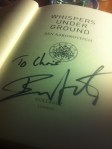
Whispers Underground itself is well up to standard; starts off with a bit of ghost-hunting on the London underground, followed swiftly by the murder of the son of a US Senator which has something whiffy about it and attracts the attention of the FBI and off we go on a really enjoyable story which as always takes in lots of interesting stuff about London and has a nice arc building up in the background.
It’s always tempting to compare this series with the Bryant and May books by Christopher Fowler (which I also adore) but despite the superficial similarities (police investigating odd things, London as a character in the books, lots of interesting facts) they are very different, the supernatural element being the most obvious, but most people I know who enjoy one author also enjoy the other.
So a series that is going from strength to strength and I can’t wait for the next one.
 Bury Her Deep is the third of Catriona McPherson’s detective novels set in 1920s Scotland and featuring her amateur sleuth Dandy Gilver.
I actually started this during the last few hours of the Readathon in April but didn’t finish it for quite a while afterwards, which is strange as I normally gallop through this sort of book and had enjoyed the previous two volumes. I’m not going to say that I didn’t enjoy this one at all, but something jarred with me.
I don’t think its Dandy herself although I was becoming a bit weary of her pulling the wool over her husband’s eyes about her sideline in detecting with her chum Alec, and was glad (not a major spoiler here) that this has now been resolved sensibly.
I don’t even think it was the mystery itself, which was quite interesting – who is attacking the ladies of Fife village on their way home from the Rural Women’s Institute meetings.
I think it was the supporting cast of characters – the women in the village, the vicars daughter and particularly the incomer toffs that I found grated with me, and I will confess that I skimmed my way through the climax of the story, wanting to see the solution but not wanting to linger in the company of some of the protagonists. I know it was set in 1920s Fife but I really wanted to shake most of the women, including Dandy herself on a couple of occasions.
So mildly disappointing but not a total disaster which is just as well as I have two more in the series to read.
 I’m sure I’ve mentioned somewhere before how much I love Gladys Mitchell’s books and what a fabulous character Mrs Bradley is. I really enjoyed the TV adaptations though Diana Rigg was far too glamorous for the part given that a common adjective for Mrs B is grotesque, but setting that to one side they were great fun and you should seek them out if you haven’t seen them already.
Watson’s Choice is up to her usual standard. Mrs Bradley and her secretary Laura are guests at Sir Bohun Chantry’s party to celebrate the anniversary of his great passion, Sherlock Holmes, and everyone is instructed to come dressed as one of the characters from the canon. However, scandal erupts when the very wealthy Sir Bohun announces he’s going to marry the governess (naturally poor as a church mouse) and the shenanigans begin with the unexpected appearance of the Hound of the Baskervilles.
And then of course there is the murder….
This is great fun. Mrs B is wonderful, Laura not quite as annoying as I had at first feared, and there are the usual red herrings, suspicious foreigners, staff who may not quite be as devoted to their employer as they appear, small boys coming across clues, and a harpoon. All sorted out in the end in a satisfying manner, of course.
My favourite line? “Red-haired people are naturally impulsive”. May have to test that one out on a couple of my friends….
There is a very, very lengthy list of “also by Gladys Mitchell” titles at the beginning of this book and I’m mildly appalled at how few of them I’ve read, though secretly pleased that they seem to be coming back into print and I may have the chance to read them all if I try hard enough!
This was my sixth Readathon read
And this is (if scheduling has worked properly) my 500th post. Woo hoo!


 Bride of the Book God