
You are currently browsing the tag archive for the ‘Crime’ tag.
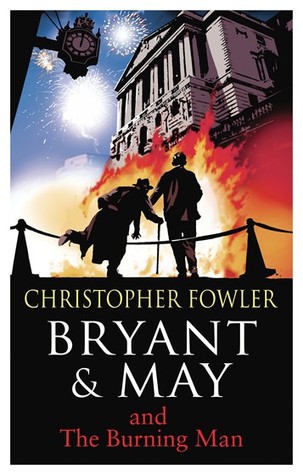 What’s The Burning Man all about?
Still under the auspices of the City of London Police, Bryant & May and the remainder of the Peculiar Crimes Unit are pulled into the investigation of the death of a homeless man during anti-capitalist protests in the city. The man was killed when a bank (in whose doorway he was sleeping rough) is firebombed. But of course there is much, much more to it than that, as an apparent random act is followed by other deaths by fire that indicate that someone is using the rioting as a cover for a protest of his own.
Why did I want to read it?
As I’ve said ad nauseam on this blog, I love these books and look forward to each one, snaffling it as soon as it’s published. Added frisson this time as I got my copy signed (see more of that below), and it might be the last we see of the PCU in this form. Which will be sad if true.
What did I think of it?
Another great story, as always full of plausible events with a strong sense of place and a delight in the characters, building on years of development but never (I think) shutting out the new or casual reader (though of course you always get more out of a series when you read them in order IMHO). And once again Christopher Fowler brings London to life with details of its history and legends underpinning the plot. For a start I am going to have to go and find Crutched Friars next time I’m near the Tower. And it was great to have a relatively rare foray outside of London, to visit the bonfires of Lewes on Guy Fawkes Night. The Book God is a Sussex man and I’ve had the opportunity to see a number of these amazing bonfires being constructed, though never been there on the big night itself, so interesting to see them incorporated into the story in such a significant way.
But back to the story; I was slightly anxious reading this as it seemed that the series was coming to an end, and although the thing that I feared did not come to pass there are significant changes for a number of members (actually probably all of them now I come to think of it) of the PCU. I understand there’s going to be a collection of short stories later in the year but this may very well be the last novel, which makes me sad.
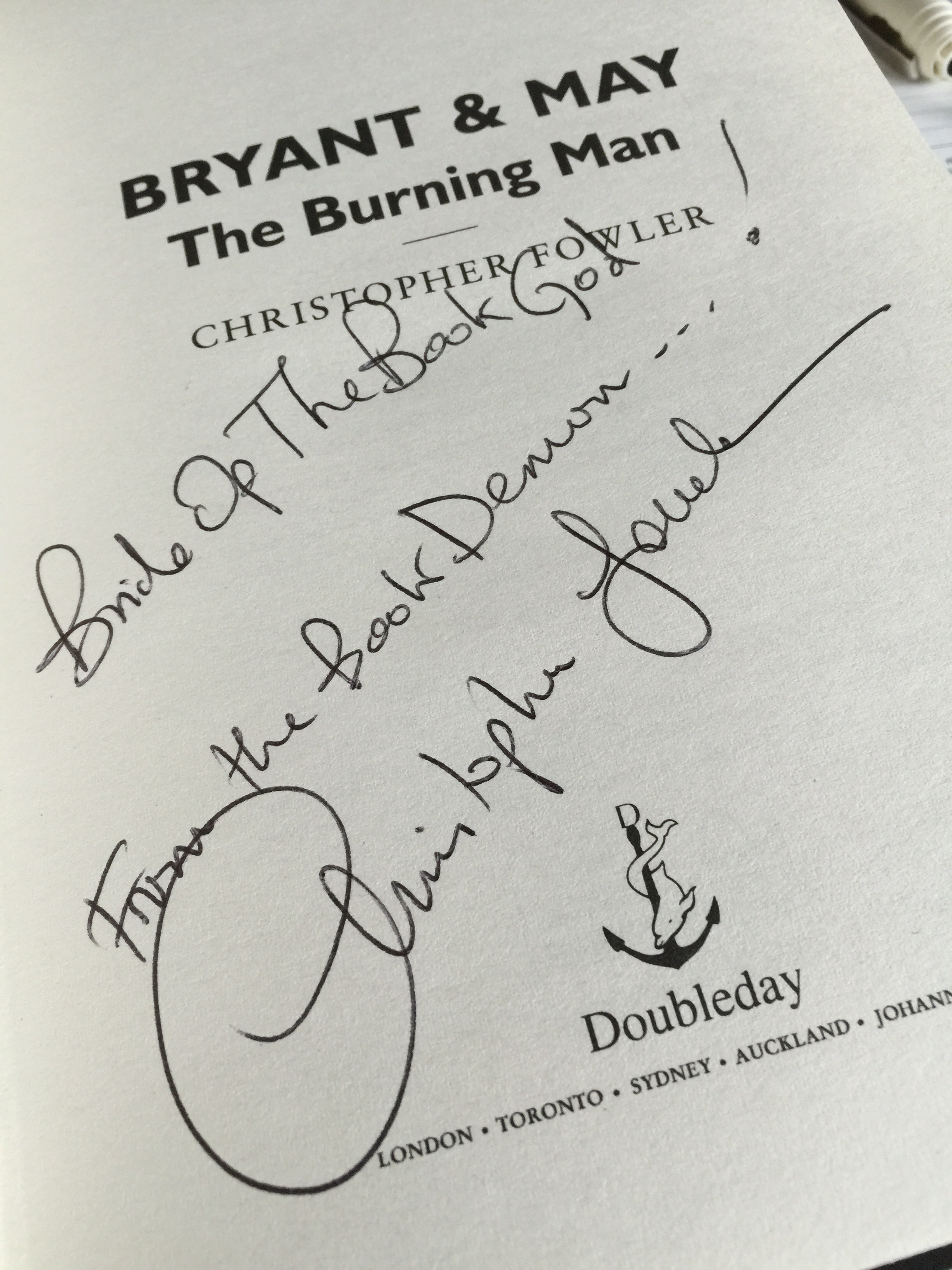 As I mentioned I was lucky enough to get to Forbidden Planet on publication day to finally meet Christopher and get my book signed. He was as lovely and charming as I had expected and it was a real treat to meet him after more than 20 years of reading his books (I first read Darkest Day on holiday in Istanbul in 1993), and I hope to be reading them for many more years to come.
 What’s it all about?
Two women have been murdered. Different methods, but both around 1 am on consecutive Sunday mornings. Seems to be coincidence until a third body turns up and the police can’t avoid the fact that they are connected which of course = Serial Killer. The events take place on the three Sundays before Christmas so obviously the press dub said murderer The Advent Killer.
As panic spreads across London, DCI Antonia Hawkins, leading her first murder investigation, must stop a cold, careful killer whose twisted motives can only be guessed at, before the next body is found
Thus endeth the blurb
Why did I want to read it?
Well, I must have read something about this somewhere or had it recommended by someone because I put it on my Christmas list and lo and behold, it turned up under the tree. And was devoured, mostly on Boxing Day. I like a good serial killer. In fiction obviously, not real life, though I did work with someone who was booked to go on a civil service training course with Dennis Nielsen. But that’s another story.
What did I think of it?
Like I said above, I read most of it in one day; it’s ideal for curling up under a blanket on the sofa, if you like that sort of thing which I of course do. It’s a fairly undemanding read in many respects but none the worse for that. A solid police procedural with a likeable lead character and all the things I have come to expect in this sort of story:
- a detective out of their depth, with a complicated personal life and occasional flashes of intuition, in this case made more interesting by the detective being female and apparently the victim of institutionalised misogyny
- sidekick, with whom lead detective has History of some kind, is brought in to assist once the out of depthness has been recognised by those Higher Up,
- time pressures – this case must be solved by X otherwise Y will happen (or not happen)
- a killer with a Mission which makes sense only to them (even after we all know what it is)
- the Red Herring
- and of course, it all gets Personal
All of which is done really well and the story moves at pace and you really do want to find out what it’s all about.
Except I actually guessed (and it really was a guess) who the murderer was within the first 90 pages, just because I’ve read and/or watched loads of these things and I just though “I wonder if it might be…..” It didn’t spoil the book for me because I couldn’t actually believe I was right and even if I was I wasn’t sure how it was actually possible (you find out in an aside quite late on in the story) but the Motive was revealed slowly throughout the book and I did want to know what that was all about. Poor thing, no wonder things turned out the way they did…
Anyway, I liked DCI Hawkins a lot, so much so that I’ve ordered the sequel. It’s called My Bloody Valentine. I think I see a pattern here…..
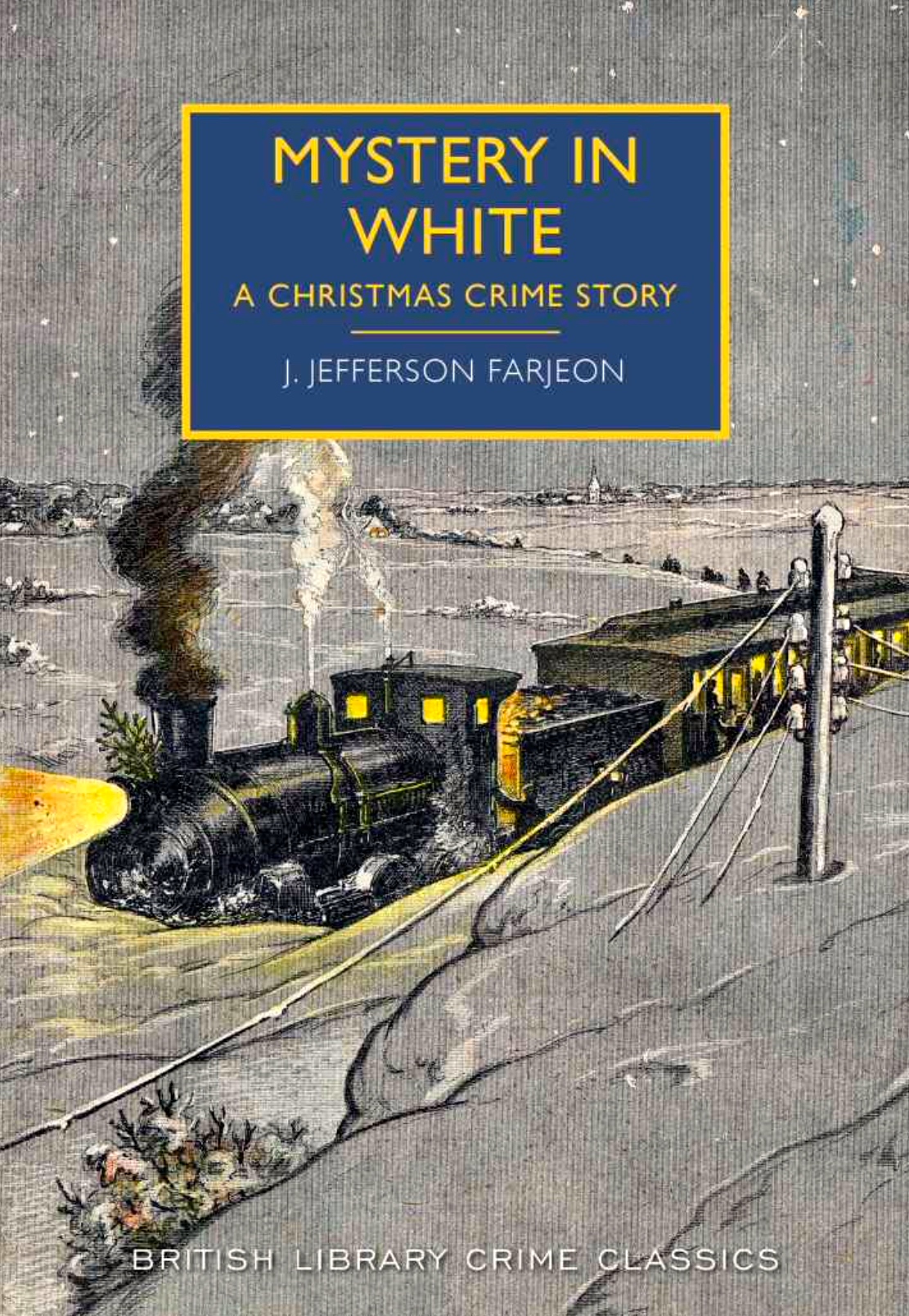 What’s it all about?
Mystery in White is part of a series of classic British crime novels being republished by the British Library (and I have bought several of them in physical or electronic formats). A group of people who don’t know each other (apart from David & Lydia who are brother and sister) are sharing a compartment on a train which has become stranded in heavy snowfall. It’s Christmas Eve and they decide to head cross-country to another station to see if they can continue their journeys. But the weather closes in and they take refuge in a house which seems deserted, despite fires burning away and the table set for tea. Where is everyone? What’s happened?
Why did I want to read it?
I can’t resist a decent classic crime mystery, and the Christmas setting for this made it ideal for a Christmas Day read.
What did I think of it?
This is great stuff. It’s one of those mysteries that really draws you in. The main group of characters – David & Lydia, Thomson the clerk, Jessie the showgirl, Hopkins the elderly bore and Maltby the psychic investigator – are (mostly) likeable and certainly an interesting bunch. The unfolding of the crime is ingenious. Or should I say crimes because it becomes clear there is more than one and not all of them happened recently. There is a potentially supernatural element but that could be explained in a completely scientific way and adds lots of atmosphere to what is already a pretty edgy story.
Think about it.
You’re in a strange house with a group of people you don’t know and a criminal on the loose. You’re not exactly sure what the crime is and you aren’t certain who the bad guy is and it’s getting dark and the weather is closing in and you can’t call for help. Very creepy.
I loved this and read it in one sitting. It would make a fantastic TV film so I hope its unexpected success brings it to the attention of the right people to make that happen, because you can never have too many bright and snappy and clever murder mysteries set in the 1930s for my liking, and I would watch this in a heartbeat. If this is typical of the standard of these reprints then I’m really going to enjoy the others I’ve bought. Recommended.
 What’s it all about?
I can’t do any better than the blurb on the back cover to explain what Lock In is all about:
Fifteen years from now, a new virus sweeps the globe. 95% of those afflicted experience nothing worse than fever and headaches. 4% suffer acute meningitis, creating the largest medical crisis in history. And 1% find themselves ‘locked in’ – fully awake and aware, but unable to move or respond to stimulus.
Because one of the highest profile victims was the President’s wife a lot, and I mean a lot, of effort and money was put in to managing this. So those who are locked in, known as Hadens after the First Lady, have access to what are basically robot bodies to which they can connect their consciousnesses so they can move around an interact with the world and get jobs; a virtual reality space called the Agora which is dedicated to their needs; and some people who have survived the disease but have been left with the ability to allow Hadens to enter their minds and have access to their bodies for a fee (they are known as Integrators).
It’s against this background that our story plays out, a sci-fi murder mystery in which one of the FBI agents is a Haden, a very famous one too. Chris Shane became ill and locked in as a child and then a poster boy for the illness as his Dad, a famous sportsman, used him in his campaigning. His Dad’s a nice guy actually so not an exploitative thing at all, by the way.
And now he’s just joined the FBI and has a nasty Haden-adjacent murder to solve with his partner, Agent Vann.
Apologies for the info dump, but there’s a lot of backstory it’s worth getting your head around, and I’m not spoiling anything (I think).
Why did I want to read it?
John Scalzi is one of those authors whom I’ve heard a lot about (and follow on Twitter where he is very entertaining) but had never read, though I do have Redshirts downloaded and after this may add it to my Sci-Fi Experience reading list. I had picked up the companion short piece to this which gives an oral history of the disease and the technological advances made to support those who have been incapacitated by it. It’s a very good read and led directly to me picking up the novel.
What did I think of it?
This is the third of the novels that got me through my recent bout of illness and it was exactly what I needed, a really well written and interesting murder mystery set against the politics of disability. The murder itself is fascinating but what adds depth to it is the debate that goes on underneath, about whether the amount of money spent on helping survivors is justified, whether it goes beyond helping people cope and gets into the realms of giving them an advantage over those who have not been locked in. The prejudice, whether intentional or the result of ignorance, is overt and realistic.
But as I said, this is primarily an ingenious puzzle. I really liked both Shane and Vann, and there was a rich cast of supporting characters. The solution to the murder was clever and plausible and it was great fun to read.
I hope this becomes a series as I would definitely read more.
Recommended.
I really need to find a different way to say that as I seem to have been using it a lot recently 🙂 but I mean it!
 What year are we in? The Laws of Murder is set in 1876.
What is Lenox’s case?
One of Lenox’s friends has been shot in Regent’s Park and the murder may be tied to an aristocratic ne’er-do-well that Lenox has been after for many years. In helping Scotland Yard work the case (after a short period of some estrangement) it becomes clear that matters are not what they seem. At all.
What did I learn about that I didn’t know before?
Quite a bit about mourning dress and Victorian funerals and the business of booking fixed berths on ships to allow cargo to be transported abroad (regardless of what that cargo might be). No questions asked. ‘Nuff said.
What’s happening in Lenox’s personal life?
Lenox has given up his seat in Parliament and has set up a professional detective agency with Dallington and two other colleagues (identified at the end of the last book but not mentioned here by name because *spoilers*) and it’s all taking a while to settle down. Dallington may be in love but is it reciprocated? All the McConnell and Lenox domestic arrangements are happy and harmonious. We see a bit of the background to the lives of Scotland Yard policemen and not all of it is edifying.
Did I enjoy it?
I did enjoy it very much. Like the previous books in the series it is an easy and likeable read, comfortable in a good way as you revisit characters you’ve watched develop over time. Seeing rich people behave badly is always a pleasure (and why I have always preferred Dallas to Eastenders) and the crime(s) and the purpose behind them were ingenious and well thought through. And nice to see that the new detective agency has its premises in Chancery Lane where my old employer used to be based.
However, I shall never look at convents again in quite the same way.
 I think I’ve said all I have to say about how much I enjoy the Peter Grant novels by Ben Aaronovitch, reinforced last week by the talk and book signing which I attended a week ago and have been banging on about ever since. But does Foxglove Summer live up to the other books in the series?
Well, of course it does.
But it is a little bit different, in that Peter is outside his comfort zone, having been despatched by Nightingale to rural Herefordshire to look into the apparent abduction of two little girls. The Folly’s intervention hasn’t been requested, but they always look into cases where children disappear because, you know, there’s a history of that sort of thing. Although at first it looks to be a sad but ordinary case it becomes clear that there may very well be a supernatural element and Peter stays on to assist with the investigation, which takes a distinctly unexpected turn.
I don’t want to say too much more because as always the fun is in seeing the plot develop. There’s a particular phrase stuck in my head which I so much want to type out here but I won’t. Though I really want to. But I won’t.
I loved it. I read it in two sittings and thoroughly enjoyed it. The new characters were just as well-rounded and interesting as the main cast (particular shout out to Dominic). It gains rather than loses from being set outside the normal London stamping ground (some people worry about that sort of thing but I like long-running series to be shaken up every once in a while). Beverley is there. The whole Lesley situation set off at the end of Broken Homes is still bubbling away. We learn something about Molly. And we meet another, if somewhat elderly, practitioner.
As always my only quibble is insufficient presence of Nightingale, but that’s a small thing really given the other pleasures on the novel.
If you have been reading along then this is a fine addition to the series. And if you haven’t then what are you waiting for?
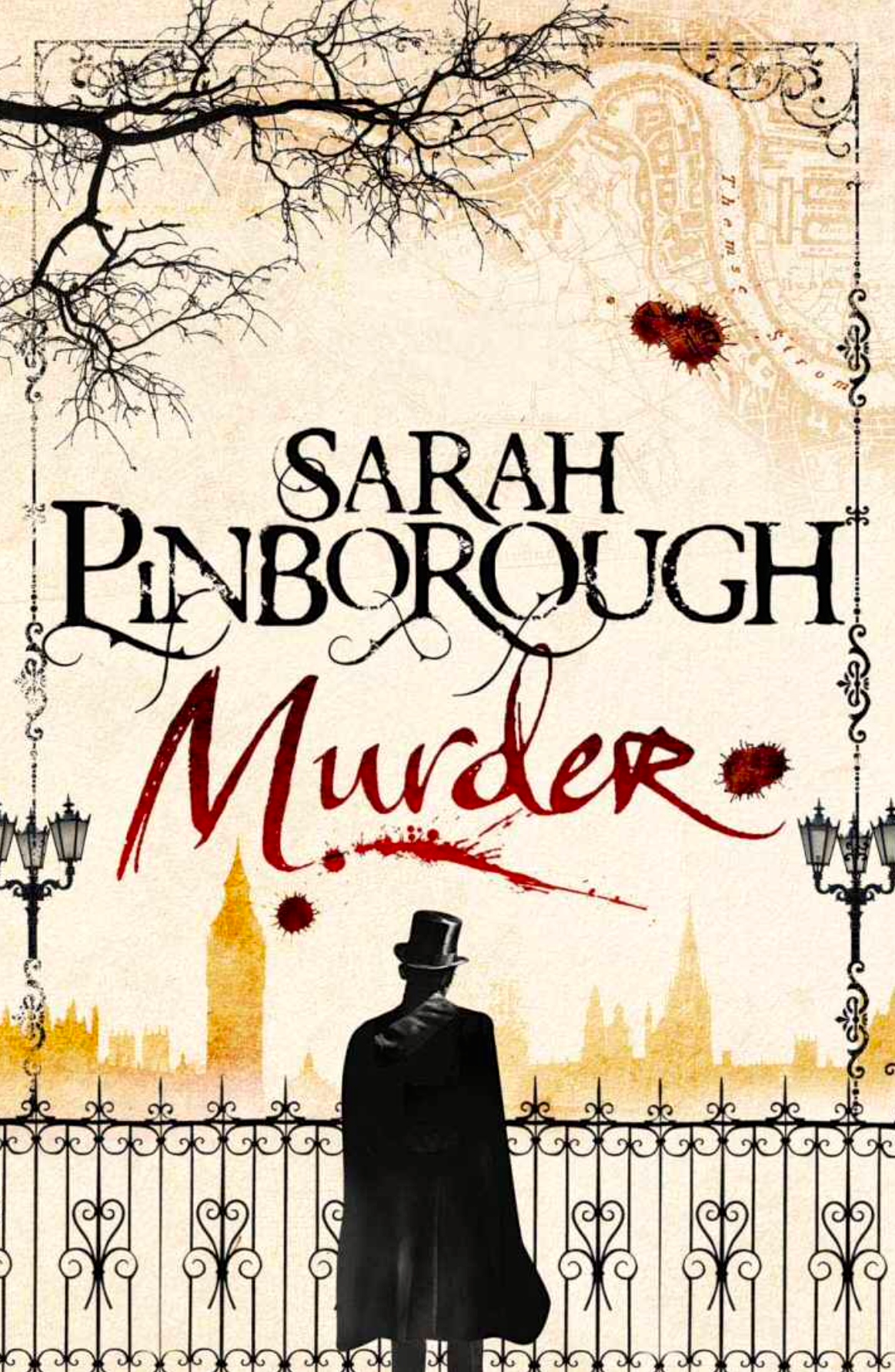 What’s it all about?
Murder is the sequel to Mayhem and picks up a few years after the events of that book, focussing very much on the Dr Thomas Bond (trying to avoid spoilers here) who is trying to deal with the aftermath of those events, hoping to finally win the love of Juliana, now widowed and the mother of a young son, and the arrival of a handsome American, Edward Kane, a friend of Juliana’s late husband who in trying to put his mind at rest on the past events may stir up some of Bond’s demons. In more ways than one.
Why did I want to read it?
I really enjoy Sarah Pinborough’s work and thought this was going to be the second in a series rather than a direct sequel. Ordered it as soon as it was announced.
What did I think of it?
As I said above I was not expecting this to be a sequel; in my head I had convinced myself that this was going to be a series of nasty (in a good way) serial killer novels with Bond as the hero hunting down the bad guys. All of this based on absolutely no evidence whatsoever, all based on assumptions rather than any hard evidence. even starting to read the book I thought that we were running through the events of Mayhem as the background to something entirely different. However, it quickly became clear that I was in for something entirely different as the events of Mayhem come back to haunt Bond in rather horrible ways with a kind of horrible inevitability in the events that were unfolding. Or so it seemed.
This was an interesting reading experience for me, one in a line of dark books with very human dilemmas underscored by creepy supernatural elements and a fair dose of nastiness. But because it was so dark I actually had to set it aside on a couple of occasions because it was almost overwhelming. This is a credit to Sarah’s writing; the triggers for me were not the obvious nastiness but the realistic portrayal of the impact of unrequited love (I have some experience in this area – don’t ask, best left alone – and just found it painful to read) and the descent of a man into madness.
But I’m glad I persevered because there are a couple of events in particular which push the story into really dark territory and I was desperate to know how this was all going to work out. I had a tiny wee suspicion of what might happen at the end which was mostly right though not delivered in quite the way I expected.
This was my eighth read for RIP IX and I’m definitely going to continue exploring this author’s work.
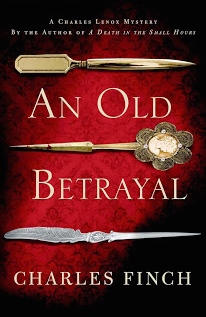 What year are we in? An Old Betrayal is set in 1875
What is Lenox’s case?
Lord John Dallington is ill and asks Lenox to help him with a case by meeting a potential client at Charing Cross station. However, the meeting doesn’t take place as planned and also seems to be connected with the death of a quiet and retiring country gentleman. As Lenox works with Dallington and Scotland Yard it becomes clear that a deeper and more sinister plot is afoot, one that might strike at the monarchy itself.
Apologies for the burst of melodrama there 🙂
What did I learn about that I didn’t know before?
Not a huge amount, though the way that people try to get access to Queen Victoria is quite interesting, and the murkiness of British politics is reinforced once again.
What’s happening in Lenox’s personal life?
Dallington is quite ill but struggling on, McConnell and his wife Toto appear to be having marital problems, there is a rival detective agency involved run by *gasp* a woman, and Lenox looks like he’s finally going to have to decide whether he priers politics or detection.
Did I enjoy it?
Huge fun. More complex in some ways than the others in the series and clearly meant to be a game changer. Alway good to have Queen Victoria pop up in her indomitable fashion and the motivation for the crimes is both obscure and mildly gothic. Looking forward to seeing where the series will go from her. Next volume is already pre-ordered.
 What year are we in? A Death in the Small Hours is set in 1874
What is Lenox’s case?
Lenox has been given the honour of making the first speech at the new Parliamentary session and he is advised to take himself out of London to have quiet time in which to write the speech and otherwise prepare. It just so happens that his Uncle Freddie had asked him and his family to stay at his home in Somerset and investigate a spate of incidents of vandalism in the local village. There is of course a murder, that of a young police constable, and investigating this uncovers a criminal conspiracy.
What did I learn about that I didn’t know before?
Not much new in this novel, though interesting to see how Lenox’s uncle undertakes his duties as a local JP, but it is mostly the usual village life sort of stuff, though very well done of course.
What’s happening in Lenox’s personal life?
Doting on his daughter and building his career are the main preoccupations for Lenox, though it’s clear he relishes the opportunity to get involved in detection again.
Did I enjoy it?
Yes, another pleasurable entry in the series. The subplots all weave together very nicely both in terms of the crimes committed and the developments within Lenox’s own family. The Parliamentary stuff is still fascinating.
 What year are we in? A Burial at Sea is set in 1873
What is Lenox’s case?
Lenox is a rising star in Parliament and has been asked by his brother and other influential politicians to undertake a mission to Egypt, ostensibly to discuss how Britain might become more involved in the Suez Canal, but actually to meet an informant who can tell him whether the French government knows the identities of British spies in their country and has been bumping them off. While on his way aboard HMS Lucy he has to investigate a number of gruesome murders and a stop a potential mutiny.
What did I learn about that I didn’t know before?
I learned a lot of genuinely interesting stuff about the Victorian navy and our view of diplomacy (in relation to the French at least) at that time. Lots of research clearly went into writing this book but it never appears heavy-handed.
What’s happening in Lenox’s personal life?
Lenox and Lady Jane are expecting a baby. Lenox’s nephew Teddy has joined HMS Lucy as a member of the crew.
Did I enjoy it?
I think this may have been my favourite of the four, partly because of the setting on board ship which was both unusual and interesting but also because of the gruesome nature of the murders and the motivation of the killer which is rather more complex than it at first appears. The French are suitably dastardly which is always good fun. Recommended this to the Book God who has a great interest in the British Navy and it seems to have been a hit so far.


 Bride of the Book God