
You are currently browsing the tag archive for the ‘Crime’ tag.
 So, cards on the table, I really, really like Tess Gerritsen. I like the fact that her two main recurring characters are women. I like the fact that her books are pacy and easy to read. I like the fact that the plots are nicely judged so that they are a bit (but not too) complicated. I like the fact that there is just enough bloody murder to satisfy the gorehounds but not so much that the crime fan who’s a bit squeamish about the whole serial killer thing will be put off. The Mephisto Club fits the bill, and I lapped it up.
I’m not even going to attempt to explain the plot because the whole point of a good crime/detective novel is not to know what’s going to happen in advance and then having the fun of trying to work it out yourself. So here we have dismemberment, ancient symbols, mirror-writing, revenge, evil, an elite group with a mysterious purpose and all the right connections, a long-buried secret, and lots and lots and lots of blood. What’s not to like?
I absolutely adore anything with a decent secret society; even though I don’t believe any of them really exist, the idea of some kind of cabal running the world, or at least a little bit of the world, or maybe just having influence in a particular sphere, manages to be both comforting and worrying at the same time.
Failed once again to work out the murderer but still huge fun.
 Over the years I’ve come to prefer Barabara Vine to Ruth Rendell (for they are one and the same). Although I used to read the Wexford novels voraciously, I really rate the psychological approach that she takes as Vine, and The Birthday Present maintains what is a pretty good record (the only one I couldn’t get into was Gallowglass).
The book is set in the 1990s when the Conservative government was moving from Mrs Thatcher’s leadership to that of John Major, and the party was struggling with allegations of sleaze. Ivor Trensham is a Tory MP, a single man with ambition and a promising career but who also has secrets – “unconventional” tastes and a mistress, Hebe Furnal, a married woman with a young son. When he organises a special birthday present for Hebe and it goes horribly wrong, leading to a tragic accident, the issue for him becomes one of avoiding scandal; how long before all this gets out, and who will help protect his reputation?
The story is told in the first person by two different narrators; one is Ivor’s brother-in-law in whom he confides over time, and the other is a friend of Hebe’s. I liked the structure of the story which allows the reader to get the full picture in an uncontrived way given that most of the characters (possibly all of them) don’t know all of the facts. I found the atmosphere of imminent ruin for Ivor really pulled me in, and although I had little sympathy for him I still wanted to know what happened. There are lots of hints all the way through but I didn’t really work out what was going to happen until very close to the end, and by then I was so hooked I didn’t really care whether my guesses were correct. I can see myself re-reading this, which isn’t normally the case with crime novels.
 I’m not sure where I came across the name of Charles Finch – it may have been mentioned on someone’s blog, or I may have simply have been seduced by the cover somewhere, but I’m glad I decided to put this on my Christmas list, and grateful to the Book God for buying it for me (I suspect that he wants to read it too)
The hero of A Beautiful Blue Death is Charles Lenox, a Victorian gentleman of leisure with a love for ancient history and travel, and a man who has clearly dabbled in amateur investigations in the past with some measure of success. It is winter in 1860’s London, and although he would prefer to be reading by a fire in his study, he gives in to the request of his childhood friend, and current neighbour, Lady Jane to look into the circumstances surrounding the death of a former maid from her household, who has been found at her new position apparently having committed suicide.
Of course the novel would be over fairly quickly if that were the case, and it becomes clear that the girl was poisoned, and Charles must find out why and by whom, both to satisfy himself and to keep his promise to Lady Jane.
This was a very enjoyable read, to the extent that I stayed up well past my normal bedtime so that I could finish the story. Lenox is a really attractive leading man, his relationship with Lady Jane is nicely drawn, and there is a wonderful cast of supporting characters, particularly his brother Sir Edmund, who is a distinguished Parliamentarian but nevertheless wants to help with the investigation. The denouement was very satisfying, and I will be looking out for the sequel when it becomes available later this year.
 Where to start with The Devil in Amber? This is the second Mark Gatiss novel to feature Lucifer Box – artist; spy/secret agent; a man with an eye for both men and women; a man who lives life to the full, shall we say.
We first met him in The Vesuvius Club which was set in the Edwardian period; we are now in the 1920s, with Fascism rising and the effects of the Great War still being felt. Lucifer is keeping an eye on Olympus Mons and his Amber Shirts, and while doing so is framed for murder and has to escape to Britain, foil the dastardly plot, save the girl and his own reputation.
This is great fun; I love Mark Gatiss (the twenty-seventh most dangerous man in Islington apparently) who has written for (and appeared in) Dr Who – which immediately gives him extra points – but he also wrote and acted in a three-part ghost story on the BBC over Christmas (called Crooked House and I hope it’s going to come out on DVD soon as it was really very good).
This novel is a cross between a classic spy thriller and Denis Wheatley (yes, there are Satanists and mysterious castles and young women in peril and megalomaniacs trying to take over the world) but it’s also really amusing; I love the names, especially Lucifer’s sister Pandora Box. An enjoyable read for a dull and cold January, and I’ve just got a hold of the third Lucifer Box adventure, which looks a little bit more James Bond-ish…..
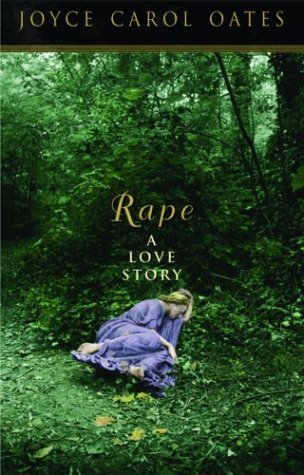 Where to start with this one? A controversial title (I received some askance looks when reading this on my daily commute) perhaps, but as with all works by Joyce Carol Oates carefully chosen, not for shock value but to reflect what the nub of the story really is.
Rape is about Teena Maguire, a single mother, and her daughter Bethie, 12 years old, and the consequences of their short-cut through a local park late at night after a Fourth of July party. Teena is raped by a number of men who are high on drugs and alcohol, beaten and left for dead; Bethie is beaten but escapes, though she can hear from her hiding place what is happening to her mother.
The men’s families hire a lawyer who is able to get their charges reduced to assault by claiming that there was consent and the beating and so on must have been carried out by a different group of men who came along later; after all, no-one actually witnessed the rape. Some of the most difficult parts of the story are here, where the justice system seems to fail Teena and Bethie; the author has made it clear from the start that these men are guilty, there is no room for ambiguity or doubt, but Teena’s poor choice that night, her dress and her family circumstances are used against her. But there is one man who is determined to see justice done, and the latter part of the novella concentrates on how he achieves that; whether his actions are right or wrong is left to the reader to decide.
This is an incredibly powerful story, but not to everyone’s taste; I’m sure many will find it a difficult read. I have said elsewhere that I admire Joyce Carol Oates greatly, and a number of her novels deal with the undercurrent of violence in modern society and how it often erupts into the lives of otherwise ordinary families, and this is no exception. The events stay with Bethie into her adult life.
This is my fifth read for the Novella Challenge.
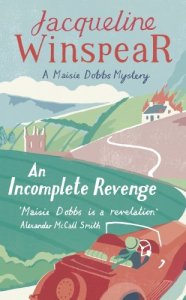 An Incomplete Revenge is the fifth Maisie Dobbs mystery, and maintains the high quality of the series. It is 1931 and Maisie is asked by the son of her former employers to investigate the circumstances around a series of petty thefts and fires in a Kent village where he is intending to buy a brick works. With the help of her assistant who is in the area hop-picking with his family she uncovers the circumstances surrounding a Zeppelin raid in 1916 which has cast a shadow over the community.
I really enjoyed this, as I always do with the Maisie Dobbs stories as I find her such a sympathetic figure. I could see where the story was generally heading, but not the detail around it; this is the second crime novel in recent weeks where that has happened (perhaps I’m reading too many of them) but I don’t mind that really, as long as the novel is well-written and I have an interest in the characters.
I found descriptions of the travelling people (or Romany or gypsies) fascinating, and what we learn about Maisie through her interaction with them really develops her as a character; it is interesting to see how little has changed really in terms of the suspicion and prejudice these people come across wherever they go.
If you haven’t read any of these novels before I wouldn’t start with this one as there is an arc story in the background which reaches a partial conclusion here; they are so lightly written (in a good way) with a lot of compassion and humanity that I would recommend reading the the whole series from the start.
 I’ve become very fond of Susan Hill’s Simon Serailler series, and have saved the reading of the latest until I could give it full and undivided attention.
The Vows of Silence begins with the shooting of a young woman, newly married. This is rapidly followed by the deaths of several others, all by a gunman, but what is the connection (if any) and is there more than one killer?
It’s fair to say that this isn’t really a standard police procedural; by that I mean that although there is the usual stuff you would expect, this is a novel as much about Serailler the private man as it is about a senior policemen leading the hunt for a dangerous killer. A lot of the book deals with several characters we have met before, including Serrailler’s family, especially his sister Cat. I didn’t find this a problem; I have grown very attached to these characters over previous novels, and in some ways the personal parts of the book were more compelling than the solution of the crime, especially as I worked out the identity of the killer quite early on.
Parts of this book are really quite moving; there is family tragedy which is so well described that I did have to reach for the tissues, something which doesn’t happen that often (and hasn’t since reading this book). So this might not be to everyone’s taste, but I enjoyed it very much.
 I have to confess that I have never really warmed to Gyles Brandreth, whether as a journalist, a TV personality or as an MP. However, with Oscar Wilde and the Candlelight Murders, I have been pleasantly surprised and will probably have to reassess my view of him.
It is 1889 and Oscar Wilde finds the body of a young man with his throat cut in the room of a house in Westminster where Wilde has an appointment. Although Scotland Yard do become involved, Wilde decides to investigate on his own as the young man was known to him, and he enlists two of his friends. Which sounds much as you would expect, except his friends are Robert Sherard, writer and great-grandson of William Wordsworth, and Artur Conan Doyle, creator of Sherlock Holmes. The game is indeed afoot.
This is really good fun, witty and clever and gives a sense of what Wilde might have been like as a friend. His relationships with both Sherard and Conan Doyle are based on fact, and there are interesting biogrpahical notes at the end of the story for those of us who like to know a bit more of the factual background to this type of novel.
I did twig reasonably early on who might be involved in the death of Billy Wood, but not the reasons why or the detail around the murder and subsequent events. Trying to guess the culprit in a crime novel is all part of the fun as far as I am concerned and it’s always enjoyable to find out just how right or wrong I am. What makes this book so satisfying is the picture it portrays of late Victorian London and the lifestyles of those with a bit of money.
This is the first in a series (I think there are three so far) and I look forward to reading the others.
 The most recent Tom Thorne thriller, Death Message is a really enjoyable police procedural and a welcome addition to one of my favourite series.
Thorne receives a picture on his mobile phone which clearly shows the face of a dead man. This turns out to be the first of several, and Thorne ends up in a psychological game with a criminal whom he sent to prison, all taking place through the actions of a killer with a clear purpose.
I really enjoyed this book. We get to know the identity of the killer and the reasons for his crimes quite early on but this only added to my enjoyment as the story stopped being a whodunit, or even a whyhedunit, but was really about what was underneath and how it would be resolved.
And as well as a resolution to these particular crimes, Thorne also gets to find out what really happened to his father, a storyline hanging over from a couple of books ago.
I think I enjoy Billingham’s books because I really like Tom Thorne, and am interested in all the personal stuff as well as the case that he’s involved in. If you are new to the series I wouldn’t necessarily start with this one because of the references to previous books, but having said that any of the Thorne novels are worth picking up. Of course now that I have said that Billingham has written a stand-alone novel as a break; hopefully he’ll be back with these characters soon.
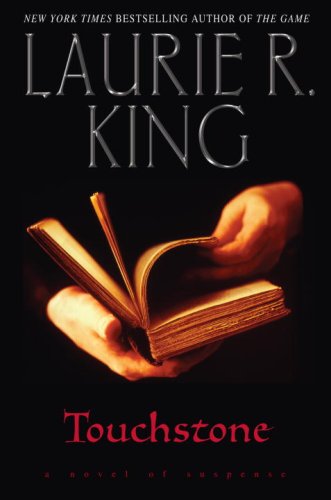 From assassination with William the Silent to anarchy in Touchstone, with a common thread of political change, all part of crime month. The background here is the General Strike of 1926 with huge tensions between the working and ruling classes, an opportunity for those with their own agenda to push the country in a certain direction.
I don’t want to give away too much of the plot; suffice to say that Harris Stuyvesant, an agent of what will become the FBI, arrives in London semi-officially to follow up some leads relating to bombings in the USA. By various means he teams up with Bennett Grey, a survivor of WWI who has some interesting abilities which could help the investigation, as well as some useful contacts with key players through his sister, Sarah.
I really like Laurie King, I have never read a novel by her which I didn’t enjoy, whether it’s the Mary Russell or Kate Martinelli series, or one of her standalones as here. I’m glad to say that I wasn’t disappointed this time either; this is a really well written thriller, the plot slips along nicely but is supported by a depth of characterisation which meant I became really attached to several of the main characters.
I read this largely during my daily commute, and it was so good that on at least one occasion I didn’t realise I’d reached Waterloo and had to scramble to get off the train. Highly recommended, and I hope that she writes more involving Grey and Stuyvesant.
I’m also really, really looking forward to next year’s Mary Russell.


 Bride of the Book God