
You are currently browsing the tag archive for the ‘Crime’ tag.
 So Susan over at You Can Never Have Too Many Books has started a very interesting discussion on the use of real-life people in fiction, whether it’s justified, how readers feel about it and so on. It’s a really thoughtful piece so do go and have a look, and I mention it here not just because I’m a fan of Susan’s blog (which I am) but because this is the second book in a row I have read which is very much set around people from the real world and I am trying to look at it in the light of Susan’s post and some of the comments that have appeared there already.
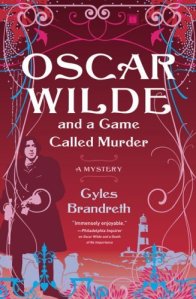
Oscar Wilde and a Game Called Murder kind of gives itself away in the title. It’s the second in Gyles Brandreth’s series (I wrote about the first one here) and does what it says on the tin; it turns Oscar Wilde into an amateur sleuth, and is packed with names that are recognisable to anyone who knows the detail of both Wilde’s life and the literary scene of the time. So, we have Arthur Conan Doyle, Bram Stoker, Lord Alfred Douglas, Robert Sherard (Wilde’s first biographer) and several other lesser known names.
The story is quite a simple one; it is 1892 and the Socrates Club is having one of it’s regular dinners, presided over by Wilde himself. At the end of the meal he suggests that the guests play a game called Murder – each of them will write anonymously on a slip of paper the name of the person they would most like to kill, and the other guests will try to work out who was chosen by whom and why. Not explained very elegantly but you can probably see where this is going. Two of the slips are blank, and the same name appears four times. And Wilde’s name is mentioned once, ditto his wife Constance. The game goes a little bit sour, but Wilde thinks nothing of it until over the course of the next three days the first three names on the list, including a parrot, die in more or less mysterious circumstances. Who around the table is a killer?
It’s an ingenious puzzle and I had absolutely no idea who the murderer was, what the motive was and how it all fitted together but I really enjoyed finding out. Wilde comes across as a complex, attractive and sympathetic figure and I learned a lot about the period. It’s well written and clearly meticulously researched by someone with an affection for both the characters and the setting. Do I think that’s what Wilde was really like? Probably not. Does it matter? I’m not sure it does. Did it make me want to find out more about the real people? Well, yes, especially in the case of Conan Doyle’s friend Willie Hornung who created Raffles; I’ve never read any of his stories and am off to find some now. The author’s note is very illuminating, and that is the one thing I do look for in a novel with real people; some indication of what’s true, and what’s invented. And there are some very nice in-jokes, too. Recommended.
 So, In An Expert in Murder Nicola Upson has created a new mystery series around a real person, namely Elizabeth Mackintosh, best know to those of us who love crime and mysteries as the author Josephine Tey.
The setting is London’s Theatreland, where Josephine’s successful long-running play Richard of Bordeaux is coming to an end. At the beginning of the novel we see her travelling from her home in Inverness, and on the train she meets a fan, a young woman called Elspeth. They hit it off, but soon after the train arrives at King’s Cross, Elspeth is murdered. Josephine’s friend, Archie Penrose (the model for her fictional detective) is leading the case and Josephine herself soon becomes involved in finding out what secret from the past has led to this and other deaths.
I’m always fascinated when authors use real people in their novels, and I’m always pleased when they include an author’s note to tell you what and who is real, what’s conjecture, what’s totally fictional. I’ve also always liked Josephine Tey’s work, especially The Daughter of Time (though I didn’t agree with her conclusion, but that’s not the point) and hopefully her transition to a fictional character will popularise her work a bit more.
The novel really does invoke the period of the 1930s, and it was great fun reading about events taking place in streets very close to where I work in central London (though obviously it all looks very different now). And though it reads like a classic murder mystery of the golden age, the occasional swearword and the description of relationships that wouldn’t have been written about quite so openly at the time remind you that this is very much a modern novel.
I’m now really looking forward to the sequel, which comes out quite soon I think.
 So in The September Society Charles Lenox is approached by the widowed mother of an Oxford student who has gone missing leaving only a dead cat behind him in his rooms.
Lenox takes on the case and finds himself working with both the Oxford police and Scotland Yard as a dead student is found in a public space, and the name of the mysterious September Society keeps on turning up.
And as if this wasn’t enough, Lenox is wrestling with his feelings as he considers making changes in his own personal life.
Although I quite enjoyed this novel I didn’t find it to be as strong as the first in the series, which I reviewed here. I still like Lenox as a character, but found the whole thing about his private life got in the way of what could have been a cracking mystery, and I’m not sure why, because generally I like to see the lead character rounded out and not just be a pawn in the game of solving the mystery. I also think that it didn’t help that I had worked out one of the big reveals quite early on and was slightly annoyed that Lenox took so long to do so, although of course it would have been a much shorter book if he had.
So, pretty solid and likeable but not as gripping as it might have been. Probably won’t stop me reading the next one though. Oh and once again I really liked the cover…
 So Among the Mad is the fifth in the increasingly excellent Maisie Dobbs series, and finds our heroine in London on Christmas Eve 1931, where she and her faithful right-hand man witness what we would call now a suicide bomber blow himself up in a busy street.
Although she doesn’t know the man involved, Maisie is soon drawn into the case when she is named in a letter which follows the bombing and it becomes clear that some sort of campaign is afoot. Maisie finds herself trying to apply her unique methods of working while assigned to Scotland Yard, and with all of the cases she has been involved in before now, the shadow of the First World War is never too far away.
I really like Maisie as a character and was pleased to see that this story matched up to the previous volumes. The psychological impact of the war on all of those involved in whatever capacity comes across very strongly in the novel, and it’s worth remembering that returning soldiers were not always treated as well as they deserved given what they had suffered, as much because the rest of the population wanted to move on, and of course the Depression also had an effect. The author manages to get this detail into the story without being too heavy handed and I thought it worked very well.
It’s also nice to see Maisie’s own personal story develop, not just in relation to her family and friends but with the people who have become her colleagues in investigating this case, whether she has chosen them or not.
A good solid read for a warm and humid summer.
 So, I have been visiting Deanna Raybourn’s blog for absolutely ages; it’s one that I look at almost every day, and I always find something of interest there. But until now I hadn’t actually read any of her novels, and I’m sorry that I waited because Silent in the Grave is very enjoyable indeed.
Our heroine is Lady Julia Grey, and she is widowed at the very outset of the story when her husband collapses during a party at their home; this isn’t a total shock as he has a congenital heart problem and none of the men in his family live terribly long. However, one of the people present at Sir Edward’s death, Nicholas Brisbane, tells Lady Julia that he had been retained by her husband who had received some threatening letters, and that he believes this was murder. So we have our set up, and things really take off from there. I don’t really want to say much more about the plot as it’s nice and twisty with lots of satisfying red herrings
I loved this for all sorts of reasons: Lady Julia herself; Brisbane, tall, dark, handsome and mysterious; Julia’s eccentric family; the servants in the Grey household; and the setting in the London of 1886. It’s well written, pacy and I found the mystery quite fascinating.
I had one of “I wonder if X is the murderer” moments, and turned out to be right purely on guesswork with no idea as to the motive, but frankly it wouldn’t have made much difference if I’d worked it all out completely as I enjoyed the experience of reading this so much that I bought the sequel as soon as I had finished this one!
 So The Dead of Winter is the third in the John Madden mystery trilogy; I read the first a long time before I started blogging, but reviewed the second here.
Another police procedural, this one is set during the Second World War, and begins with a murder in Paris and the theft of a number of valuable diamonds. The action then moves to London in the blackout, where a young Polish girl is murdered, seemingly at random. Of course, as with all good mysteries, there is significantly more to this than meets the eye.
Madden gets drawn into the investigation surrounding this crime because the girl in question, Rosa Nowak, was a land girl working on his farm. He feels that this wasn’t a random crime, that there was a reason Rosa was killed, and determines to help his former colleagues in any way he can. And of course he is right, and as the bodies pile up all over the place it becomes clear they are dealing with a particularly ruthless and efficient killer and that the motive is buried in Rosa’s past.
It’s always difficult reviewing books in a series because you tend to find that the things that you loved in the earlier book(s) are repeated in the later ones. So again, a sense of melancholy in Madden’s character, his happy home life contrasting with the lives of the people drawn into this crime are all very satisfying; what’s different here is how effectively Airth gives a sense of London as the war is coming to an end, the weariness of the population and the need to make do in their everyday lives. There’s also an interesting subplot about the introduction of women police officers and the limitations that were imposed on them.
Very well written as always, I devoured this one pretty quickly. It’s a real shame that it doesn’t look like there will be any more in the series.
 I don’t like August very much. It can be too hot (though the weather here in London up till now has suggested otherwise, but I bet a mini-heatwave will sneak up on me when I least expect it); all my friends and a large proportion of my team at work head off on holiday (and I get grumpy because my hols aren’t until October but they’ll all miss me when I’m not here, just wait and see); there is very little on TV and all of these things added together mean that I get very bored very easily.
But there are two things that help to keep me going. One is the BBC Proms (and I am going to five concerts this year between 4 August and 12 September) and the other is Crime Month on Bride of the Book God. Because of all the things I’ve said above, I don’t want to read anything too heavy or difficult where my brain has to work even though I’m sitting in a hot train trying to manage a bottle of water, a fan, my bags, my iPod and a book, and crime fiction has been the perfect solution in the past.
So between now and August Bank Holiday (after which life gets back to a semblance of normality) I intend to read as many of the following as I possibly can (in no particular order):
Broken Skin, Flesh House and Blind Eye, all by Stuart MacBride
The Victoria Vanishes and Bryant and May on the Loose by Christopher Fowler
When Will There be Good News? by Kate Atkinson
In the Dark by Mark Billingham
An Expert in Murder by Nicola Upson
Dead Clever by Scarlett Thomas
Devil Bones by Kathy Reichs
After the Armistice Ball by Catriona McPherson
Oscar Wilde and a Game Called Murder by Giles Brandreth
The Bone Garden by Tess Gerritsen
The September Society by Charles Finch
Among the Mad by Jacqueline Winspear
Silent in the Grave by Deanna Raybourn
I hope that the Language of Bees by Laurie King will arrive very shortly and if it does it will almost immediately go to the top of the pile. And I’ve made a start with The Dead of Winter by Rennie Airth. If you’ve read any of the above I’d love to know what you think.
 Some new additions to the Bride’s library in recent weeks:
Margaret of York: The Diabolical Duchess by Christine Weightman: a biography of the sister of Richard III, a thorn in the side of the Tudors, wife of Charles of Burgundy, fomenting rebellion from across the Channel. Looks absolutely fascinating;
Leviathan, or The Whale by Philip Hoare: this book has just won the BBC Samuel Johnson Prize for Non-Fiction 2009, and is apparently a mixture of the natural history of the whale and Hoare’s own obsession with them which was triggered by Moby Dick. Already dipped in, and this may move to the top of the tbr pile;
The September Society by Charles Finch: the second Charles Lenox mystery, set in Oxford in 1866. I enjoyed the first one very much so looking forward to this as part of August crime month.
 While I was about a quarter of the way through this novel I happened upon an episode of Law & Order: Criminal Intent from a few years ago (we are woefully behind here…) which was similarly based on the Jon-Benet Ramsay murder case but took a very different approach (and guest starred the wonderful Liza Minnelli as the grieving mother); an interesting coincidence.
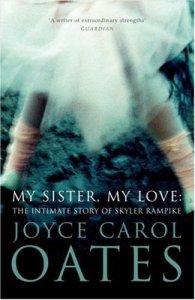
The L&O slant was very much a classic solve-the-murder thing, as you might expect, but My Sister, My Love is as much about family dynamics and wider society as it is about who killed a small, precociously-talented girl and why.
But it’s fair to say that this is really the story of Skyler Rampike, the older brother of Bliss Rampike, the tiny little skating prodigy who is found murdered in her parents basement not long before her seventh birthday. Skyler tells his story in the first person, and not only gives us the background to his sister’s murder (which happened when he was only nine) but the effect that it has had on him – his estrangement from his parents, his drug addiction, his myriad doctors and special schools as he becomes a problem child who has to be managed rather than a damaged youngster who needs to be looked after.
What is interesting for me is the satirical picture it paints of a certain section of society in the USA, of which I have to say I have no knowledge other than what I see on TV and read in books like this. His parents are acquisitive and have aspirations to move up in society. Skyler (and a number of the youngsters at his various schools) are diagnosed with a range of disorders and syndromes and heavily medicated, and you get the impression from Oates’ perspective that actually most of the time there isn’t really anything wrong with them at all, they are just inconveniently becoming teenagers with all that entails.
Part way through I had developed a pretty good idea of who was responsible for what happened to Bliss but not why, and being right re the culprit didn’t spoil the enjoyment of the novel for me, it’s really well-written and wonderfully put together. I’m a huge JCO fan and looking forward to working through the pile of her stuff that I have tucked away on various bookshelves in the house; happy to have started with this one.
Yesterday, in honour of the Bank Holiday, I went on the first book spending spree that I’ve had in a long time. I haven’t been writing much about new books simply because I haven’t really been buying any; the Book God’s largesse at Christmas and my birthday at the end of January satisfied my cravings, and I was determined to make inroads into the tbr pile which now resembles nothing so much as the Great Pyramid.
But yesterday was a public holiday close to payday, and I found myself in a book shop and just had to succumb.
The spoils were:
- The Bone Garden by Tess Gerritsen – following on from my recent post I just had to get the next one in the series, possibly to hold for August Crime Month
- Henry by David Starkey – my love for the sixteenth century is well-known and I’ve been watching Starkey’s series on TV so this was a bit of a no-brainer
- Bloomsbury Ballerina by Judith Mackrell – this has been on my wishlist for ages, snaffled now that it’s out in paperback; and
- A Literature of Their Own by Elaine Showalter – British women writers from Charlotte Bronte to Doris Lessing – ’nuff said.
Not a bad haul for someone who really wasn’t intending to get anything at all – well, maybe Henry was always in the cards, the others were a bonus!


 Bride of the Book God