
You are currently browsing the tag archive for the ‘Alternative history’ tag.
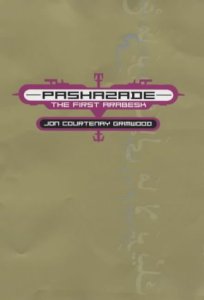 So we find ourselves in an alternative 21st century, one where Germany won the First World War and the Ottoman Empire still exists. Ashraf Bey is the son of an American photographer and apparently the Emir of Tunis, though his mother always told him his Dad was a Swiss watchmaker or something. Anyhow, Raf is on the run from prison near Seattle where he was serving time for a murder he probably didn’t commit, and has been summoned to El Iskandryia (alternative world Alexandria) by an aunt he didn’t know existed, and is to be married off for money. For he is pashazade, a member of the aristocracy with a diplomatic passport and extremely eligible as a husband for the daughter of a man climbing his way up the social ladder.
But of course it doesn’t work out quite like that. His aunt is murdered, he is the prime suspect and of course that means he has to go on the run again, relying as much as he can on the help, reluctant or otherwise, of Felix (an expatriate American policeman), Zara (the woman whose hand in marriage he has rejected) and Hani (his nine year old niece). All while trying to identify both the killer and the motive and clear his own name.
I really enjoyed this, because it brings together two things I love – science fiction and crime – and does so very successfully. The sci-fi is quite light, the world of El Iskandryia is not so far away from our own that its unrecognisable, but still sufficiently different that you know we are in an alternative time-line. The mystery is well done; didn’t guess the murderer this time but you can’t win them all. It works because Raf himself is an ambivalent and attractive character and its easy to root for him. This is the first of a trilogy and I am looking forward to reading the sequels.
 Last Saturday – May 2nd – was Free Comic Book Day, so some questions around that topic:
- Do you read graphic novels/comics? I certainly do, love them to bits. I tend to read graphic novels simply because I am never organised enough to (a) find out about something in the comic world coming up before issue 1, and (b) even if I did manage that I don’t have the necessary geeky discipline to make sure I get every issue.
- And on that note, the only difference in my mind between comics and graphic novels is format. But that may be a bit simplistic.
- And for the friend who has never tried graphic novels? Well that’s a difficult one because it depends on whether they are into fantasy or not, because most of my stuff is in that genre. I started with The Dark Knight Returns and that’s what I’d give them, or anything Sandman, or what I’ve just lent to my friend The Silvery Dude, 1602. There’s Maus, of course. And Watchmen. Where to stop?
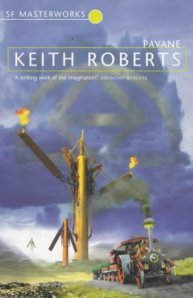 Pavane by Keith Roberts paints a picture of an alternative western world where Elizabeth I was assassinated in1588, the Spanish Armada won, the Protestant Reformation in Europe was defeated, the New World didn’t gain its independence, and the Catholic Church Militant holds sway.
The resulting world is technologically backwards in most respects (no cars but steam driven road trains; no phones but semaphore towers etc.), superstition is rife and the Inquisition (now known as the Court of Spiritual Welfare) continues to put people to the question. Oh and the old ones, in the person of Fairy, are still lurking around, watching and occasionally assisting.
This is less a novel than a series of linked stories which begin in 1968 (the year the book was published). I was immediately attracted by the basic premise (those of you who read this blog regularly will know that sixteenth century history is one of my great loves) and I found the book absolutely fascinating – a complete world which is internally logical. All of the stories are good, my favourite being Corfe Gate where a young woman leads a rebellion against the Church in south-west England, which is where the stories are mainly set.
I enjoyed this very much, although it does throw up a question for me about what we really mean by sci-fi, something which I occasionally find puzzling. This book has a number of fantasy elements, but I suppose it falls into the sci-fi genre because of the alternative history aspect.
The Encyclopaedia of Science Fiction describes Pavane as “moody, eloquent, elegiac and thoroughly convincing” and I think its well worth a read.
 I have to confess to a failure here – I managed to get to page 160 of Emperor when I ground to a halt. This is a rarity for me and I’m not sure why it’s happened in this case; after all:
- I like Stephen Baxter
- I like reading about Rome
- I like alternative history type stuff
But, despite all of these things I just couldn’t persevere with this book. It’s not badly written, and the first section (set around the time of the Claudian invasion of Britain) was really good and I trotted through it very quickly. But then……. who knows?
It’s a shame really as this looked like it could be an interesting series (I think it ran ultimately to four books) but there you have it; the second unfinished novel this year.


 Bride of the Book God