
You are currently browsing the tag archive for the ‘42 Challenge’ tag.
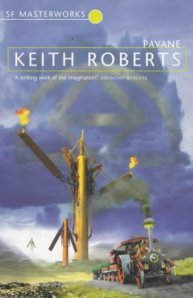 Pavane by Keith Roberts paints a picture of an alternative western world where Elizabeth I was assassinated in1588, the Spanish Armada won, the Protestant Reformation in Europe was defeated, the New World didn’t gain its independence, and the Catholic Church Militant holds sway.
The resulting world is technologically backwards in most respects (no cars but steam driven road trains; no phones but semaphore towers etc.), superstition is rife and the Inquisition (now known as the Court of Spiritual Welfare) continues to put people to the question. Oh and the old ones, in the person of Fairy, are still lurking around, watching and occasionally assisting.
This is less a novel than a series of linked stories which begin in 1968 (the year the book was published). I was immediately attracted by the basic premise (those of you who read this blog regularly will know that sixteenth century history is one of my great loves) and I found the book absolutely fascinating – a complete world which is internally logical. All of the stories are good, my favourite being Corfe Gate where a young woman leads a rebellion against the Church in south-west England, which is where the stories are mainly set.
I enjoyed this very much, although it does throw up a question for me about what we really mean by sci-fi, something which I occasionally find puzzling. This book has a number of fantasy elements, but I suppose it falls into the sci-fi genre because of the alternative history aspect.
The Encyclopaedia of Science Fiction describes Pavane as “moody, eloquent, elegiac and thoroughly convincing” and I think its well worth a read.
 So Carl is hosting this mini challenge as part of his Sci-Fi Experience and to honour Dewey. The idea is to read at least one sci-fi short story and post about it on his official page. I read three stories from an old anthology that we’ve had kicking around the house for ages, namely The Mammoth Book of Best New SF 13, which covers stories first published in 1999 (wow, last century, remember that?), and therefore cannot be found on Amazon for me to link to (sorry). I read:
1. Suicide Coast by M John Harrison – I found this quite difficult and bleak and I’m not entirely sure that I fully understood it; it’s about gaming and rock climbing I think, and what’s real and what isn’t. Perhaps I just wasn’t in a receptive frame of mind to understand the subtleties?
Anyway, I wasn’t put off, and moved on to:
2. How We Lost The Moon: A True Story By Frank W Allen by Paul J McAuley – I like McAuley’s work though I haven’t read as much as I should have. This story does what it says on the tin; Frank is a witness to and participant in the events that saw an experiment on the Moon go terribly wrong and we, sort of, lost the Moon. Very enjoyable.
3. Evermore by Sean Williams – a story of crippled space-ship crewed by entitities based on the minds of real people on Earth but who technically don’t really exist, and in any case aren’t really speaking to each other. So what happens when something needs to change?
There are a couple of other stories in this anthology that I might save for another time, but all in all this was an interesting experience.
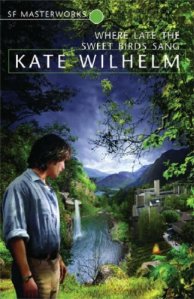 So I said that one of the things I wanted to do as part of the Sci-fi Experience was read more science fiction by women, and when I wrote that Where Late The Sweet Birds Sang was one of the books I had in mind.
To my shame I knew very little about Kate Wilhelm but she is a multi-award winning writer, instrumental in setting up and teaching at the Clarion Workshops which have been very influential in the sci-fi world. And this novel seems to be considered amongst her very best work.
So this is a book about cloning, not just about the idea of it but the successful application of it in an isolated community which has set itself up in the Appalachian Mountains in preparation for the world catastrophe that is clearly coming; not just famine, disease and war but the rapidly developing sterility of the human and animal populations. The community is made up largely of one wealthy family who use their money and expertise to clone and breed themselves in order to survive.
The novel is in three sections, each one told through the eyes of a particular character (David, Molly and Mark) who follow the evolution of the clone society over a period of time. And that’s what’s really fascinating about this novel; the cloning technology is a given, but what the author is really exploring is the kind of a society that would develop, how the original, naturally born people would be regarded by the clones,and how (if and when the time comes) they would venture out of their self-sufficient world.
I was really very impressed with this novel; it’s a moving story, and although my sympathies lay in a particular direction I could really understand the opposite point of view. The structure works really well as it provides a means of watching this society evolve. It’s beautifully written and one that will definitely be on my re-read pile.
 So I decided to start the year off with a proper sci-fi read by an author new to me but highly regarded by the Book God. Gary Gibson lives and writes in Glasgow, and the Scottish connection is always of interest to me as we seem to produce some fine writers in the genre (Iain M Banks to name but one)
I like most varieties of sci-fi but will admit to a huge soft spot for those with universe-spanning plots, ambiguous alien races, spaceships, explosions and lots of scientific exposition for me to get my teeth into; Stealing Light meets all of those criteria. And with a really good female protagonist to boot.
Dakota Merrick is a pilot and a machine-head – a person with implants (known as her Ghost) which allow her to perform well above normal human capacity. She is on the run having participated in and witnessed some terrible events, and signs up as the pilot on a cargo ship for what seems to be a straightforward job – taking an expedition to survey a potential mining operation. But of course all is not what it seems. What is the expedition really looking for?
I really, really enjoyed this novel; Dakota is a flawed and damaged heroine and I came to like her very much. The mysterious alien race which seems to be behind most of what happens to her, The Shoal, are a race of sentient fish and the only species with faster than light travel, and although the whole idea of them seems a bit weird at first, I certainly got used to them quite early on. It is quite a violent book, but I didn’t find the level of violence excessive given the dynamics of the plot (and I must admit this isn’t something that normally puts me off).
All I can say is that this is so well done it kept me up to the wee small hours over two nights to finish it, and represents a really good start to my 2009 reading.


 Bride of the Book God