
The Bride’s film page is no more. Visit me on my new blog Bride of the Screen God for movie and TV related stuff. Hope to see you there!
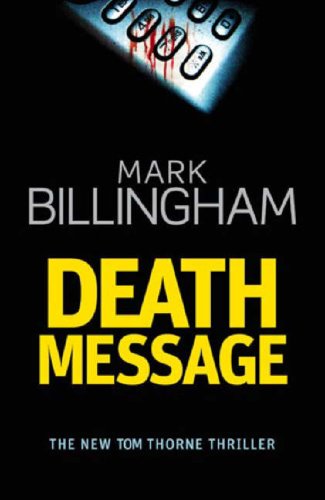 The most recent Tom Thorne thriller, Death Message is a really enjoyable police procedural and a welcome addition to one of my favourite series.
Thorne receives a picture on his mobile phone which clearly shows the face of a dead man. This turns out to be the first of several, and Thorne ends up in a psychological game with a criminal whom he sent to prison, all taking place through the actions of a killer with a clear purpose.
I really enjoyed this book. We get to know the identity of the killer and the reasons for his crimes quite early on but this only added to my enjoyment as the story stopped being a whodunit, or even a whyhedunit, but was really about what was underneath and how it would be resolved.
And as well as a resolution to these particular crimes, Thorne also gets to find out what really happened to his father, a storyline hanging over from a couple of books ago.
I think I enjoy Billingham’s books because I really like Tom Thorne, and am interested in all the personal stuff as well as the case that he’s involved in. If you are new to the series I wouldn’t necessarily start with this one because of the references to previous books, but having said that any of the Thorne novels are worth picking up. Of course now that I have said that Billingham has written a stand-alone novel as a break; hopefully he’ll be back with these characters soon.
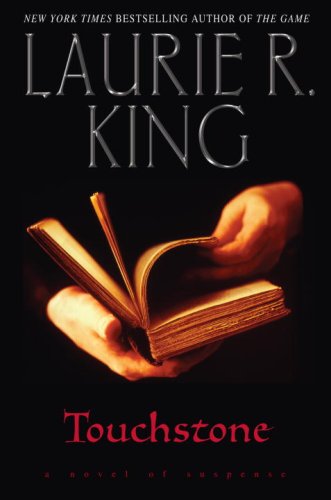 From assassination with William the Silent to anarchy in Touchstone, with a common thread of political change, all part of crime month. The background here is the General Strike of 1926 with huge tensions between the working and ruling classes, an opportunity for those with their own agenda to push the country in a certain direction.
I don’t want to give away too much of the plot; suffice to say that Harris Stuyvesant, an agent of what will become the FBI, arrives in London semi-officially to follow up some leads relating to bombings in the USA. By various means he teams up with Bennett Grey, a survivor of WWI who has some interesting abilities which could help the investigation, as well as some useful contacts with key players through his sister, Sarah.
I really like Laurie King, I have never read a novel by her which I didn’t enjoy, whether it’s the Mary Russell or Kate Martinelli series, or one of her standalones as here. I’m glad to say that I wasn’t disappointed this time either; this is a really well written thriller, the plot slips along nicely but is supported by a depth of characterisation which meant I became really attached to several of the main characters.
I read this largely during my daily commute, and it was so good that on at least one occasion I didn’t realise I’d reached Waterloo and had to scramble to get off the train. Highly recommended, and I hope that she writes more involving Grey and Stuyvesant.
I’m also really, really looking forward to next year’s Mary Russell.
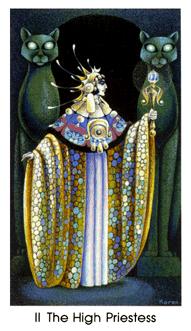
You are The High Priestess
Science, Wisdom, Knowledge, Education.
The High Priestess is the card of knowledge, instinctual, supernatural, secret knowledge. She holds scrolls of arcane information that she might, or might not reveal to you. The moon crown on her head as well as the crescent by her foot indicates her willingness to illuminate what you otherwise might not see, reveal the secrets you need to know. The High Priestess is also associated with the moon however and can also indicate change or fluxuation, particularily when it comes to your moods.
What Tarot Card are You?
Take the Test to Find Out.

Three Act Tragedy
I’m sure I’ve mentioned on this blog before that I got into reading crime fiction through Agatha Christie, partly because of the wonderful film version of Murder on the Orient Express (reviewed on my film page) but also through my Mum buying me a copy of Nemesis with a creepy Tom Adams cover to get me through a bout of flu.
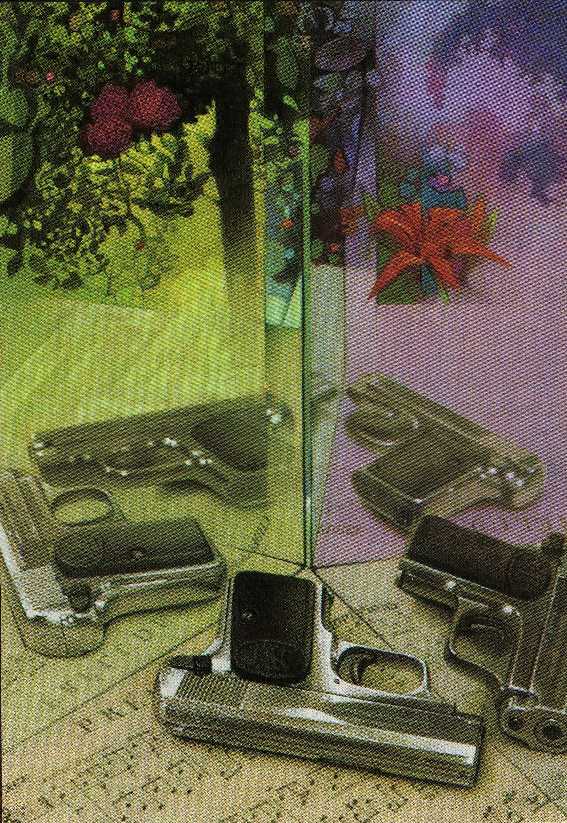
They Do it With Mirrors
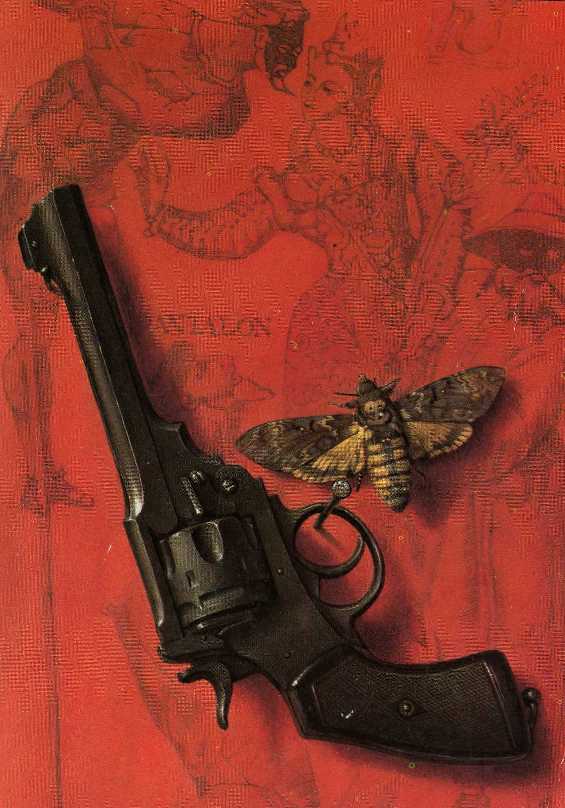
The paintings of Tom Adams were associated with Christie’s novels in paperback for almost 20 years. A number of them were collected in Agatha Christine: The Art of Her Crimes in the early 1980s. Sadly this seems now to be out of print, but I was able to get hold of a slightly bashed second hand copy which, in addition to the artist’s own comments, has a commentary by Julian Symons and an introduction by John Fowles.
The Mysterious Mr Quin
I have always loved how Adams’ paintings caught the spirit of Christie’s novels, even when the objects on the covers seem obscure in terms of the story, although I’ve always suspected that if I had been paying more attention I would have seen a greater relevance in the objects he uses.

Hickory Dickory Dock
Sadly I don’t have a full set of the Tom Adams Christies but I’ve reproduced one or two of my favourites here and hope that you enjoy them. Although some of the later paperbacks have attractive covers nothing says Agatha to me like Tom Adams.
 The Awful End of Prince William the Silent by Lisa Jardine describes the events leading up to the assassination of William and the repercussions of his death within the Low Countries and across Europe. It brings together two of my favourite things – crime and history – and does so in a really accessible way.
You don’t need to know anything about the political situation on the continent at that time as the author gives one of the best synopses I have ever read. So you get an understanding of why the Low Countries were in revolt against Spain, why Philip II felt the need to put a price on William’s head, and why someone might want to take up that challenge even though they knew it meant a certain and deeply unpleasant death for them. You also learn the impact this crime had on the rulers of Europe, Particularly Elizabeth II, and the growing fear of handguns. For as Lisa Jardine says, this crime wouldn’t have been possible without the invention of a pistol that could be loaded and primed in advance, concealed about the person and produced at the right moment to deadly effect.
What I found particularly interesting about this book are the parallels that are drawn with the present day. The 16th century assassin is compared to 21st century suicide bombers, who are almost impossible to stop because they have no concern for their own survival. The repressive measures taken by the English government in particular, trying to stop the wrong type of person from entering the country because of the fear that the Queen might be killed, and the lengths the intelligence services at the time went to to keep tabs on people also have a resonance in today’s fight against terror. And of course the murder of a celebrity and what that can mean to their ongoing reputation is also touched upon.
I thought this was an excellent introduction to the subject, and had the bonus of some original documents in the appendices which really fleshed out the background. Highly recommended.
Updated – I was so intent on trying to articulate what I thought about this book that I forgot to mention it was my fifth and final read for the Non-Fiction Five Challenge.
Transformers [2007], directed by Michael Bay, starring Shia LaBeouf, Megan Fox, Josh Duhamel and loads more.
 So it’s August in London; hot, humid, wet, busy with tourists and grumpy commuters, and it’s nine weeks today until my holiday. What is a girl to do to cheer herself up, I hear you ask, with no Dr Who on TV, Criminal Minds finishing this week, and not many Without a Traces left to divert her from the long haul through what remains of the summer?
The answer is clearly to plunge into my large tbr pile of crime fiction. There is nothing like murder, mayhem and failing to guess the culprit to bring a smile to the Bride’s face, so all my reading in August will have crime as a theme; even the stuff I am reading for challenges.
And as if to endorse this plan, Thursday’s podcast from Simon Mayo’s book panel on Radio 5 Live reviewed new books by Mark Billingham and Karin Slaughter, so this is clearly a sign that I’m on the right track!
 R M Dashwood is the daughter of E M Delafield who wrote The Diary of a Provincial Lady, which I read and thoroughly enjoyed many years ago. In Provincial Daughter, Rosmund Dashwood has written not exactly a sequel to her mother’s books, but a new take on a similar situation, that of a middle class woman and the trials and tribulations of bringing up a family with not enough money to quite meet the social expectations of her class. Which makes it all sound a bit pompous, but this is a very funny novel.
The story is set in the 1950s and covers three months where the narrator (never named) decides to keep a diary of her goings-on just to demonstrate to herself that she isn’t wasting her fine mind and expensive education. So we find out about her husband the doctor, her three sons, her friends and neighbours, her German au pair and her writing career.
I found it fascinating; I was born in the early 1960s so this world had largely gone by the tme I would have been old enough to recognise it, although I suspect this is a very English take on things and it might have been a bit different where I grew up. I liked the narrator very much, which always helps, and it’s a shame that there don’t seem to be any further adventures; I would have liked to know whether they moved to Scotland as seemed to be on the horizon at the end of the book, and what that might have meant.
This is good fun, and I loved the cover – what a frock! – and the illustrations by Gordon Davies are excellent. Recommended.
 Regular readers will know that one of my main interests is history, and so when looking for books to read for the non fiction challenge I picked several that were about the past, and this one, Ubiquity, which is about the science of history, an idea that I have always found intriguing. Mark Buchanan is using this book to describe what the blurb calls a new law of nature which can be applied to anything.
I found this a difficult read largely because it is perhaps inevitably more about the science than the history, but the ideas the author discusses were sufficiently interesting to make me persevere, though I did find it hard going at times. If I have understood the book correctly (and that might be a big if) there is evidence of “ubiquitous patterns of change” that run through everything on earth (and presumably beyond). Things that look very different may actually be extremely similar in the way that they are organised. Buchanan uses earthquakes, forest fires and mass extinctions among others as examples of how this might all work.
There is a lot of discussion about power laws which I think means that the bigger something is the less likely it is to happen – the example that stuck with me was research into wars and the size of each conflict as a fraction of the world’s population at the time, which demonstrates that wars become 2.62 time less frequent every time the number of deaths doubles.
One of the key ideas behind this book is probably best described by the author himself: if
chaos teaches physicists that the truly simple can nevertheless look complicated, the critical state teaches them that the truly complicated can behave in ways that are remarkably simple
Buchanan does deal with how this all applies to human society by facing up to the objection that I suspect would be made by many people, that is what about our free will. He uses a number of examples to show that although we do indeed have free will, we also have tendencies and often follow the line of least resistance, so that though we deal with each other on the basis of our own opinions and decisions, there almost always emerges a regular pattern of behaviour.
I’m sure I haven’t done justice to the complexities of this book, and although it wasn’t quite as I expected I found it thought-provoking.
This is my fourth read for the Non Fiction Five challenge.


 Bride of the Book God