
You are currently browsing the category archive for the ‘Reviews’ category.
 What’s it all about?
The Starry Rift: Tales of New Tomorrows is an original sci-fi anthology edited by Jonathan Strahan and winner of the Aurealis Award, which I had to look up and discovered it’s an annual award given for excellence in speculative fiction (covering sci-fi, fantasy and horror). As the blurb says, Strahan asked the contributors to “look past the horizon of the present day”.
Why did I want to read it?
Well, I didn’t actually know that I wanted to read it as such, but last year I was lucky enough to get tickets to see Neil Gaiman’s performance/reading of The Truth is a Cave in the Black Mountains, and one of the other stories he read was the hugely entertaining Orange, which I wanted to hunt down and experience myself, and this is the collection it was written for (for which it was written?), (whatever). Of course it’s now been included in his new collection Trigger Warnings but I’m glad I found it here first because this is a really cool anthology.
What did I think of it?
Short story collections are always strange because they can’t help but be a bit uneven, whether they’re by a single author or a number of different writers; we have sixteen of them here. But I thought this was a really strong bunch of stories; a couple of them were definitely not to my taste in terms of theme but none of them were poor or badly written (IMHO at least) and I enjoyed dipping into this over several days. There is a wide range of futuristic subject matter covered, some set classically in space and others set here in contemporary (or near contemporary) Earth. Stand-outs for me (in addition to the aforementioned Orange, obvs) were:
- Cheats by Ann Halam – immersive gaming, using code to travel between worlds
- The Dismantled Invention of Fate by Jeffery Ford – love and fate in a tale inspired by the work of Michael Morrcock
- Sundiver Day by Kathleen Ann Goonan- loss and grief and possibilities, with added cloning
- The Star Surgeon’s Apprentice by Alistair Reynolds – cyborg space pirates!
- Infestation by Garth Nix – alien space vampires and their hunters!
A really enjoyable collection, very much worth your time.
 What’s it all about?
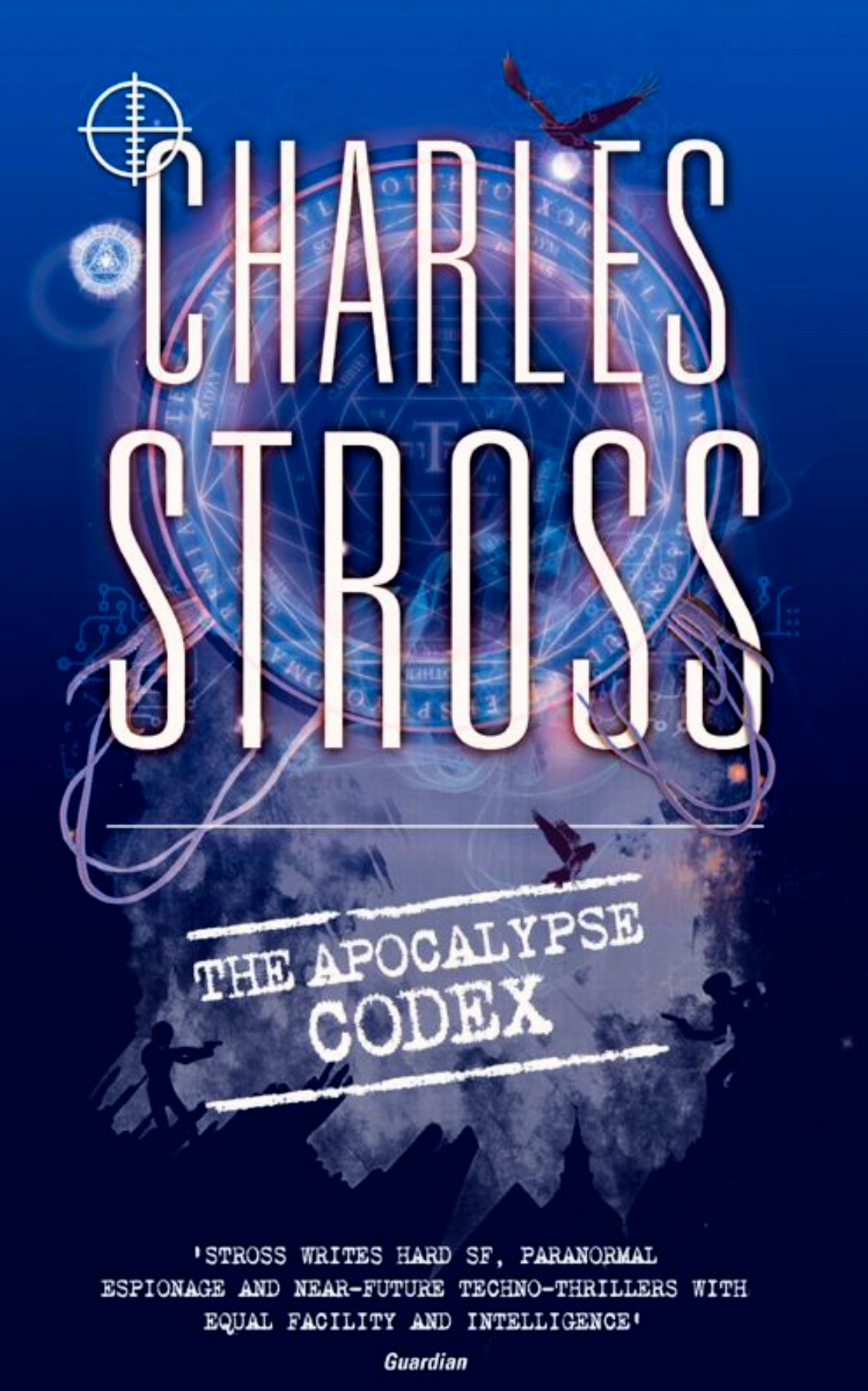
The Apocalypse Codex is the fourth in the series of novels set in The Laundry, the really really secret bit of the British Civil Service that deals with nasties from other dimensions, the Old Ones and their ilk.
This time Bob Howard, our hero, is contending with, well, the impending Apocalypse. Specifically, an attempt to awaken Something from Another Dimension (capitals always seem necessary here) which Bob has come across before, mostly in his dreams nightmares.
This time round he has the “help” of two external assets – Persephone Hazard (who is basically a witch) and Jonny McTavish (who has form with the kind of cultish religion involved here).
Oh and they are in Colorado dodging the local equivalent of the Laundry (amongst other things).
Why did I want to read it?
As I’ve said before I’m working my way through the series in order (as is only right and proper). Thoughts on The Atrocity Archives, The Jennifer Morgue and The Fuller Memorandum have already been shared as linked.
What did I think of it?
I don’t know whether it’s because I read this so close to finishing the previous volume (and that’s why I usually take longish breaks between elements of a series) but it took me a bit longer to get into The Apocalypse Codex than normal, and the use of a greater amount of third person narrative (as opposed to us mostly seeing the action through Bob’s perspective) might not have helped. But once the Big Bad was identified and the action got under way then I was sucked in as per usual. The main new characters this time round were Jonny and Persephone (as mentioned above) and Gordon Lockhart, a senior manager in the Laundry who looks after External Assets. So lots of new people and consequently not enough Mo or Angleton for my taste but once we are in the USA dealing with a completely bonkers evangelical church with a charismatic leader and a plan to bring forward the end of the world and save us all whether we want to be saved or not then those reservations all passed.
Of course the bad guys are (partially) unwitting dupes of something other than they expect, and of course the new guys underestimate Bob’s talents and skills because he looks like a boring civil servant, and of course it all goes a bit pear-shaped and they have to make it up as they go along, but the end of the world is diverted once again, we learn a lot more about the internal workings of the Laundry and things change for Bob, probably in a good way but we’ll wait and see.
I am still really enjoying this series and have one novel and three short stories to go to catch up, but may give myself a break for a bitto keep it all fresh. But as always, recommended if Lovecraftian-related administrative shenanigans are your bag.
 What’s it all about?
Well, what does the blurb say?
When the alien Mimics invade, Keiji Kiriya is just one of many recruits shoved into a suit of battle armor called a Jacket and sent out to kill. Keiji dies on the battlefield, only to be reborn each morning to fight and die again and again.
Live. Die. Repeat. As the movie poster has it.
Why did I want to read it?
Well. This is a bit embarrassing. I saw and loved the film Edge of Tomorrow which was an Americanised version of the story told in All You Need is Kill and which I reviewed here. I knew that it was based on a novel but I was more interested in the graphic version, which is what I thought I had downloaded (I think that’s an easy mistake given the cover), so imagine my surprise when I opened it up and there were no pictures. What an idiot.
What did I think of it?
I really didn’t think I was in the market for Japanese military sci-fi but how wrong was I? I was drawn very quickly into Keiji’s story which is told mostly in the first person and describes his bewilderment at his situation in the first, instance, then his growing skill as a warrior determined to defeat the alien invaders. I’m not sure if it was a help or a hindrance knowing the story in advance; although the core is the same, the film and book are very different in many respects, though the character of Rita, the Full Metal Bitch, is consistent and of course totally fabulous. I liked the structure of the novel and thought it was really gripping. So a happy accident. Though I still think I’m going to get my hands on the graphic novel at some point, just to compare.
As well as the reasons given above, I read this for the 2015 Sci-fi Experience.
 What’s it all about?
The Fuller Memorandum is the third in the series of novels set in The Laundry, the really really secret bit of the British Civil Service that deals with nasties from other dimensions, the Old Ones and their ilk.
This time Bob Howard, our hero, is contending with secret dossiers, the odder-than-usual behaviour of his scary boss Angleton, zombie killers, Russian counterparts, apocalyptic death cults and the end of the world being a bit more imminent than originally thought. But at least he has an understanding manager.
Why did I want to read it?
I’m working my way through the series in order (as is only right and proper). Thoughts on The Atrocity Archives and The Jennifer Morgue have already been shared as linked. And it’s paranormal-civil-servanty-espionage after all.
What did I think of it?
I think this is probably my favourite of the Laundry Files so far. Bob has a bit of a problem at the beginning of the book which means that he isn’t working as normal when all the oddness starts happening, so that adds a slightly different perspective as he has to do quite a bit of sneaking around.
But what makes this a particularly fine entry into the series is that we lean more about Mo, Bob’s wife, who also works at the Laundry, and the toll that her duties take on her (she sees some really really nasty stuff as part of her day job) as well as finding out quite a bit about Angleton (one of my favourite characters), information that serves to explain a lot about his position int he organisation.
Chuck in some authentic Russian history with an occult twist, a very unpleasant cult who are actually dying (in more ways than one) to get those other-dimensional through to our side to wreak havoc on the world, season with really black humour and some proper horror and you have a gripping story that I couldn’t put down. Made all the better for an old civil servant like me because of all the bureaucratic nonsense, which is not that far from the truth (except for the zombies of course). Looking forward to continuing with the series.
 What’s it all about?
I described this in an earlier post as an academic-investigating-the-life-of-a-long-dead-poet novel, which is exactly what it is. Murray Watson is taking a sabbatical to explore the life of the poet Archie Lunan who drowned at a young age leaving behind a slim volume of poetry and an air of unfulfilled promise. Murray wants to write the book that will bring Lunan back to prominence once more (and establish his own reputation in the process, of course).
Why did I want to read this?
I’ve been working my way slowly through Louise Welsh’s back catalogue and she is rapidly becoming one of my favourite modern authors. I just really like her books 🙂
What did I think of it?
I am an absolute sucker for stories about academics doing research on anything (see my review of the John Langan collection recently where my favourite story was about that very thing, though in the context of a horror tale), and when coupled with being set in Glasgow (virtually my home town though I went to the other University) this was a no brainer for me.
It helps that it’s a really strong story with a mystery element as well as lots of personal stuff about Murray’s family background and collegiate rivalry and a climax set on a fairly remote island, all adding up to a very enjoyable read. I really liked Murray, flawed though he is, and the other key characters were just as fascinating and true to life. And there was enough sense of Archie Lunan to find him believable as a real person overtaken by his own legend, but avoids the trap of representing too much of his work so you don’t get caught up in whether it’s actually any good or not.
I’m looking forward to reading the other books by Louise Welsh that I already have in the stacks. The Bullet Trick and Tamburlaine Must Die are the only ones left, and I think I will then have caught up, annoyingly. Recommended.
 What’s it all about?
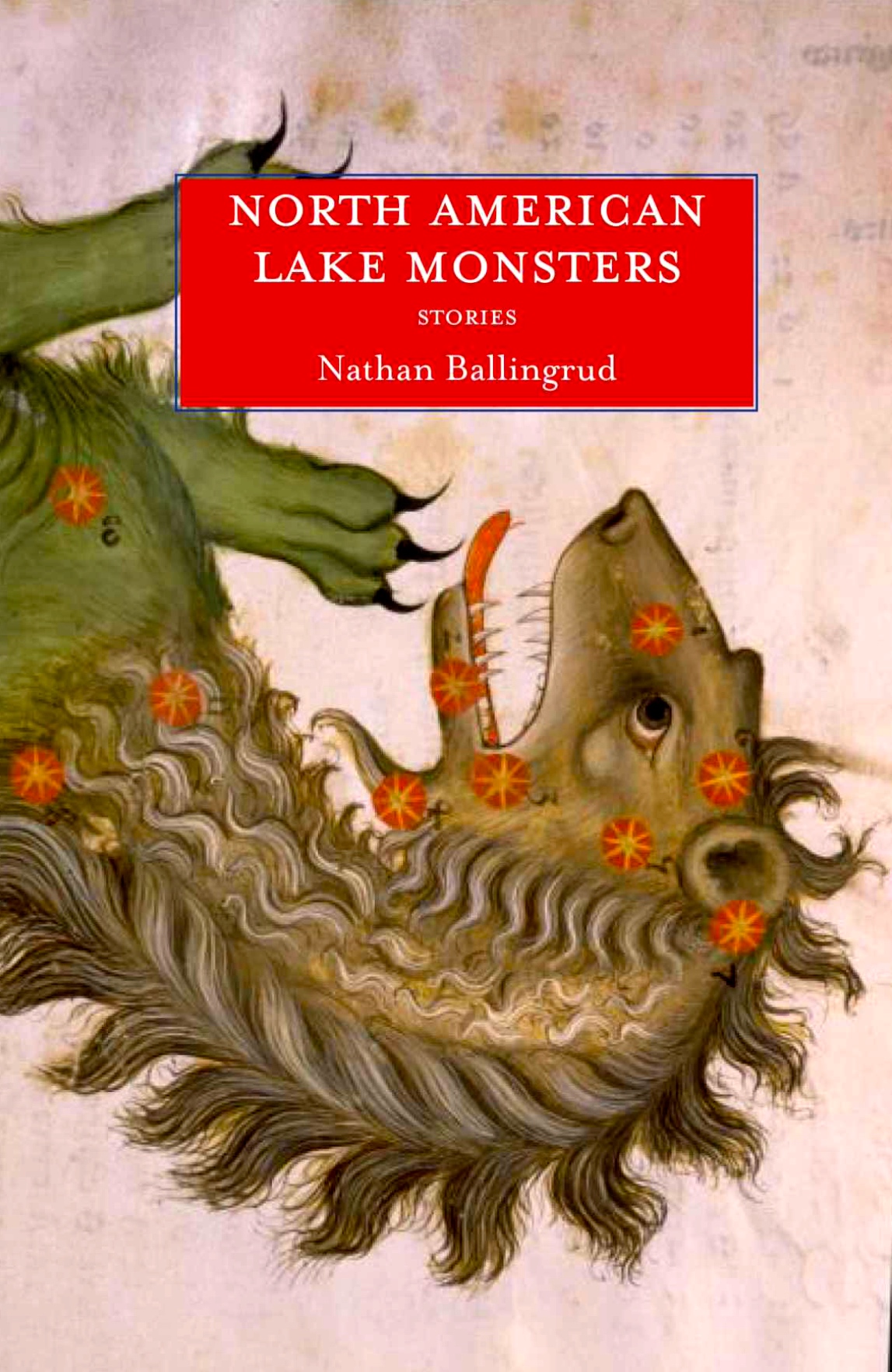
North American Lake Monsters is a collection of horror stories set in the modern USA. I described it in my reading notes as
horror at the periphery of everyday lives of working people, mostly men
The description I’ve seen elsewhere (and not until after I’d finished the book) is
In this striking, bleak yet luminous debut collection, Nathan Ballingrud, winner of the inaugural Shirley Jackson Award, uses the trappings of the Gothic and the uncanny to investigate a distinctly American landscape: the loneliest and darkest corners of contemporary life.
So better put but fairly similar *phew*
Why did I want to read it?
I had come across a couple of Ballingrud’s stories in other collections and want to give his wider work a try. I hadn’t realised how many awards he had been nominated for until I got my hands on the volume (though nominations or award wins don’t always affect whether I want to read something).
What did I think of it?
Hmm. This was really a bit of a mixed bag. It contained the two stories I had read elsewhere, one of which didn’t stand up to a second read; the other, The Crevasse, was wonderfully Lovecraftian in its Antarctic setting and I enjoyed it just as much this time around. As for the others, I could appreciate the skill but they just didn’t connect with me; perhaps they were just too bleak (not that I mind bleak usually, but there was no relief at all here that I could see), and *whispers* too masculine for me. That’s not something I think I would have noticed if I’d come across any of these stories mixed in with the work of others, but it just leapt out at me reading them in a single volume.
Glad I gave it a shot but I don’t think I’ll be actively seeking out any more of his work.
I read this as part of the 2015 Horror Reading Challenge.
 What’s it all about?
The latest novel from David Mitchell, The Bone Clocks is another tour de force of interwoven stories with multiple characters told over several timelines. Ostensibly (mostly) about the life of one woman, Holly Sykes, and the people she meets and forms relationships with throughout her life, it’s also a story of a time war that plays out through the lives of (perhaps not entirely) ordinary people.
Or as I flippantly described it in an earlier post “the one that’s a timey-wimey-metaphysical-thriller”
Why did I want to read it?
I enjoyed Cloud Atlas once I got into it (you can read my review of that here and the film version here) and I always full intended to read more of Mitchell’s work but haven’t got round to it until now. As well as being well-received by reviewers this was long-listed for the Man Booker so a good place to start in catching up with his work.
What did I think of it?
I really loved this, was so happy that my first full novel of the year was such a pleasure. I found it much more readily accessible than Cloud Atlas but I don’t know if that’s just because that I’m more used to the way Mitchell structures his novels, or whether the timeline was just more chronologically straightforward. But the main thing is that I really liked Holly as a character, the strange things that happened to her, and enjoyed waiting to see how (or even whether) she would appear in those sections of the story narrated by other characters.
And there is a such a lot to enjoy; the five narrators who bring their different perspectives to the table, the nature of love and friendships and how they develop and change over time as the same people drift in and out of our lives at key points. And how the connections we make can come back and have an unexpected impact.
The speculative elements of the story – the struggle between two views on how those who are effectively immortal should behave towards others, and the vision of our own world in the near future – worked well and the whole thing is just so beautifully written and constructed that I read it in several enormous chunks as I got sucked in, desperate to know how it would all work out. Very satisfying indeed.
 Whats it all about?
The Wide Carnivorous Sky (subtitle and Other Monstrous Geographies) is a collection of nine modern horror stories.
Why did I want to read it?
I came across the work of John Langan through the annual best of horror anthologies edited by Ellen Datlow where his stories stuck out as something exceptional. I wanted to read more and got a hold of this collection as a good starting point. He is clearly highly regarded by his peers.
What did I think about it?
I really enjoyed this collection which nicely covers the full range of horror themes. Cannibalistic children? Check. Zombie apocalypse in the style of Thornton Wilder’s Our Town? Check. Werewolf-type things? Check. Unspeakable Lovecraftian entities breaking into our world and creating havoc? Why yes. Reasons why you shouldn’t hitch-hike? Indeed.
Particular favourites were
- Technicolor – what was Poe up to in his lost week, what’s the Masque of the Red Death about, why you should really pay attention in your English Lit class
- The Wide Carnivorous Sky – space vampires meet USA’s finest but not in a good way; assuming there is in fact a good way….
and my absolute favourite in the collection
- Mother of Stone – the story of an academic investigating what appears to be an urban legend of about the events that follow the digging up and installation in a local hotel of a statue of headless pregnant woman, taking in myths, ancient religions, all manner of Fortean stuff and turning it into a disturbing tale of what happens when you don’t leave something well enough alone.
The collection also includes an introduction by Jeffery Ford and an afterword by Laird Barron, as well as notes on the stories by the author himself (I love author’s notes and aways read them where they are included) which give some insight into the genesis of the stories and what he was trying to achieve.
I’m pleased that my initial feelings about Langan’s work have been reinforced by the stories in this book, and I’ll definitely be looking out for more.
I read this as part of the 2015 Horror Reading Challenge. I also learned that I have real problems typing the word “carnivorous”.
 What’s it all about?
Two women have been murdered. Different methods, but both around 1 am on consecutive Sunday mornings. Seems to be coincidence until a third body turns up and the police can’t avoid the fact that they are connected which of course = Serial Killer. The events take place on the three Sundays before Christmas so obviously the press dub said murderer The Advent Killer.
As panic spreads across London, DCI Antonia Hawkins, leading her first murder investigation, must stop a cold, careful killer whose twisted motives can only be guessed at, before the next body is found
Thus endeth the blurb
Why did I want to read it?
Well, I must have read something about this somewhere or had it recommended by someone because I put it on my Christmas list and lo and behold, it turned up under the tree. And was devoured, mostly on Boxing Day. I like a good serial killer. In fiction obviously, not real life, though I did work with someone who was booked to go on a civil service training course with Dennis Nielsen. But that’s another story.
What did I think of it?
Like I said above, I read most of it in one day; it’s ideal for curling up under a blanket on the sofa, if you like that sort of thing which I of course do. It’s a fairly undemanding read in many respects but none the worse for that. A solid police procedural with a likeable lead character and all the things I have come to expect in this sort of story:
- a detective out of their depth, with a complicated personal life and occasional flashes of intuition, in this case made more interesting by the detective being female and apparently the victim of institutionalised misogyny
- sidekick, with whom lead detective has History of some kind, is brought in to assist once the out of depthness has been recognised by those Higher Up,
- time pressures – this case must be solved by X otherwise Y will happen (or not happen)
- a killer with a Mission which makes sense only to them (even after we all know what it is)
- the Red Herring
- and of course, it all gets Personal
All of which is done really well and the story moves at pace and you really do want to find out what it’s all about.
Except I actually guessed (and it really was a guess) who the murderer was within the first 90 pages, just because I’ve read and/or watched loads of these things and I just though “I wonder if it might be…..” It didn’t spoil the book for me because I couldn’t actually believe I was right and even if I was I wasn’t sure how it was actually possible (you find out in an aside quite late on in the story) but the Motive was revealed slowly throughout the book and I did want to know what that was all about. Poor thing, no wonder things turned out the way they did…
Anyway, I liked DCI Hawkins a lot, so much so that I’ve ordered the sequel. It’s called My Bloody Valentine. I think I see a pattern here…..
 What’s it all about?
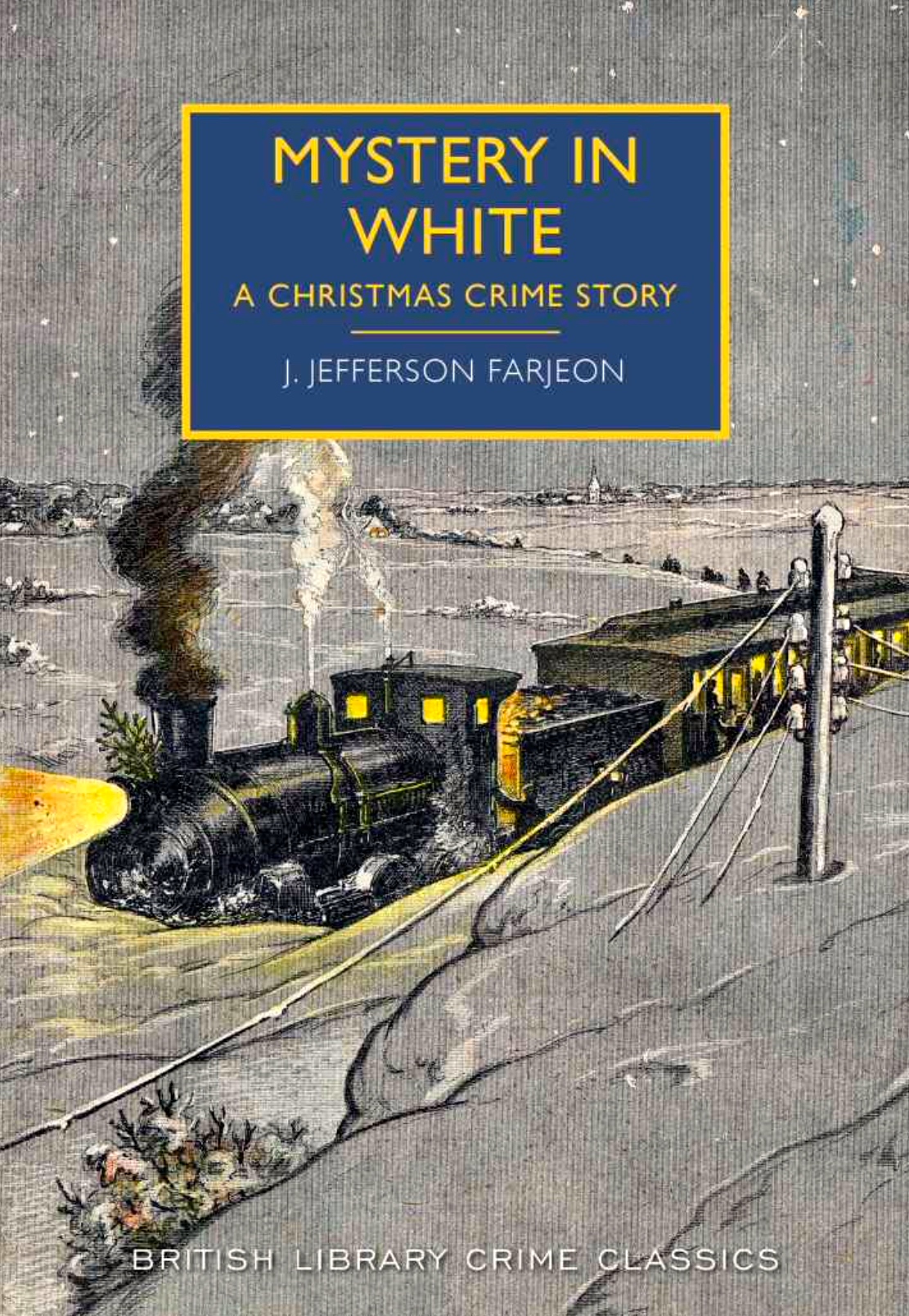
Mystery in White is part of a series of classic British crime novels being republished by the British Library (and I have bought several of them in physical or electronic formats). A group of people who don’t know each other (apart from David & Lydia who are brother and sister) are sharing a compartment on a train which has become stranded in heavy snowfall. It’s Christmas Eve and they decide to head cross-country to another station to see if they can continue their journeys. But the weather closes in and they take refuge in a house which seems deserted, despite fires burning away and the table set for tea. Where is everyone? What’s happened?
Why did I want to read it?
I can’t resist a decent classic crime mystery, and the Christmas setting for this made it ideal for a Christmas Day read.
What did I think of it?
This is great stuff. It’s one of those mysteries that really draws you in. The main group of characters – David & Lydia, Thomson the clerk, Jessie the showgirl, Hopkins the elderly bore and Maltby the psychic investigator – are (mostly) likeable and certainly an interesting bunch. The unfolding of the crime is ingenious. Or should I say crimes because it becomes clear there is more than one and not all of them happened recently. There is a potentially supernatural element but that could be explained in a completely scientific way and adds lots of atmosphere to what is already a pretty edgy story.
Think about it.
You’re in a strange house with a group of people you don’t know and a criminal on the loose. You’re not exactly sure what the crime is and you aren’t certain who the bad guy is and it’s getting dark and the weather is closing in and you can’t call for help. Very creepy.
I loved this and read it in one sitting. It would make a fantastic TV film so I hope its unexpected success brings it to the attention of the right people to make that happen, because you can never have too many bright and snappy and clever murder mysteries set in the 1930s for my liking, and I would watch this in a heartbeat. If this is typical of the standard of these reprints then I’m really going to enjoy the others I’ve bought. Recommended.


 Bride of the Book God