
You are currently browsing the category archive for the ‘Reviews’ category.
 The Language of Bees is the latest instalment in the tales of Mary Russell, wife to Sherlock Holmes, and starts off from the end of the last story (Locked Rooms) with Russell and Holmes arriving back to their home in Sussex to find one of the bee colonies deceased (if that’s what happens to hives) and a figure from Holmes’ past (and I’m not going to say who it is) looking for help. This starts a murder mystery which involves Mycroft (one of my favourite characters from the canon) and his extensive resources assisting Russell and Holmes in travelling up and down the UK to visit some of the most ancient sites in the country, seeking a dangerous and influential man. I think. It’s quite hard to write about this without giving away too much of the plot, which is something I really don’t want to do as the intricacies of the story is what makes the series so successful, alongside as the lead characters of course.
I will put my cards on the table and say that years ago, when King first started writing this series I was sceptical; I loved Sherlock Holmes and couldn’t see him ever getting married, especially to a much younger woman. But I picked up The Beekeeper’s Apprentice and gave it a go, and was instantly hooked. The books are written with such affection for Holmes, Watson et al, Russell herself is a distinctive character, and the events of each (while often harking back on occasions to the past) are all set after Holmes has retired, so don’t really tinker with the mythology at all.
The only disappointment in relation to The Language of Bees is the phrase “to be continued” which appears at the end, and the knowledge that I have to wait untill sometime in 2010 to find out how this particular story develops.
Well worth reading, snatched out of my hands by the Book God as soon as I had finished it, and if you haven’t read any of the Russell stories, then you really should. Excellent.
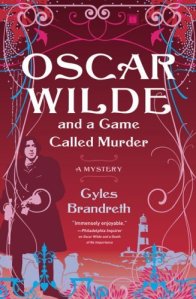 So Susan over at You Can Never Have Too Many Books has started a very interesting discussion on the use of real-life people in fiction, whether it’s justified, how readers feel about it and so on. It’s a really thoughtful piece so do go and have a look, and I mention it here not just because I’m a fan of Susan’s blog (which I am) but because this is the second book in a row I have read which is very much set around people from the real world and I am trying to look at it in the light of Susan’s post and some of the comments that have appeared there already.
Oscar Wilde and a Game Called Murder kind of gives itself away in the title. It’s the second in Gyles Brandreth’s series (I wrote about the first one here) and does what it says on the tin; it turns Oscar Wilde into an amateur sleuth, and is packed with names that are recognisable to anyone who knows the detail of both Wilde’s life and the literary scene of the time. So, we have Arthur Conan Doyle, Bram Stoker, Lord Alfred Douglas, Robert Sherard (Wilde’s first biographer) and several other lesser known names.
The story is quite a simple one; it is 1892 and the Socrates Club is having one of it’s regular dinners, presided over by Wilde himself. At the end of the meal he suggests that the guests play a game called Murder – each of them will write anonymously on a slip of paper the name of the person they would most like to kill, and the other guests will try to work out who was chosen by whom and why. Not explained very elegantly but you can probably see where this is going. Two of the slips are blank, and the same name appears four times. And Wilde’s name is mentioned once, ditto his wife Constance. The game goes a little bit sour, but Wilde thinks nothing of it until over the course of the next three days the first three names on the list, including a parrot, die in more or less mysterious circumstances. Who around the table is a killer?
It’s an ingenious puzzle and I had absolutely no idea who the murderer was, what the motive was and how it all fitted together but I really enjoyed finding out. Wilde comes across as a complex, attractive and sympathetic figure and I learned a lot about the period. It’s well written and clearly meticulously researched by someone with an affection for both the characters and the setting. Do I think that’s what Wilde was really like? Probably not. Does it matter? I’m not sure it does. Did it make me want to find out more about the real people? Well, yes, especially in the case of Conan Doyle’s friend Willie Hornung who created Raffles; I’ve never read any of his stories and am off to find some now. The author’s note is very illuminating, and that is the one thing I do look for in a novel with real people; some indication of what’s true, and what’s invented. And there are some very nice in-jokes, too. Recommended.
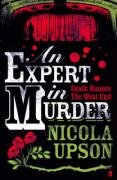 So, In An Expert in Murder Nicola Upson has created a new mystery series around a real person, namely Elizabeth Mackintosh, best know to those of us who love crime and mysteries as the author Josephine Tey.
The setting is London’s Theatreland, where Josephine’s successful long-running play Richard of Bordeaux is coming to an end. At the beginning of the novel we see her travelling from her home in Inverness, and on the train she meets a fan, a young woman called Elspeth. They hit it off, but soon after the train arrives at King’s Cross, Elspeth is murdered. Josephine’s friend, Archie Penrose (the model for her fictional detective) is leading the case and Josephine herself soon becomes involved in finding out what secret from the past has led to this and other deaths.
I’m always fascinated when authors use real people in their novels, and I’m always pleased when they include an author’s note to tell you what and who is real, what’s conjecture, what’s totally fictional. I’ve also always liked Josephine Tey’s work, especially The Daughter of Time (though I didn’t agree with her conclusion, but that’s not the point) and hopefully her transition to a fictional character will popularise her work a bit more.
The novel really does invoke the period of the 1930s, and it was great fun reading about events taking place in streets very close to where I work in central London (though obviously it all looks very different now). And though it reads like a classic murder mystery of the golden age, the occasional swearword and the description of relationships that wouldn’t have been written about quite so openly at the time remind you that this is very much a modern novel.
I’m now really looking forward to the sequel, which comes out quite soon I think.
 So Among the Mad is the fifth in the increasingly excellent Maisie Dobbs series, and finds our heroine in London on Christmas Eve 1931, where she and her faithful right-hand man witness what we would call now a suicide bomber blow himself up in a busy street.
Although she doesn’t know the man involved, Maisie is soon drawn into the case when she is named in a letter which follows the bombing and it becomes clear that some sort of campaign is afoot. Maisie finds herself trying to apply her unique methods of working while assigned to Scotland Yard, and with all of the cases she has been involved in before now, the shadow of the First World War is never too far away.
I really like Maisie as a character and was pleased to see that this story matched up to the previous volumes. The psychological impact of the war on all of those involved in whatever capacity comes across very strongly in the novel, and it’s worth remembering that returning soldiers were not always treated as well as they deserved given what they had suffered, as much because the rest of the population wanted to move on, and of course the Depression also had an effect. The author manages to get this detail into the story without being too heavy handed and I thought it worked very well.
It’s also nice to see Maisie’s own personal story develop, not just in relation to her family and friends but with the people who have become her colleagues in investigating this case, whether she has chosen them or not.
A good solid read for a warm and humid summer.
 So, I have been visiting Deanna Raybourn’s blog for absolutely ages; it’s one that I look at almost every day, and I always find something of interest there. But until now I hadn’t actually read any of her novels, and I’m sorry that I waited because Silent in the Grave is very enjoyable indeed.
Our heroine is Lady Julia Grey, and she is widowed at the very outset of the story when her husband collapses during a party at their home; this isn’t a total shock as he has a congenital heart problem and none of the men in his family live terribly long. However, one of the people present at Sir Edward’s death, Nicholas Brisbane, tells Lady Julia that he had been retained by her husband who had received some threatening letters, and that he believes this was murder. So we have our set up, and things really take off from there. I don’t really want to say much more about the plot as it’s nice and twisty with lots of satisfying red herrings
I loved this for all sorts of reasons: Lady Julia herself; Brisbane, tall, dark, handsome and mysterious; Julia’s eccentric family; the servants in the Grey household; and the setting in the London of 1886. It’s well written, pacy and I found the mystery quite fascinating.
I had one of “I wonder if X is the murderer” moments, and turned out to be right purely on guesswork with no idea as to the motive, but frankly it wouldn’t have made much difference if I’d worked it all out completely as I enjoyed the experience of reading this so much that I bought the sequel as soon as I had finished this one!
 So The Dead of Winter is the third in the John Madden mystery trilogy; I read the first a long time before I started blogging, but reviewed the second here.
Another police procedural, this one is set during the Second World War, and begins with a murder in Paris and the theft of a number of valuable diamonds. The action then moves to London in the blackout, where a young Polish girl is murdered, seemingly at random. Of course, as with all good mysteries, there is significantly more to this than meets the eye.
Madden gets drawn into the investigation surrounding this crime because the girl in question, Rosa Nowak, was a land girl working on his farm. He feels that this wasn’t a random crime, that there was a reason Rosa was killed, and determines to help his former colleagues in any way he can. And of course he is right, and as the bodies pile up all over the place it becomes clear they are dealing with a particularly ruthless and efficient killer and that the motive is buried in Rosa’s past.
It’s always difficult reviewing books in a series because you tend to find that the things that you loved in the earlier book(s) are repeated in the later ones. So again, a sense of melancholy in Madden’s character, his happy home life contrasting with the lives of the people drawn into this crime are all very satisfying; what’s different here is how effectively Airth gives a sense of London as the war is coming to an end, the weariness of the population and the need to make do in their everyday lives. There’s also an interesting subplot about the introduction of women police officers and the limitations that were imposed on them.
Very well written as always, I devoured this one pretty quickly. It’s a real shame that it doesn’t look like there will be any more in the series.
 This is not my first exposure to the Gothic creepy tales of Chris Priestley; last year I read and reviewed this, and Tales of Terror from the Black Ship has a very similar structure.
Ethan and Cathy are ill, and have been left home alone by their father who has gone off in search of a doctor. But this is no ordinary home; The Old Inn is perched on top of a cliff which is only joined to the Cornish coastline by a bridge of rock. A huge and powerful storm has blown up and while they wait for their father to return, they are joined by a mysterious stranger called Thackeray, a youngish man who has somehow managed to make his way to the inn through the treacherous weather. He settles in to see out the storm, and to “entertain” the children he tells them creepy stories, all connected with the sea and sailors.
And after that it’s more of the same, which is no bad thing in my book. The stories are nicely unsettling, as is the wraparound tale, because it becomes very clear that something is not quite right in Ethan and Cathy’s world.
Favourites for me were The Boy in the Boat (beware innocent looking little children), Nature (you will never look at snails the same way again, though in all honesty I have trouble looking at them at the best of times), and The Scrimshaw Imp (I didn’t know what scrimshaw was until I read this).
I really enjoyed this book, and the unsettling nature of some of the tales wasn’t lessened by the fact that I was reading it during a more or less sunny late July. Recommended for the Gothic lovers among us, this would have worked really well for Carl’s RIP challenge.
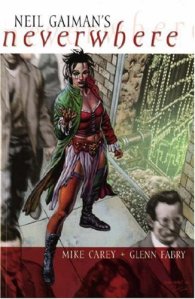 It’s always interesting to look at the graphic novelisation of a story to see what’s been left out, what’s been changed, do the characters look different to what you imagined and so on. I have to confess that although I have the novel I haven’t got round to reading it yet, but I do remember the BBC TV series from goodness knows when, so I have something to compare it to.
And it’s Gaiman of course so it’s bound to have a higher quality starting point than lots of other things.
So Richard helps a girl he finds in the street and gets dragged into a world below London which slightly mirrors what goes on above, but only slightly. There is a quest, there is betrayal, there are some rather unpleasant villains, there is a satisfying resolution (well I thought so anyway).
I enjoyed this; the artwork was cool, the story made sense, I liked the mythology of a London under London (I will never look at Knighstbridge quite the same way again) and the authors showed proper respect to Neil Gaiman without being constrained. And now I really must read the novel….
Oh, and this was my final read for the Dream King Challenge, though I feel the pull of Sandman…….
 I have to confess that I have never read anything written by Jodi Picoult and from what I know of her work it probably isn’t my thing anyway. I also have never read a Wonder Woman graphic novel before, so the combination of the two looked interesting enough to give it a try.
Not going to even attempt to describe what this is about as it’s clearly in the middle of a much longer story (there’s even a ‘Previously on Wonder Woman’ thing at the beginning which was an interesting approach) and it ends on a cliffhanger. Suffice to say that WW’s human alter ego is supposed to capture and bring to justice WW herself, which is all far too confusing for everyone involved.
The story is quite good but I always feel a bit odd about WW – maybe it’s my age but I can’t help thinking she’llcatch her death in that outfit, that the costume just looks so uncomfortable, and that despite all the stuff about female empowerment I’m probably not the intended audience for someone so impossibly pneumatic. Having said all that I read it in a sitting and am curious as to how the situation at the end is going to be resolved, though not curious enough to have actually bought the sequel.
Enjoyed the Batman cameo though.
 OK, so we all know that my admiration for Joyce Carol Oates knows no bounds, that I have read a lot of her stuff but that there is still a huge amount out there to read because she is astonishingly prolific. One of the areas she writes in that I haven’t explored in too much detail is her young adult stuff, and Sexy definitely falls into that category.
Darren Flynn is 16, athletic (he swims in his school team) and beginning to realise, uncomfortably, that he is attractive. As he is struggling to come to terms with his identity he has an encounter with a male teacher who clearly has some regard for him, and this confuses him even more. The same teacher then becomes a target for a campaign by a number of other students, most of them friends of Darren’s from the swim team, which rapidly gets out of hand and has serious consequences, not least for Darren who gets dragged in to the whole thing and has to decide not only what to do but how he feels.
It’s quite difficult to write about this short, powerful novel without giving away what happens, so all I’m going to say is that I thought this was extremely well-written as you would expect, that Darren himself was a compelling character, and that unfortunately what the teenagers get up to is all too believable. Sometimes young people are just not very pleasant, but this is compounded by a tendency not to think things through, or to be aware that their actions have outcomes and consequences which are often beyond what they intended.
A really interesting and worthwhile reading experience.


