
You are currently browsing the category archive for the ‘Reviews’ category.
 I decided to re-read this Agatha Christie novel in advance of the three part TV adaptation which was on the BBC over the Christmas weekend. Although I was familiar with the story I wanted to refresh my memory so that I could see what changes the screenwriter had and hadn’t made. This is in part because of bad experiences with recent Christie adaptations where they have packed the episodes with big name actors even in the smallest parts and have mucked about with the stories so that they are basically unrecognisable.
Rant over.
Though for the avoidance of doubt I should say that Joan Hickson’s Miss Marple and David Suchet’s Poirot are exempt from this criticism.
Context
I have owned a reasonable sized collection of Christies since I was in secondary school so I rummaged in the stacks to find the copy I knew I had, with the aim of reading it on a train trip to and from Manchester. What I had forgotten is that my paperback is from 1975 (22nd impression) and not only has a golliwog on the cover (one of the great Tom Adams illustrations) but also has the original 1939 title which today would be totally unacceptable, so that scuppered that idea. Didn’t want to be glared at on the Pendolino. In the end I read it roughly in parallel with the broadcast.
The novel
I was pleased to see that my memory of the story had held up pretty well. 10 people, strangers to each other apart (obviously) from the married couple who are the only servants, are invited to an island off the coast of Devon for a house party. They are a pretty mixed bunch and it becomes clear that they have all been spun a different story to get them there and more importantly they all have something to hide. And then they start being bumped off one after the other.
The tone is very dark, none of the characters are particularly likeable and of course paranoia and hysteria soon settle in and accusations start flying around. The central conceit of the nursery rhyme works well and the only thing I found jarring was the explanation of it all at the end. But still enjoyably twisted. As someone said on Twitter (and sorry, I can’t find it again) Christie invented the slasher movie 🙂
The TV adaptation

Unusually, and in this case pleasingly, the BBC decided to do three one hour episodes which I think worked really well in allowing the story to develop. It didn’t lose any tension at all, and they didn’t tinker with the ending at all. In fact, the dramatised version solved the problem in the novel of how we find out who was behind it all. Even the inevitable jazzing up for modern tastes (more sex, more obvious drug taking, some of which is hinted at on the novel) was sensitively done and didn’t jar at all. An excellent cast and high production values helped deliver the highlight of holiday TV for me (I will deal with The Abominable Bride elsewhere).
This read-along has made me want to revisit the Christie back catalogue, and that can only be a good thing. That includes reading a more modern edition of the novel to see how it’s been changed
I must do this sort of thing more often, but don’t think I’ll start with War and Peace…..
I really really did intend to write proper full reviews for each of the books below (and still will for my actual final read of the year because I will be linking it to something else) but life sort of got in the way and I want to start the new year with a reasonably clean slate so the fact that I have chosen to do mini-reviews for each of these is no reflection on the books themselves; I really enjoyed all three of them.
And when you write a paragraph-long sentence you need to stop and breathe 😀
Bryant & May: London’s Glory by Christopher Fowler
 I’m not going to go on again about how much I love these books, but will just say that this short story collection was a real treat and I had only read one of them previously so that was even better. The additional pleasure was to be found in the extras:
- an introduction which gave us CF’s insights into crime fictions, always fascinating
- additional information on each of the stories; and
- a synopsis of each of full-length cases so far (there’s another one coming in a few months)
Great fun
The Bazaar of Bad Dreams by Stephen King
 Along with the Fowler collection this chunky book of stories from my favourite writer of horror really got me back into the pleasure of reading short fiction.
Again, brilliant notes from the author and the two stories I had read before really stood up well to a revisit.
I think King’s short works are often overlooked and this had some real goodies. If you haven’t tried them you really should.
Slade House by David Mitchell
 The Bone Clocks was one of my favourite reads of 2015 so when I found out that Mitchell was bringing out a short book set in the world of that novel then I know I was going to read it as soon as I could, and I wasn’t disappointed. Apart from the fact that it has one of the most beautiful book covers of the year, it is really very creepy and disorienting and reinforced my feeling that Mitchell will become a regular on my to buy list. Luckily I have a couple of his novels already on the stacks as I am on a buying freeze. This is a goodie and one I intend to re-read. Still thinking about it weeks after I finished reading it.
 I think that when I flagged up that I was going to read this I said that I must be the last person in the known galaxy to do so (that wanted to read it in any case) but I’ve discovered that I’m not so that’s gratifying. I have a natural ambivalence to books being touted as The Next Big Thing – yes, I want to read them because they are being raved about, but I don’t want to read them at the same time as everyone else because hype and also because I want the dust to settle and not be too influenced by the succession of reviews that inevitably follow.
I should also admit to not buying this but borrowing it from a friend who brought it all the way from Edinburgh for me (though it sat in Silvery Dude’s desk for a month before I was able to collect it due to everyone forgetting the plan for handing it over).
Having said all that, what’s The Girl on the Train all about (in case you’ve been under a rock or something)?
From the blurb:
Rachel catches the same commuter train every morning. She knows that it will wait at the same signal each time, overlooking a row of back gardens. She even feels that she knows the people who live in one of the houses.
And she makes up a life story for them and then sees something unexpected which shocks her, and then the woman who lives there goes missing and Rachel inserts herself into their lives…..
Why did I want to read it?
See above. Also, as someone who regularly commuted by train into London for many years I know the pleasure of looking into people’s gardens as you trundle past.
What did I think of it?
I enjoyed reading this very much but I really think as a novel it wasn’t helped by the hype surrounding it. It’s very well written, has a story that really grips you but is not the great big new thing that the marketing campaign implied. The comparisons to Gone Girl (read and reviewed here) didn’t help either; I can see the superficial resemblance (multiple alternating viewpoints, unreliable narrators, people not being what they seem) but it has significant differences. It’s very British for a start (and I mean that as a good thing).
I also found Rachel, the main character, much more sympathetic than those in GG; I actually worried for her at several points in the book. I know that in real life she would be horrendously annoying and I would probably cross the road to avoid her but her vulnerability and desperate need to be involved to give herself some purpose was convincing and very sad.
I worked out who the baddie was likely to be about two-thirds of the way through but not the details of the solution so it didn’t get in the way of enjoying the unravelling of the mystery.
So, worth reading if you enjoy a good thriller but don’t get carried away by the marketing spiel.
 What’s it all about?
Against a background of young children turning on members of their families and killing them, Hesketh Lock is investigating a parallel series of incidents involving industrial sabotage across the world. Neither of these things make sense, but are they actually connected? What do you think? And who or what are The Uninvited?
Why did I want to read it?
I’ve read two of Liz Jensen’s previous creepy novels, The Rapture and The Ninth Life of Louis Drax, and enjoyed then a great deal. This sounded like it was very much in that vein.
What did I think of it?
This is the book that hopefully broke my reading slump of recent months. I found it fascinating and read it in a coupe of days which is quite something for me at the moment. Hesketh is a compelling character, a man with Asperger’s going through difficult times in his personal life and being confronted by two sets of mysteries which (not really a spoiler) are connected in a most unexpected way. How he reacts (or doesn’t) is central to the development of the story.
I don’t want to say too much about the plot other than that; how it all comes together part of the fun, if you can call the end of the world as we know it “fun”. But I have a particular fondness for books that describe the world falling apart (the literary equivalent of a disaster movie I suppose) and this very much fits into that genre, with the added bonus of really creepy children. It’s fast paced and an enjoyable read. I liked it.
 What’s it all about?
DI Antonia Hawkins is recovering from the events of her first outing (The Advent Killer which I reviewed here) and her anxiety to get back to work has her returning earlier than she probably should and straight into what rapidly becomes a new serial killer investigation, this time starting on yes, you guessed it, Valentine’s Day.
Why did I want to read it?
I enjoyed the first novel and wanted to see what the author would do with the characters. And I like nothing more than a good serial killer novel. Which sounds a bit creepy but you know what I mean. I hope.
What did I think of it?
It took me a month to finish this novel, some of which was to do with the reading slump I’ve been in for several months but a lot to do with the fact that although this is a solid read I felt that it did have some problems. Not insurmountable problems, but they stuck out for me nonetheless.
So to start with Antonia, her paranoia was really jarring to me; I get that she has issues about whether she will get her position permanently but it’s worth noting that some of those are down to how she handles the job in the first place. At least in this story there is some justification for her concerns as a high-flyer is lurking around making an impression on her superiors. The problem for me here was that what appears to be a significant subplot just sort of disappears without a proper resolution towards the end of the story.
Then there’s the title. Apart from the first body being found on the day itself the Valentine thing doesn’t really have much to do with the unfolding serial killer plot line so I thought that was a bit of a swizz (and possibly a marketing ploy); although it’s irrelevance is dealt with fairly early on it was still an annoyance.
I’m also getting a tiny wee bit bored with angst-ridden police officers. I know there needs to be drama but I would have thought the murders themselves would have provided that and we could connect with the main characters in a different way. It stuck out for me particularly because I’ve been catching up on an ITV series, Unforgotten, which has police officers whose private lives are there to show them as rounded human beings but don’t actually intrude into the story (I thought it was excellent by the way, you should check it out).
But having said all that, I did persevere with the novel and I’m glad I did because suddenly, about three-quarters of the way through, the story and pacing kick up a gear and I read that last chunk in a single sitting, and it was very satisfying. I had worked out who at least one of the people involved was likely to be quite early on, and I did wonder what if the purpose behind the murders was what it turned out to be (if that makes sense and avoiding spoilers), but it was more interesting than that, and all rather sad to be honest.
So, patchy but glad I read it and I will pick up further books in the series, but please give Antonia a break from the angst, she’s a good detective!
 What’s it all about?
We are in the future (a few hundred years or so) and the world has been overtaken by some form of ecological disaster which has apparently left most of the land covered in water. Osiris is a city of great towers and buildings full of the rich while surrounded by refugees living in squalid conditions. There are, of course, tensions between the two, and Osiris concentrates on two characters from opposite sides of this divide: Adelaide, estranged daughter of one of the wealthiest and most important families, and Vikram, former prisoner, protestor and someone who wants to change the lot of the poor outside the city’s limits.
Why did I want to read it?
As you will know by now, I love sci-fi, I love post-apocalyptic stuff, but I bought this mostly because I was lucky enough to hear EJ Swift read from one of the later books in this trilogy at an event earlier this year and met her briefly; I liked her a lot.
What did I think of this?
I’m still in a bit of a reading slump and also went on holiday in the middle of reading this novel so I read it more slowly than I perhaps would have otherwise, but I really enjoyed it. I thought the world-building was very strong, and I got a real sense of the society that Adelaide in particular was part of, the politics and social conventions and the way in which the young rich fill their time with excess and frivolity to escape the rigidity of the world they are part of; Vikram’s world is messier and less clear but that makes sense to me as I would expect it to be chaotic and unstructured with shifting alliances based on a different type of power. The way the two characters are brought together and who their perspectives begin to shift as they experience each others worlds (more Vikram than Adelaide as we spend the majority of the book within Osiris itself) was fascinating, and I came to like both characters very much.
The plot is in some ways very straightforward; Vikram needs a supporter within Osiris to help him achieve his aims, and Adelaide needs someone to help her break the wall of silence around the disappearance (and assumed suicide) of her twin brother, and they are brought together in an alliance born out of necessity. Of course, it doesn’t work out as planned but along the way we discover with them both that there is more going on than meets the eye, and this presumably forms the basis of the rest of the trilogy.
I liked Adelaide a great deal. I’ve seen a couple of reviews elsewhere that suggest that she just responds to the men in her life rather than taking action in her own right, but I didn’t get that sense at all. In particular, her drive to find out what’s happened to her brother seems very much her own and if one of my brothers went missing in such circumstances I would like to think I would focus on finding out what happened to him too. And the rest of her behaviour seems consistent with the society she lives in as it’s described to us.
I didn’t warm to Vikram quite so much until later in the book, as I couldn’t really understand what he thought he was going to be able to achieve.
So, a well-written and absorbing first novel, and I’ve already got a hold of the two sequels. Definitely worth your time.
 Subtitled The Life and Lies of Jimmy Savile, this is an attempt by Dan Davies to explain (if that’s at all possible) how Savile became (as far as we know, and I shudder at the thought there might be someone worse) the most prolific sexual offender in UK history while maintaining a high-profile career as a TV celebrity over several decades.
Given the subject matter I wasn’t sure if I wanted to read this, but it’s been nominated for a major non-fiction award and just because something is difficult doesn’t mean it should be avoided when, as here, it tries to provide answers to the questions those of us who grew up listening to Savile on the radio or watching him on TV have been asking about his crimes.
I was then not at all sure if I wanted to talk about it, but here we are.
The most interesting aspect of the book, and something which I didn’t expect, is that Davies actually started looking into Savile’s life a long time before he died. He spent a lot of time in Savile’s company trying to get underneath the famously prickly personality but didn’t get terribly far; this is a man who protected himself through a combination of misdirection, threats, wilful eccentricity and peculiar charm.
The book alternates between a straightforward chronological telling of the life and the exposure of his crimes, with special focus on the travails of the BBC, almost entirely self-inflicted as they flinched from taking forward an investigation into what were long-standing rumours about Savile’s predilections.
He was a big part of popular culture when I was growing up so reading the stuff about his career took me right back to my teenage years. We all thought he was a bit odd but it was always put down to cleverly manufactured eccentricity. And of course that’s how he got away with it all for so long – a famous man with friends at the highest levels of all walks of life who raised huge amounts of money for charity and used all of this to access vulnerable people who wouldn’t be taken seriously if they told anyone. Appalling.
Well written and in my opinion not at all salacious, but as I was reading it I kept wanting to wash my brain out with soap. I can’t in all conscience recommend it, it’s so grim, but it’s also totally compelling.
 About The Shining
(which I originally typed as The Shinning which isn’t at all frightening unless you played hockey at school, that is)
Anyway, about The SHINING:
Danny was only five years old but in the words of old Mr Halloran he was a ‘shiner’, aglow with psychic voltage. When his father became caretaker of the Overlook Hotel his visions grew frighteningly out of control.
As winter closed in and blizzards cut them off, the hotel seemed to develop a life of its own. It was meant to be empty, but who was the lady in Room 217, and who were the masked guests going up and down in the elevator? And why did the hedges shaped like animals seem so alive? Somewhere, somehow there was an evil force in the hotel – and that too had begun to shine…
When did I first read this? 1977, as soon as it came out in NEL paperback, having loved both Carrie and (still my absolute favourite) ‘Salem’s Lot.
What age was I? 15
How many times since then? Apparently this is the third time I’ve read this and the first time since 1983.
Thoughts about the book:
By the time I read The Shining I was a committed Stephen King fan, and the idea of a small boy trapped in an old hotel with his parents for a whole winter troubled by things that go bump in the night (but also in the day, let’s not forget those hedge animals) was intriguing to me. I think I expected a classic ghost story and that’s partly the case, but as always with King there is so much more there – the sensitive child with the troubled father and the mother who is not sure about the security of her family, the spectre of alcoholism and writer’s block all brewing in a building with a long and frightening history. It was bound not to end well.
I think The Shining is a good example of a child protagonist who manages to be convincing, not understanding what’s going on in the adult world but able to pick up on the complex and contradictory emotions of his parents, knowing how important the job is to his father and so not wanting to talk about the stuff he is experiencing until it’s all too late. I had forgotten how evenly spread the story is between Jack and Danny, and with big chunks being devoted to Wendy and Halloran as well. A properly haunting story with limited amounts of gore and some really frightening and dread-inducing imagery.
It’s very interesting to go back to a book after a film version has been released. I have lots of issues with the Kubrick film (and most of my friends disagree, at which point it becomes clear that they have never read the novel, so what do they know?). First off it’s worth saying that in many respects it’s a great Kubrick film, but not a great King adaptation. I find it just too unbalanced, focusing so much on Jack (Nicholson) Torrance that you forget this is largely Danny’s story. I had forgotten for example that one of Jack’s irritations at the Overlook is that it is using him to get to Danny and doesn’t really want him at all, and I don’t remember that coming across in the movie. The biggest problem I have of course is with Wendy, who has so much more agency in the book than she does in the film, and I just hate the ending of the movie.
So although it took me longer than intended to re-read (I was doing so for The Horror Book Club but realised I couldn’t make the meeting and so slowed down) I really enjoyed it, especially the last 25% when the tension really builds up.
And of course there is a sequel, Doctor Sleep, which I read and reviewed here.
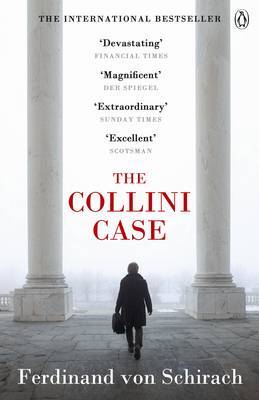 What’s it all about?
In some ways The Collini Case is both really easy and really difficult to describe. A young defence lawyer, Caspar Leinen, gets his first opportunity to appear in court when he is assigned the case of an Italian citizen, Fabrizio Collini, who has brutally murdered a prominent German businessman in one of Berlin’s swankiest hotels. I know how swanky it is because both Michael Jackson and I have stayed there, though obvs not at the same time; it’s just lovely and luxurious. Anyway, advert over, back to the point. Leinin finds out that he has a connection to the murdered man (confusion over names causes this) and tries to recuse himself from the case, but ends up taking it forward and is appalled by what he finds.
Why did I want to read it?
I love courtroom stuff and legal arguments and such like, plus I had read a couple of reviews which made it sound intriguing.
What did I think of it?
This is a book that really grabbed me and I read it in two sittings. It manages to be both very simple and very complex, because it hinges on the motive for the murder and some aspects of German law. I was aware that the author, who is an acclaimed lawyer himself, wrote the book partly to bring to everyone’s attention a particular issue which he felt needed to be addressed, and although the actual details were fascinating the campaigning part of the book (if I can even call it that) was well handled and didn’t get in the way of a tragic and compelling story of the legacy of the Second World War. Anyone who knows anything about that period and sees that the murder victim is an elderly man will probably guess what the murder may be all about but there is so much more to it than that.
This all sounds very cryptic but it’s a really fast and cleanly written story and it’s worth discovering for yourself.
I actually didn’t read that much non-fiction while I was away from the blog, probably because my fuzzy brain was incapable of dealing with anything too complicated. But I did manage the following:
 Nick Hornby’s Housekeeping vs the Dirt and Shakespeare Wrote for Money
These are the last volumes collecting together Hornby’s book columns from The Believer magazine. As I think I’ve said somewhere previously, whether you enjoy these or not will depend almost entirely on whether you like Hornby’s personality (at least as it comes across here) but I definitely do so I was very happy reading  these. After all, this is a man who has been able to articulate why I have never got on with the works of Thomas Hardy, to wit:
Hardy’s prose is best consumed when you’re young, and your endless craving for misery is left unsatisfied by a diet of The Smiths and incessant parental misunderstanding.
It is worth mentioning that I never got The Smiths either.
 Val McDermid’s Forensics (subtitled The Anatomy of Crime)
I love Val McDermid. I am ashamed to say that I have not kept up with her novels but I think she is just fabulous, and I will remedy the book thing at some point (I have at least made a note of what I haven’t read so that i can do the thing.) This was a fascinating book; I can’t resist this sort of thing as my dedication to watching CSI and related shows will testify, and this was a great introduction to the various techniques and how they have developed over time using key historical (and more recent) cases as illustration. So well written, I devoured this in a couple of sittings. You will notice that there is a fly on the cover. It appears in random places throughout the book and I can’t tell you the number of time I turned the page and forgot what it was and tried to brush it off the paper. Idiot that I am 😀


 Bride of the Book God