You are currently browsing the category archive for the ‘Reviews’ category.
 OK, so before I start talking about Barking, which has as its central character (and quite a few of its secondary characters as well) a lawyer (specialising in winding up the estates of deceased persons) I feel I need to point out (given how disparagingly they are referred to throughout the novel) that some of my best friends are lawyers.
Seriously.
Well, two of my best friends, including Silvery Dude who actually got this for me as a birthday present to show that he has a sense of humour (which he has) as well as a reasonable taste in fantasy novels (which he also has). The other lawyer friend has no nickname for the purposes of this blog, but does also have sense of humour as well as a taste for light opera, but that can’t be helped.
In order to put this into a wider context, the rest of my best friends are either accountants or civil servants or (in more than one case) both. Now you can see why I don’t blog here every day, my life is just one giant whirlwind of excitement and really wild things.
Or something like that.
But nothing as wild as what happens to Duncan Hughes in Barking.
So here we have a man who is in a dead-end job doing OK, not yet a partner, divorced and kind of just muddling along, when an old friend from school comes back into his life, teases him away from his current firm (with the help of Duncan’s boss who decides to fire him) and makes him a partner in a rather unusual way. He bites him and turns him into a werewolf.
This is not the weirdest thing that happens in the novel. There are vampires (also a firm of lawyers). There are reanimated people (not exactly zombies). There is a unicorn. And there is the estate of Bowden Allshapes, whose file follows Duncan to his new firm and which has been a constant in his working life for some time. If only he could get the accounts to balance….
This is huge fun, very amusing, well-written with a great story at the heart of it. I’m always a bit wary of comic fantasy; for every great author (Pratchett, Adams) there are lots of misses so I tend to take a cautious approach but I’m glad the Dude of Silver introduced me to this and I enjoyed the whole reading experience very much.
And it’s not giving too much away to say that it has a happy ending.
And the best thing of all is I’ve found a new author to binge on.
 This is without doubt a beautifully written book. I finished it a while ago and have been mulling it over ever since, wondering what I could actually say about it without diminishing what was a truly lovely reading experience.
The Alchemy of Stone tells the story of Mattie, an automaton who has become emancipated (up to a point) and who has trained as an alchemist. It’s a dysfunctional society in which she lives, of Alchemists versus Mechanics, each with their own views on how the city should be run, and an underclass which appears to be rising up to overthrow the existing order.
Mattie treads a fine line between maintaining her independence and the need to find a way to get the thing she needs from the mechanic who made her – Loharri, who, though ostensibly letting her go, still holds the key which winds her heart.
I won’t say any more about the story itself, but it’s worth dwelling on the themes which develop within it.
This is a book about identity, what it means to be free, what it means perhaps to be a person. It’s also about class and oppression, about those who claim to know what’s best, about where women fit in to society, about the nature of difference, and about love. The quote on the cover of my edition says it better than I ever could:
A gorgeous meditation on what it means not to be human
And it has gargoyles.
And a man who absorbs the souls of the dead, who can still speak through him.
It’s steampunk at its best, with a main character of real substance, and an ending that I found moving, heart-breaking but also hopeful.
Seriously recommended. And if you’re not sure just look at Carl’s review here. Which has the wonderful cover that originally drew me to finding out about this book, though I’ve come to love the one on mine more.
I thought this was just lovely and am so glad that I was finally able to get my hands on a copy.
 I have to confess that I’m not normally one for thrillers. Not entirely sure why; it dates to before Dan Brown so I can’t really blame him, and it’s nothing to do with le Carre cos I’ve read loads of his stuff, so it may just be one of those inexplicable things.
But I heard Robert Harris being interviewed on the radio when The Ghost was about to be published and it sounded sufficiently intriguing that I bought it when it came out, and its been sitting on my shelf until I decided that I wanted a break from the beginning-of-the-year-sc-fi-fest and picked it up.
And read it very,very quickly.
So our hero is a ghost writer who normally deals with the scandal-packed lives of celebrities but is catapulted into the world of politics when the man helping a former British Prime Minister write his memoirs drowns after falling overboard from a ferry in Martha’s Vineyard. Said book has a big advance attached to it and so has to be delivered on time. Things get a little more pressured when said PM looks like he’s going to be charged for war crimes in relation to a conflict not a million miles away from what’s going on at the moment. And our hero delves more than he should and finds out stuff that he shouldn’t and, well, it all gets a bit exciting.
I couldn’t put this down. Another book that almost had me missing my stop when I was reading on the train, it’s very well written, well-paced, has you entertained as you try to work out how much of the PM is based on Tony Blair, how much his wife is like Cherie, who the other political figures might be based on. And it was timely reading given that the Iraq enquiry is underway in London at the moment and a lot of the subject matter covered in this story is being openly debated. Well, as open as any inquiry into something like this ever can be.
Polanski has directed the film version which will come out shortly (starring Pierce Brosnan and Ewan McGregor) and I’ll be interested to see how that all works.
Very enjoyable and certainly recommended if you like a political thriller.
 It is a month for favourites – Charles Stross is rapidly becoming one of the authors I leap upon (metaphorically speaking of course) as soon as something new comes out (we have lots of his stuff in the house but I am trying not to gorge myself as he is far too good to be wasted in that way) and Lee Gibbons is becoming one of my favourite sci-fi cover artists.
So Saturn’s Children is yet more space opera with a strong female lead and an extremely interesting premise, so there was no way that I was going to dislike this novel, which is a really good thriller as well as a sci-fi tale.
Freya Nakamachi-47 is a cloned synthetic person, designed to be a concubine for humans, but activated long after the human race has totally died out. The robots, for want of a better word, have built their own society which unfortunately has taken on many of the worst aspects of how humans behaved – rigidly hierarchical with everything from aristocrats to slaves, overly legalistic and potentially very harsh.
Freya gets into trouble on Venus and needs to get off-planet very quickly; to do so she takes on a job as a courier, taking contraband from Mercury to Mars. Of course, this all goes a bit pear-shaped as you might expect, and Freya’s troubles multiply as she tries to find out what’s going on, and in particular who wants to kill her.
I really enjoyed this – it’s very funny in places, the thriller bits are thrilling, Freya is a likeable character in difficult circumstances and the story had a nice pay-off as far as I was concerned. Some of the funniest parts relate to the horrors of interplanetary travel – basically not a lot of fun, takes ages, is expensive and passengers often don’t survive. The variety of robot entities, some more humanoid than others, really add to the offbeat alienness of a non-human society. And there are a number of really cool spaceships.
This is another read for the 42 Challenge, and the Sc-fi experience 2010.
 So where to begin? Let’s start with what it says on the back of the book:
For more than half a century Miss Hyacinthe Phypps has been offering guidance on proper behaviour. It is the publishers’ fondest hope that this book will serve the current generation of young ladies as it served their mothers.
The subtitle for TRDG (as it has become known in this house) is “The Right Thing to Say on Every Dubious Occasion” And all of the occasions covered here are distinctly dubious.
So, you are a young woman stepping over the threshold into adult womanhood, and you need to find something appropriate to say after the event. Miss Phypps has some remarkable suggestions depending on the location of your own particular threshold-stepping moment, some of them rather peculiar but all of them very funny.
At least I thought they were – let’s just say my reaction to this book was to dip in, giggle/snort with laughter depending, and then to read bits out to the Book God.
Of course the main attraction for me was the fact that this was illustrated by Edward Gorey, and the book does reflect the humour of the mid-1960s (originally published in 1965 and has been out of print for a long time) with the male characters tending to be crooners, marimba players and Chinese detectives amongst others, but I was very amused by it and still dip in occasionally when I need to be cheered up.
If you like your humour quaint, tongue in cheek and a little surreal then this might be for you.
Unless you are of a delicate disposition, of course.
Thanks to Bloomsbury for the free book.
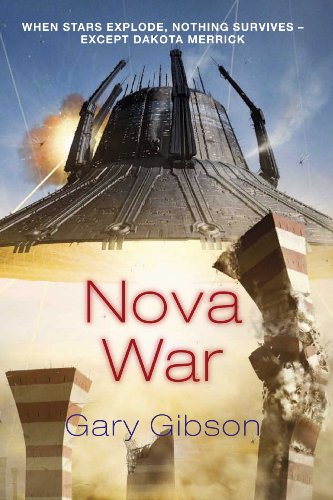 So Gary Gibson was my big find of last year (well, I didn’t exactly find him, I was pointed in his direction by the Book God) and Stealing Light one of my favourite reads. So anticipation was high for Nova War and it didn’t disappoint.
But it’s going to be difficult to review here because it is a straight sequel (part of the Shoal sequence, the third volume comes out later this year) and so any in-depth discussion would give away details of the outcome of the first book, and I wouldn’t want to do that because it was huge fun to read and I don’t want to spoil it for anyone likely to give it a go.
So what do you need to know? Well, it’s a space opera (hurrah! I’m a sucker for those) with a couple of strong central characters, a convincing range of truly alien alien races (the Emissaries being particular favourites for their sheer nastiness), fantastic spaceships, revelations, war, realpolitik and (yay!) exploding suns.
I absolutely loved it from the Lee Gibbons cover to the set-up for book three. I strongly identified with at least one of the main characters (is it too much to say that Dakota Merrick survives from book one ? Probably not given that she is the heroine after all), actually felt a tiny wee bit of sympathy for one of the villains (we find out what was done to him in the past to make him who he is now and it is truly terrible – sympathy doesn’t last that long, though) and just enjoyed the whole big-wide-world-of-spacefaring thing that was going on.
What can I say? I just can’t resist hard SF.
 So, I’ve probably stated elsewhere that I’m not really very good with zombies, they totally creep me out and I’ve tended to avoid them for that reason.
However, I’ve recently begun to find the literary versions rather interesting, starting with Handling the Undead, and now in World War Z.
I think I picked this up on a trip to Forbidden Planet but I’m not entirely sure why; possibly the cover but more likely because I read about it on someone else’s blog and it just sounded like something I would want to read. And it certainly was, because I was totally drawn into the story and ended up cracking through the novel in almost a single sitting.
So this is looking on ten years of fighting a zombie plague (for want of a better description) which has swept across the planet from its beginnings in China, that led to a huge, almost catastrophic reduction in the population of earth, a massive war and a realignment of the planet’s political structures.
For me the huge success of this novel was the fact that it looked back and was structured as an oral history, the sort of thing you see on satellite TV channels every day; people from all walks of life and all affected nations telling their stories. It’s well-written and pacy and has enough gruesomness in it to satisfy the horror fan but without being overwhelming. And the people and stories are credible and not stereotypical, and advance the plot in a convincing way.
And the way the zombie menace spread, the inefficiency of a variety of governments in dealing with it and so on has parallels in today’s world. If you replace “zombie” with bird flu or Ebola and imagine what would happen if something like that got loose in the world, our reaction would probably be something like this – trying to confine it, failing to do so and then panicking before taking quite radical and drastic action.
All without the need to kill the undead with baseball bats, of course.
Really very, very good.
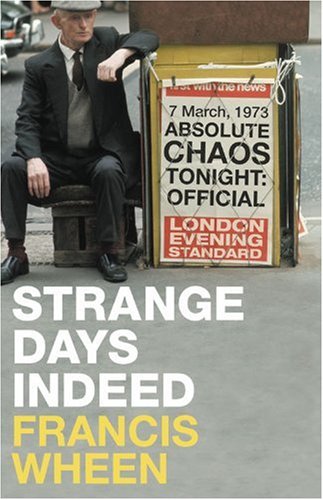 So this is the book that reminds us what the 1970s were really like.
I have to declare an interest here; I was born in January 1962 (I know, I know, who would have thought it), which of course means that I was 8 when the 70s began, and 17 in 1979. My views of the decade are obviously coloured by my own personal experiences, and recently, when people have been a bit sniffy about the era, I’ve rushed to defend it as I remember as a kid having a lot of fun.
And falling in love with Donny Osmond, but let’s leave that for another day…
So I was really looking forward to this, both because of the subject matter (duh) but also because I really, really like Francis Wheen – don’t always agree with him, but he is thoughtful and measured and also incredibly funny. I pestered the Book God to get this for me and devoured it as soon as I could. And it did make me look at my childhood in a very different light.
His theory about the seventies is that it was a time of mass paranoia. The politics of the time were affected by it (thinking of the whole Nixon/Watergate thing as well as what was happening politically here in the UK); there was economic crisis all over the place – and I do remember having to do my homework by paraffin lamp and being in school only every second day for a while because of problems with heating (and actually I’m sure I remember often not being in our school building at all but in a local church hall because it didn’t have oil-fired heating.)
And then there’s what was happening in some African countries (Amin in Uganda in particular, the number of military coups across the continent).
And Wheen’s own bête noire, Uri Geller.
So it did make me revisit my childhood and teenage years, and realise how much effort my parents had put in to make sure my younger brothers and I weren’t affected by what was going on, though looking back from my current position I can see how worried they must have been.
But.
I still think that, for all that went on, the 1970s in western Europe was a pretty good place to grow up and I look back on the fashions with fondness (so much better than the 80s IMHO) and still listen to the music.
But this book sheds light on what was going on in the background, and for that alone can be recommended.
 So I was trying to think how best to describe Bryan Talbot’s Grandville; hummed and hawed about steampunk, alternative history, anthropomorphic animals, played about with a few sentences but couldn’t get it quite right.
And then I thought “wonder what it say on the back of the book?” And that sort of solved my problem for me, cos what the blurb says is:
Inspired by the work of the nineteenth-century French illustrator Gerard, who worked under the nom-de-plume JJ Grandville, and the seminal science fiction illustrator Robida – not to mention Sir Arthur Conan Doyle, Rupert the Bear and Quentin Tarantino – Grandville is a steampunk masterpiece in which Detective Inspector LeBrock of Scotland Yard stalks a gang of ruthless killers through the streets of belle époque Paris.
And you know it would be very difficult to improve on that as a description; the only thing I can add is how wonderful the artwork is, how convincing the animals as characters are, what an interesting perspective it takes on terrorism, and that it’really is quite enjoyably violent in places. There’s a reference to a “hairless breed of chimpanzee that evolved in the town of Angouleme,” menial workers known as “doughfaces” , obviously humans, which adds a little bit of depth to the world Talbt has invented.
I absolutely loved this, devoured it in a sitting as you do, and can recommend it to anyone interested in Bryan Talbot’s work.
This is my first read for the Graphic Novel Challenge 2010.
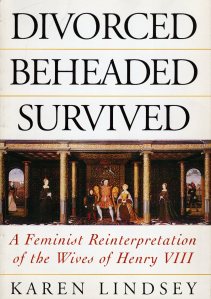 So I had such great plans for reviewing this fascinating book. There are pencilled notes and pages turned down because of quotes or references that I didn’t want to have to go looking for later. And I’ve been pondering what I want to say since I finished the book at the end of last year.
And that’s turned out to be my problem – there is just so much that could be said about this book that I don’t actually know where to start.
Divorced, Beheaded, Survived is Karen Lindsey’s feminist reinterpretation of Henry VIII’s wives, but it also takes into account the lives of his mother, sisters, daughters and some of the other significant women at court to paint a picture of what it was like to be a woman in the Tudor era.
And as you might expect it wasn’t easy, even for those in the privileged position that many of these women held.
In her introduction, Lindsey talks about what drew her to the subject, and the realisation that the modern topic of sexual harassment in the workplace could be relevant here. After all, if you consider being lady-in-waiting to the Queen as a job, then the unwelcome attentions of the King were very much in the harassment mould. And certainly over time the focus of largely male historians has been on poor old Henry having all these wanton young women thrust at him, and under those circumstances what’s a man to do?
The fact that most of these women were positioned at court by their ambitious families hoping that their girl would catch Henry’s eye and attract a good marriage as a former mistress of the King has been, if not overlooked, then certainly not given the prominence by earlier historians that it perhaps should have. But one of the great benefits of women’s studies is that their voices are heard, however faintly.
Those of you who visit here regularly will know that the sixteenth century is the period of history that holds my attention the most, and that is largely because of the women who were prominent in the period – Mary, Queen of Scots, Catherine de Medici, Mary Tudor and my great heroine Elizabeth I. So I found this book totally captivating and thought-provoking. It has given me a new insight inot the life of Catherine of Aragon, and made me want to find out more about Anne of Cleves, who really was the survivor of the bunch.
And lord, if I didn’t know before what a monster Henry was, I certainly do now!
I can’t recommend this too highly if you are at all interested in this period, or court politics, or women’s lives in general. There is much to think about.
And this is my first read for the Women Unbound Challenge.


 Bride of the Book God