
You are currently browsing the category archive for the ‘Reviews’ category.
 Oh Lordy. So, I’m back in that place where I always seem to find myself these days, trying to write a review months and months after everyone else has read the thing and (almost) everyone has loved it and articulated their feelings about it much better than I think I can (I refer the jury to Carl’s review as exhibit number one).
Your view of The Sweetness at the Bottom of the Pie is I think going to depend on how you feel about Flavia de Luce, heroine and amateur sleuth, 11 years old and plunged into a murder investigation when the body of a man who may or may not be known to her father is found in the cucumber patch. Given that Flavia’s mother died when she was very young, her father is her only family apart from her two fairly odious sisters, so she naturally sets out to get to the bottom of the whole thing.
We are in 1950’s England, recovering from the Second World War, and Flavia is part of a family fallen on hard times and living in a mansion that has seen better days. She has a remarkable chemistry lab which sounds fabulous (even though I don’t do smells), her father is obsessed with his stamp collection (can understand that, I drool over my own occasionally) and their household staff are pretty odd but very loyal.
The plot is irrelevant in lots of ways, though it is fairly enjoyable and although I suspect there are several plot holes I quite happily went along with it all simply because, precocious and faintly unbelievable though she may be, I really liked Flavia.
Like my other read-a-thon books this probably benefitted from being read in a sitting (more or less) and it certainly got me through to the wee small hours. Looking forward to the sequel which is probably out already but I’m saving for later in the year.
 Annabelle is a small rag doll who doesn’t know whether she is the cause of or merely a witness to the suffering of those people into whose possession she falls.
For suffering and misfortune are certainly all around her, and try as she might she cannot always warn or protect the innocent.
Or something along those lines.
Nightmares and Fairy Tales: Once Upon a Time is a creepily inventive little book of new horror stories and twisted re-tellings of fairy tales, all in graphic form. Wicked nuns, cruel parents, and even poor old Cinderella get the full treatment.
The only thing that saves this from totally over-the-top-grisly-goriness is the fact that it’s in black and white, but it’s still fairly horrible. And therefore right up my street!
This was my fifth read for the 2010 Graphic Novel Challenge, and did a lot to keep me awake during read-a-thon (largely cos I was too scared to sleep……..)
 It’s actually going to be quite difficult to review Anthropology, a book of 101 short stories, each just a page long and all about love in its various aspects and all narrated in the first person.
The stories are arranged in alphabetical order, so we move from Anthropology (where he explains how he lost his anthropologist girlfriend to the culture she was studying) to Words (about what keeps a marriage together). Some of them are very funny, some of them rather sad, but they are all little gems.
This was another read-a-thon book, and again I read it in one sitting. Looking back I wonder if that was entirely wise and whether some of the stories lost their impact because I read the book like a novel. It made me wonder what the best way to read short stories actually is.
I remember listening to Simon Mayo’s book review podcast ages and ages ago when he was interviewing (I think) Anne Enright and the subject of how to read stories came up. The two approaches discussed were reading one, savouring it and closing the book, as opposed to doing what I’ve just done. Someone compared it to how you might eat a box of chocolates, and I suppose I just have to confess that I handle both the same way – once that box is opened I very rarely have the self-control to just have one chocolate….
I’m going to look for some more Dan Rhodes as I really admired his style, and as a bonus they all seem (like this one) to have a fabulous David Roberts cover illustration.
 Finally getting around to reviews after another (and not yet finished) busy period at work, and of course all the excitement of the UK General Election (which is still distracting me from other things – as a civil servant I am keen to know who my next set of bosses is going to be….)
All this means that I’m not reading as much as I should – I often go through these patches driven sometimes by not being able to find something that I’m interested on reading just at that particular point, but more often (as now) just not finding the time to read regularly.
So, After the Armistice Ball by Catriona McPherson is a detective novel in the classic style, set in 1920s Scotland and is huge fun. In terms of plot, there’s a bit of a scandal brewing amongst Dandy (short for Dandelion) Gilver’s social set when some valuable diamonds are stolen after the eponymous ball. Asked by her friend Daisy to do a bit of sleuthing she gets pulled into something much darker when Cara Duffy, the youngest daughter of the diamonds’ owner dies in a fire in a remote cottage, and it becomes clear that this might not have been an accident.
Which is about all that can be said without giving away too much of the plot. It’s well-written, pacy, has a nice sense of location and time and an attractive heroine who is easy to identify. This was my first read-a-thon book and so benefitted from being read in one sitting, and I enjoyed it so much I’ve already bought the second in the series.
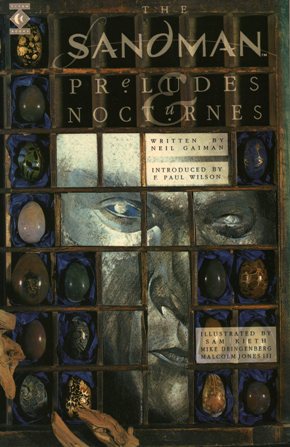 Signing up for the 2010 Graphic Novel Challenge gave me the perfect excuse (in case I really thought I needed one) to re-read the Neil Gaiman Sandman series from scratch, alongside the fascinating-and-occasionally-dipped-into-but-never-properly-read Sandman Companion by Hy Bender. And of course you start at the beginning, with Preludes and Nocturnes.
The thing about the need for an excuse is that my TBR pile (which with my tendency to be unable to avoid buying books plus all the stuff the Book God has in his possession) has actually become a TBR room, if not taking over the whole house, and so any re-reading has to be carefully thought through because there are just so many new(ish) books waiting for me to pick them up.
This is a problem that will not go away for two reasons:
- the Book God and I currently have a combined age of 106, and if you assume that we both started buying our own books as teenagers (let’s say arbitrarily 15) then that’s potentially 76 years of book buying
Which brings me to reason number 2:
- I am constitutionally incapable of getting rid of anything vaguely book shaped. At all. So I almost certainly have just about everything I have bought since I was a teenager
So you can see my problem.
Nevertheless the draw of Sandman was irresistible and I ploughed on, really enjoying the opportunity to get back inside a world that I have always enjoyed. And then another issue hit me – how do I review this? I mean, I can’t really review this as if I have come to it fresh, because I haven’t, and it is such a well-loved series and so many other bloggers have written about it all so eloquently. So I’m not going to attempt the feat at all.
I love it still, and if you haven’t read the series I urge you to have a go.
———–
I’ve also had a couple of relatively rare outings this week (I don’t count cocktails with Silvery Dude and friend on Wednesday because in my simple little mind that’s the sort of thing I should be doing every day); no, this is proper going out for the evening stuff, involving:
- on Thursday, the Birmingham Royal Ballet performing Sleeping Beauty at the London Coliseum – wonderful stuff with costumes based on the court of Louis XIV and a classic fairy tale on stage the way it should be done
- on Saturday, The Lord of the Rings: Two Towers at the Royal Albert Hall, with the full score performed live by the London Philharmonic Orchestra – and lovely to see Howard Shore, the composer, take a bow at the end.
And then home to Dr Who and River Song. What more could a girl want?
 So having enjoyed volume one (reviewed here) and just so happening to have volume 2 kicking around the house for some strange reason, I decided to leap straight into the world of Fables once again with Animal Farm.
So after the fall out from the events of volume 1, not to be discussed here in case there is someone out there who has been even tardier than me in coming to the series, the Fabletown Mayor, Snow White, is heading upstate from New York for her annual visit to the Farm. This is the property, hidden by a glamour, where the non-human fables can live away from the prying eyes of the “normal” world. So we have the Three Pigs, Goldilocks and the Three Bears, a few dragons and sleeping giants and so forth.
But all is not well; these fables want to take their homelands back from the Adversary, and are fomenting a revolution in order to do so, led by a very different take on Goldilocks than you would have seen before. Can Snow White stop them, and who can she trust to help her?
If anything this was even more fun than the previous story, with some well-known characters from literature (Shere Khan and Baghera, anyone?) involved, plus who could resist animals with weapons? Not giving away what happens but the fable approach to justice is brutal if necessary.
And you have to feel a bit sorry for Colin the Pig.
Will definitely be continuing to follow this series.
This was my third read for the 2010 Graphic Novel Challenge.
 Well, bit of a blogging hiatus as I recovered from the fun-packed-but-tiring read-a-thon with a mountain (well, small pile) of reviews to catch up on both here and over at the Screen God blog. Plus work has been really busy so not reading much that’s new.
All very feeble excuses but the tide is about to turn, and I’m going to start with Bill Willingham’s Fables:Legends in Exile, first in a graphic novel series which is hugely popular in the blog world, and to which I have come, as always, as a late adopter.
So the land(s) of the fairy tale and other legends have been taken over by the minions of the evil being known (so far) only as The Adversary, and they have all been driven out to live alongside us normal folk (well, in New York) in their own environment of Fabletown. And there has been an apparent murder, so the question is who killed Rose Red?
This is really great stuff if you like the idea of a world ruled by King Cole, where Snow White is the Mayor and the Big Bad Wolf (in human form) is a private detective. The mystery isn’t really the point though it’s a good way to get immersed in the world of the fables.
So in summary, a good story, strong artwork and a nice premise makes for an enjoyable read.
And I went straight onto volume 2 which I’ll review shortly.
This was my second read for the 2010 Graphic Novel Challenge.
 So, back in January February I posted on Francis Wheen’s most recent book, which was all about the 1970s. Mumbo-Jumbo was published in 2004, I think, but could be considered as a sequel since it covers the period from 1979 (using the election of Mrs Thatcher and the return of the Ayatollah to Iran as his starting point) to something very close to the present day.
And although as alway this is well-written and makes loads of really good points about the way the world is, I found it much less entertaining and more difficult to get into than Strange Days.
And I think I know why.
You see, as I’ve mentioned before, I turned 17 in 1979 and left home to attend university. So the period that is covered by this book is the one where I grew up and established myself as an adult, so a lot of the things he covers are just so depressing and take me back to a period (especially the 1980s) that I just found dispiriting and awful. At least during the vast majority of the 1970s I was too young to understand the gravity of what was going on in the world, but you couldn’t miss it in the early 80s even if you wanted to.
Wheen’s main point, which I largely agree with, is that the Enlightenment was a good thing, in terms of how it looked at the world and the traditions of scientific enquiry and liberal democracy which it fostered. But since the 80s the world has, for all sorts of reason, moved away from those principles and operates on the basis of celebrity culture, dodgy economics and “moral confusion”, and this is generally a bad thing.
It’s just that for all his humour in approaching these things, what underlies it is so bleak in some respects that the (occasionally extremely funny) jokes ring a bit hollow to me.
So, well-written and clever but perhaps it’s all still to close for comfort to be genuinely enjoyable for me.
 This is an interesting one.
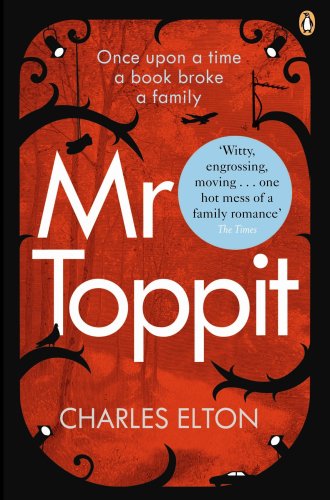
Mr Toppit is the story of the impact of a series of children’s books on the family of the author, Arthur Hayman, after he is run over by a cement lorry when walking in London. The story is mostly told from the point of view of his son, Luke, who has been immortalised in the books as Luke Hayseed (the series is known as The Hayseed Chronicles) . The novel follows Luke, his mother, sister, and Laurie, the American woman who was with Arthur when he died and for reasons of her own takes up the cause of the novel when she gets back home, and kick starts a publishing phenomenon.
Which doesn’t really tell you very much about the story at all. And it is a difficult novel to summarise or explain, and part of that is that I went into it expecting one thing and actually got something else. I blame the blurb, myself. I have long enjoyed (if that’s the word) trying to match the puff on the back of a book with what’s inside; most of the time it’s all fine, but on occasions they do diverge and that can sometimes affect how I view the tale itself.
So, the paperback cover says
buried deep inside the books lie secrets that begin to shake the Hayman family,
which reads to me that a major mystery will be divulged, and (without giving anything away) that really doesn’t happen. Or maybe the secret that does emerge, while sad, isn’t really a life-changing thing and is a bit anti-climactic.
And it’s a shame, actually, because what you do get is an entertaining and, on occasions, funny story about what happens when something takes on a life of its own in popular culture; when a series of books gets away from the ownership of the person who wrote them and the family he based them on; when people get so attached to something that they feel they are its custodians and know the author’s intentions better than he does; and when people who are looking for something missing in their own lives adapt what they read to try to fill that gap.
I enjoyed reading this; it’s not a great novel by any means but its entertaining, and has some amusing insights into the world of publishing and show business, though to be fair I’m not involved in either of those worlds so it could all be wildly off-beam, but it seemed convincing to me. I particularly liked Luke himself, coping as best he can with a life he didn’t want and a connection with a character which doesn’t really reflect him at all.
My only quibbles are that the big secret isn’t that big; Laurie’s subplot really doesn’t go anywhere; and it sort of ends suddenly without really reaching any kind of conclusion. It also seemed a bit timeless; I think it was set in the 80s but it felt like it was actually set in the 60s, and I found that a bit disorienting.
But I wanted to know what happened and so finished the second half of the book in one sitting, and you can’t say fairer than that, can you?
 OK, so I know I’ve come to this one so much later than everyone else, but if you read this blog regularly then you will have worked out by now that I have never really been an early adopter (of anything). Add to that a natural reluctance to be reading something at the same time as everyone else and you get an inkling about why it’s taken me so long to pick this up.
In fact, my resistance was so strong I wasn’t even going to buy this as I thought it couldn’t possibly live up to the hype, and it was the Book God who brought it into the house.
A little bit of context on the reading experience. As I’m sure I’ve said before, for all sorts of reasons I do most of my reading on the train to and from work, and this is how I started The Girl with the Dragon Tattoo. Then Oscar weekend came along, and I planned to pull an all-nighter (succeeded, too). However, I have to recognise that I am getting on a bit and the whole staying up all night thing is not as easy for me as it used to be, so in addition to taking a day off on the Monday to recover, I decided to take an afternoon nap. I am not a natural napper; I don’t really like sleeping during the day and find it difficult to do so unless I am ill. So I decided that I needed something to read as a way of lulling me towards a natural, relaxing sleep.
Bad move.
I had read as far as page 149 in my copy. By the time I decided that I probably should move I had actually read the remainder of the book, that’s around 365 pages. In one afternoon. Can’t remember the last time I did that, but it tells you something about the power of the story.
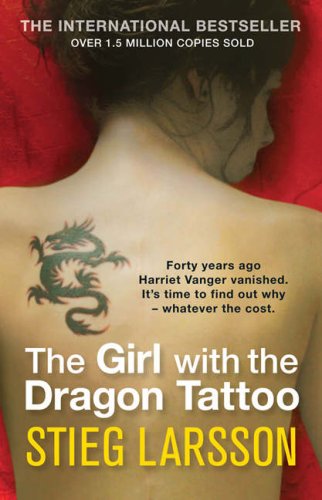
So, plot synopsis very briefly in case there is anyone else out there who hasn’t had a go at this. Crusading journalist convicted of libel steps back from his day job and takes on a private commission, ostensibly the history of an industrialist’s family but actually an investigation into the disappearance and likely murder of said industrialist’s niece, probably by another member of the family. Throw in titular investigator, a young woman with, I think it’s fair to say, issues and you have a really enjoyable and gripping, if occasionally unpleasant, thriller. Don’t mind unpleasant, myself, so not an issue.
As a story it really tanks along at great speed. I never know how to judge translations (I don’t speak/read Swedish though I know a man who does) so can’t say how this stacks up to the original, but I thoroughly enjoyed it.
The Book God has now got his hands on the first sequel so I’m sure I’ll be revisiting these characters later in the year.


 Bride of the Book God