
You are currently browsing the category archive for the ‘Reviews’ category.
 The Girl Who Played with Fire is the second novel in Larsson’s much-praised Millennium trilogy, and pick Lisbeth Salander’s story up some months after the events of The Girl with the Dragon Tattoo (which I talked about here).
It’s always difficult to talk about the plot of a book which is part of a series and I suppose theoretically could be read as a standalone but does really need some knowledge of its predecessor to really make sense.
Suffice to say that Blomkvist is now a major celebrity and Lisbeth is no longer in touch with him. Because of stuff that happened in the previous story some nasty people are out to get Lisbeth, and this leads to her being suspected of murdering three people. So the bulk of the story covers her on the run while trying to find out what’s going on.
Separately, Blomkvist is trying to clear Lisbeth’s name; two of the victims were friends/colleagues of his and he doesn’t belive Lisbeth committed the crime (though interestingly enough not because she isn’t capable of doing so). It’s her capacity for wreaking revenge on those who have treated her badly or offended her very personal moral code that makes her such a compelling character.
It’s all very grim, with strong violence particularly (but not solely) against women – the original journalistic investigation which kicks all of this off is about sex trafficking, continuing the theme of the exploitation of women as a hidden facet of Swedish society which characterised the first book.
In the end, how you react to this will depend on your stomach for the subject matter and whether you warm to the character of Lisbeth. I thought this was a very powerful story with some quite appalling events and revelations at the end of the book which mean that I will definitely be picking up the final volume in the series.
 Jane Smiley’s Duplicate Keys is part of my summer of re-visiting previous reads.
I first picked this up and read it in March 1997 (astonishingly) and this is my third time of reading. I absolutely love this novel with a passion and will be hard-pushed to explain why but am going to have a pretty good stab at it.
Firs a quick trot through the basic story. Alice is part of a group who moved to New York in the late 1960s/early 1970s following their friends Craig and Denny hoping to make it in the music business and although things hadn’t turned out as planned they have settled there. We are now in the early 1980s and Alice visits the apartment of her friend Susan (away on a trip) to water the plants and make sure all is OK, and finds the two musicians shot dead. The novel tells the story of the impact of the murder on the group and, of course, is all about finding who the killer is.
So much so traditional thriller, but this really clicked with me:
- I absolutely fell in love with the cover (I can be funny that way)
- I really, really like Alice – she is ordinary but actually rather brave in her own way (I’ve tried to think over the years who might best play her in a movie version of this but can’t think of anyone) – she is one of my absolutely favourite female characters
- the initial impact of the murder on Alice is seen at a slight distance – we aren’t with her when she finds the bodies of her two friends but pick the story up as she talks to the investigating detective, and I liked that detachment at the start
- the novel says a lot about the mindset of a certain 60’s type – trusting people who seemed like themselves to the extent of giving out keys to their apartment – to the point that Susan has trouble telling the police who might have been able to get in
This works really well as a thriller but is also a fascinating study of friendship and how it changes over time. The 80’s setting seems slightly historical now but of course this was a contemporary thriller and I wished I’d read it when it came out (it was published in 1984, the year I got married the first time).
This really is one of my favourite books.
 I always find it difficult to review a biography; I think if you are really going to do it justice you must have some understanding of the subject at hand, and by that I mean the substance of the person’s life. In this case we are talking about Duncan Grant, Bloomsbury figure and a major artist of the 20th century. And this is where I have to declare that although I know quite a lot about Bloomsbury (a mild obsession since picking up my first Virginia Woolf novel when I was a student) but not very much at all about the art world, which is what made this such a fascinating read.
So because of the reading I had done before I knew roughly where Grant fitted in terms of time and style, and his life does cover a period of significant change n the art world – as it says in the blurb, we are talking about a life that spanned Alma-Tadema to Gilbert & George. What I don’t know anything about are the technical aspects of painting, and although I’m sure I missed a great deal of the significance of the technical discussions I certainly didn’t feel horribly left behind, or indeed talked-down to.
Of course when it comes to a member of Bloomsbury then the private life is bound to be absolutely fascinating and that is very much the case here as you would expect. Again I knew a lot about Grant up to the point of Vanessa Bell’s death but afterwards was a bit murky, and the biography was very revealing about his family life and wider circle, his passions and friendships.
So, all in all a very worthwhile and absorbing read, with a great deal of information being passed on but never feeling that the reader is being talked at.
This was my first read for the Art History Reading Challenge.
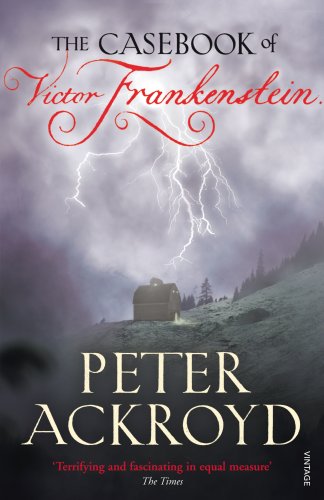 So this is a recommendation from Silvery Dude for which he does need to receive full credit as it was a really good read; bought last year and dragged all the way to Scotland and back during my annual holiday so that I could totally fail to read it as part of last year’s RIP IV challenge, but definitely worth waiting for.
And I say this as someone who has a bit of a love/hate relationship with Peter Ackroyd, though to be fair it’s currently waited heavily on the love side, if only for his masterful biography of London.
Anyway, The Casebook of Victor Frankenstein is exactly what it says on the tin; it’s Frankenstein’s own version of his experiments and their outcome with particular emphasis on those close to him. So much so normal revised version of old story, but this has a couple of interesting aspects to it which made it more than just another retelling of something familiar.
There is the standard mix of fact and fiction, so we get to meet Shelley, Mary Shelley, Lord Byron and Dr Polidori. But most of the experiments take place in and around London’s East End rather than on the continent. We have resurrectionists bringing whole corpses rather than the body parts sewn together thing so beloved of old movies. We have stuff about doppelgängers, split personalities, cutting-edge scientific experimentation taken to its limits all explained by someone who can at best be described as an unreliable narrator.
It has a wonderfully creepy and unsettling atmosphere which wasn’t lost on me despite the fact that I read it mostly in balzing hot sunshine rather than howling autumnal wind and rain which might have suited it slightly better.
I will say that I was slightly thrown by the end which, though it makes sense when you look back at the novel seemed to happen very suddenly. But that shouldn’t take away from what was a really good story well told.
 I always struggle a little bit when reviewing non-fiction books because I guess you either accept the author’s point of view/thesis/whatever or you don’t. So this will no doubt be a bit waffly (why break the habit of a lifetime, I hear you cry)
So I’ve had this book for ages and just never got round to reading it until Silvery Dude mentioned that he had heard Malcom Gladwell speak at some work-related event and that it had been hugely interesting, and that was just the spur I needed to pull this off the shelf and have a go. But please note for the record this is not a Silvery Dude recommendation….
The Tipping Point tries to explain why some things just seem to take off in unplanned or inexplicable ways, and uses a whole range of examples to explain why that may be the case, from sexually transmitted diseases to preferences in footwear to children’s TV programmes.
And I must admit I found it all pretty persuasive – the idea that epidemics can occur in more than diseases (if that makes sense and I’m not sure that it does), the idea that there are certain types of people who can influence responses simply by the way they behave or their own particular personality traits, and so on – it all began to make sense.
But I have to confess that the thing that stuck with me the most took only a page to discuss, and that was the effect on your personality of the order in which you were born. Full disclosure here; I am the oldest of three born across a six-year spread. I’m the only girl and my youngest brother was born on my 6th birthday. I’m not bitter (actually I am still seething quietly 42 years later).
But that’s not the point (well it is the point but not for the purposes of this discussion). The actual point is that all my life I have read that being the oldest makes me naturally domineering and conservative. Which isn’t me at all (well, I don’t think so anyway). What Gladwell points out (from work done by another sociologist) is that this is only true within the actual family; when with others we are no more likely to behave that way than anyone else.
I was quite pleased to read this, and felt mildly vindicated. Though the Book God pointed out that this means that my bossiness must be rooted in something else.
An unhelpful statement at best.
So all in all this was a fascinating read, and like the best books dealing with cultural behaviour it all seems like common-sense when spelled out. But none the worse for that.
 I can announce quite happily that my reading slump is finally over, but what that means is that I now have a nice stack of reviews for both here and the Screen God blog that I need to catch up on (grammatically incorrect I’m sure but too hot to think of an alternative).
But I have an excuse (I think) and it’s not my normal gosh-I’ve-been-so-busy-at-work-poor-little-me nonsense. No, this backlog is all because of a hectic social life which has seen lunches and cocktails and catching up with friends before they go on holiday all having taken place since last Sunday. There won’t be another week like it until Christmas, mark my words.
I like excuses like that, it sounds like I know how to have a good time. Which I do, I just don’t get the chance to do it all at once. Anyhow, enough of all this nonsense.
First on the review pile is the latest Christopher Fowler, namely Bryant & May off the Rails. Now, it isn’t that long ago since I read and reviewed the previous book in the series (see here) and I normally don’t read sequences close together because I’m always afraid that I will somehow lose interest, but in this case I was really keen to get my hands on this because the events follow on almost immediately from the previous story and I wanted to know what happens.
And it doesn’t disappoint, building on what’s gone before, developing the character of the enigmatic Mr Fox, and throwing in loads of absolutely fascinating information about the London Underground. As before, not going to discuss the plot as I don’t want to spoil it for anyone but as always I really, really enjoyed this. Not terribly eloquent as a review, but that just shows what too many Cosmopolitans can do to a woman; although I’m not entirely convinced that there is such a thing as too many Cosmopolitans, but that may be a Scottish thing.
And behind the curve as always, I discover that I’m one of the last to know that Mr Fowler has his own blog which is really worth reading; you can find it here.
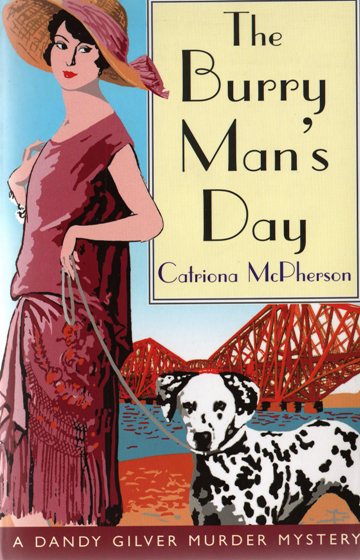 So, having read the first Dandy Gilver mystery (as reviewed here) and fallen in love with it, it seemed the natural thing to do to read the second as a way of getting myself a little further out of my current reading slump.
The Burry Man’s Day finds Dandy in Queensferry where an old schoolfriend and her American husband have come into their inheritance (a rather nice castle-type dwelling with attendant estate). With this inheritance has come some obligations around the annual fair – judging various competitions, awarding prizes and so on – and Dandy and her other friend Daisy are there to assist.
One of the highlights of the fair is the Burry Man – a sort of Green Man type character wearing a costume completely covered in burrs (hence the name) who progresses through the town collecting pennies and/or shots of Scotch to bring good luck to the town. Unfortunately said Burry Man drops dead at the end of the day and the big question is, of course, was it murder?
Step forward Dandy, who calls in her “Watson” from the first book, Alec, to assist.
I enjoyed this very much. There was sufficient uncertainty about whether there had been foul play to keep it going, and I liked the fact that Dandy did try to remind everyone that, though there may be a mystery about some of the actions of key players, that didn’t necessarily mean that murder had taken place. I thought the solution was plausible, but my only quibble is with the very end, which I did think was a bit far-fetched. But to be fair it didn’t spoil the remainder and did show (if it needed to be repeated) that the effects of the First World War were deep and far-reaching.
Still fond of Dandy, so much so that I’ve bought the three other books in the series so far, and will enjoy working my way through them over the summer.
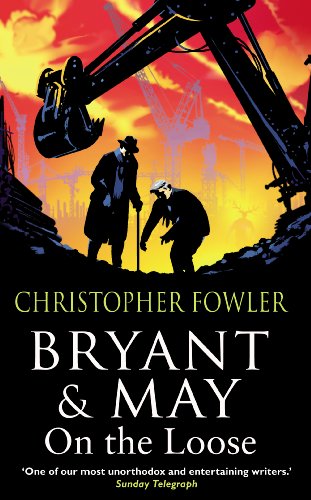 Another excellent entry in the Bryant & May series, On the Loose finds the Peculiar Crimes Unit disbanded and our protagonists looking for a new purpose, or possibly just having to accept retirement. But the finding of a decapitated body in a freezer in a derelict shop in King’s Cross leads to the unit being unofficially reconstituted and as more headless bodies are found it becomes clear that something very strange is happening in this part of London. And the authorities want it all kept quiet, hence turnign reluctantly to the PCU.
This is great stuff; I’ve always been a fan of this series and one of the great pleasures of the books is the way Christopher Fowler feeds in the history and mythology of London. Now, I’ve lived here for over twenty years and don’t profess to know huge amount about the city but one of the things I do know is that it is an ancient and fascinating place and there is still an air of mystery about certain parts of the city, and it is tapping into this which gives the Bryant & May books such depth.
You wouldn’t think that an area as seemingly prosaic as King’s Cross, with its major stations and regeneration programme would fit the bill, but digging up a place can reveal some interesting elements of the past, and the idea that change can lead some people to get in touch with history and use it to their own ends is really plausible. So the idea that the personification of an ancient myth (in the shape of a half man half beast with antlers constructed from knives) can be terrorising the workers on a construction site isn’t really that far-fetched, especially when you consider that many of those workers come from eastern Europe where some of these traditions are still very evident in everyday life.
So not much more to say about the plot (don’t want to give anything away) but the villain of the piece is a very interesting character and the ending sets up a sequel very nicely. And I read this just in time for the next one (Bryant and May Off the Rails) which comes out towards the end of the month.
So, one of the best of the series and very, very enjoyable indeed.
 So I may have mentioned before that I have been in a bit of a reading slump recently, but that seems mainly to be about fiction. I am solidly working my way through a number of non-fiction books at the moment, and the first I’ve finished is It’s Only a Movie by the one and only Mark Kermode.
Those of you who wander over to my other blog will know that I love movies and one of the critics whose opinions I pay most attention to (even though I don’t always agree with him) is the Good Doctor Mark Kermode. His Friday afternoon reviews with Simon Mayo on Radio Five Live are a real joy and the podcast is one of my Saturday morning rituals. So good fun to read his memoir, subtitled “reel life adventures of a film obsessive”.
It has all the great stories that those of you who follow the Good Doctor have heard before (his brush with Helen Mirren who took him to task for saying The Queen wasn’t a proper film, Werner Herzog being shot while Mark was interviewing him, and so on), plus some new stuff that I hadn’t come across before (the trip to the Soviet Union to visit the set of Dark Waters). The only thing missing are the great rants about films he doesn’t like (Pirates of the Caribbean a special favourite) so if you can search these out on YouTube or elsewhere because when he’s in full flow there is nothing more wonderful.
It’s difficult to review this – I thoroughly enjoyed it, one of the few books I could be bothered trying to read while standing up on my daily commute, precariously balanced but any man who
grew up believing that Planet of the Apes told you all that you needed to know about politics, that Slade in Flame was a savage expose of the pop world, and that The Exorcist revealed the meaning of life
deserves to be listened to.
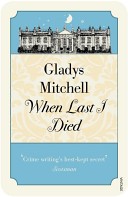 So I want it noted for the record that I love Gladys Mitchell, and have done so for years. I read my first one (The Mystery of a Butcher’s Shop – my old paperback has an absolutely hideous cover) in 1991 and was sad to see them go out of print, despite quite a good BBC adaptation starring Diana Rigg, who was brilliant in the main role despite being far too glamorous for the character.
However, chuffed to see that Vintage is bringing the novels of the Great Gladys (so named by Philip Larkin) back and grabbed the opportunity to pick up one I hadn’t read before as a way of rounding off the read-a-thon.
First published in 1941 When Last I Died kicks off with Mrs Bradley visiting a reformatory school where she has been asked to consult as a psychologist on behalf of the government. She subsequently takes a house on the coast to give some of the boys a chance for a break from the institution, and once they’ve been packed off she spends some time there with her grandson, who finds rather an interesting diary. The diary’s author (now dead) used to work at the same reformatory and was once accused of murdering her aunt. This is the starting point for a mystery involving haunted houses, investigations of the paranormal and missing schoolboys.
And I absolutely loved it. Really satisfying story, clever plotting and Mrs Bradley is a gloriously grotesque character. Suspect I will be building up my collection over the next few months.


 Bride of the Book God