You are currently browsing the category archive for the ‘Reviews’ category.
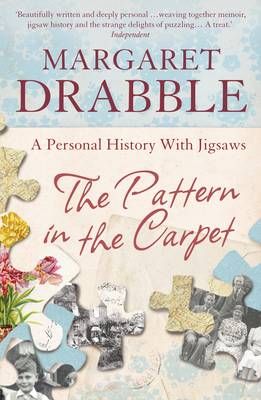 I really did mean to blog about this ages ago but got caught up in other things as explained in recent posts, but I’m really keen to write about it now in case you haven’t come across it yet, because it was so absorbing.
Pattern in the Carpet is subtitled “a personal history with jigsaws” which is a lovely description of a wonderful, ostensibly rambling but actually probably very carefully constructed book.
And it’s important to say that I really enjoyed this book and dashed off to a cupboard in my study where I believe my own collection of jigsaws are stashed but couldn’t actually get to them because of other stuff.
Margaret Drabble is very clear what’s important to her about the toys/games/pastimes/whatever you call them:
one of the reasons why the jigsaw appeals to me, as I have already suggested, is that it is pre-made, its limits finite, its frame fixed. […] It can’t be done badly. Slowly, but not badly. All one needs is patience. […] in this aspect , the jigsaw is the very opposite of the novel.
It’s a book full of learning, reminiscences, anecdotes and the kind of information that I absolutely love to store away and drop into conversation and (if I’m ever invited) pub trivia quizzes. Such as the fact that Paternoster Row, which used to have lots of bookshops, was “wiped out in all but name on the night of 29 December 1940, along with six million books.” Six million books, can you imagine?
There is a great deal about children’s education over the centuries and how jigsaws came to be, but in the end she feels that she “has strayed far from my plan , which was to write a brief illustrated history of the jigsaw puzzle.” And I’m glad she did because this is so much richer being as much I think about memory and family as anything else.
There is so much to this book and I can’t recommend it enough. I’ll finish with my favourite quote which is about Margaret Drabble’s father:
I don’t know whether or not he believed in God, but he would certainly have liked to be able to do so, and he behaved as though he did
Please give this a try.
 The Winter Ghosts was my first experience of Kate Mosse, though I have both Labyrinth and Sepulchre somewhere in the stacks but just haven’t got round to them yet. I may have been slightly put off by comments from friends that her writing style wasn’t great and although I don’t usually pay attention to that sort of thing (our tastes are all different after all, and sometimes a story transcends the style in which it was written) it possibly prevented these floating to the top of the TBR pile.
However, I was looking for something reasonably short and suitably wintery to lug around in the old handbag to read on the commute, and this seemed to fit the bill.
So the story is that Freddie Watson is on holiday in the French Pyrenees in winter. Even though its 1928, he is still mourning the loss of his older brother in World War I; he’s emotionally paralysed by his grief, compounded by the fact that his brother’s body was never found so for a long time he didn’t accept that he was dead, and so ended up in a psychiatric hospital. But here he is, after the death of parents who don’t seem to have loved him as much as their dead son, trying to achieve some semblance of normality.
But he hears voices in the mountains, and on a lonely road in the middle of a snowstorm he crashes his car and has to take refuge in a small village where at a feast to mark St Etienne he meets a young, beautiful but sad woman and unburdens himself of his grief and escapes with her when strange events begin to unfold. And of course in the morning he finds himself in his room with no sign that he had been anywhere the night before, and no-one knows who the girl was. A mystery to be unravelled – will he solve it and bring peace to the village and himself?
Of course he will.
I actually rather enjoyed this. It had a nice atmosphere, the story was nicely book-ended and it does have a basis in historical events in the area. It was a nice melancholy read for a dark night; I read it over two sittings and might have enjoyed it more if I had been able to read it all in one, as the atmosphere builds nicely and can get lost if you take a break. It’s not ground-breaking and the central mystery about the girl isn’t in some respects a mystery at all, but the tension where it exists is all about Freddie – will he get to the bottom of things and will it help him?
So on the basis of this I’m going to give her other works a go this year (though having looked at some of the reviews on Amazon I may have to manage my expectations…)
Update: this is part of the TBR challenge – the book has been on my stacks since November 2010.
 The first book to be finished in 2011 though it was very much the last read of 2010 and a chunky one too. But also absolutely fascinating and I found myself reading large sections of it in each sitting.
In common with a number of women, Vere Hodgson began to keep a diary when war started, partly to record her own impressions but also to share with members of her family abroad so that they would have news about what was happening on the Home Front. She describes it as:
a diary showing how unimportant people in London and Birmingham lived through the war years 1940-45 written in the Notting Hill area of London
Vere originally came from Birmingham but lived in London where she did welfare work for a private organisation which meant that she was exempt from the conscripted war work that caught up so many other women. Her descriptions of the impact of the Blitz are very vivid as you might expect, and her curiosity about the aftermath of some of the attacks took her on walks throughout London to see what had been damaged and what was still standing. It might seem a bit odd (if not slightly ghoulish) to go off and see where homes and business premises had been destroyed, but in one way I can understand that in a period where rumours about what was gone and what was still standing abounded, going to find out for yourself (if you could) was probably an effective coping mechanism.
Some of the descriptions of her walks are hugely interesting to me; I spend quite a lot of time on business in the area around London Wall, Cheapside and St Paul’s where so much was destroyed, and I work close to Holborn which was again badly hit, so (with a little bit of thinking) it is quite possible to imagine myself standing alongside her.
As the preface says, she can be a tiny bit pompous on occasion and her uncritical admiration of Churchill and De Gaulle jars a little, bit but her descriptions of rationing and fire-watching, trying to travel to visit her family in Birmingham, the sheltering from the bombs, the lack of sleep but also the camaraderie with her friends and colleagues gives a really rounded picture of what it was like during those five years, and is well-worth reading.
Part of the TBR challenge – this book has been on my shelves since I received it as a Christmas present in 2004.
 So if I was a lazy blogger I would probably just link to Raych’s post here and sit back because everything she says is absolutely right. But I do have stuff to say about this book and so will ignore my laziness and do the blogging thing.
Alexia Tarabotti has no soul (hence the title), which only a few select people know (and that doesn’t include anyone in her family). This lack of soul makes her unusual even in a Victorian society which accepts the existence of vampires, werewolves and ghosts. It also means that she can neutralise the supernatural abilities of others simply by touching them, which comes in pretty handy (pun unintentional).
The great fun of this book is its tone, which is very arch (to use an old-fashioned phrase). Actually, I could go further than that and say quite honestly that the novel is basically hugely enjoyable tosh. It has all the necessary elements:
- feisty heroine who knows more than everyone suspects but whose talents aren’t recognised;
- the handsome hero with whom she spends the whole story fighting but you just know she’s going to end up with him in huge romantic moment at some point;
- sidekicks with varying levels of acceptability;
- a nefarious plot which could represent the end of civilisation as it is known; and of course
- the obligatory evil, twisted genius who must be stopped at all costs.
Oh, and because of the period in which this is set, an appearance by Queen Victoria herself.
I just loved it; not great art by any means but an indulgent, steampunkish romp which passes the time very pleasantly. I already have (and fully intend to read) the sequels.
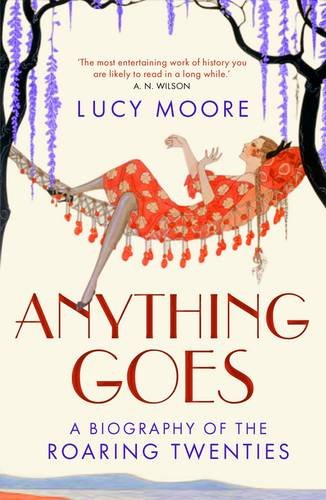 So I got this as a present (last Christmas or this year’s birthday, not entirely sure which) and it was on my wish list because of a fascinating series of programmes about the 1920s which was shown on BBC4; one of the programmes had an interview with the writer of Anything Goes, Lucy Moore.
This interest in the 1920s faded slightly until recently when, following a mixture of inter-war-Mitford-madness and watching the film Bright Young Things I decided to pull this off the TBR stack and give it a go. I hadn’t fully appreciated that this was a biography of the Roaring Twenties i.e. the American rather than the British experience, but that doesn’t matter because it was a thoroughly enjoyable read.
The author covers a wide range of topics and in most of the chapters, which are thematic rather than chronological, she picks key character(s) or event(s) which are emblematic of the topic she’s considering at that point. As a technique that worked very well for me, illuminating the general from the particular.
So for example we have:
- Prohibition through Al Capone;
- Flappers and women in Hollywood through Zelda Fitzgerald and Mary Pickford;
- Americans in Paris through Harry and Caresse Crosby
- Hollywood through Chaplin and a variety of scandals
- The New Yorker through Harold Ross, and so on.
It’s such an interesting and well-written book with lots of asides and nuggets and anecdotes that I just wanted to go off and read more on each of the topics. And it made me glad in many respects that I wasn’t around in the 1920s, although if I had been I would probably have been working in a thread mill in my home town like my great-aunts did rather than swilling illegal cocktails.
Cocktails being very important now as then because as they say
you cannot make your shimmy shake on tea.
A mission statement that I can certainly get behind!
 I’ve said a lot about the Mitford sisters and my current obsession in this post here, so plan just to plunge into my thoughts about this book without much explanation.
A collective biography must be one of the most difficult things to write. How do you decide how much space to give to each of the individuals concerned? How can you be fair to all points of view when the individuals themselves have such different recollections of the same events?
The Mitford Girls is a prime example of the problems inherent in trying to write this kind of biography. Mary Lovell has done (I think) a really good job here but it isn’t (and probably never could be) perfect. The amount of time spent on each of the sisters is dictated by events, and the years before and during the war were always going to be dominated by Unity (with her Nazi sympathies and suicide attempt), Diana (with her marriage to Oswald Mosley and her imprisonment in Holloway) and Jessica (with her elopement, Communist views and move to America). Nancy dips in and out between these stories with her books, her affair with Palewski and her life in Paris. Deborah and Pamela don’t seem to get much of a look in when compared to the other four.
And I think that’s a bit of a shame, especially in Pam’s case. In some respects she’s the one that interests me the most simply because she seems so ordinary compared to the others – well as ordinary as an eccentric member of the aristocracy can be. I would love to have known more about her, especially the period after her marriage broke up and she made a life with one of her female friends. Others have commented how Mary Lovell dismisses without any real exploration the idea that Pam was gay. But for the most part I really just wanted to know what Pam felt about the rest of them.
And Debo; well she is the baby and comes into her own in later life as the doyenne of Chatsworth but I didn’t feel she came across as strongly as she did in the letters where her personality really shone through.
It was disappointing that the period after 1955 takes up so little time as one of the fascinations for me about the sisters is how they grew old and mellowed (or mostly didn’t mellow). Again that’s something that comes across most strongly in the letters.
Don’t get me wrong, everything I’ve said above is really quibbling about the detail of what was an enjoyable read, but I suppose with hindsight that I probably should have read this before I read the letters, as the biography stops in 2000 when Diana is still alive and the letters go on further and so may have satisfied my curiosity a bit more. All I could see here were the gaps.
And my Mitford mania hasn’t diminished at all (though I may give it a rest for a bit…….)
 I have always had a mild obsession with the Mitfords; I’m not exactly sure when it started, but it has been kicking around for a long time. My first exposure to them was probably picking up David Pryce-Jones’s biography of Unity Mitford at a point when I was interested in what made an upper-class young woman fall in withe the Nazis. This led me not so much to Diana Mitford but to Nancy, and I read a couple of her novels and her book about Madame de Pompadour, and thus was I hooked.
I have piles of books by and about the Mitfords all over the house and at some point I will pull together a post about the ones I’ve read and the ones I’m going to read, and probably astonish myself with how many there actually are.
But for now it’s all about Letters Between Six Sisters, edited by Charlotte Mosley; and what a task that must have been, deciding what to include and what to leave out from a mountain of correspondence over not quite eighty years (the first letter is from 1925, the last from 2003). I’ve had this for a while but decided to pick it up after seeing the Duchess of Devonshire at 90 exhibition when I visited Chatsworth last month. And I have romped through what is understandably a pretty chunky book, over 800 pages including the index, but I just couldn’t put it down. The complex relationships between six women with strong personalities and equally strong views is totally absorbing, the feuds and alliances and misunderstandings and misrememberings all entirely fascinating, often funny but moving and sad as well. One of the things I loved most was the sisters’ use of nicknames, which seemed so specific to their world until I looked at some of my e-mails to friends and realised that I do exactly the same thing.
If like me you are drawn to reading letters and diaries then you will find this really enjoyable, even if you don’t know much about the family itself. Loved it and am heading off to find the joint Mitford biography which is skulking on a shelf somewhere…..
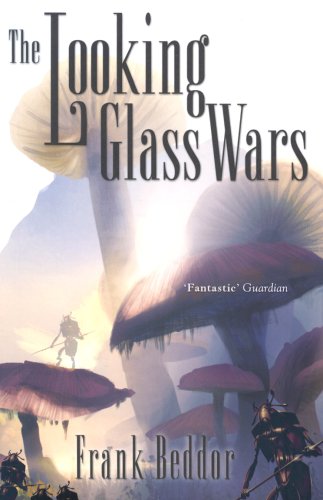 Well, I have always had rather a soft spot for good old Alice, and having watched and enjoyed the re-imagining that was Tim Burton’s movie earlier this year, I was really up for having a punt at Frank Beddor’s The Looking Glass Wars.
So Alyss is being trained to become Queen of Wonderland after a period of horrendous civil war which saw her parents defeat her wicked Aunt Redd. Things go totally pear-shaped on her birthday and she is forced to flee to our world in order to save herself. There she becomes Alice and tells her story to Charles Dodgson who uses it as the basis for the books we know and love.
But can Alice really find happiness in the arms of Prince Leopold or will her destiny reclaim her?
Well, we all know what’s going to happen here.
I thought I would probably like this but wasn’t prepared for how much I would love it and how quickly I would read it. I loved playing spot the character: some of them pretty straightforward correlations to our Alice (Hatter M being the most wonderful to my mind) but others a little more difficult to fathom.
I liked the conceit of Alice being a foundling brought into the Liddell’s home and how no-one believes her fantastic tales, so much so that she begins to doubt them herself as she grows older. I loved the idea of her becoming Queen Victoria’s daughter-in-law. I loved how she got here and how she gets back. And I adored the monstrous figure that is Redd and the havoc that she unleashes.
And then, of course, there is the violence…..
I enjoyed it so much that I now have the two sequels and the first of the Hatter M graphic novels, and will indulge myself at a suitable point.
Really very clever indeed.
 So while on holiday I finally got around to reading Her Fearful Symmetry by Audrey Niffenegger.
Now, this was always going to be a bit of a big deal because I had so enjoyed The Time Traveler’s Wife, which I read before starting this blog and have never reviewed here – suffice to say (as I’m sure I already have) that I became heavily emotionally involved with that novel to the point of almost disgracing myself by crying on public transport over the ending.
And I suspect that’s why I waited until this came out in paperback and even after I bought it didn’t leap into reading it immediately, concerned as I was that I might hate it. But thankfully I didn’t (though I get the impression that some other readers were disappointed in it.)
In terms of plot, this is really a story about two sets of twins, Edie and Elspeth, and Edie’s daughters Valentina and Julia. Elspeth dies at the beginning of the novel, never having reconciled with her sister after an estrangement lasting 20 years, and leaves her flat overlooking Highgate Cemetery to her American nieces, with the proviso that Edie never goes there and that her papers are removed by her neighbour and lover Robert. The only fly in the ointment is that Elspeth comes back as a ghost.
Will her presence become known to the other inhabitants? Will the big secret she has been hiding come out? Will there be unintended consequences?
Well, yes, of course there will.
I took absolutely ages to read this, not because I wasn’t enjoying it or didn’t want to know what was going to happen, but possibly just because it was not sufficiently light for a holiday read. I was determined not to set is aside, though, as whenever I did pick it up I enjoyed reading it. It’s fair to say that I didn’t connect with it the way I did with TTTW but I enjoyed the story, though I found Valentina and Julia really annoying at times and was in many ways more interested in Robert, Martin (another neighbour, one with OCD who compiles crosswords), the setting and the practical problems around corporeality in ghosts. I’m ashamed to say that I have lived in London for over 20 years and never once been to any of the great cemeteries, though the pull of both Highgate and Kensal Green is now very strong.
The big secret didn’t really come as a huge revelation; I had already wondered if it was going to be along the lines that it eventually turned out to be (grammatically awful way of expressing it, but I’m sure you know what I mean), although I didn’t get the details exactly right. I also found the ending a little abrupt.
But I have to say that I enjoyed it, and may even pick it up again in the future as, now that I know the story, I’m sure there are nuances that I missed on the first read.
If I had been participating in Carl’s RIP V challenge I would certainly have tried to claim this as my second read.
 The Fleet Street Murders is third in the Charles Lenox mystery series set in the 1860s. He’s a sort of mid-nineteenth century Lord Peter Wimsey, I suppose (and I’m not the first to have suggested this at all), with detection as more than a hobby but less than a profession (given his aristocratic position).
So, in this one Lenox is standing for Parliament while his friends are in some distress and his love life is wobbling. At the same time two journalists have been murdered in London and he is torn between his duty to his potential constituents and his desire to solve the crime.
As with the others I found this an enjoyable and easy read. The author is American, and there were the occasional usage of words that wouldn’t trip off a Londoner’s tongue now (sidewalk? cookies? (well, maybe these days the latter might be heard) ) let alone in the mid-Victorian period (and I’m happy for any Captain Pedantics out there to set me straight if I’ve got that wrong) but these were only very mildly irritating. His lady love is still too good to be true, though maybe marriage will sort that out. Mystery was pretty satisfying but the best bits for me were all to do with his political campaign.
So, good holiday read and I will certainy look out for the fourth in the series.


 Bride of the Book God