You are currently browsing the category archive for the ‘Reviews’ category.
 The Greatcoat by Helen Dunmore is another ghost story but couldn’t be more different from The Small Hand, though equally atmospheric.
This is set in 1952, and Isabel, newly married, moves to Yorkshire with her husband who is a GP. It’s a time of austerity with rationing still in force and their flat isn’t very warm or welcoming. Isabel is left very much to her own devices as her husband is constantly busy. One night Isabel wakes freezing and wraps herself in an old greatcoat she finds at the back of a cupboard wakes.
And then there is a knock at the window and she sees a young RAF pilot wanting to come in….
This is a story of unfinished business, loneliness and passion, the impact of war and how the recent past can come back to haunt. Very intense and powerful.
This was my seventh and final Readathon read (or at least the last one I finished).
 I’m sure I’ve mentioned somewhere before how much I love Gladys Mitchell’s books and what a fabulous character Mrs Bradley is. I really enjoyed the TV adaptations though Diana Rigg was far too glamorous for the part given that a common adjective for Mrs B is grotesque, but setting that to one side they were great fun and you should seek them out if you haven’t seen them already.
Watson’s Choice is up to her usual standard. Mrs Bradley and her secretary Laura are guests at Sir Bohun Chantry’s party to celebrate the anniversary of his great passion, Sherlock Holmes, and everyone is instructed to come dressed as one of the characters from the canon. However, scandal erupts when the very wealthy Sir Bohun announces he’s going to marry the governess (naturally poor as a church mouse) and the shenanigans begin with the unexpected appearance of the Hound of the Baskervilles.
And then of course there is the murder….
This is great fun. Mrs B is wonderful, Laura not quite as annoying as I had at first feared, and there are the usual red herrings, suspicious foreigners, staff who may not quite be as devoted to their employer as they appear, small boys coming across clues, and a harpoon. All sorted out in the end in a satisfying manner, of course.
My favourite line? “Red-haired people are naturally impulsive”. May have to test that one out on a couple of my friends….
There is a very, very lengthy list of “also by Gladys Mitchell” titles at the beginning of this book and I’m mildly appalled at how few of them I’ve read, though secretly pleased that they seem to be coming back into print and I may have the chance to read them all if I try hard enough!
This was my sixth Readathon read
And this is (if scheduling has worked properly) my 500th post. Woo hoo!
 It seems only fitting that as Carl announces his RIP VII challenge (more of that in a future post) I finally get around to collecting my thoughts on one of two ghost stories I read during April’s Readathon.
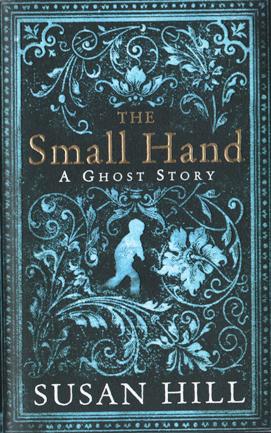
The Small Hand by Susan Hill is the tale of Adam Snow who is a bookseller specialising in hunting down antiquarian volumes for a mostly wealthy clientele. On return from a visit to one of his clients he gets lost on a country road and finds himself confronted with a decaying mansion with which he becomes totally fascinated. He walks up to the entrance and as he stands there he feels a small hand slipping into his own, just as if a child was holding on to him.
He convinces himself that he has imagined the whole thing (as you do) but as he goes about his daily business he starts to experience panic attacks and nightmares, and on occasion the small hand returns, even when he thought himself to be safe on a trip abroad. Needless to say Adam decides that he needs to get to the bottom of this mystery and heads back to the house….
This was a lovely atmospherically ghostly read and benefitted (as all the Readathon books did) from being devoured in one sitting. For some reason once I’d finished it I kept on getting it confused in my mind with The Winter Ghost, which is absurd really as they share little in common apart from being set (partially in this case) in France and having an air of melancholy and unfinished business (which you always get with a ghost story, let’s face it).
The Small Hand is beautifully written and rather sad and I enjoyed it very much.
This was my fifth Readathon read.
 I can’t believe how long it’s been since I last sat down to update this blog, but that’s been a constant refrain this year due to a combination of not reading as much as I used to and other distractions (mostly work) leading to me only really thinking about this sort of ting at the weekend when there are competing priorities. But I am determined to catch up on my reviews before I go on holiday to Italy in the middle of September.
And where better to start than with a book I picked up purely on spec in our local branch of Waterstone’s.
I don’t know why it caught my eye – a combination of the cover and the fact that this is a new imprint designed to
showcase unjustly neglected works by great writers from the 1930s – the so-called golden age of crime writing – through to the 1970s
Francis Beeding is a pseudonym for two guys who wrote collaboratively over more than 20 years, and five of their novels have been made into films – haven’t gone looking for those yet – so clearly very successful but until now I hadn’t heard of them at all, and there works seem to have drifted into relative obscurity. Which is a real shame because this is an absolute cracker.
So we have a seaside resort in England, nothing special about it really, except that at least one of its residents has a pretty significant secret. And then the murders start.
This is a classic police procedural; we see the impact from the local angle as well as from the press (a reporter happens to be on holiday here and covers the story) and the detectives from London brought in to help solve the case. There is a real sense of unease as the community turns in on itself, wondering why this is happening to them. Perhaps unusually for this sort of story there is not only an arrest but a court case and a wonderful twist at the end which I will confess I didn’t really see coming and which has a really modern (to my mind) approach. Without giving anything away, I worked out the what but had no idea about the who.
Death Walks in Eastrepps was once apparently described as one of the ten greatest detective stories of all time, and its easy to see why. Highly recommended.
This was my fourth Readathon read.
 I am so, so far behind on my reviews that I seriously thought about skipping some (heresy) or having more than one (unrelated) book in a post (anathema). So I’ve decided to do the next best thing and crank out some mini-reviews. no disrespect intended to any of the books at all, of course.
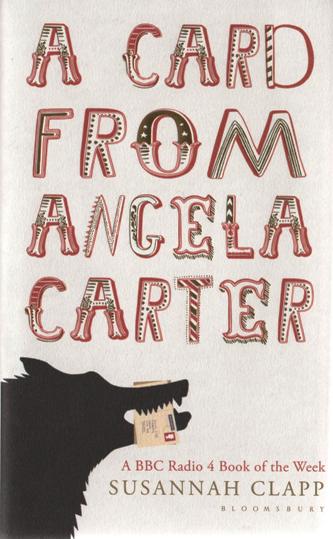
First up is a tiny wee (in size not substance) memoir by Susannah Clapp; she was a long-time friend of Angela Carter, and A Card From…. is her attempt to capture the personality, interests, passions and life of an intelligent and versatile author by using the postcards she sent through her lifetime as a jumping off point for anecdotes and remembrances. The postcards themselves are often odd but it makes sense that Angela Carter would not have taken a traditional approach to dropping a note to her friends, and they make an interesting gateway into aspects of her life.
I really enjoyed reading this for two reasons:
(1) I hugely admire Angela’s work; I read and adored The Bloody Chamber when I was a student and every time I read something about her it makes me regret that I haven’t read more. I have thirteen of her books as far as I can tell and seem to skew towards her non-fiction. I’m mildly astonished (and a bit appalled) that I haven’t read either Wise Children or *gasps* The Magic Toyshop.
(2) I am incredibly nosey about people, I love reading diaries and letters and reminiscences so this was right up my street. She sounds like she must have been a challenging friend but they are often the best kind.
Very enjoyable, though this is the second time this week I’ve felt that the English Lit police will be after me (I may have disrespected Falstaff in a Facebook status update). and this hasn’t turned out to be such a mini after all…
This was my third Readathon read.
 The Baskerville Legacy was not at all what I expected. When I saw it in the book shop I was immediately attracted by the cover and the subtitle “A Confession”. Ah ha, I thought, this is going to be a lovely Holmesian pastiche telling the true story of the Hound of the Baskervilles; not a straight retelling because Conan Doyle himself appears all the way through, so not a version of Holmes but a “how it came to be”. Which it was and wasn’t.
There isn’t actually a mystery here. It’s the story of how The Hound came to be written; the germ of an idea by a friend of Conan Doyle, a man called Bertram Fletcher Robinson, worked on jointly or so it would appear. But in many ways the tale being written is incidental, as this is a book about friendship, writing, collaboration, professional jealousy, talent or the lack of it and the impact of a dissolute lifestyle. Oh and of course there is spiritualism.
It’s a really enjoyable short book, and one of the most interesting things (apart from the portrait of Conan Doyle who isn’t always the jovial chap he was often portrayed as) is where the author has taken real events and changed or elaborated on them to produce his novel. because Robinson and Doyle were friends, holidayed together, and appeared to have collaborated though Doyle is the sole author on all published versions. there seems to have been a real controversy over this though as the author says none of the correspondence between the two men (if it still exists) has ever been made public. The author’s note at the end is a fascinating read all by itself.
I very much enjoyed this story, with its unsettling air of creepiness, of jealousy and strong feelings, and would recommend it as something a little bit different on the whole Holmesian thing. So not what I expected as I said, but a very happy accident.
This was my second Readathon read.
 About The Abbess of Crewe:
An election (?) has been held at the Abbey of Crewe. The new Lady Abbess takes up her high office with implacable serenity. She had expected to win – one way or the other
When did I first read this? sometime after 1977 (when the edition I have was published) and June 1980 (when I started keeping a record of books read)
What age was I? between 16 and 19
How many times since then? This is my fifth time of reading.
Thoughts about the book:
I have been a fan of Muriel Spark for almost thirty-five years which is an astonishing thing to realise given that inside my head I am still 17 rather than the batty old dear I sometimes consider myself these days. I can’t recall now when I was first introduced to her; my memory says The Prime of Miss Jean Brodie (which I have reviewed here) but another part of me thinks that I may have read some of her stuff before then and that The Abbess was one of the first.
It fascinates me because it is a short and pointed re-telling of the Watergate saga if it had taken place in an English convent, with The Abbess the Nixonian figure and her rival, Sister Felicity, representing the Democrats. And of course it’s not the theft of the silver thimble during the election of the Abbess, it’s the ensuing cover up which causes the problems. I think this has stuck with me not just because it’s another one of Sparks’ perfect little jewels but because it’s about Watergate which has fascinated me since I read All The Presidents Men in the early seventies (I still have the film tie-in edition somewhere in the house with long-haired Redford and Hoffman on the cover) and I have quite a few books on the subject, so some of the fun in reading The Abbess is in trying to identify the equivalents of the real life protagonists such as Haldeman and Kissinger (though the latter is really easy, Sister Gertrude a wonderful character awkays at one remove from political danger).
So almost certainly not a masterpeice but one of my absolute favourites and short enough to be read in one satisfying sitting.
Favourite bits:
“Why should they trouble themselves about a salacious nun and a Jesuit? I must say a jesuit, or any priest for that matter, would be the last man I would myself elect to be laid by. A man who undresses, maybe; a man who unfrocks, no”
“And it seems to me, Gertrude, that you are going to have a problem with those cannibals on the Latter Day when the trumpet shall sound. It’s a question of which man shall rise in the Resurrection, for certainly those that are eaten have long since become the consumers from generation to generation.”
“Now if you please, Walburga, let’s consult The Art of War because time is passing and the sands are running out.”
This is the second book in my Big Re-read Project; it was also my first Readathon read and would have been part of my contribution to Muriel Spark week if I had been sufficiently organised to (1) read a couple of other Sparks and (b) get around to blogging about The Abbess.
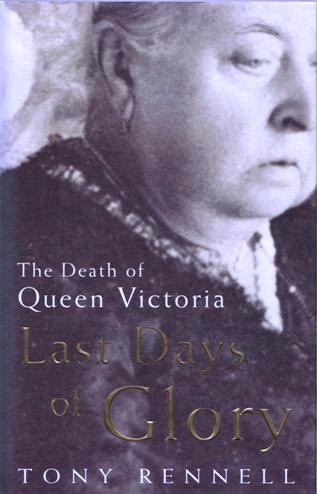 The Last Days of Glory by Tony Rennell gives us a detailed insight into events around the death of Queen Victoria, from Christmas 1900 until her magnificent funeral six weeks later.
It’s a book that’s been on my shelves for a long time; I spotted it in a bookshop just after it came out which is why I have this rather handsome little hardback copy. I’m slightly astonished (and also a bit ashamed) to say that means this has been in the stacks for close to twelve years. But it is one of those books which needs to be read at exactly the right time because of its level of detail. I can’t even remember why I picked it up when I did but I was soon absorbed and read it over a weekend.
I studied history at university and the past has always been of great interest to me, regardless of period, but I came late to the Victorians, probably being in my early thirties when I started to read up on the nineteenth century although the social history of her reign was very much a focus at school and so I knew enough to get by, I just wasn’t interested enough to become absorbed. I blame the Bloomsbury set a bit for that, probably unfairly, but it seems to make sense that I wasn’t interested in a period which some of my great literary heroes had written off. A number of books on social and cultural history and a bit of a passion for the Pre-Raphaelites had me wandering back, and the figure of Queen Victoria herself became increasingly fascinating to me.
So if you are at all interested in Victoria and her family and household then this is a really enjoyable book. Much of what is in it comes from the recollections of the doctor who attended her in her last weeks and months, and who assisted in preparing her body for burial. Rather than being slightly morbid as a topic, the whole issue around what she had instructed was to be placed in the coffin with her is a mini-drama in itself, and Rennell devotes a number of pages to it, giving a sense of how strong-willed and secretive the old Queen could be. There is a real insight into the complex relationships between her children and grandchildren and the figure of the Kaiser looms large. There is also a great deal about the planning of the funeral itself; she had been on the throne for so long that there was no-one alive who could remember the last time a monarch was buried and what the protocol should be, so much had to be reconstructed and quite a bit invented entirely.
It seems odd in some ways to consider the impact of her death, but for a great many of her subjects she was the only ruler they had ever known; it will be interesting to see if something similar happens when the present Queen dies (she came to the throne 10 years before I was born) although I’m not so sure in this day and age whether it will be seen in quite the same way as the end of an era.
This is a book full of rich anecdotal material and a really interesting and useful annex on the whole issue of the role of John Brown in Victoria’s life; it is well written and it gave me great pleasure to read. Recommended.
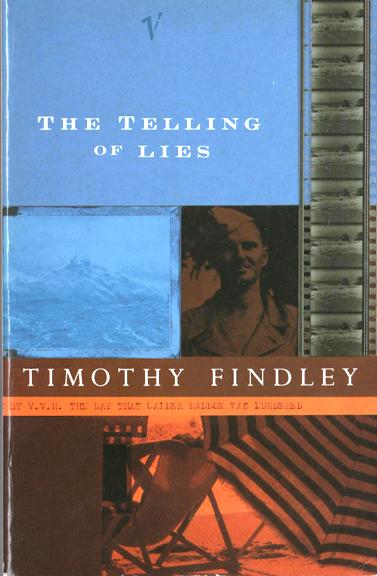 About The Telling of Lies:
On a beautiful hot day off the coast of maine an iceberg looms on the horizon and Calder Maddox, and aged and unprepossessing pharmaceuticals millionnaire is found dead on the beach. Nessa van Horne has photographed the day’s events and as she studies the pictures she draws parallels between her own experience of evil when she was imprisoned in a Japanese concentration camp and the increasingly chilling evidence of Maddox’s murder and a political cover-up
When did I first read this? February 1993
What age was I? 31
How many times since then? This is my first re-read.
Thoughts about the book:
I can’t remember when I first realised I had a thing for all matters Canadian. I think I must actually have been quite small and it may have been because of a visit from some of Dad’s relatives who had emigrated from Scotland to Ontario in the 1920s. Anyhow, it is a real thing for me and although I haven’t yet made it there (I was insanely jealous of the Book God when he went to Vancouver on business and I couldn’t go with him because I had just started a new job, but I will get my revenge, oh yes) I seek out the books and films and music and of course lovely blogging people like Susan. But I digress. In my twenties I worked my way through Margaret Atwood, Alice Munro, Robertson Davies etc and was looking to widen my horizons a bit, and someone recommended Timothy Findley to me. The Telling of Lies wasn’t the first of his books that I read (that honour probably goes to Famous Last Words or The Butterfly Plague) but it is the one that has stayed with me the longest. It pops into my head every so often and I was completely astonished to find that I had only read it that one time.
I love this book but I’m not really sure that I have got to the bottom of what it’s actually about. On the surface it’s exactly what it says on the cover, murder and cover-ups and so on, but I can’t help feeling that there is something more that I’m just not getting and that’s perhaps why it stays with me. And of course I just love Nessa; I see her as being a sort of Vanessa Redgrave figure (as she was when I was lucky enough to see her in The Year of Magical Thinking, tall and dignified and white-haired), and she is a remarkable character.
Favourite bits:
Everyone has always known that Lily has a heart of gold; but we have also known it’s a chocolate heart and the gold is only a wrapper made of foil
I asked him if, there being so many more, he intended to read them all. And he said “I’ve read them all before, Miss Van Horne. This time, I’m reading them just for pleasure.” I had no reply for this, not having known there could be pleasure in Henry James.
Memory is like that. It buffets you with stories out of sequence. It harries you with the past and it blinds you to the present. It seems to take all its cues at random – failing to deliver what you want to know, while it offers up data that seems to have no bearing on the moment.
As for me – I saw them both as beautiful and exceptional, until he died. It was only then that I encountered Mother as she really was: a reflection stranded in an abandoned mirror.
If I could only learn to be at peace with the wonderfully simple, scientific fact of life: we die. Surely, how we die is all that matters, when it comes to that.
If online comments are to be believed (and I haven’t been exhaustive in my search for the views of others), I’m one of the few out there who seems to rate this novel. One thing is certain; I’m not going to leave it for another almost twenty years before I pick this up again.
This is the first book in my Big Re-read Project
 Let’s start with the introduction:
Once there was a widow with three sons, and their names were Black, Brown and Blue. Black was the eldest; moody and aggressive. Brown was the middle child; timid and dull. But Blue was his mother’s favourite. And he was a murderer.
So our narrator is B.B., and what an unreliable person he is. All of his story is told through blog entries, some of them public and commented on by a small group of readers, some of them private and giving more detail and context to what are ostensibly murderous vengeful fantasies, but are they fictionalised versions of real events?
B.B. by his own admission is (as my Gran would have said) “not a nice man, not a nice man at all”, part of a dysfunctional family (horrible brothers, absent father and monstrous mother) and surrounded by secrets from the past which he shares with us piece by piece until we think we have a picture of his troubled past. And then there is a revelation near the end which certainly gave me a bit of a WTF moment and a quick flick back through the pages to see whether I had missed anything as it was rather unexpected.
Joanne Harris has set blueyedboy in the same town as her excellent Gentleman and Players which I read and enjoyed last year, so there is an air of familiarity about the setting and the feeling of being an outsider. I’m not sure I would go so far as to say its a companion piece but there are some similarities, particularly around the need for revenge, but blueyedboy is not anywhere near as gleeful as I found G&P.
It’s an unsettling novel, well written and cleverly plotted and I enjoyed reading it at the time but as the weeks have passed I think the impact has diminished and I’m not sure this is one that will stay with me.


 Bride of the Book God