
You are currently browsing the category archive for the ‘Reviews’ category.
 John Connolly’s The Book of Lost Things is another one of those books that I’ve had for a while but only really paid attention to when Silvery Dude told me that I would enjoy it. I made a start sometime last summer and for some reason couldn’t get on with it; the Silvery One dared to suggest that I might find it difficult to put myself in the mind of the lead character given that I have “never been a 12-year-old boy”, I countered with the fact that I had lost my mother so thought I might have an inkling of what was going on in our hero’s head. Though of course I was much older, but still.
For the lead character is indeed a young boy called David whose mother has died and who has had to watch his father remarry and have a child with his second wife. World War Two is in full flow and David is struggling with what looks like OCD, anger over his loss and feeling left out in his father’s new family (though not because of his stepmother who I rather liked). Like any sensible child he has a love of books but they begin to speak to him at night and start to affect the way he look sat the world.
And then the Crooked Man comes and David crosses over into a dark and dangerous world populated by the myths, folk and fairy tales with which he has become absorbed. Enticed by what appears to be his mother’s voice, he has to make his way through many perils to reach the King of this land and find his way home.
I thought this was a really dark story, which makes sense when you think about what the fairy tales we all know and love were like before they were sanitised for the safe consumption of youngsters. The Huntress in particular is truly dreadful, but it is the Crooked Man himself, who preys on the fears and jealousies of children to get what he wants; truly evil. And I’m not ashamed to say that I cried at the end, sad and lovely all at once.
My edition of the book has a fabulous section at the end which gives background on the tales referenced in the story for those who find that sort of thing interesting – that would be me – and led to a little follow-up reading list:
- From the Beast to the Blonde by Marina Warner
- Nocturnes by John Connolly
- Transformations by Anne Sexton
- The Island of Dr Moreau by HG Wells
David’s story stayed with me for days after I read it. Another potential re-read, and a further read for Once Upon a Time VII.
 The Night Circus is one of those books that you just know you are going to adore from page one. I bought this when it first came out in hardback and it hung around on my TBR mountain for no real reason other than I just didn’t get to it. That was, of course, until Silvery Dude got the paperback and started harrying me to read it as he had totally fallen in love with it. So of course I had to pick it up because I (mostly) trust his judgement, not because we read competitively, not at all, whatever gave any of you that idea.
So, the Night Circus (or Cirque des Reves to give it its proper title but not its appropriate punctuation) is a touring sensation in the 1880s, with all the attractions of a normal circus but entirely in black and white and with some very particular elements – tents filled with clouds, an unusual clock and a dedicated group of followers identified by the wearing of red items amongst their black and white clothing. The story is not so much about the circus itself, although it is of course one of the main characters if I can put it that way, but is really about a duel (?) bet (?) wager (?), let’s say contest between two practitioners of magic which is played out through their protégés, Celia (the daughter of one) and Marco (the apprentice of the other). A contest that the participants have no real control over and only slowly come to understand who their opponent is. Opponents are. You know what I mean.
This is just glorious, I devoured it in a couple of sittings over a Bank Holiday and was totally immersed in the world that Erin Morgenstern creates. A remarkable set of characters, a narrative dipping backwards and forwards in time, with a really wonderful and believable love story slap bang in the middle and a very satisfying ending. One of those books that you just wish would keep going and that you miss as soon as you’ve finished it.
I know that I’m probably one of the last people in the universe to have read this, but on the off-chance that you haven’t and that you are someone who enjoys being beguiled, then please do read this. You won’t be sorry.
Another read for Once Upon a Time VII.
 It’s so long since I’ve written a book review that I’m bit concerned that I’ve forgotten how but I am on a reading jag at the moment and have already built up a bit of a backlog (13 books and 7 films) with no sign of slowing down the reading/watching process, and I’m determined to catch-up before it all gets out of hand, so apologies in advance if your feeds etc. get swamped over the next week or so. Though some of the reviews may be fairly short given that I am known these days for having a poor remembery and some of this stuff goes back to May.
Let’s start with The Land of Laughs by Jonathan Carroll. This was one of my reads for Carl’s Once Upon a Time challenge which finished on 21 June so well out of date in recording my thoughts. Carroll is one of those authors that I’ve been meaning to try over the years, as other bloggers have recommended. We already had this one in the house as part of the Book God’s Fantasy Masterwork collection so it seemed a good place to start. And it’s a book about books; well, a book about stories and their power and the obsession that readers sometimes develop with particular writers, especially writers that may have influenced during their childhoods.
The main characters in this story are Thomas, a school teacher who decides, along with his equally obsessed and fairly recently acquired girlfriend Saxony, to write a biography of the late and much-loved children’s author Marshall France. Previous attempts had failed under the apparently malign influence of France’s daughter Anna who still lives in her father’s house in the small town of Galen. Thomas and Saxony decide to move there in the hopes of persuading her to help. And that’s when things get weird.
This is one of those books that I wasn’t sure whether I liked or not until I had actually finished it, but it really stayed with me, especially the idea that the magic of writing could seep out into the real world. Elements of the story are really quite disturbing and it’s one of those fantasy novels that almost but not quite slips into horror. After a few months my considered opinion is that this is a really clever, slightly scary and distinctly odd book with a very original take on the imaginary becomes real theme and one that I may very well re-read.
And I’ll never look at bull terriers in quite the same way again.
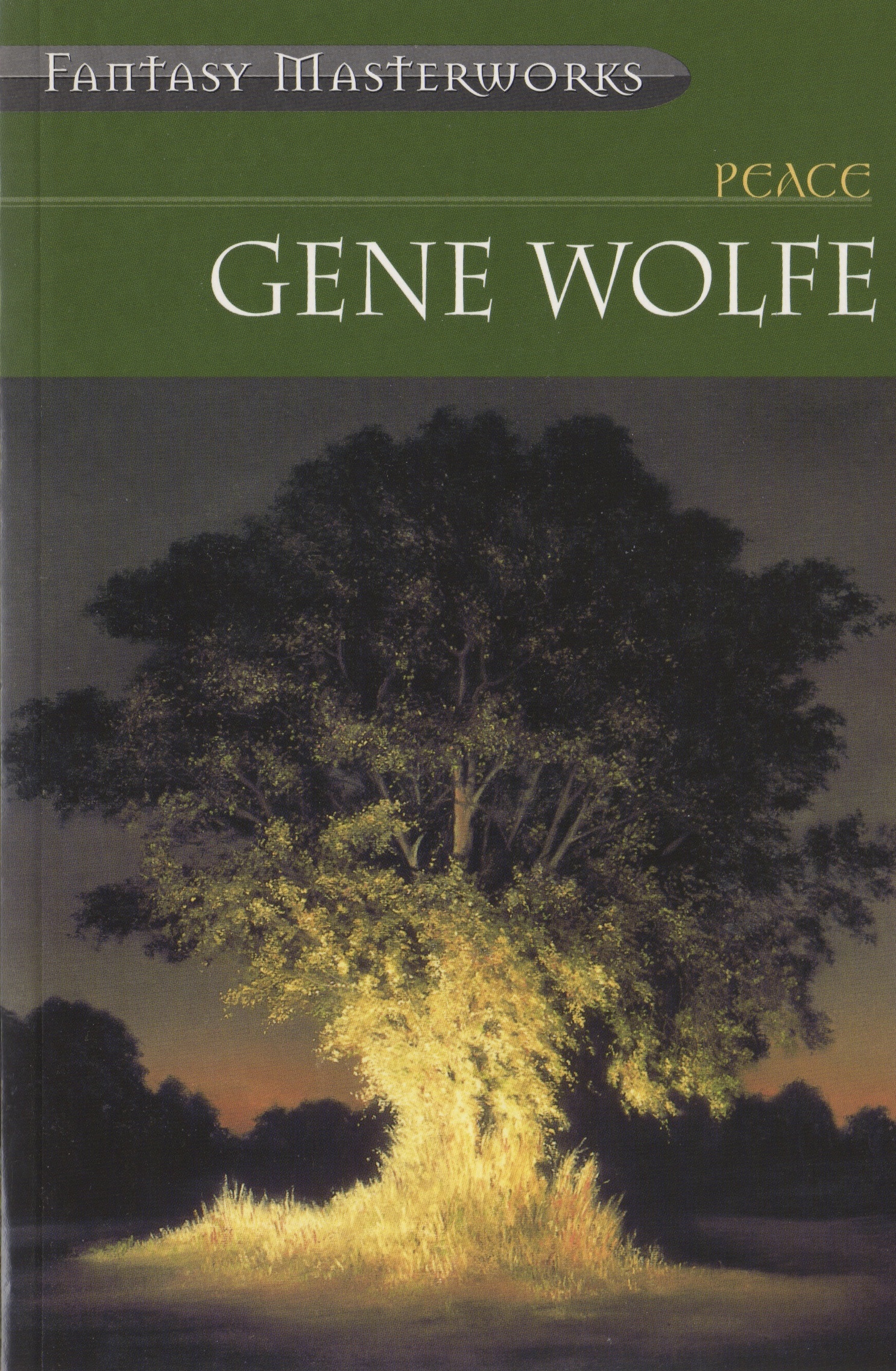 To my shame I have never read any Gene Wolfe before now and decided to start with Peace, partly because of the beautiful cover (yes, I am that shallow) but also because the blurb on the back of the Fantasy Masterworks edition I have sounded intriguing and not at all fantasy like, and the book itself reinforces that view because it reads very much like an ordinary memoir of a man’s life, but it is implied that there is a lot more going on here.
Which is where I have to confess that I had a bit of a problem, because I clearly missed a lot of the subtext around death (not giving too much away as this is mentioned on the back of the book) and I was aware but possibly didn’t entirely understand the timey-wimey stuff until close to the end. This, I hasten to say, is totally my failure to appreciate what Wolfe was doing with this story.
Peace is beautifully written, engaging, with believable characters that I became very fond of, especially our hero Alden Dennis Weer’s Aunt Olivia and her various suitors.
Because I was aware when I got to the end of the novel that I had not really got underneath the skin of this novel, I went off to the world-wide webs to find out what others have said with the result that I am definitely going to read Peace again to see if I was just being particularly dim or if it is as ambiguous as it appears.
All of that sounds like I didn’t enjoy Peace but I really did like it very much. As I said, the writing is super. There is a female character who is rumoured (on apparently no basis at all) to be no better than she should be, the other ladies around her considering all the rumours to be true because she is so fit
For to them a physical pliancy implies moral accommodation
There is also a lovely quote which made me think more about the process of writing than I normally do. Our narrator talks abut doing something between the last sentence he had written and the one he is currently writing, and says
have you never thought as you read that months may lie between any pair of words?
Reading back this is a very fuzzy and disjointed review of what is clearly an important book in the fantasy genre. But I was confused and can only leave you all with the quote on the cover from Neil Gaiman:
a tricky, deep and remarkable novel
I may have missed some of the points but I am very glad that I read it.
This was my first read for Once Upon a Time VII.
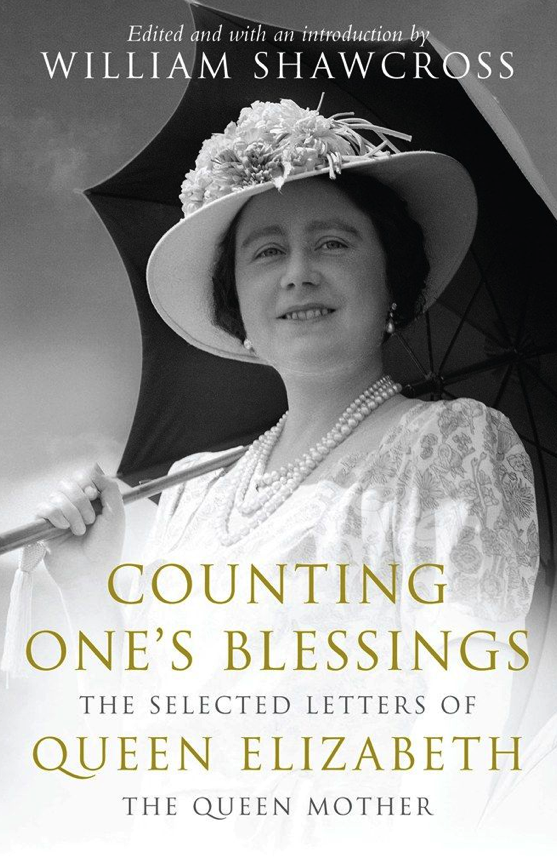 I think it was Anne Fadiman who talked in one of her books about the shelf where she kept books about her particular obsession which was (as far as I remember) polar exploration. I would have a similar shelf if I was more organised (and didn’t have quite so many books) but mine would be all about Royal and aristocratic women. I just can’t resist them, everything from Queen Marie of Romania to The Mitfords via our own royal family. Adore the glamour and clothes and jewellery and privilege as only someone brought up on a council estate in the West of Scotland can.
This is largely my late Mum’s influence and sits uncomfortably alongside my general centre left politics but, you know, can’t help it. Doesn’t mean I watch stuff like Downton Abbey though, I do draw the line (though I used to adore the Upstairs Downstairs, though I have no illusions that I would have been anything other than a scullery maid)
Counting One’s Blessings is a selection of the letters of Queen Elizabeth the Queen Mother from her childhood to her death. I’ve said before that I often find it difficult to review books like this because they are what they are, and this very much is what it is – demonstrating nothing more than that the QM was a woman of her class and generation, loving the country (and in particular horses), with some insights into her life with King George VI (some of which is picked up in The King’s Speech), her friendships with some interesting people (Osbert Sitwell. Ted Hughes) and her interest in British Art.
If you are looking for scandal, especially around Diana, Princess of Wales, then you will be disappointed. It appears that the QM was so concerned in her later life about things being leaked that she didn’t put her intimate thought on such matters in her letters. Enjoyable if you are interested in the Royal Family or ladies of a certain class and era, but not sure it is for everyone.
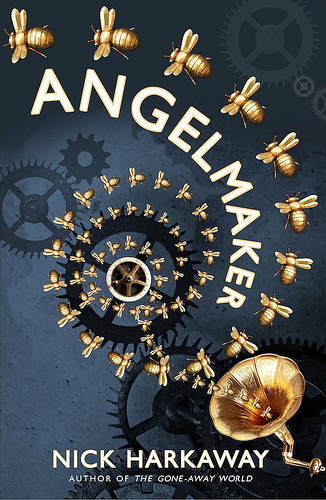 I could actually review Angelmaker in one word – awesome. I totally, totally adored this book which was recommended by my dear friend Silvery Dude who then bought it for me as a belated birthday present in Waterstones Piccadilly the day after the Oscar ceremony when I went to assist him in the spending of his Christmas book vouchers.
I also *fangirl squee* had a Twitter exchange with Nick Harkaway, the author, after which I swooned and then finished the book in a massive reading session on Good Friday.
This is the story of Joe Spork, who repairs clocks and automatons and other lovely mechanical devices in London, and is asked to fix something really peculiar which kicks off a whole series of events which brings him to the attention of secret bits of the government, a magnificent super villain, a notorious serial killer and a strange sect of monkish types. In this situation he finds himself in the company of the greatest lawyer in the world (sorry Silvery Dude) Mercer Cradle (on whom I now have a huge girly crush), the lovely Polly and the nonagenarian spy Edie Banister.
And then there are the mechanical bees.
This is just rollicking good fun, an exciting and pacy story with lovely, sympathetic, complex and realistic characters that I became very attached too. Without giving too much away (and deciding not to go on and on about Mercer but, you know, best thing in a lot of very very good things) I loved it when Joe decided to tap into the influence of his late Dad-with-a-criminal-past. I loved the fact that everything that happens in this has consequences both good and bad for the characters and so has a real heart of truth in amongst all the fantastical elements.
And there’s quite a bit of enjoyable naughtiness as well. For those who like that sort of thing (count me in).
Almost impossible to articulate exactly how wonderful this is. One of my absolute favourite reads of the year, can’t see it being shifted at all.
 So, Gone Girl by Gillian Flynn is one of those books that everyone was reading at the same time last year, and, as I always seem to do, I postponed my read so as not to get caught up in it all. I have absolutely no idea why I do this but it has become a habit and I suspect I’m not going to change anytime soon.
I have read Gillian (a bit over-familiar, sorry) before, Sharp Objects which I reviewed here, and enjoyed it enough to buy (but not yet read, her second novel, Dark Places, and I do have a tendency to read things in order, but I jumped into Gone Girl because I became curious and ended up finishing it in a massive single sitting when I wasn’t very well just before Easter. And I can recommend it as a book to take your mind off illness because it is totally compelling and I really, really wanted to know how it was going to work out.
This is the story of Nick and Amy, a golden couple whose life changes when they have to move away from New York to Nick’s hometown when they both lose their jobs. One day Amy disappears; there are signs of a struggle and Nick is distressed but there is something not quite right, and we follow the investigation into her disappearance from Nick’s point of view, alternating with entries from Amy’s diary from the point at which she first meets her husband.
I loved this. I thought I knew where the story was going, and then a thing happened that both reinforced my theory and undermined it entirely, and then another thing happened which I didn’t see coming at all.
As well as a fabulous psychological thriller it’s also a compelling portrait of a marriage and reminds us all that you never really know what’s going on in someone else’s head.
Gillian has been accused of misogyny amongst other things; if you want to know what her reaction is to that then do read this interview with her in The Guardian.
If you are one of the three people in the world who hasn’t read this yet then I can’t recommend it too highly.
 Seeing Redd is the second volume in Frank Beddor’s Looking Glass Wars trilogy (my thoughts on volume one are here), and expands on Alyss Heart’s story now that she is (Spoiler Alert) back in charge of Wonderland having defeated her Aunt Redd and regained her Queendom.
Of course, things are not going smoothly as she tries to consolidate her rule, not only having to contend with those members of her kingdom who supported Redd during her rule but with the machinations of King Arch from a neighbouring kingdom (who doesn’t believe women should rule) and her growing attraction to her now-grown-up childhood friend Dodge.
This is very enjoyable but I didn’t find it quite as compelling as the first book, although it still has many things of interest: Redd’s wonderful dress made of living toothed roses, her assassin The Cat (yes, that cat), and the rather nasty sidekicks of Arch (especially Blister) and the whole concept of The Millinery. Redd’s appearances on Earth are also very spooky and disturbing.
I think it suffers a bit from being the middle volume of a trilogy; if builds on the outcome of the first but is clearly designed to set us up for the big finish in the third volume. Still enjoyable and I do want to know how it all works out.
 I don’t believe in guilty pleasures, I think people like what they like and should celebrate that, but if I did have a guilty pleasure it would be fashion. So having missed the exhibition of ballgowns at the Victoria & Albert Museum I was really keen to get a hold of the catalogue from the London Library so I could feast my eyes on the wonderful dresses.
The book is of course visually stunning but the articles and background information were just as fascinating. My favourite quote is about the peculiarities of the British couture client as experienced by John Cavanagh in the 50s and 60s:
One titled client chose a dress from his collection and requested that her own fabric be used: some eighteenth century golden-yellow Chinese embroidered wall hangings then arrived a the atelier. Another client would choose several designs and then have fabric samples sent to her home to ensure she didn’t clash with her furnishings.
Designing around heirloom jewellery was also often required, and once a designer had to match a particular shade of satin to “a set of aquamarines the size of gobstoppers”.
How the other half lived! Green with envy.
 So having finally finished Wolf Hall at the second attempt I was so absorbed in the story of Thomas Cromwell that I immediately picked up the sequel, Bring Up The Bodies. This turned out to be a wise decision as it was equally as well written as its predecessor though potentially darker in tone and with a slightly different style which I can’t quite put my finger on.
This picks up from the end of Wolf Hall, with Henry VII divorced from wife one, married to wife two and casting his eye around at other women in the court, with a particular fancy for Jane Seymour whom we know will become wife three. Although he now has Anne in his possession she id pregnant and the King needs female companionship. It’s also becoming clear even at this early stage that he is becoming tired of Anne as a personality; Mantel portrays her as manipulative and unforgiving and her behaviour will sow the seeds of her inevitable downfall when she fails to provide a male heir. She does of course produce Elizabeth I, my great heroine of which I will say no more other than that her rare appearances as a baby and toddler in the book are rather sweet.
This reads like a thriller and I tanked my way through the second half in a single sitting. Once its clear that no son is forthcoming Henry starts casting around for reasons to get rid of Anne and Cromwell, with his informants everywhere and his growing attachment to the Seymour family , helps pull together the evidence required to have her executed for treason. I found the portrayal of Anne really compelling; I’ve always felt she was hard done by, and I know Mantel is taking a particular position here but I have to say that her descriptions of Anne’s alleged behaviour shows her to be at the very least a foolish woman who overestimated her power and influence over the King.
The role of families in court politics is also fascinating, the way fathers and brothers effectively pimped their women folk to royalty for land and power and influence is remarkably dismaying but, of course, par for the course over many centuries.
I still like Cromwell. His attempts to help Katherine, Mary and Anne to give the King what he wants and needs while allowing them to retain some form of dignity are admirable but doomed. Pride is a very important commodity for these women, and for Henry himself, who comes across as rather more petulant and self-serving in this volume. Still can’t stand the man though.
There will be a third book which will take us up to Cromwell’s death; not sure when that will appear but I’m already looking forward to seeing how my favourite Henrician queen, Anne of Cleves, is handled. Wonderful stuff.


 Bride of the Book God