You are currently browsing the category archive for the ‘Reviews’ category.
 What’s it all about?
Mayhem is set in the height of the Jack the Ripper murders, but body parts found at New Scotland Yard are definitely the work of a different killer, no matter how much the authorities wish it wasn’t. Thomas Bond is the police surgeon working on both cases, and as he delves into the murders he begins to suspect that something more supernatural than a rampaging serial killer is at work in London.
Why did I want to read it?
Serial killers, Jack the Ripper, Victorian London, what’s not to like? Plus although I had a couple of her e-books I hadn’t read any of Sarah Pinborough’s books and wanted to give her a try, partly due to the subject matter and partly because she is great fun to follow on Twitter (there’s that word again).
What did I think of it?
I liked it a great deal. It was a very interesting experience reading it so soon after Drood (reviewed earlier) as there are some similarities in the use of the supernatural, the main character’s tendency to dabble in drugs, the mix of real and fictional characters and events. I thought this was much more successful; I liked Thomas Bond very much and found his struggle with opium and the effect it had on him much more sympathetic, as were the domestic elements in the story contrasting with the grimness of the crimes being investigated. But I don’t want to dwell too much on comparisons with someone else’s work, this is a really good novel.
Conclusion
Recommended. I’m going to be searching out more of Sarah Pinborough’s work, although disappointed that the next volume in this series won’t be published until 2015.
This was a read for RIP VIII
 What’s it all about?
In The Memory of Blood the Peculiar Crimes Unit get called in to deal with the death of a child thrown from his bedroom window while elsewhere in the apartment his parents hold a party for the cast and crew of a play being performed in the theatre owned by the child’s father. It’s a PCU case because the door was locked, there seems to be no forensic evidence, and, well, there’s a life-size puppet of Mr Punch on the floor. Supernatural activity or human agency? Oooh.
Why did I want to read it?
My love for the Bryant & May series is well-documented on this blog. I’ve read the lot in order and wasn’t going to miss this one.
What did I think?
Loved it. I am a sucker for stories about the theatrical world and this one is chock full of corruption, venality and oddness amongst the suspects, plus a nice political back story for the assistant stage manager and the spectre of Home Office disapproval hanging over the case. As always I learned loads – about London, the theatre, Punch and Judy and much more. Didn’t work out who the murderer was which was nicely satisfying in a strange way. The series just gets better and better.
Conclusion
If you haven’t read any of the Bryant & May books, why ever not? Get on with it. You won’t be disappointed.
This was a read for RIP VIII
 What’s it all about?
Let’s use the words of the narrator, one Wilkie Collins, to describe what we’re talking about here:
This story shall be about my friend (or at least about the man who was once my friend) Charles Dickens and about the accident that took away his piece of mind, his health, and some might whisper, his sanity
The story kicks off with the Staplehurst railway accident that Dickens was involved in while travelling home from Paris with his mistress Ellen Ternan. While trying to assist those injured in the accident Dickens comes across a mysterious and rather ghoulish figure who becomes known to him as Drood. Dickens then drags Collins into his obsession, which leads them to investigate the underworld of London, with all the crime, squalor and danger that involved. And not a little madness. And quite a lot of death.
Why did I want to read it?
I’ve had mixed fortunes with the works of Dan Simmons. I read The Song of Kali in 2009 and really struggled with it, finding it a little too grim for my tastes. But I had also read The Terror the year before and absolutely loved it. The combination of real literary figures and a Gothic sensibility promised by Drood was very attractive.
What did I think of it?
Well. I finished reading this in the middle of September and I’m still not sure what I think. I was drawn in by the early part of the book and cracked on with the story which promised a great deal, but somewhere around the middle, when the focus shifts almost entirely to Collins and his problems I began to get a bit bogged down and actually stopped reading it for a bit. But I was determined to finish it and it did pick up again in the last third. It is completely mad. Although I have to say that it seems pretty authentic in its representation of both the central characters and all levels of society at that time.
Conclusion
There is a quote towards the end of the book where Collins says:
You never cared about my part of this memoir. It was always Dickens and Drood, or Drood and Dickens, which kept you reading
And maybe that is the problem for me, insufficient Drood. So fair to say that my response to the novel is ambivalent; glad I read it but not a favourite and *whispers* too long.
It has made me want to finally read Armadale though.
For a more positive review you should visit Roxploration who discusses the book here.
This was a read for RIP VIII.
 What’s it all about?
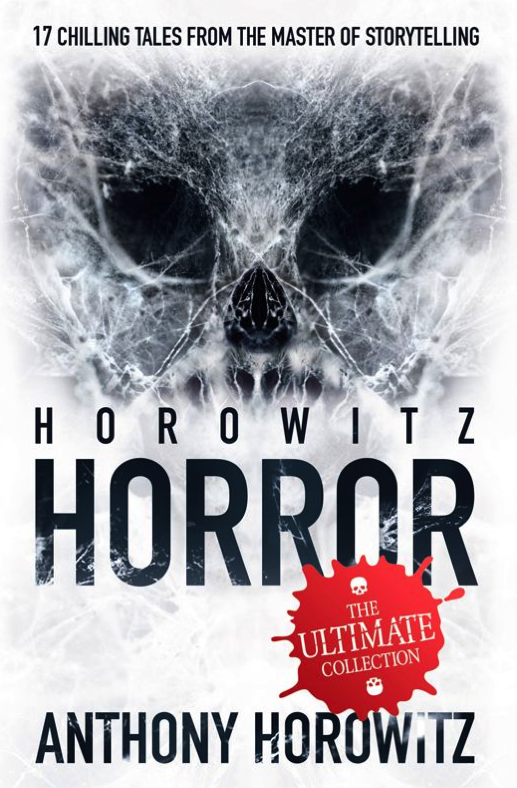
So Horowitz Horror is exactly what it says on the tin; a collection of horror stories for young adults by Anthony Horowitz, he of the Alex Rider books (amongst others).
Why did I want to read it?
I love a good horror story. As a teenager I religiously collected the Pan Book of Horror series (as edited by Herbert van Thal) with their gruesome stories and lurid pulpy covers (this one a particular joy). My parents were probably appalled but very much of the view that reading was reading was reading and let me get on with it as there was no evidence that I was turning into an axe-murderer. These stories are much less nasty, to be fair, but suitably creepy.
What did I think of it?
I’m not the target audience for this collection by a good 35 years but I enjoyed them all; particular favourites were The Hitchhiker and Bath Night. I liked the ordinariness of the situations the protagonists found themselves in, how unsettling everyday objects can become. Light touch in the story telling.
Conclusion
Really great fun.
This was a read for RIP VIII.
 So, the first of a flurry of mini-reviews to clear my backlog and leave me with a relatively clean slate for 2014. Apologies in advance for swamping timelines and feeds and whatnot but it has to be done!
What’s it all about?
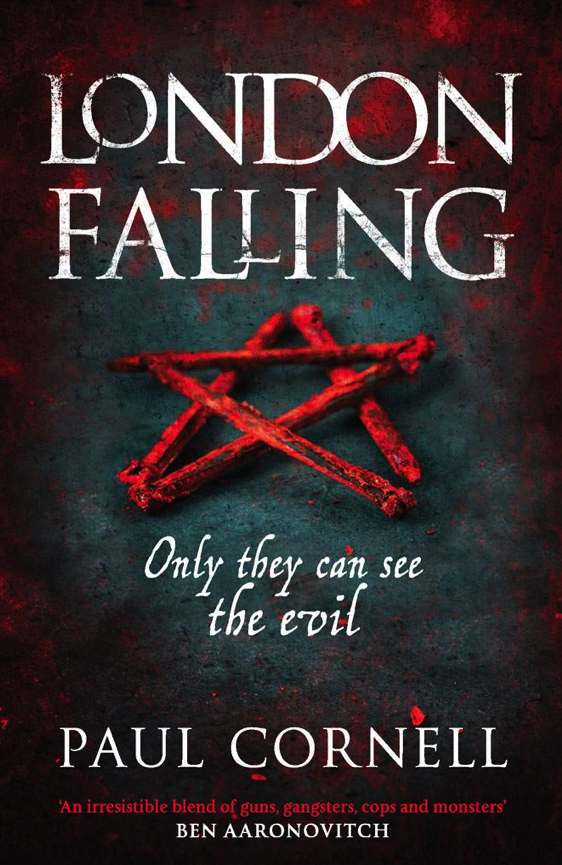
So London Falling is basically a police procedural which takes an unexpected turn. DI James Quill is managing an undercover op as part of an investigation into London’s organised crime when it all goes horribly wrong and his main target is killed in a gruesome and unusual manner, and it becomes clear that there is something evil lurking around London. Cue the creation of a team of misfits shunned by their colleagues and using unorthodox methods to get to the bottom of something very old. There’s a witch. There’s a talking cat. There’s a football connection. And there’s a lovely set up for what is clearly going to be a series.
Why did I want to read it?
I like Paul Cornell; I follow him on Twitter, I’ve got his Wolverine comics on my iPad and he’s written some cool stuff for Doctor Who. I liked the premise for the novel, especially as I’m a sucker for anything in which the history and mythology of London is as big a part of the story as the human characters.
What did I think of it?
Loved it. Read it over a couple of days, felt the story pulling me along, really wanted to know how it was all going to work out. It would be lazy to say that it’s similar to the Rivers of London series by Ben Aaronovitch and Christopher Fowler‘s Bryant & May books, both of which I love deeply. London Falling is grittier than the former and not quite as peculiar (peculiar is a positive word in this context) as the latter but they do all complement each other very nicely.
Conclusion
Enjoyed it a great deal and am looking forward to the next one (The Severed Streets, due out here in May)
This was a read for RIP VIII.
 Earlier this year I enjoyed watching a series on BBC4 about Flemish painting written and presented by Andrew Graham-Dixon. One of the paintings featured was the Arnolfini portrait by Jan van Eyck, one of the most recognisable pictures in the world, and a firm favourite of mine. A few days later I happened to be in King’s Cross station and spotted Carola Hicks’ Girl in a Green Gown: the history and mystery of the Arnolfini portrait and just had to buy it.
I’m so glad that I did.
What I hadn’t realised is that, unusually for a painting this old, its provenance can be tracked from the date it was painted right up until it became part of the collection in the National Gallery in the 1840s. What makes this book so fascinating is that it alternates the stories of the various owners (including one of my favourite historical figures, Philip II of Spain) with various detailed aspects of the picture itself – the mirror, the clothes, the chandelier, the dog etc. – explaining both the symbolism and the technical skills involved.
There is heaps of information in this book but it’s presented in a light and engaging way which certainly held my interest and had me looking up further information elsewhere. there is also a fascinating chapter on how perceptions of the picture have changed over time and how it has ben adopted and adapted for satirical and advertising purposes among others.
Sadly, Carola Hicks died from complications relating to cancer before she had put the finishing touches to the book, but her notes and amendments were incorporated by her husband so that her work could be published. I’m so glad he was able to do so because this is just a delight and if you are at all interested in art you should seek this one out.
About time for another National Gallery visit I think!
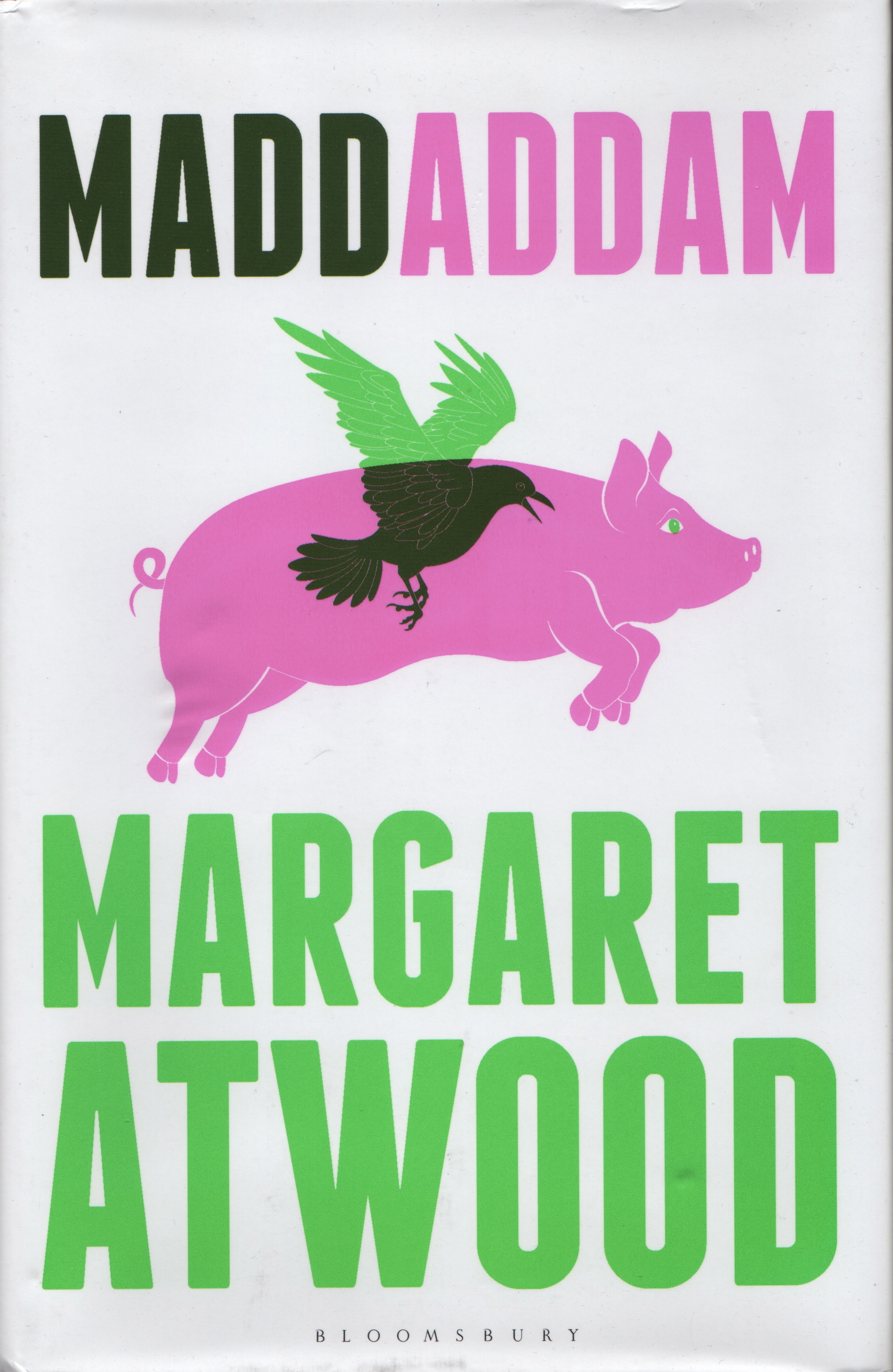 So, MaddAddam is the final volume in the eponymous trilogy by Margaret Atwood which began with Oryx & Crake and The Year of the Flood which I have reviewed separately here and here respectively. At the end of the previous volume the various threads of narrative came together and we are now moving forward into the future.
After the man-made plague a small group of humans have survived and we watch them come together and try to form a community and find a way to live in a world where supplies are dwindling, there uncertainty about just how many other people are still alive, and where they have to adapt to sharing the world with the Crakers, a genetically designed species of people who were designed to replace humanity which should have been wiped out. In amongst all this there are two threats: a few extraordinarily unpleasant men who seem to enjoy nothing other than inflicting pain and misery and, more interestingly, the pigoons, genetically modified intelligent carnivorous pigs who become really key to the survival of our little group in quite unexpected ways.
Although the novel is primarily focussed on establishing a new society (albeit a very localised one) there continue to be flashbacks to the past told through the eyes of Zeb who has become the partner of my favourite character Toby, and in telling her his life story illuminates us further on the background to the creation of the plague and the founding of God’s Gardeners, a sect which turns out to have been more than it seemed.
I enjoyed MaddAddam, was pleased to find out more about characters I had come to feel strongly about, but I’m not sure that it really comes to a conclusion, unless the conclusion is that no matter how well you think you have designed something (in this case the Crakers) you cannot plan for everything and once things are out in the world they will develop as they must. And it is very amusing in places.
 I’m glad I took the time to read the trilogy so close together as I feel that I might have got lost if I’d read them as they were published; I found them dense (in a good way), lots to think about and jeep track of. If you enjoy speculative fiction you should give these a try.
And I was thrilled to get my copy signed by the great lady herself; more of that in a future post.
 The Year of the Flood is the second book in Margaret Atwood’s MaddAddam trilogy. It takes us back to the events described in Oryx & Crake (my review of that is here) but where the first novel told the story of the events around the man-made plague which devastates the world from the inside through one character, Snowman, The Year of the Flood addresses the same events from the perspective of two women in the outside world.
Though it comes as no surprise that, as we work our way through the stories of Ren and Toby, we become aware of links and connections with Snowman’s tale, some more obvious than others.
Ren is an exotic dancer who finds herself trapped in quarantine in the club where she works. Toby has taken refuge in an abandoned health spa and watches and waits on the building’s roof garden. The book alternates between the stories of each woman, and within their individual tales between the present and the past. This helps us build up a picture of the society destroyed by the actions of Crake, and gives us some clues as to why he thought it all had to be wiped away. The segregation, casual violence and exploitation of technology is vividly described in the novel, and the voices of the two women are strong and affecting.
I became particularly fond of Toby as a character, especially her involvement with the sect known as God’s Gardeners and her habit of noting the sermons and saints days and rituals that they practised. And of course her tending of the bees. Inevitably she and Ren come together and the book ends at almost the same point as Oryx & Crake, bringing the two narrative strands together and setting us up for the final instalment.
I loved this book and read it very quickly; middle books often suffer (just like middle films) from being a bridge between the set-up and the denouement and being unresolved in themselves, but I didn’t feel that was the case here at all. Perhaps it was the female point of view, perhaps it was the greater understanding it provided of the world the story is set in, perhaps it was just that I loved Toby so much, but for me (and without pre-empting my review of the final novel) this was the strongest instalment in the trilogy and the one I can see myself going back to. Very enjoyable.
 I have been reading Margaret Atwood since I got a hold of Lady Oracle when I was 15 years old and was totally smitten; that was *gulp* 36 years ago, which is really hard to have to acknowledge, so let’s move swiftly on. I have always wanted to see her in person so was thrilled to get an opportunity to hear her speak about her newest novel, MaddAddam (more of that in another post). Then I realised that I hadn’t read the previous two volumes in what has become known as the MaddAddam trilogy, so I decided to put that right.
Oryx and Crake is set in the not terribly distant future and is seen through the perspective of Snowman who believes himself to be the only survivor of humankind after a man-made plague has wiped out all but the Crakers, a genetically engineered species of humanoid. The book alternates between the difficult present where Snowman struggles to survive, and his memories of the past where he was Jimmy, the best friend of the man who would become Crake and in love with the beautiful Oryx. Before the great catastrophe, the world (or at least the world that Jimmy knew) was split into the Pleeblands, where the majority of the ordinary population lived, and the various Compounds in which the elite lived and worked for corporations and were involved in experimentation in genetic engineering, producing strange hybrid animals which are now roaming free. Snowman is a sort of guardian to the Crakers, for whom the world was swept clean. Sort of.
I thought this was a wonderful piece of speculative fiction (Atwood doesn’t like this novel to be referred to as science fiction, which I’ll pick up on in a future post). Typically I found the build up to the dreadful events more interesting than Snowman’s current struggles and if I’m honest I found the Crakers a bit irritating at first, but it as it becomes clear that their designer had not been able to remove those human traits that he considered destructive (he was not a fan of speculative fiction) they grew on me, as did Jimmy/Snowman himself.
The ending of the book is inconclusive but I quite liked that, the uncertainty of what was going to happen next seemed to me to fit well with the tone of the novel, although I don’t believe at the time that Atwood had a trilogy planned, though se has said that she realised that readers would have questions which she aimed to respond to in the later books.
This had sufficient impact for me to start the sequel immediately, something that I hardly ever do (in fact I can’t think of the last time that happened). More of that anon.
 Every so often a book comes along that everyone seems to be reading and talking about all at once, and because I can be a bit perverse I tend to avoid them until the puff dies down a bit, then I dive in when no-one else is looking and often fall in love with them quietly in a corner. I did that most recently with Gone Girl (which I thought was great as you can see here) and was going to do the same this time round with Lauren Beukes’ The Shining Girls which only came out in April. But something drew me in, possibly the tagline; after all who can resist the idea of “the girl who wouldn’t die hunting the killer who shouldn’t exist”? Certainly not me.
So the book opens in Chicago in the 1920s where we meet Harper Curtis who I think its fair to say is not a nice man at all. He’s in pretty dire straits when we first come across him, beaten and hunted, but he finds himself in possession of a key to a very particular House one that allows him access to other times (and for that reason really deserves to be capitalised). Harper is a killer, hunting down the shining girls, young women of promise and vitality whom he taunts and murders rather brutally. But he meets his match in Kirby Mazrachi who astonishingly survives his horrendous attack and when the police cannot (understandably) find her would-be murderer begins to investigate and comes across evidence which points to a situation which cannot possibly be true. But of course is. And she goes after him.
The Shining Girls is absolutely brilliant, a fabulously clever idea and a wonderfully constructed book which twists and loops through time as we follow both Harper and Kirby. The structure of the novel is complex but never confusing though it must have required a phenomenal amount of organisation to keep the various stories straight over 80 years of events. The young women whom Harper kills are all proper characters; we learn quite a bit about each of them and that makes what happens to them so awful. Kirby is a wonderful character, trying to make sense of the terrible thing that was done to her but still flawed and damaged as you would expect. Harper is just a dreadful human being; it isn’t clear whether the House “makes” him do these awful things or whether he would have done something like this anyway, it’s just the spread of his attacks over time which keeps him hidden. But totally totally odious.
I really loved the mix of time-travel and serial killer and I appreciated that not all of the answers are handed to you as a reader. The situation is just as it is and I found that was good enough for me. Definitely a book worthy of re-reading.


 Bride of the Book God